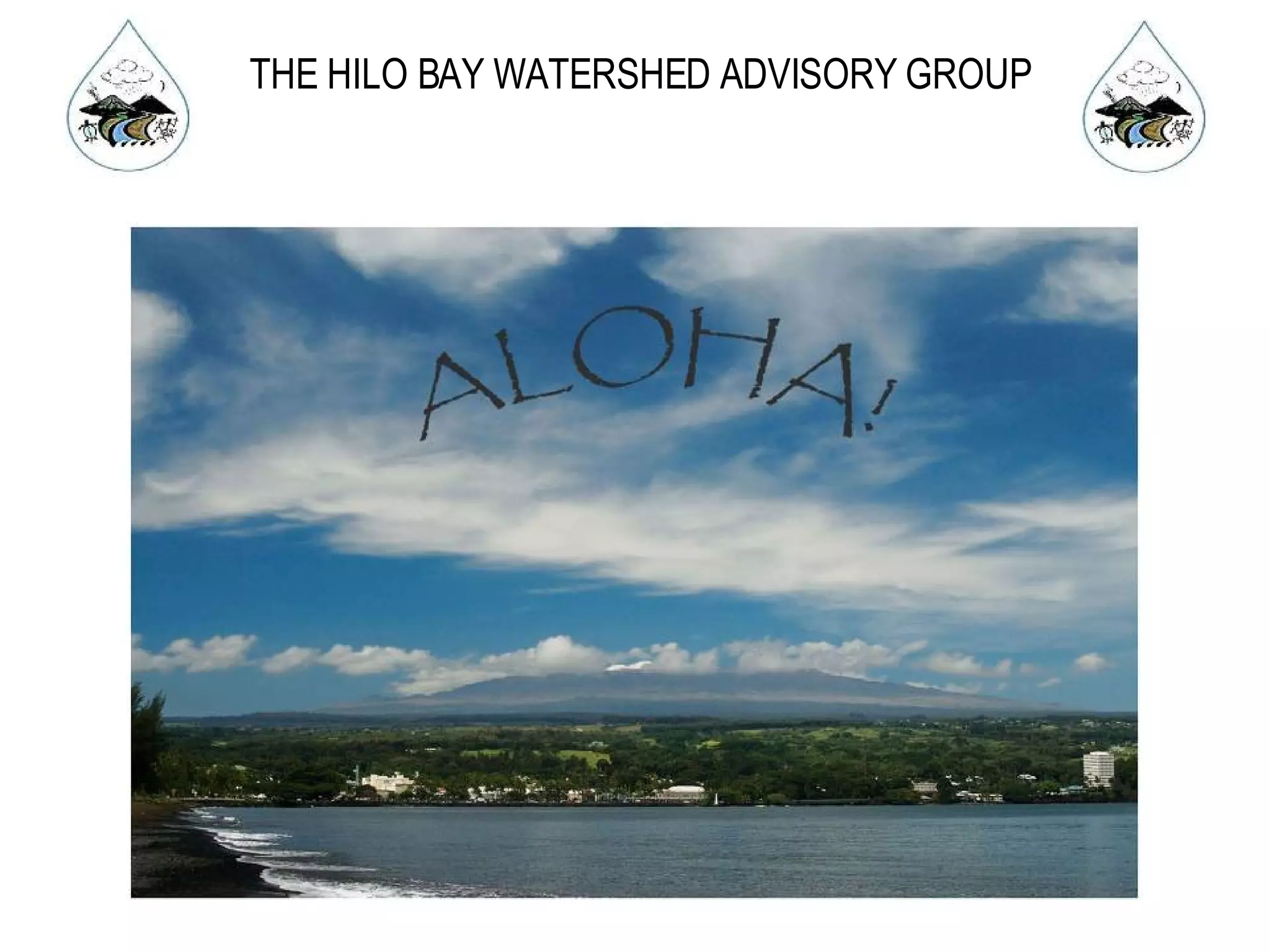
THE HILO BAY WATERSHED ADVISORY GROUP
INTRODUCTION Comprised of a partnership of concerned citizens and organizations in Hilo Organized with a steering committee, general membership, and advisors Steering committee and general membership (show and tell) meeting are held monthly Monthly presentations keep the interest alive
 
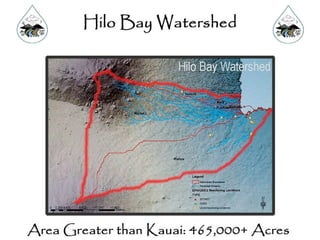
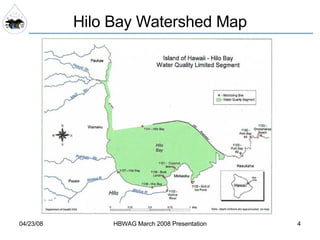
Hilo Bay Watershed Map
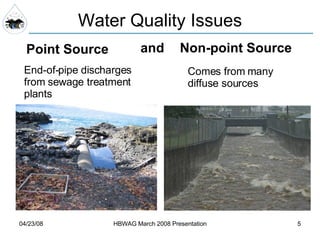
Water Quality Issues Point Source and   Non-point Source Comes from many diffuse sources End-of-pipe discharges from sewage treatment plants
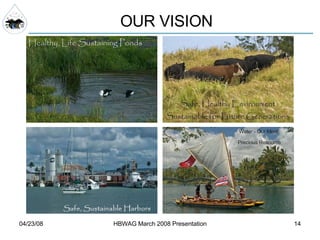
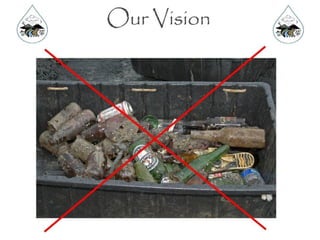
HBWAG MISSION The purpose/mission of the Hilo Bay Watershed Advisory Group shall be to bring the community together to understand and protect the ecology of the Hilo Bay Watershed. VISION Future generations will enjoy a cleaner Hilo Bay, cleaner streams, and a watershed that supports both human activities and the natural ecosystem. Stewardship of the Hilo Bay Watershed will be embraced by all members of the community.  Our  community will better understand, protect, nurture, utilize, and enhance the Hilo Bay Watershed through a cooperative effort based on ecosystem processes and the community’s needs and cultural values. CUSTOMERS The HBWAG’s ‘customers’ include the Hilo Bay Watershed, community, property  owners, governmental and non-governmental agencies…essentially, all the  stakeholders who affect and are affected by the watershed.
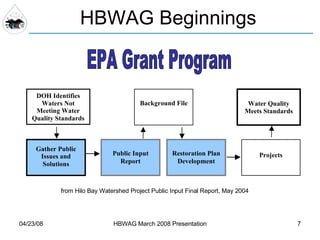
HBWAG Beginnings from Hilo Bay Watershed Project Public Input Final Report, May 2004 Gather Public  Issues and  Solutions Public Input  Report Restoration Plan Development Project s Water Quality  Meets Standards Background File  DOH Identifies  Waters Not  Meeting Water  Quality Standards EPA Grant Program
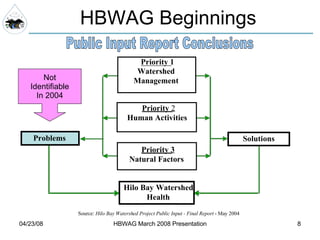
HBWAG Beginnings Human  Activities/  Impact Priority  2 Human Activities Problems Priority 3 Natural Factors Soluti ons Hilo Bay  Watershed Health Priority 1 Watershed  Management Source:  Hilo Bay Watershed Project Public Input - Final Report  - May 2004 Public Input Report Conclusions Not Identifiable In 2004
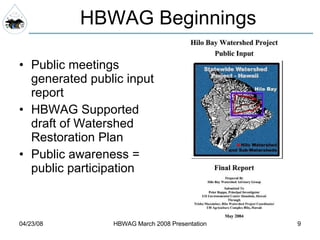
HBWAG Beginnings Public meetings generated public input report HBWAG Supported draft of Watershed Restoration Plan Public awareness = public participation
HBWAG Operations Steering committee meets monthly to plan direction and activities By-laws govern organization Decisions are by consensus Many steering committee members also participate on sub-committees Activities are resource limited Prioritize issues/activities via strategic plan
To seek Partnerships To engage in collaborative problem identification and solutions OVERARCHING STRATEGY
To promote comprehensive watershed management principles To identify and resolve watershed and water quality problems To propose solutions based on scientifically based information and research OVERARCHING STRATEGY
To strive to increase group membership To foster community participation in learning about and improving conditions in the watershed Develop working relationship with local SWCD groups OVERARCHING STRATEGY
OUR VISION
 
OUR PROCESS AWARENESS
OUR PROCESS Keep community informed Prevent problems through education Prevention
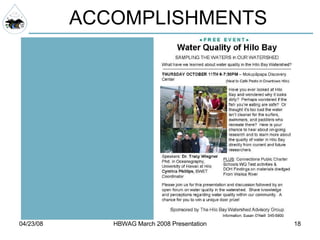
ACCOMPLISHMENTS
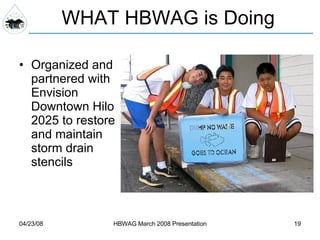
WHAT HBWAG is Doing Organized and partnered with Envision Downtown Hilo 2025 to restore and maintain storm drain stencils
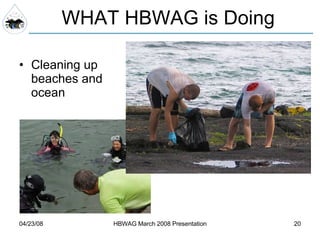
WHAT HBWAG is Doing Cleaning up beaches and ocean
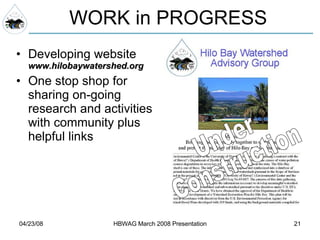
WORK in PROGRESS Developing website  www.hilobaywatershed.org One stop shop for sharing on-going research and activities with community plus helpful links Under Construction
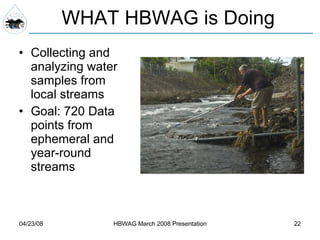
WHAT HBWAG is Doing Collecting and analyzing water samples from local streams Goal: 720 Data points from ephemeral and year-round streams
Have streams deemed “impaired” and listed in 303(d)/305(b) report by DOH to USEPA Why do stream monitoring Stream Monitoring Benefits To provide data points that can substantiate if impairment exists To obtain base line data for future comparison
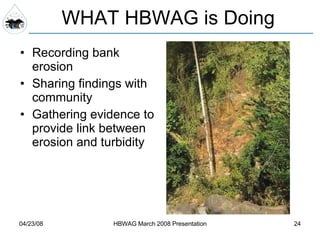
Recording bank erosion Sharing findings with community Gathering evidence to provide link between erosion and turbidity WHAT HBWAG is Doing
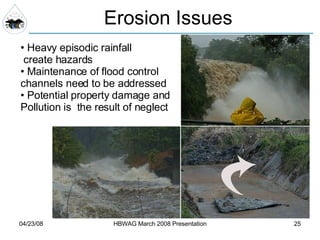
Erosion Issues Heavy episodic rainfall  create hazards Maintenance of flood control channels need to be addressed Potential property damage and  Pollution is  the result of neglect
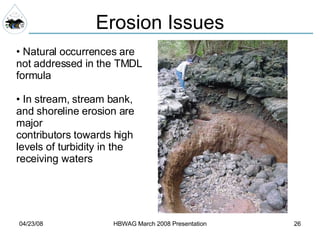
Erosion Issues Natural occurrences are not addressed in the TMDL formula In stream, stream bank, and shoreline erosion are major  contributors towards high levels of turbidity in the receiving waters
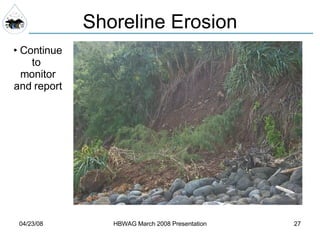
Shoreline Erosion Continue to  monitor and report
Environmental Stressors Stream Bank and Shore Line Erosion are the largest visible contributing factors During Large Rainfall Events it is reported that a flush of wastewater pollution has been evident for a short time and generally clears up in a couple of days (DOH Testing) Hilo’s Wastewater system has critical areas that need expansion and coverage. Lack of maintenance in stream and flood control channels
LESSONS LEARNED Organization must be dynamic and flexible There are  never   enough  volunteers Partnerships are  essential Money may limit activities Success is achievable
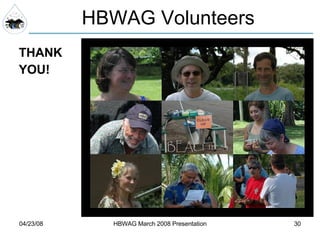
HBWAG Volunteers THANK YOU!
HBWAG Partners THANK YOU! Big Island Resource Conservation and Development Council Hawaii County Department of Planning Department of Water Supply Pacific Aquaculture and Coastal Resources Center NOAA and Mokup ā papa Discovery Center Envision Downtown Hilo 2025 Hilo and Waikea High School Teachers and Students Hamakua SWCD Hilo DOH Clean Water Branch UH Hilo Marine science Lab
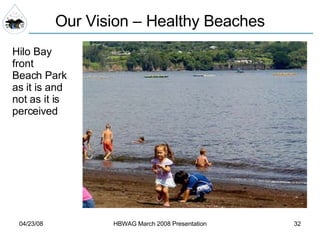
Our Vision – Healthy Beaches Hilo Bay front Beach Park as it is and not as it is perceived
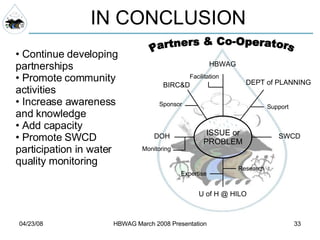
IN CONCLUSION Continue developing partnerships Promote community activities Increase awareness and knowledge Add capacity Promote SWCD participation in water quality monitoring DEPT of PLANNING ISSUE or PROBLEM Partners & Co-Operators HBWAG BIRC&D U of H @ HILO SWCD DOH Expertise Facilitation Research Support Sponsor Monitoring
 

Hilo Bay Watershed Advisory Group Activities

  • 1.
    THE HILO BAYWATERSHED ADVISORY GROUP
  • 2.
    INTRODUCTION Comprised ofa partnership of concerned citizens and organizations in Hilo Organized with a steering committee, general membership, and advisors Steering committee and general membership (show and tell) meeting are held monthly Monthly presentations keep the interest alive
  • 3.
  • 4.
  • 5.
    Water Quality IssuesPoint Source and Non-point Source Comes from many diffuse sources End-of-pipe discharges from sewage treatment plants
  • 6.
    HBWAG MISSION Thepurpose/mission of the Hilo Bay Watershed Advisory Group shall be to bring the community together to understand and protect the ecology of the Hilo Bay Watershed. VISION Future generations will enjoy a cleaner Hilo Bay, cleaner streams, and a watershed that supports both human activities and the natural ecosystem. Stewardship of the Hilo Bay Watershed will be embraced by all members of the community. Our community will better understand, protect, nurture, utilize, and enhance the Hilo Bay Watershed through a cooperative effort based on ecosystem processes and the community’s needs and cultural values. CUSTOMERS The HBWAG’s ‘customers’ include the Hilo Bay Watershed, community, property owners, governmental and non-governmental agencies…essentially, all the stakeholders who affect and are affected by the watershed.
  • 7.
    HBWAG Beginnings fromHilo Bay Watershed Project Public Input Final Report, May 2004 Gather Public Issues and Solutions Public Input Report Restoration Plan Development Project s Water Quality Meets Standards Background File DOH Identifies Waters Not Meeting Water Quality Standards EPA Grant Program
  • 8.
    HBWAG Beginnings Human Activities/ Impact Priority 2 Human Activities Problems Priority 3 Natural Factors Soluti ons Hilo Bay Watershed Health Priority 1 Watershed Management Source: Hilo Bay Watershed Project Public Input - Final Report - May 2004 Public Input Report Conclusions Not Identifiable In 2004
  • 9.
    HBWAG Beginnings Publicmeetings generated public input report HBWAG Supported draft of Watershed Restoration Plan Public awareness = public participation
  • 10.
    HBWAG Operations Steeringcommittee meets monthly to plan direction and activities By-laws govern organization Decisions are by consensus Many steering committee members also participate on sub-committees Activities are resource limited Prioritize issues/activities via strategic plan
  • 11.
    To seek PartnershipsTo engage in collaborative problem identification and solutions OVERARCHING STRATEGY
  • 12.
    To promote comprehensivewatershed management principles To identify and resolve watershed and water quality problems To propose solutions based on scientifically based information and research OVERARCHING STRATEGY
  • 13.
    To strive toincrease group membership To foster community participation in learning about and improving conditions in the watershed Develop working relationship with local SWCD groups OVERARCHING STRATEGY
  • 14.
  • 15.
  • 16.
  • 17.
    OUR PROCESS Keepcommunity informed Prevent problems through education Prevention
  • 18.
  • 19.
    WHAT HBWAG isDoing Organized and partnered with Envision Downtown Hilo 2025 to restore and maintain storm drain stencils
  • 20.
    WHAT HBWAG isDoing Cleaning up beaches and ocean
  • 21.
    WORK in PROGRESSDeveloping website www.hilobaywatershed.org One stop shop for sharing on-going research and activities with community plus helpful links Under Construction
  • 22.
    WHAT HBWAG isDoing Collecting and analyzing water samples from local streams Goal: 720 Data points from ephemeral and year-round streams
  • 23.
    Have streams deemed“impaired” and listed in 303(d)/305(b) report by DOH to USEPA Why do stream monitoring Stream Monitoring Benefits To provide data points that can substantiate if impairment exists To obtain base line data for future comparison
  • 24.
    Recording bank erosionSharing findings with community Gathering evidence to provide link between erosion and turbidity WHAT HBWAG is Doing
  • 25.
    Erosion Issues Heavyepisodic rainfall create hazards Maintenance of flood control channels need to be addressed Potential property damage and Pollution is the result of neglect
  • 26.
    Erosion Issues Naturaloccurrences are not addressed in the TMDL formula In stream, stream bank, and shoreline erosion are major contributors towards high levels of turbidity in the receiving waters
  • 27.
    Shoreline Erosion Continueto monitor and report
  • 28.
    Environmental Stressors StreamBank and Shore Line Erosion are the largest visible contributing factors During Large Rainfall Events it is reported that a flush of wastewater pollution has been evident for a short time and generally clears up in a couple of days (DOH Testing) Hilo’s Wastewater system has critical areas that need expansion and coverage. Lack of maintenance in stream and flood control channels
  • 29.
    LESSONS LEARNED Organizationmust be dynamic and flexible There are never enough volunteers Partnerships are essential Money may limit activities Success is achievable
  • 30.
  • 31.
    HBWAG Partners THANKYOU! Big Island Resource Conservation and Development Council Hawaii County Department of Planning Department of Water Supply Pacific Aquaculture and Coastal Resources Center NOAA and Mokup ā papa Discovery Center Envision Downtown Hilo 2025 Hilo and Waikea High School Teachers and Students Hamakua SWCD Hilo DOH Clean Water Branch UH Hilo Marine science Lab
  • 32.
    Our Vision –Healthy Beaches Hilo Bay front Beach Park as it is and not as it is perceived
  • 33.
    IN CONCLUSION Continuedeveloping partnerships Promote community activities Increase awareness and knowledge Add capacity Promote SWCD participation in water quality monitoring DEPT of PLANNING ISSUE or PROBLEM Partners & Co-Operators HBWAG BIRC&D U of H @ HILO SWCD DOH Expertise Facilitation Research Support Sponsor Monitoring
  • 34.