Watershed Condition
         Frameworks


A framework to assess watersheds and identify and
      prioritize watershed scale restorations on the
                            Tongass National Forest
 Gather existing information on Watershed
  Condition (scientific and local)
 What are our gaps? Social Factors &
  Local Concerns?
 Develop watershed assessments to
  identify projects that will reach our
  desired future condition
 Complete project monitoring & adaptive
  management

What are Prince of Wales
watershed needs??
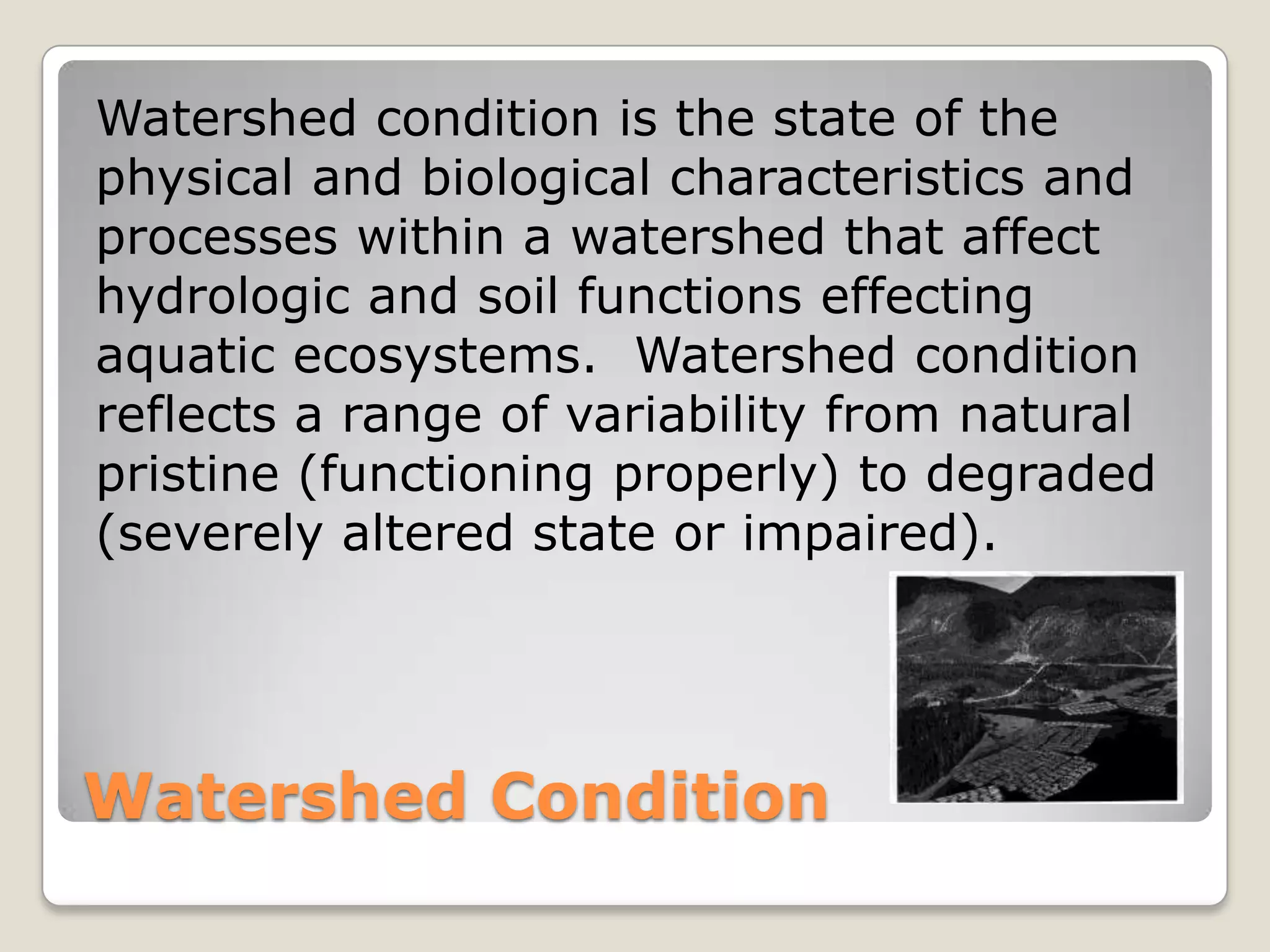
Watershed condition is the state of the
physical and biological characteristics and
processes within a watershed that affect
hydrologic and soil functions effecting
aquatic ecosystems. Watershed condition
reflects a range of variability from natural
pristine (functioning properly) to degraded
(severely altered state or impaired).


Watershed Condition
 Terrestrial, riparian, aquatic ecosystems
  that capture, store, and release water,
  sediment, wood, and nutrients within their
  natural range of variability for these
  processes
 Create and sustain functional terrestrial,
  riparian, aquatic and wetland habitats
  that are capable of supporting diverse
  populations of native aquatic and riparian-
  dependent species

Watersheds that are
functioning properly have:
Watersheds that are
functioning properly:
   Provide for high biotic integrity, which includes
    habitats that support adaptive animal and plant
    communities that reflect natural processes.
   Are resilient and recover rapidly from natural and
    human disturbances.
   Exhibit a high degree of connectivity
    longitudinally along the stream, laterally across
    the floodplain and valley bottom, and vertically
    between surface and subsurface flows.
   Provide important ecosystem services, such as
    high-water quality, the recharge of streams and
    aquifers, the maintenance of riparian
    communities, and the moderation of climate
    variability change.
   Maintain long-term soil productivity
   National Watershed Condition Classification
   Landscape Assessments
   Watershed Analyses (Stream Surveys, Tier
    II, III, IV) and Proper Functioning Condition
    Assessments
   Watershed Restoration Plans
   Project Recommendations, Prescriptions,
    designs and Cost Estimates
   NEPA & Implementation
   Monitoring
Types of Assessments
Resources the FS has
generated on POW:
Watershed Condition Classification

   Class 1 watersheds exhibit high geomorphic,
    hydrologic, and biotic integrity relative to
    their natural potential condition.
   Class 2 watersheds exhibit moderate
    geomorphic, hydrologic, and biotic integrity
    relative to their natural potential condition.
   Class 3 watersheds exhibit low geomorphic,
    hydrologic and biotic integrity relative to their
    natural potential condition.
 Class 1 = Functioning Properly
 Class 2 = Functioning at Risk
 Class 3 = Impaired Function


Watershed Condition Classification
   The Tongass has a number of Watersheds,
    that are ―at risk‖ for maintaining
    ecological function and aquatic resource
    values and productivity

   Watershed health issues mostly revolve
    around riparian forest condition, road
    related risks and impacts, and instream
    habitat condition and risk of decline in
    productivity.


Priority Watershed Program
   National direction continues to stress
    maintain watersheds that have important
    ecological values. Tongass has an
    abundance of watersheds in this category.
    We can produce a good return on restoration
    and improvement investments.

   We are building on strong support from
    numerous partner organizations -- TNC, TU,
    SCS— who are helping to leverage
    substantial grant funding for watershed,
    riparian and aquatic habitat improvement
    projects.


Priority Watershed Program
Priority
Watershed
Program
Priority
Watershed
Program
Priority
Watershed
Program
 Documents/
  Research
 Models
 Assessments/
  Aquatic
  Inventory


Existing Information
Identify gaps and local
concerns????
Develop watershed assessments
to identify projects that will reach
our desired future condition
   (1) maintaining long-term watershed
    health,
   (2) determining baseline aquatic
    resource
   conditions,
   (3) evaluating aquatic resource
    condition trends,
   (4) interpreting resource responses to
    natural and
   human disturbance, and
   (5) assigning achievable desired future
    conditions
Aquatic Assessment/ Inventory
Uses
More Aquatic Inventory
Uses


•   1.   Asses riparian habitat conditions
•   2.   Assess populations
•   3.   Support design of in-stream structures
•   4.   Monitor effects
•   5.   Watershed restoration planning
Types of Assessments
• Tier I - classification level
• Tier II - quantitative measures of core habitat
attributes summed by reach
• Tier III - replication of physical measurements,
additional habitat attributes summed by habitat
unit, habitat units to meso level
• Tier IV - systematic replication of physical
habitat
measures, addition attributes summed by habitat
units, habitat units to micro level

Fish and Aquatic Stream Inventory
Hierarchy
 Tier I – Minimum field verification
  standards for timber sale project planning
 Tier I/II – Upstream Assessment of Fish
  Habitat
 Tier II/III – Watershed condition and
  needs
assessment
 Tier IV - Channel condition assessment


Aquatic Inventory Applications
   Width to Depth Ratio
   Total Large Wood per Kilometer
   Total Key Large Wood per Kilomter
   Pools per Kilometer
   Pool Space
   Residual Pool Depth/ Channel Bedwidth
   Substrate Size
   Pool Length per Meter
   Pool Size


Habitat Management Objectives
Complete project monitoring &
adaptive management
Resources

•    Staney Creek Vegetative Management Strategy
    Staney IRMP Proposal for Action
    Staney Creek Restoration Environmental Assessment
    Staney Creek Restoration EA Decision Document
    Staney Creek Watershed Restoration Plan
    Alaback - Opportunities for Restoring Second Growth
    Ecosystems
    Brinkman - Trends of Deer and Hunters on Prince of Wales
    Island
    Unit 2 Wildlife Harvest Data
    Young Growth Management Strategy for Unit 2
    Framework for Setting Restoration Priorities on POW
    Alaback - Evaluation of canopy gaps for wildlife in SE
    Alaska
    Ellanna and Sherrod - Timber Management and Fish and
    Wildlife use in Klawock (1987)
    Brock and Coiley-Kenner - Traditional Knowledge about
    the Fisheries of Southeast Alaska (2009)
    Collaborative Forest Landscape Restoration Program
    Proposal (5/14/10)
    Impacts of restoration on sustainable timber harvest levels
    (Brackley).
    Tradeoffs among ecosystem services benefits (Nicholls)
    Integrating ecosystem Services and forest restoration
    (Deal/Patterson)
    Heating options suing biomass removals from Staney
    young growth (Nicholls).
    Social benefits of restoration projects (Kruger).
    Staney Community Forestry Project FINAL: REPORT


Resources
 http://www.fs.fed.us/publications/watersh
  ed/
 http://conserveonline.org/workspaces/sta
  ney-creek/
 http://conserveonline.org/workspaces/sta
  ney-creek/documents/documents-and-
  papers/view.html
 The Forest Service 


Resources

Watershed Condition Frameworks by Angela Coleman

  • 1.
    Watershed Condition Frameworks A framework to assess watersheds and identify and prioritize watershed scale restorations on the Tongass National Forest
  • 2.
     Gather existinginformation on Watershed Condition (scientific and local)  What are our gaps? Social Factors & Local Concerns?  Develop watershed assessments to identify projects that will reach our desired future condition  Complete project monitoring & adaptive management What are Prince of Wales watershed needs??
  • 3.
    Watershed condition isthe state of the physical and biological characteristics and processes within a watershed that affect hydrologic and soil functions effecting aquatic ecosystems. Watershed condition reflects a range of variability from natural pristine (functioning properly) to degraded (severely altered state or impaired). Watershed Condition
  • 4.
     Terrestrial, riparian,aquatic ecosystems that capture, store, and release water, sediment, wood, and nutrients within their natural range of variability for these processes  Create and sustain functional terrestrial, riparian, aquatic and wetland habitats that are capable of supporting diverse populations of native aquatic and riparian- dependent species Watersheds that are functioning properly have:
  • 5.
    Watersheds that are functioningproperly:  Provide for high biotic integrity, which includes habitats that support adaptive animal and plant communities that reflect natural processes.  Are resilient and recover rapidly from natural and human disturbances.  Exhibit a high degree of connectivity longitudinally along the stream, laterally across the floodplain and valley bottom, and vertically between surface and subsurface flows.  Provide important ecosystem services, such as high-water quality, the recharge of streams and aquifers, the maintenance of riparian communities, and the moderation of climate variability change.  Maintain long-term soil productivity
  • 7.
    National Watershed Condition Classification  Landscape Assessments  Watershed Analyses (Stream Surveys, Tier II, III, IV) and Proper Functioning Condition Assessments  Watershed Restoration Plans  Project Recommendations, Prescriptions, designs and Cost Estimates  NEPA & Implementation  Monitoring Types of Assessments Resources the FS has generated on POW:
  • 8.
    Watershed Condition Classification  Class 1 watersheds exhibit high geomorphic, hydrologic, and biotic integrity relative to their natural potential condition.  Class 2 watersheds exhibit moderate geomorphic, hydrologic, and biotic integrity relative to their natural potential condition.  Class 3 watersheds exhibit low geomorphic, hydrologic and biotic integrity relative to their natural potential condition.
  • 9.
     Class 1= Functioning Properly  Class 2 = Functioning at Risk  Class 3 = Impaired Function Watershed Condition Classification
  • 10.
    The Tongass has a number of Watersheds, that are ―at risk‖ for maintaining ecological function and aquatic resource values and productivity  Watershed health issues mostly revolve around riparian forest condition, road related risks and impacts, and instream habitat condition and risk of decline in productivity. Priority Watershed Program
  • 11.
    National direction continues to stress maintain watersheds that have important ecological values. Tongass has an abundance of watersheds in this category. We can produce a good return on restoration and improvement investments.  We are building on strong support from numerous partner organizations -- TNC, TU, SCS— who are helping to leverage substantial grant funding for watershed, riparian and aquatic habitat improvement projects. Priority Watershed Program
  • 12.
  • 13.
  • 14.
  • 15.
     Documents/ Research  Models  Assessments/ Aquatic Inventory Existing Information
  • 16.
    Identify gaps andlocal concerns????
  • 17.
    Develop watershed assessments toidentify projects that will reach our desired future condition
  • 18.
    (1) maintaining long-term watershed health,  (2) determining baseline aquatic resource  conditions,  (3) evaluating aquatic resource condition trends,  (4) interpreting resource responses to natural and  human disturbance, and  (5) assigning achievable desired future conditions Aquatic Assessment/ Inventory Uses
  • 19.
    More Aquatic Inventory Uses • 1. Asses riparian habitat conditions • 2. Assess populations • 3. Support design of in-stream structures • 4. Monitor effects • 5. Watershed restoration planning
  • 20.
  • 21.
    • Tier I- classification level • Tier II - quantitative measures of core habitat attributes summed by reach • Tier III - replication of physical measurements, additional habitat attributes summed by habitat unit, habitat units to meso level • Tier IV - systematic replication of physical habitat measures, addition attributes summed by habitat units, habitat units to micro level Fish and Aquatic Stream Inventory Hierarchy
  • 24.
     Tier I– Minimum field verification standards for timber sale project planning  Tier I/II – Upstream Assessment of Fish Habitat  Tier II/III – Watershed condition and needs assessment  Tier IV - Channel condition assessment Aquatic Inventory Applications
  • 25.
    Width to Depth Ratio  Total Large Wood per Kilometer  Total Key Large Wood per Kilomter  Pools per Kilometer  Pool Space  Residual Pool Depth/ Channel Bedwidth  Substrate Size  Pool Length per Meter  Pool Size Habitat Management Objectives
  • 27.
    Complete project monitoring& adaptive management
  • 28.
    Resources • Staney Creek Vegetative Management Strategy  Staney IRMP Proposal for Action  Staney Creek Restoration Environmental Assessment  Staney Creek Restoration EA Decision Document  Staney Creek Watershed Restoration Plan  Alaback - Opportunities for Restoring Second Growth Ecosystems  Brinkman - Trends of Deer and Hunters on Prince of Wales Island  Unit 2 Wildlife Harvest Data  Young Growth Management Strategy for Unit 2  Framework for Setting Restoration Priorities on POW  Alaback - Evaluation of canopy gaps for wildlife in SE Alaska
  • 29.
    Ellanna and Sherrod - Timber Management and Fish and Wildlife use in Klawock (1987)  Brock and Coiley-Kenner - Traditional Knowledge about the Fisheries of Southeast Alaska (2009)  Collaborative Forest Landscape Restoration Program Proposal (5/14/10)  Impacts of restoration on sustainable timber harvest levels (Brackley).  Tradeoffs among ecosystem services benefits (Nicholls)  Integrating ecosystem Services and forest restoration (Deal/Patterson)  Heating options suing biomass removals from Staney young growth (Nicholls).  Social benefits of restoration projects (Kruger).  Staney Community Forestry Project FINAL: REPORT Resources
  • 30.
     http://www.fs.fed.us/publications/watersh ed/  http://conserveonline.org/workspaces/sta ney-creek/  http://conserveonline.org/workspaces/sta ney-creek/documents/documents-and- papers/view.html  The Forest Service  Resources