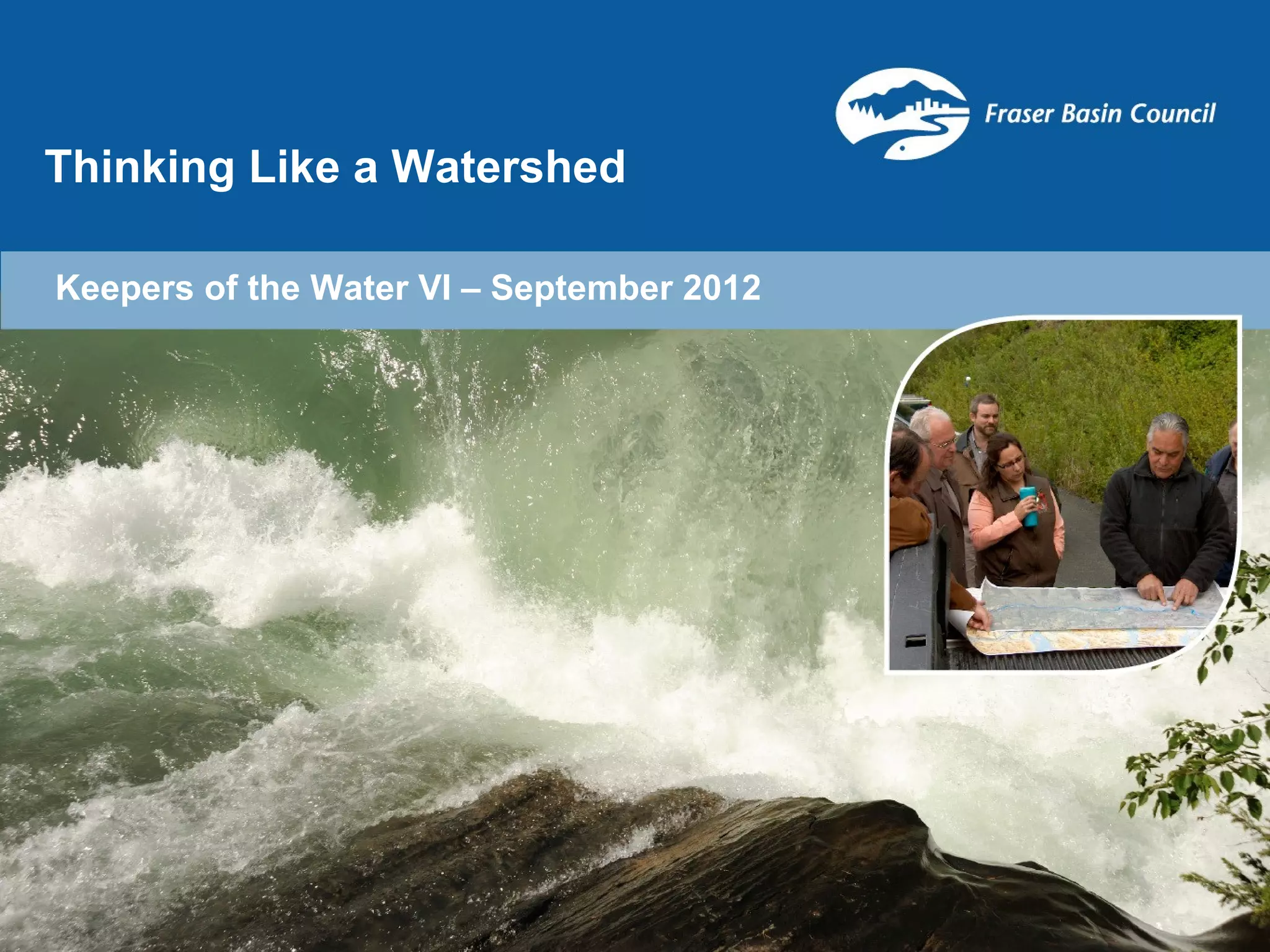
Thinking Like a Watershed

Keepers of the Water VI – September 2012
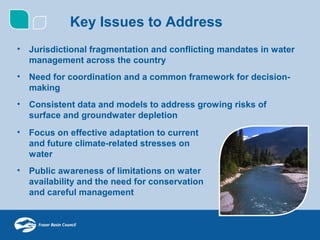
Key Issues to Address
•   Jurisdictional fragmentation and conflicting mandates in water
    management across the country
•   Need for coordination and a common framework for decision-
    making
•   Consistent data and models to address growing risks of
    surface and groundwater depletion
•   Focus on effective adaptation to current
    and future climate-related stresses on
    water
•   Public awareness of limitations on water
    availability and the need for conservation
    and careful management
What is Collaborative Water Governance?
•   Collaborative water governance may be broadly defined as
    the involvement of non-state actors in decision-making for
    water management
•   Delegation by government of water governance to a
    council, committee, or basin organization
•   Involves multiple agencies and organizations (greater
    participation by a wide variety of non-state actors)
•   Use collaboration, dialogue and consensus to inform
    decision-making (also involves trust-building)
    (Nowlan, Bakker)
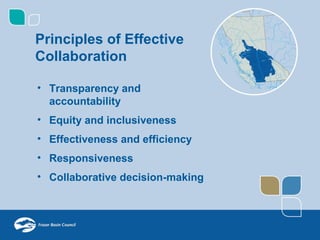
Principles of Effective
Collaboration

• Transparency and
  accountability
• Equity and inclusiveness
• Effectiveness and efficiency
• Responsiveness
• Collaborative decision-making
Collaborative Water and Watershed Planning
Who are the Participants / Stakeholders?

• Those with jurisdictional authority and management
  responsibilities:
   – All orders of government (Provincial, Federal, First
     Nations, Local (municipalities and regional districts)
   – Water suppliers
• Those with title, rights and interests:
   – Aboriginal title and rights
   – Water licensees / water use “sectors” such as
     agriculture, recreation
   – Water and watershed stewards
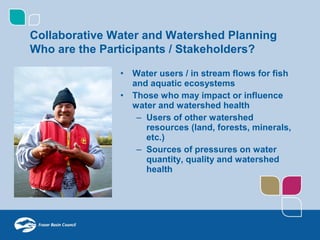
Collaborative Water and Watershed Planning
Who are the Participants / Stakeholders?

               •   Water users / in stream flows for fish
                   and aquatic ecosystems
               •   Those who may impact or influence
                   water and watershed health
                    – Users of other watershed
                      resources (land, forests, minerals,
                      etc.)
                    – Sources of pressures on water
                      quantity, quality and watershed
                      health
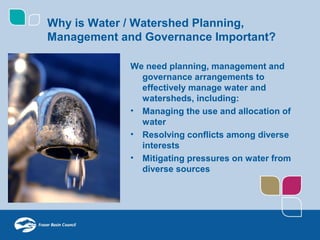
Why is Water / Watershed Planning,
Management and Governance Important?

             We need planning, management and
               governance arrangements to
               effectively manage water and
               watersheds, including:
             • Managing the use and allocation of
               water
             • Resolving conflicts among diverse
               interests
             • Mitigating pressures on water from
               diverse sources
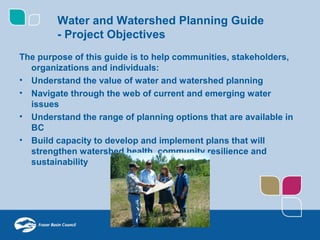
Water and Watershed Planning Guide
        - Project Objectives
The purpose of this guide is to help communities, stakeholders,
  organizations and individuals:
• Understand the value of water and watershed planning
• Navigate through the web of current and emerging water
  issues
• Understand the range of planning options that are available in
  BC
• Build capacity to develop and implement plans that will
  strengthen watershed health, community resilience and
  sustainability
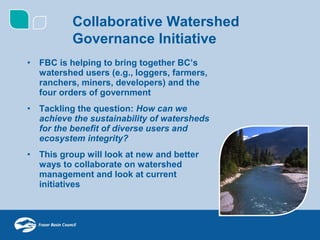
Collaborative Watershed
           Governance Initiative
•   FBC is helping to bring together BC’s
    watershed users (e.g., loggers, farmers,
    ranchers, miners, developers) and the
    four orders of government
•   Tackling the question: How can we
    achieve the sustainability of watersheds
    for the benefit of diverse users and
    ecosystem integrity?
•   This group will look at new and better
    ways to collaborate on watershed
    management and look at current
    initiatives
CWGI Draft Accord:
          Guiding Principles for Watersheds
• Existing agreements, rights and obligations will be respected
• Ecological, social and economic considerations will be
  integral parts of decision-making
• Transparency, accountability and inclusivity are essential for
  effective watershed governance
• Effective working relationships will be developed
  and maintained through trust and cooperation
• Decisions will be based on the best available
  information, both traditional and scientific

Thinking Like A Watershed

  • 1.
    Thinking Like aWatershed Keepers of the Water VI – September 2012
  • 2.
    Key Issues toAddress • Jurisdictional fragmentation and conflicting mandates in water management across the country • Need for coordination and a common framework for decision- making • Consistent data and models to address growing risks of surface and groundwater depletion • Focus on effective adaptation to current and future climate-related stresses on water • Public awareness of limitations on water availability and the need for conservation and careful management
  • 3.
    What is CollaborativeWater Governance? • Collaborative water governance may be broadly defined as the involvement of non-state actors in decision-making for water management • Delegation by government of water governance to a council, committee, or basin organization • Involves multiple agencies and organizations (greater participation by a wide variety of non-state actors) • Use collaboration, dialogue and consensus to inform decision-making (also involves trust-building) (Nowlan, Bakker)
  • 4.
    Principles of Effective Collaboration •Transparency and accountability • Equity and inclusiveness • Effectiveness and efficiency • Responsiveness • Collaborative decision-making
  • 5.
    Collaborative Water andWatershed Planning Who are the Participants / Stakeholders? • Those with jurisdictional authority and management responsibilities: – All orders of government (Provincial, Federal, First Nations, Local (municipalities and regional districts) – Water suppliers • Those with title, rights and interests: – Aboriginal title and rights – Water licensees / water use “sectors” such as agriculture, recreation – Water and watershed stewards
  • 6.
    Collaborative Water andWatershed Planning Who are the Participants / Stakeholders? • Water users / in stream flows for fish and aquatic ecosystems • Those who may impact or influence water and watershed health – Users of other watershed resources (land, forests, minerals, etc.) – Sources of pressures on water quantity, quality and watershed health
  • 7.
    Why is Water/ Watershed Planning, Management and Governance Important? We need planning, management and governance arrangements to effectively manage water and watersheds, including: • Managing the use and allocation of water • Resolving conflicts among diverse interests • Mitigating pressures on water from diverse sources
  • 8.
    Water and WatershedPlanning Guide - Project Objectives The purpose of this guide is to help communities, stakeholders, organizations and individuals: • Understand the value of water and watershed planning • Navigate through the web of current and emerging water issues • Understand the range of planning options that are available in BC • Build capacity to develop and implement plans that will strengthen watershed health, community resilience and sustainability
  • 9.
    Collaborative Watershed Governance Initiative • FBC is helping to bring together BC’s watershed users (e.g., loggers, farmers, ranchers, miners, developers) and the four orders of government • Tackling the question: How can we achieve the sustainability of watersheds for the benefit of diverse users and ecosystem integrity? • This group will look at new and better ways to collaborate on watershed management and look at current initiatives
  • 10.
    CWGI Draft Accord: Guiding Principles for Watersheds • Existing agreements, rights and obligations will be respected • Ecological, social and economic considerations will be integral parts of decision-making • Transparency, accountability and inclusivity are essential for effective watershed governance • Effective working relationships will be developed and maintained through trust and cooperation • Decisions will be based on the best available information, both traditional and scientific