HIGH-RISE BUILDINGS
Presented by
Muhammad Sulman Sarwar 2008-CIVIL-
23
Kaleem ullah 2008-
CIVIL-17
Mehmood Munawar 2008-
CIVIL-19
Usman Bhatti 2008-
CIVIL-45
Definition
A high-rise Building as defined by Emporis
Data Community is
“A building 35 meters or greater in height, which is
divided at regular intervals into occupiable
levels.”
What are High-Rise Building ?
 There is no consensus on what constitutes a tall building or at
what magic height, number of stories, or proportion a building
can be called tall.
 A dividing line should be drawn where the design of the
structure moves from the field of statics into the field of
structural dynamics.
 From structural point of view, a building is considered as tall
when its structural analyses and design are affected by the
lateral loads, particularly sway caused by such loads. Under
wind load the overturning moment at the base of a building
varies in proportion to the square of the height of the building,
and lateral deflection varies as the fourth power of the height
of the building, others things being the equal.
Design Considerations
 There are three major factors to consider in the design
of all structures:
 Strength
 rigidity and
 stability
 As height increases, the rigidity and stability
requirements become more important, and they are
often the dominant factors in the design. So
 the size of the members may be increased
beyond and above the strength requirements.
 change the form of the structure into something
more rigid and stable to confine the deformation
and increase stability.
Design Considerations
 P-Δ effect, in which the eccentricity of the gravity
load increases to such a magnitude that it brings
about the collapse of the columns as a result of
axial loads.
 Therefore, an important stability criterion is to
assure that predicted wind loads should be below
the load corresponding to the stability limit.
 The second consideration is to limit the lateral
deflection to a level that will ensure that
architectural finishes and partitions are not
damaged.
Material Requirements
 In general, for high-rise buildings the resistance to
overturning moment and lateral deflection will
almost always require additional material over and
above that required for gravity load alone.
 The material required for floor framing is a
function of the column-to-column span and not the
building height.
 However, the material required for the vertical
system, such as columns and walls, in high-rise
structure is substantially more than that of a low-
rise building.
Material Requirements
 The material increases in the ratio (n + 1) / 2, where n is
the number of floors, because the vertical components
carrying the gravity loads will need to be strengthened
for the full height of the building, requiring more vertical
steel than a one-story structure having the same floor
area.
 For example in a steel building using rigid frame action,
the total weight of approximately 117 kg/m2 of structural
steel is split evenly at about 39 kg/m2 for each of the
three subsystems, namely,
-floor framing,
-gravity columns, and
-wind bracing system.
Average Weight per unit floor Area
is decreasing
 Historically, the unit weight of structural
framing members in term of, say, average
weight per unit floor area appears to be
progressively decreasing over the years.
 For example, a survey of tall building built in
the period 1950 – 1990 will verify that in this
period it was possible to build a 100-story
building with perhaps no more than 147 kg/m2
of steel as compared to the 205 kg/m2 of steel
used for the Empire State Building in the
1930’s.
Reasons for gradual decrease in
weight per unit area of Building
1. Innovative design concepts. Structural engineers are
continually seeking better and more efficient methods of
resisting the lateral loads.
-Increase the effective width of subsystems to resist the overturning
moment.
-Design systems such that the components interact in the most efficient
manner.
-Use interior or exterior bracing for the full width of the building.
2. Use of high-strength low-alloy steels. Today it is a
common practice to use 345 MPa steel in most
composite floor framing systems, gravity columns, and
not too infrequently in lateral-load-resisting elements.
3. Increased use of welding as compared to bolting, which
effects a saving in the range of 8 to 15 percent in the
weight of steel.
Reasons for this gradual decrease
in weight of Building
4. Increased use of composite construction.
5. Application of computers to both the design
and the analytical processes.
6. Gradual increase in the allowable stresses in
the materials based on research and
successful past performance.
7. A reduction in the weight of other construction
materials, like partition and curtain walls.
Factors for Reduction of
Reinforcement and Concrete in
concrete construction
1. New framing techniques, such as skip joist
construction in which every other joist is
eliminated, have caught on in high-rise
construction with a consequent reduction in the
weight of structural frame.
2. Increased use of mechanical couplers in
reinforcement for transferring both compression
and tensile forces.
3. Use of welded cage for column ties, beam
stirrups, etc., which reduces the amount of
reinforcement steel.
4. Use of high strength concrete; 40 MPa is quite
common, and strengths up to 70MPa are being
Factors for Reduction of
Reinforcement and Concrete in
concrete construction
5. Use of lightweight aggregate typically reduces 50
to 100 kg/m2 in the dead load of the structure,
resulting in savings of approximately 10 to 15
percent in the reinforcement requirement.
6. Most codes do not require as great a thickness of
slabs when structural lightweight concrete is used.
Typically a thickness of 12 mm of concrete can be
taken off from floor slabs without reducing the fire
rating.
7. Use of 520 MPa steel reinforcement.
8. Use of the state-of-the-art design methods.
Reasons of construction of High-
rise Buildings
 Computer aided Analysis and Design has
made it an easy job to design high-rise
Buildings.
 Increase in land values.
-Except in the Holy Makah where the land is rare and
is extremely expensive especially near the Holy
Mosque, where a square Meter could reach the rate
of about 40000 USD near in Makah.(3500 USD per
Square Foot)
 Higher density of population.
Characteristics of a successful
Building
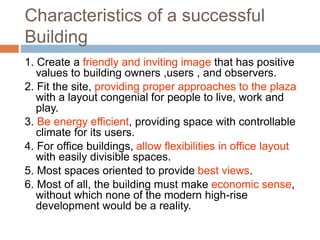
1. Create a friendly and inviting image that has positive
values to building owners ,users , and observers.
2. Fit the site, providing proper approaches to the plaza
with a layout congenial for people to live, work and
play.
3. Be energy efficient, providing space with controllable
climate for its users.
4. For office buildings, allow flexibilities in office layout
with easily divisible spaces.
5. Most spaces oriented to provide best views.
6. Most of all, the building must make economic sense,
without which none of the modern high-rise
development would be a reality.
List of Top 10 High-Rise
Buildings
# Building City Floors Height Year
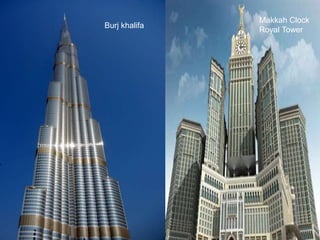
1 Burj Khalifa Dubai 163 828 m 2010
2 Makkah Clock Royal Tower
[Abraj Al Bait]
Makkah 95 601 m 2012
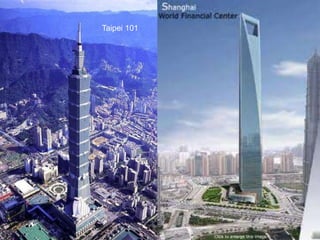
3 Taipei 101 Taipei 101 509 m 2004
4 Shanghai World Financial
Center
Shanghai 101 492 m 2008
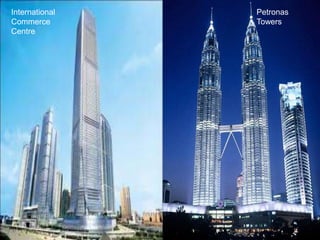
5 International Commerce
Centre [Union Square]
Hong Kong 118 484 m 2010
6 Petronas Tower 1
[Petronas Towers]
KualaLump
ur
88 452 m 1998
7 Petronas Tower 2
[Petronas Towers]
KualaLump
ur
88 452 m 1998
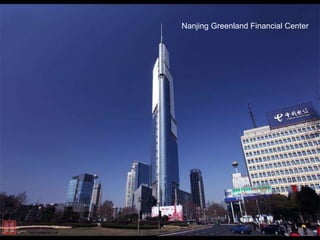
8 Nanjing Greenland Financial
Center
Nanjing 66 450 m 2010
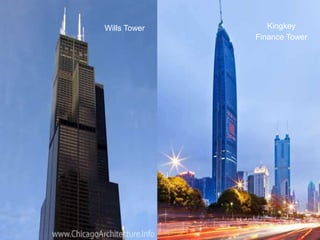
9 Willis Tower Chicago 108 442 m 1974
10 Kingkey Finance Tower Shenzhen 100 442 m 2011
Completed High Rise-Buildings in
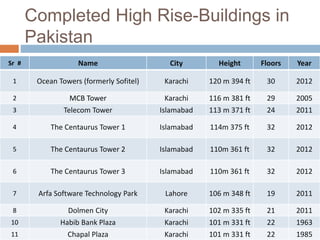
Pakistan
Sr # Name City Height Floors Year
1 Ocean Towers (formerly Sofitel) Karachi 120 m 394 ft 30 2012
2 MCB Tower Karachi 116 m 381 ft 29 2005
3 Telecom Tower Islamabad 113 m 371 ft 24 2011
4 The Centaurus Tower 1 Islamabad 114m 375 ft 32 2012
5 The Centaurus Tower 2 Islamabad 110m 361 ft 32 2012
6 The Centaurus Tower 3 Islamabad 110m 361 ft 32 2012
7 Arfa Software Technology Park Lahore 106 m 348 ft 19 2011
8 Dolmen City Karachi 102 m 335 ft 21 2011
10 Habib Bank Plaza Karachi 101 m 331 ft 22 1963
11 Chapal Plaza Karachi 101 m 331 ft 22 1985
Under Construction High-Rise
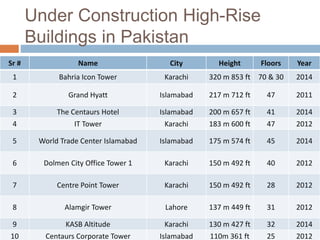
Buildings in Pakistan
Sr # Name City Height Floors Year
1 Bahria Icon Tower Karachi 320 m 853 ft 70 & 30 2014
2 Grand Hyatt Islamabad 217 m 712 ft 47 2011
3 The Centaurs Hotel Islamabad 200 m 657 ft 41 2014
4 IT Tower Karachi 183 m 600 ft 47 2012
5 World Trade Center Islamabad Islamabad 175 m 574 ft 45 2014
6 Dolmen City Office Tower 1 Karachi 150 m 492 ft 40 2012
7 Centre Point Tower Karachi 150 m 492 ft 28 2012
8 Alamgir Tower Lahore 137 m 449 ft 31 2012
9 KASB Altitude Karachi 130 m 427 ft 32 2014
10 Centaurs Corporate Tower Islamabad 110m 361 ft 25 2012
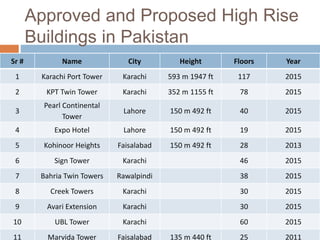
Approved and Proposed High Rise
Buildings in Pakistan
Sr # Name City Height Floors Year
1 Karachi Port Tower Karachi 593 m 1947 ft 117 2015
2 KPT Twin Tower Karachi 352 m 1155 ft 78 2015
3
Pearl Continental
Tower
Lahore 150 m 492 ft 40 2015
4 Expo Hotel Lahore 150 m 492 ft 19 2015
5 Kohinoor Heights Faisalabad 150 m 492 ft 28 2013
6 Sign Tower Karachi 46 2015
7 Bahria Twin Towers Rawalpindi 38 2015
8 Creek Towers Karachi 30 2015
9 Avari Extension Karachi 30 2015
10 UBL Tower Karachi 60 2015
11 Marvida Tower Faisalabad 135 m 440 ft 25 2011
Burj khalifa
Makkah Clock
Royal Tower
Taipei 101
Petronas
Towers
International
Commerce
Centre
Nanjing Greenland Financial Center
Kingkey
Finance Tower
Wills Tower
Thank you...

Highrise buildings....

  • 1.
    HIGH-RISE BUILDINGS Presented by MuhammadSulman Sarwar 2008-CIVIL- 23 Kaleem ullah 2008- CIVIL-17 Mehmood Munawar 2008- CIVIL-19 Usman Bhatti 2008- CIVIL-45
  • 2.
    Definition A high-rise Buildingas defined by Emporis Data Community is “A building 35 meters or greater in height, which is divided at regular intervals into occupiable levels.”
  • 3.
    What are High-RiseBuilding ?  There is no consensus on what constitutes a tall building or at what magic height, number of stories, or proportion a building can be called tall.  A dividing line should be drawn where the design of the structure moves from the field of statics into the field of structural dynamics.  From structural point of view, a building is considered as tall when its structural analyses and design are affected by the lateral loads, particularly sway caused by such loads. Under wind load the overturning moment at the base of a building varies in proportion to the square of the height of the building, and lateral deflection varies as the fourth power of the height of the building, others things being the equal.
  • 4.
    Design Considerations  Thereare three major factors to consider in the design of all structures:  Strength  rigidity and  stability  As height increases, the rigidity and stability requirements become more important, and they are often the dominant factors in the design. So  the size of the members may be increased beyond and above the strength requirements.  change the form of the structure into something more rigid and stable to confine the deformation and increase stability.
  • 5.
    Design Considerations  P-Δeffect, in which the eccentricity of the gravity load increases to such a magnitude that it brings about the collapse of the columns as a result of axial loads.  Therefore, an important stability criterion is to assure that predicted wind loads should be below the load corresponding to the stability limit.  The second consideration is to limit the lateral deflection to a level that will ensure that architectural finishes and partitions are not damaged.
  • 6.
    Material Requirements  Ingeneral, for high-rise buildings the resistance to overturning moment and lateral deflection will almost always require additional material over and above that required for gravity load alone.  The material required for floor framing is a function of the column-to-column span and not the building height.  However, the material required for the vertical system, such as columns and walls, in high-rise structure is substantially more than that of a low- rise building.
  • 7.
    Material Requirements  Thematerial increases in the ratio (n + 1) / 2, where n is the number of floors, because the vertical components carrying the gravity loads will need to be strengthened for the full height of the building, requiring more vertical steel than a one-story structure having the same floor area.  For example in a steel building using rigid frame action, the total weight of approximately 117 kg/m2 of structural steel is split evenly at about 39 kg/m2 for each of the three subsystems, namely, -floor framing, -gravity columns, and -wind bracing system.
  • 8.
    Average Weight perunit floor Area is decreasing  Historically, the unit weight of structural framing members in term of, say, average weight per unit floor area appears to be progressively decreasing over the years.  For example, a survey of tall building built in the period 1950 – 1990 will verify that in this period it was possible to build a 100-story building with perhaps no more than 147 kg/m2 of steel as compared to the 205 kg/m2 of steel used for the Empire State Building in the 1930’s.
  • 9.
    Reasons for gradualdecrease in weight per unit area of Building 1. Innovative design concepts. Structural engineers are continually seeking better and more efficient methods of resisting the lateral loads. -Increase the effective width of subsystems to resist the overturning moment. -Design systems such that the components interact in the most efficient manner. -Use interior or exterior bracing for the full width of the building. 2. Use of high-strength low-alloy steels. Today it is a common practice to use 345 MPa steel in most composite floor framing systems, gravity columns, and not too infrequently in lateral-load-resisting elements. 3. Increased use of welding as compared to bolting, which effects a saving in the range of 8 to 15 percent in the weight of steel.
  • 10.
    Reasons for thisgradual decrease in weight of Building 4. Increased use of composite construction. 5. Application of computers to both the design and the analytical processes. 6. Gradual increase in the allowable stresses in the materials based on research and successful past performance. 7. A reduction in the weight of other construction materials, like partition and curtain walls.
  • 11.
    Factors for Reductionof Reinforcement and Concrete in concrete construction 1. New framing techniques, such as skip joist construction in which every other joist is eliminated, have caught on in high-rise construction with a consequent reduction in the weight of structural frame. 2. Increased use of mechanical couplers in reinforcement for transferring both compression and tensile forces. 3. Use of welded cage for column ties, beam stirrups, etc., which reduces the amount of reinforcement steel. 4. Use of high strength concrete; 40 MPa is quite common, and strengths up to 70MPa are being
  • 12.
    Factors for Reductionof Reinforcement and Concrete in concrete construction 5. Use of lightweight aggregate typically reduces 50 to 100 kg/m2 in the dead load of the structure, resulting in savings of approximately 10 to 15 percent in the reinforcement requirement. 6. Most codes do not require as great a thickness of slabs when structural lightweight concrete is used. Typically a thickness of 12 mm of concrete can be taken off from floor slabs without reducing the fire rating. 7. Use of 520 MPa steel reinforcement. 8. Use of the state-of-the-art design methods.
  • 13.
    Reasons of constructionof High- rise Buildings  Computer aided Analysis and Design has made it an easy job to design high-rise Buildings.  Increase in land values. -Except in the Holy Makah where the land is rare and is extremely expensive especially near the Holy Mosque, where a square Meter could reach the rate of about 40000 USD near in Makah.(3500 USD per Square Foot)  Higher density of population.
  • 14.
    Characteristics of asuccessful Building 1. Create a friendly and inviting image that has positive values to building owners ,users , and observers. 2. Fit the site, providing proper approaches to the plaza with a layout congenial for people to live, work and play. 3. Be energy efficient, providing space with controllable climate for its users. 4. For office buildings, allow flexibilities in office layout with easily divisible spaces. 5. Most spaces oriented to provide best views. 6. Most of all, the building must make economic sense, without which none of the modern high-rise development would be a reality.
  • 15.
    List of Top10 High-Rise Buildings # Building City Floors Height Year 1 Burj Khalifa Dubai 163 828 m 2010 2 Makkah Clock Royal Tower [Abraj Al Bait] Makkah 95 601 m 2012 3 Taipei 101 Taipei 101 509 m 2004 4 Shanghai World Financial Center Shanghai 101 492 m 2008 5 International Commerce Centre [Union Square] Hong Kong 118 484 m 2010 6 Petronas Tower 1 [Petronas Towers] KualaLump ur 88 452 m 1998 7 Petronas Tower 2 [Petronas Towers] KualaLump ur 88 452 m 1998 8 Nanjing Greenland Financial Center Nanjing 66 450 m 2010 9 Willis Tower Chicago 108 442 m 1974 10 Kingkey Finance Tower Shenzhen 100 442 m 2011
  • 16.
    Completed High Rise-Buildingsin Pakistan Sr # Name City Height Floors Year 1 Ocean Towers (formerly Sofitel) Karachi 120 m 394 ft 30 2012 2 MCB Tower Karachi 116 m 381 ft 29 2005 3 Telecom Tower Islamabad 113 m 371 ft 24 2011 4 The Centaurus Tower 1 Islamabad 114m 375 ft 32 2012 5 The Centaurus Tower 2 Islamabad 110m 361 ft 32 2012 6 The Centaurus Tower 3 Islamabad 110m 361 ft 32 2012 7 Arfa Software Technology Park Lahore 106 m 348 ft 19 2011 8 Dolmen City Karachi 102 m 335 ft 21 2011 10 Habib Bank Plaza Karachi 101 m 331 ft 22 1963 11 Chapal Plaza Karachi 101 m 331 ft 22 1985
  • 17.
    Under Construction High-Rise Buildingsin Pakistan Sr # Name City Height Floors Year 1 Bahria Icon Tower Karachi 320 m 853 ft 70 & 30 2014 2 Grand Hyatt Islamabad 217 m 712 ft 47 2011 3 The Centaurs Hotel Islamabad 200 m 657 ft 41 2014 4 IT Tower Karachi 183 m 600 ft 47 2012 5 World Trade Center Islamabad Islamabad 175 m 574 ft 45 2014 6 Dolmen City Office Tower 1 Karachi 150 m 492 ft 40 2012 7 Centre Point Tower Karachi 150 m 492 ft 28 2012 8 Alamgir Tower Lahore 137 m 449 ft 31 2012 9 KASB Altitude Karachi 130 m 427 ft 32 2014 10 Centaurs Corporate Tower Islamabad 110m 361 ft 25 2012
  • 18.
    Approved and ProposedHigh Rise Buildings in Pakistan Sr # Name City Height Floors Year 1 Karachi Port Tower Karachi 593 m 1947 ft 117 2015 2 KPT Twin Tower Karachi 352 m 1155 ft 78 2015 3 Pearl Continental Tower Lahore 150 m 492 ft 40 2015 4 Expo Hotel Lahore 150 m 492 ft 19 2015 5 Kohinoor Heights Faisalabad 150 m 492 ft 28 2013 6 Sign Tower Karachi 46 2015 7 Bahria Twin Towers Rawalpindi 38 2015 8 Creek Towers Karachi 30 2015 9 Avari Extension Karachi 30 2015 10 UBL Tower Karachi 60 2015 11 Marvida Tower Faisalabad 135 m 440 ft 25 2011
  • 19.
  • 20.
  • 21.
  • 22.
  • 23.
  • 24.