SHEET TITLE
HIGH RISEBUILDING CASE STUDY
SIGN DATE REMARK NAME : YASH GANESH BHEGADE. STAMP
DIV. : C ROLL NO. : 210078
YEAR : 4TH SEM. : VIII
SUB : ABCS - II
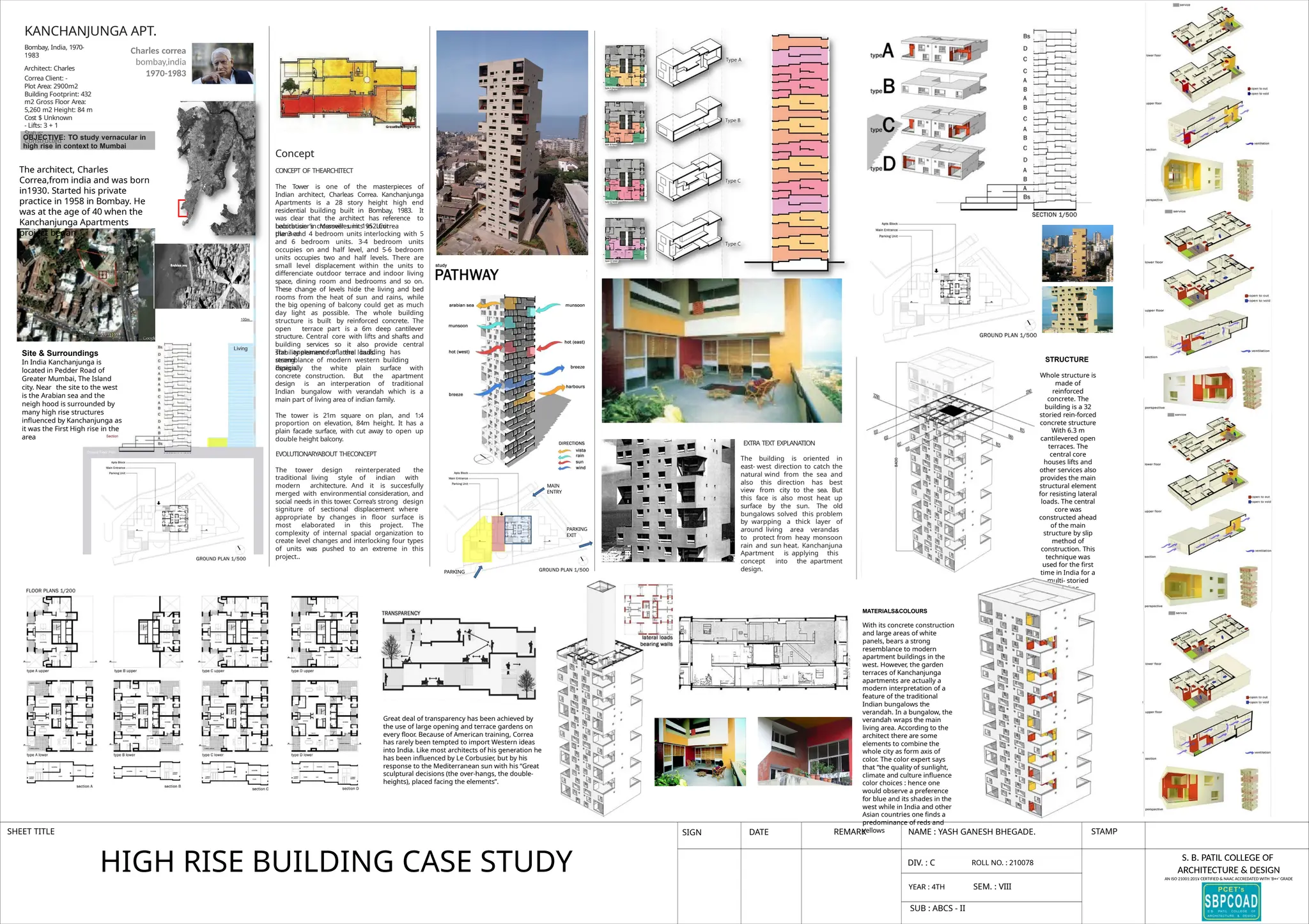
KANCHANJUNGA APT.
Bombay, India, 1970-
1983
Architect: Charles
Correa Client: -
Plot Area: 2900m2
Building Footprint: 432
m2 Gross Floor Area:
5,260 m2 Height: 84 m
Cost $ Unknown
- Lifts: 3 + 1
Status:
Constructed
Concept
CONCEPT OF THEARCHITECT
The Tower is one of the masterpieces of
Indian architect, Charleas Correa. Kanchanjunga
Apartments is a 28 story height high end
residential building built in Bombay, 1983. It
was clear that the architect has reference to
Lecorbusier’s crossover units in Unit
habitation in Marseilles in 1952.Correa
planned
the 3 and 4 bedroom units interlocking with 5
and 6 bedroom units. 3-4 bedroom units
occupies on and half level, and 5-6 bedroom
units occupies two and half levels. There are
small level displacement within the units to
differenciate outdoor terrace and indoor living
space, dining room and bedrooms and so on.
These change of levels hide the living and bed
rooms from the heat of sun and rains, while
the big opening of balcony could get as much
day light as possible. The whole building
structure is built by reinforced concrete. The
open terrace part is a 6m deep cantilever
structure. Central core with lifts and shafts and
building services so it also provide central
stability element for lateral loads.
The appearance of the building has
strong
resemblance of modern western building
design.
Especially the white plain surface with
concrete construction. But the apartment
design is an interperation of traditional
Indian bungalow with verandah which is a
main part of living area of indian family.
The tower is 21m square on plan, and 1:4
proportion on elevation, 84m height. It has a
plain facade surface, with cut away to open up
double height balcony.
The tower design reinterperated the
traditional living style of indian with
modern architecture. And it is succesfully
merged with environmential consideration, and
social needs in this tower. Correa’s strong design
signiture of sectional displacement where
appropriate by changes in floor surface is
most elaborated in this project. The
complexity of internal spacial organization to
create level changes and interlocking four types
of units was pushed to an extreme in this
project..
EVOLUTIONARYABOUT THECONCEPT
The architect, Charles
Correa,from india and was born
in1930. Started his private
practice in 1958 in Bombay. He
was at the age of 40 when the
Kanchanjunga Apartments
project began
Charles correa
bombay,india
1970-1983
EXTRA TEXT EXPLANATION
The building is oriented in
east- west direction to catch the
natural wind from the sea and
also this direction has best
view from city to the sea. But
this face is also most heat up
surface by the sun. The old
bungalows solved this problem
by warpping a thick layer of
around living area verandas
to protect from heay monsoon
rain and sun heat. Kanchanjuna
Apartment is applying this
concept into the apartment
design.
MAIN
ENTRY
PARKING
PARKING
EXIT
OBJECTIVE: TO study vernacular in
high rise in context to Mumbai
Site & Surroundings
In India Kanchanjunga is
located in Pedder Road of
Greater Mumbai, The Island
city. Near the site to the west
is the Arabian sea and the
neigh hood is surrounded by
many high rise structures
influenced by Kanchanjunga as
it was the First High rise in the
area
S. B. PATIL COLLEGE OF
ARCHITECTURE & DESIGN
AN ISO 21001:201 CERTIFIED & NAAC ACCREDATED WITH 'B++' GRADE
STRUCTURE
Whole structure is
made of
reinforced
concrete. The
building is a 32
storied rein-forced
concrete structure
With 6.3 m
cantilevered open
terraces. The
central core
houses lifts and
other services also
provides the main
structural element
for resisting lateral
loads. The central
core was
constructed ahead
of the main
structure by slip
method of
construction. This
technique was
used for the first
time in India for a
multi- storied
building.
MATERIALS&COLOURS
With its concrete construction
and large areas of white
panels, bears a strong
resemblance to modern
apartment buildings in the
west. However, the garden
terraces of Kanchanjunga
apartments are actually a
modern interpretation of a
feature of the traditional
Indian bungalows the
verandah. In a bungalow, the
verandah wraps the main
living area. According to the
architect there are some
elements to combine the
whole city as form axis of
color. The color expert says
that “the quality of sunlight,
climate and culture influence
color choices : hence one
would observe a preference
for blue and its shades in the
west while in India and other
Asian countries one finds a
predominance of reds and
yellows
Great deal of transparency has been achieved by
the use of large opening and terrace gardens on
every floor. Because of American training, Correa
has rarely been tempted to import Western ideas
into India. Like most architects of his generation he
has been influenced by Le Corbusier, but by his
response to the Mediterranean sun with his “Great
sculptural decisions (the over-hangs, the double-
heights), placed facing the elements”.