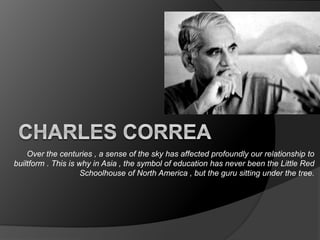
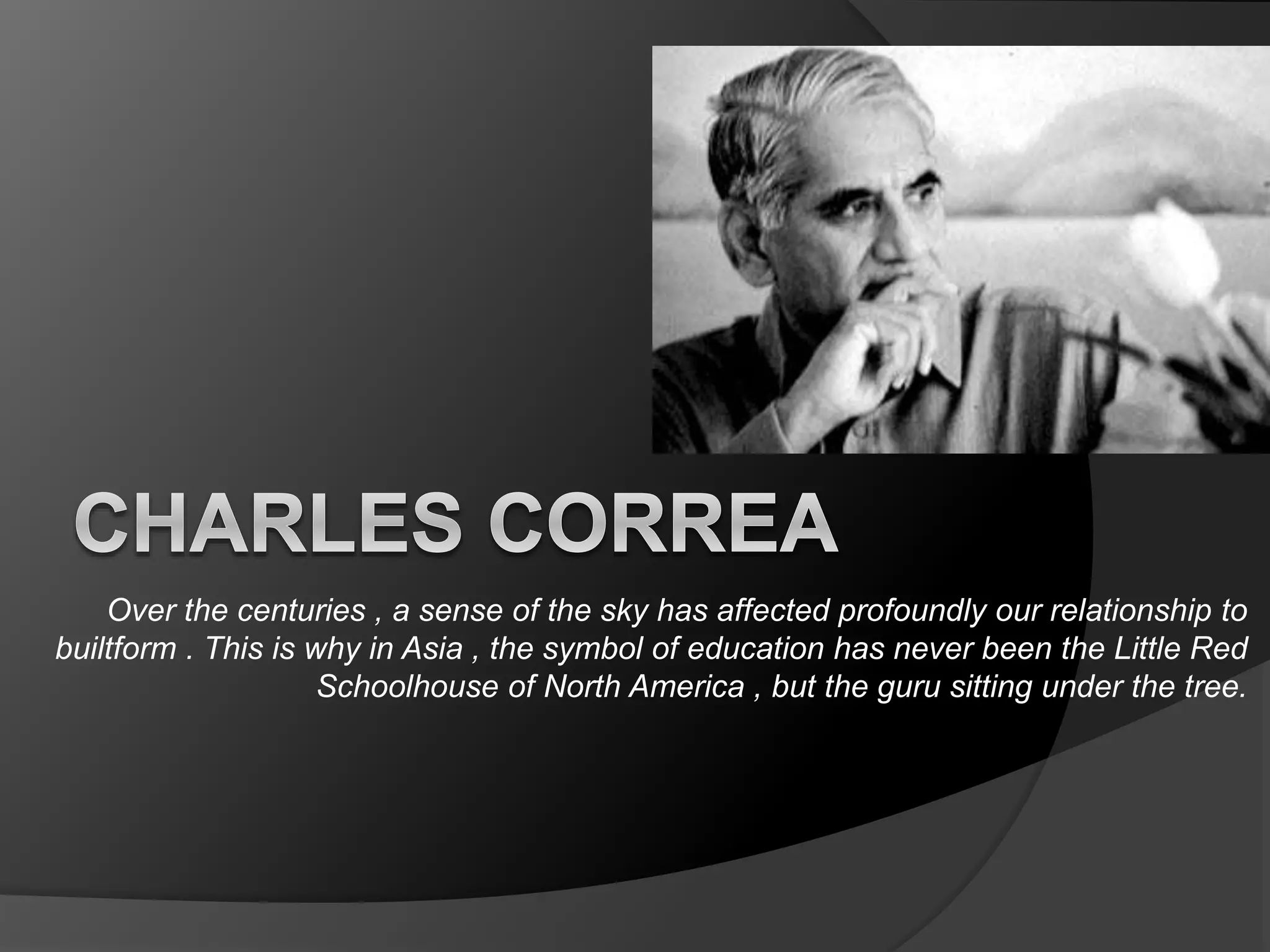
Over the centuries , a sense of the sky has affected profoundly our relationship to
builtform . This is why in Asia , the symbol of education has never been the Little Red
Schoolhouse of North America , but the guru sitting under the tree.
INTRODUCTION
ļ‚ž Born in Hyderabad , India in 1930.
ļ‚ž Studied at the University of Michigan and Massachusetts
Institute of Technology.
ļ‚ž Established a private practice in Bombay in 1958.
ļ‚ž Work in India – development ,understanding and adaptation
of Modernism to non-western cultures.
ļ‚ž Attempt to explore a local vernacular within a modern
environment.
ļ‚ž Emphasis on prevailing resources,energy and climate as
major determinants in ordering of space.
ļ‚ž ā€˜Open-to-sky space’ pervasive theme in his architecture.
ACHIEVEMENTS
ļ‚ž Pioneering work in urban issues and low cost shelter .
ļ‚ž Appointed Chairman of the National Commission on Urbanization in 1985.
ļ‚ž Founded the Urban Design Research Institute in Bombay – dedicated to
protection of built environment &improvement of urban communities in
1984.
ļ‚ž An international lecturer and traveller,awarded the RIBA Royal Gold Medal
in 1984, the Aalto Medal,UIA Gold Medal IN 1990 , Aga Khan award for
architecture, Praemium Imperiale of Japan
ļ‚ž Padma Shree (1972) and Padma Vibhushan (2006)
TUBE HOUSING
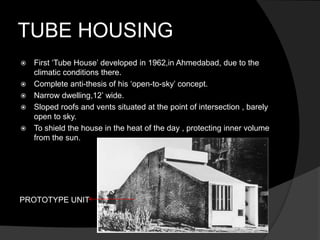
ļ‚ž First ā€˜Tube House’ developed in 1962,in Ahmedabad, due to the
climatic conditions there.
ļ‚ž Complete anti-thesis of his ā€˜open-to-sky’ concept.
ļ‚ž Narrow dwelling,12’ wide.
ļ‚ž Sloped roofs and vents situated at the point of intersection , barely
open to sky.
ļ‚ž To shield the house in the heat of the day , protecting inner volume
from the sun.
PROTOTYPE UNIT
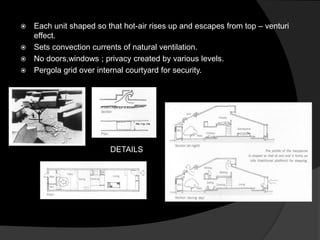
ļ‚ž Each unit shaped so that hot-air rises up and escapes from top – venturi
effect.
ļ‚ž Sets convection currents of natural ventilation.
ļ‚ž No doors,windows ; privacy created by various levels.
ļ‚ž Pergola grid over internal courtyard for security.
DETAILS
KANCHENJUNGA
APRTMENTS
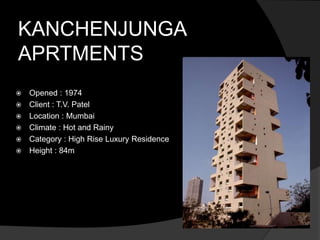
ļ‚ž Opened : 1974
ļ‚ž Client : T.V. Patel
ļ‚ž Location : Mumbai
ļ‚ž Climate : Hot and Rainy
ļ‚ž Category : High Rise Luxury Residence
ļ‚ž Height : 84m
ABOUT THE DESIGN :
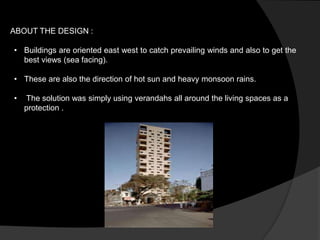
• Buildings are oriented east west to catch prevailing winds and also to get the
best views (sea facing).
• These are also the direction of hot sun and heavy monsoon rains.
• The solution was simply using verandahs all around the living spaces as a
protection .
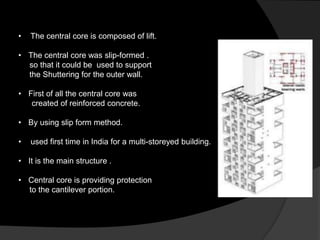
• The central core is composed of lift.
• The central core was slip-formed .
so that it could be used to support
the Shuttering for the outer wall.
• First of all the central core was
created of reinforced concrete.
• By using slip form method.
• used first time in India for a multi-storeyed building.
• It is the main structure .
• Central core is providing protection
to the cantilever portion.
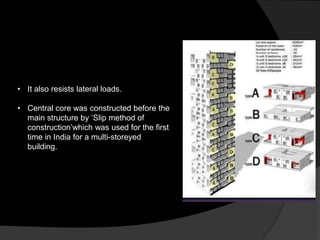
• It also resists lateral loads.
• Central core was constructed before the
main structure by ā€˜Slip method of
construction’which was used for the first
time in India for a multi-storeyed
building.
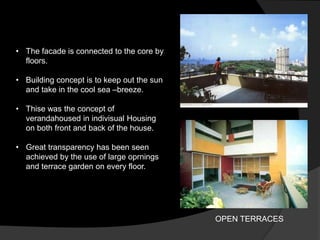
• The facade is connected to the core by
floors.
• Building concept is to keep out the sun
and take in the cool sea –breeze.
• Thise was the concept of
verandahoused in indivisual Housing
on both front and back of the house.
• Great transparency has been seen
achieved by the use of large oprnings
and terrace garden on every floor.
OPEN TERRACES
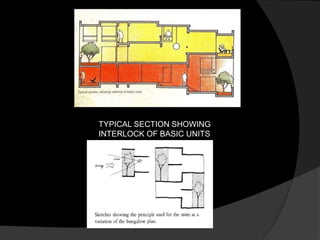
TYPICAL SECTION SHOWING
INTERLOCK OF BASIC UNITS
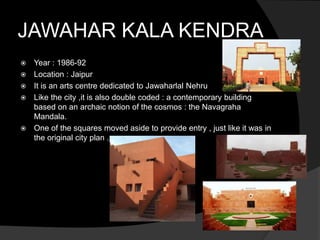
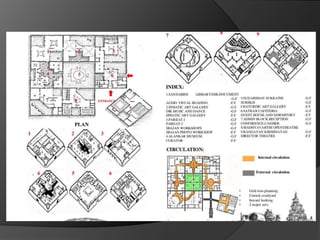
JAWAHAR KALA KENDRA
ļ‚ž Year : 1986-92
ļ‚ž Location : Jaipur
ļ‚ž It is an arts centre dedicated to Jawaharlal Nehru
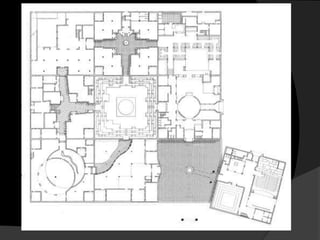
ļ‚ž Like the city ,it is also double coded : a contemporary building
based on an archaic notion of the cosmos : the Navagraha
Mandala.
ļ‚ž One of the squares moved aside to provide entry , just like it was in
the original city plan .
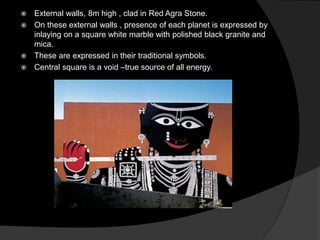
ļ‚ž External walls, 8m high , clad in Red Agra Stone.
ļ‚ž On these external walls , presence of each planet is expressed by
inlaying on a square white marble with polished black granite and
mica.
ļ‚ž These are expressed in their traditional symbols.
ļ‚ž Central square is a void –true source of all energy.
Charles correa
Charles correa

Charles correa

  • 1.
    Over the centuries, a sense of the sky has affected profoundly our relationship to builtform . This is why in Asia , the symbol of education has never been the Little Red Schoolhouse of North America , but the guru sitting under the tree.
  • 2.
    INTRODUCTION ļ‚ž Born inHyderabad , India in 1930. ļ‚ž Studied at the University of Michigan and Massachusetts Institute of Technology. ļ‚ž Established a private practice in Bombay in 1958. ļ‚ž Work in India – development ,understanding and adaptation of Modernism to non-western cultures. ļ‚ž Attempt to explore a local vernacular within a modern environment. ļ‚ž Emphasis on prevailing resources,energy and climate as major determinants in ordering of space. ļ‚ž ā€˜Open-to-sky space’ pervasive theme in his architecture.
  • 3.
    ACHIEVEMENTS ļ‚ž Pioneering workin urban issues and low cost shelter . ļ‚ž Appointed Chairman of the National Commission on Urbanization in 1985. ļ‚ž Founded the Urban Design Research Institute in Bombay – dedicated to protection of built environment &improvement of urban communities in 1984. ļ‚ž An international lecturer and traveller,awarded the RIBA Royal Gold Medal in 1984, the Aalto Medal,UIA Gold Medal IN 1990 , Aga Khan award for architecture, Praemium Imperiale of Japan ļ‚ž Padma Shree (1972) and Padma Vibhushan (2006)
  • 4.
    TUBE HOUSING ļ‚ž Firstā€˜Tube House’ developed in 1962,in Ahmedabad, due to the climatic conditions there. ļ‚ž Complete anti-thesis of his ā€˜open-to-sky’ concept. ļ‚ž Narrow dwelling,12’ wide. ļ‚ž Sloped roofs and vents situated at the point of intersection , barely open to sky. ļ‚ž To shield the house in the heat of the day , protecting inner volume from the sun. PROTOTYPE UNIT
  • 5.
    ļ‚ž Each unitshaped so that hot-air rises up and escapes from top – venturi effect. ļ‚ž Sets convection currents of natural ventilation. ļ‚ž No doors,windows ; privacy created by various levels. ļ‚ž Pergola grid over internal courtyard for security. DETAILS
  • 6.
    KANCHENJUNGA APRTMENTS ļ‚ž Opened :1974 ļ‚ž Client : T.V. Patel ļ‚ž Location : Mumbai ļ‚ž Climate : Hot and Rainy ļ‚ž Category : High Rise Luxury Residence ļ‚ž Height : 84m
  • 7.
    ABOUT THE DESIGN: • Buildings are oriented east west to catch prevailing winds and also to get the best views (sea facing). • These are also the direction of hot sun and heavy monsoon rains. • The solution was simply using verandahs all around the living spaces as a protection .
  • 8.
    • The centralcore is composed of lift. • The central core was slip-formed . so that it could be used to support the Shuttering for the outer wall. • First of all the central core was created of reinforced concrete. • By using slip form method. • used first time in India for a multi-storeyed building. • It is the main structure . • Central core is providing protection to the cantilever portion.
  • 9.
    • It alsoresists lateral loads. • Central core was constructed before the main structure by ā€˜Slip method of construction’which was used for the first time in India for a multi-storeyed building.
  • 10.
    • The facadeis connected to the core by floors. • Building concept is to keep out the sun and take in the cool sea –breeze. • Thise was the concept of verandahoused in indivisual Housing on both front and back of the house. • Great transparency has been seen achieved by the use of large oprnings and terrace garden on every floor. OPEN TERRACES
  • 11.
  • 12.
    JAWAHAR KALA KENDRA ļ‚žYear : 1986-92 ļ‚ž Location : Jaipur ļ‚ž It is an arts centre dedicated to Jawaharlal Nehru ļ‚ž Like the city ,it is also double coded : a contemporary building based on an archaic notion of the cosmos : the Navagraha Mandala. ļ‚ž One of the squares moved aside to provide entry , just like it was in the original city plan .
  • 14.
    ļ‚ž External walls,8m high , clad in Red Agra Stone. ļ‚ž On these external walls , presence of each planet is expressed by inlaying on a square white marble with polished black granite and mica. ļ‚ž These are expressed in their traditional symbols. ļ‚ž Central square is a void –true source of all energy.