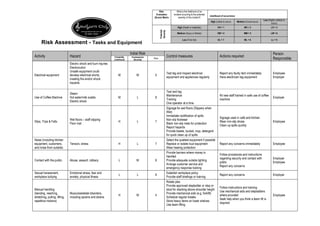
Risk Assessment - Tasks and Equipment
Activity Hazard
Initial Risk
Control measures Actions required
Person
ResponsibleProbability
(Likelihood)
Consequence
(Severity)
Risk
Electrical equipment
Electric shock and burn injuries
Electrocution
Unsafe equipment could
develop electrical shorts,
creating fire and/or shock
hazards
M M 5
Test tag and inspect electrical
equipment and appliances regularly
Report any faulty item immediately
Have electrician tag equipment
Employee
Employer
Use of Coffee Machine
Steam
Hot water/milk scalds
Electric shock
M L 8
Test and tag
Maintenance
Training
One operator at a time
All new staff trained in safe use of coffee
machine
Employer
Slips, Trips & Falls
Wet floors – staff slipping
Floor mat
H L 7
Signage for wet floors (Slippery when
Wet)
Immediate rectification of spills
Non-slip footwear
Black non-slip mats for protection
Report hazards
Provide towels, bucket, mop, detergent
for quick clean up of spills
Signage used in café and kitchen
Wear non-slip shoes
Clean up spills quickly
Employee
Noise (including kitchen
equipment, customers,
and noise from outside)
Tension, stress H L 7
Select the quietest equipment if possible
Replace or isolate loud equipment
Wear hearing protection
Report any concerns immediately Employee
Contact with the public Abuse, assault, robbery L M 6
Provide barriers where money is
handled
Provide adequate outside lighting
Arrange customer service and
emergency response training
Follow procedures and instructions
regarding security and contact with
public
Report any concerns
Employer
Employee
Sexual harassment,
workplace bullying
Emotional stress, fear and
anxiety, physical illness
L L 9
Establish workplace policy
Provide staff briefings or training
Report any concerns Employer
Manual handling
(bending, reaching,
stretching, pulling, lifting,
repetitive motions)
Musculoskeletal disorders,
including sprains and strains
H M 4
Rotate jobs
Provide approved stepladder or step or
stool for stacking above shoulder height
Provide mechanical aids (e.g. forklift)
Schedule regular breaks
Store heavy items on lower shelves
Use team lifting
Follow instructions and training
Use mechanical aids and stepladders
where provided
Seek help when you think a team lift is
required
Employee
Risk
Evaluation
(Score) Matrix
What is the likelihood of an
incident occurring & the potential
severity of the incident?
Likelihood of occurrence
High (Likely to occur) Medium (Could occur)
Low (Highly unlikely to
occur)
Potential
Severity
High (Death or disability) HH = 1 MH = 2 LH = 3
Medium (Injury or illness) HM = 4 MM = 5 LM = 6
Low (First Aid) HL = 7 ML = 8 LL = 9
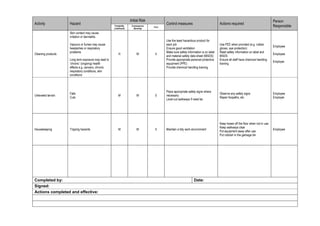
Activity Hazard
Initial Risk
Control measures Actions required
Person
ResponsibleProbability
(Likelihood)
Consequence
(Severity)
Risk
Cleaning products
Skin contact may cause
irritation or dermatitis
Vapours or fumes may cause
headaches or respiratory
problems
Long term exposure may lead to
‘chronic’ (ongoing) health
effects e.g. cancers, chronic
respiratory conditions, skin
conditions
H M 4
Use the least hazardous product for
each job
Ensure good ventilation
Make sure safety information is on label
and material safety data sheet (MSDS)
Provide appropriate personal protective
equipment (PPE)
Provide chemical handling training
Use PEE when provided (e.g. rubber
gloves, eye protection)
Read safety information on label and
MSDS
Ensure all staff have chemical handling
training
Employee
Employee
Employer
Unleveled terrain
Falls
Cuts
M M 5
Place appropriate safety signs where
necessary
Level out walkways if need be.
Observe any safety signs
Repair foopaths, etc
Employee
Employer
Housekeeping Tripping hazards M M 5 Maintain a tidy work environment
Keep hoses off the floor when not in use
Keep walkways clear
Put equipment away after use
Put rubbish in the garbage bin
Employee
Completed by: Date:
Signed:
Actions completed and effective:
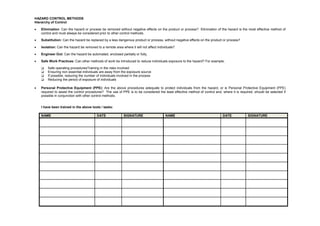
HAZARD CONTROL METHODS
Hierarchy of Control
 Elimination: Can the hazard or process be removed without negative effects on the product or process? Elimination of the hazard is the most effective method of
control and must always be considered prior to other control methods.
 Substitution: Can the hazard be replaced by a less dangerous product or process, without negative effects on the product or process?
 Isolation: Can the hazard be removed to a remote area where it will not affect individuals?
 Engineer Out: Can the hazard be automated, enclosed partially or fully,
 Safe Work Practices: Can other methods of work be introduced to reduce individuals exposure to the hazard? For example:
 Safe operating proceduresTraining in the risks involved
 Ensuring non essential individuals are away from the exposure source
 If possible, reducing the number of individuals involved in the process
 Reducing the period of exposure of individuals
 Personal Protective Equipment (PPE): Are the above procedures adequate to protect individuals from the hazard, or is Personal Protective Equipment (PPE)
required to assist the control procedures? The use of PPE is to be considered the least effective method of control and, where it is required, should be selected if
possible in conjunction with other control methods.
I have been trained in the above tools / tasks:
NAME DATE SIGNATURE NAME DATE SIGNATURE

Risk assessmenttemplate

  • 1.
    Risk Assessment -Tasks and Equipment Activity Hazard Initial Risk Control measures Actions required Person ResponsibleProbability (Likelihood) Consequence (Severity) Risk Electrical equipment Electric shock and burn injuries Electrocution Unsafe equipment could develop electrical shorts, creating fire and/or shock hazards M M 5 Test tag and inspect electrical equipment and appliances regularly Report any faulty item immediately Have electrician tag equipment Employee Employer Use of Coffee Machine Steam Hot water/milk scalds Electric shock M L 8 Test and tag Maintenance Training One operator at a time All new staff trained in safe use of coffee machine Employer Slips, Trips & Falls Wet floors – staff slipping Floor mat H L 7 Signage for wet floors (Slippery when Wet) Immediate rectification of spills Non-slip footwear Black non-slip mats for protection Report hazards Provide towels, bucket, mop, detergent for quick clean up of spills Signage used in café and kitchen Wear non-slip shoes Clean up spills quickly Employee Noise (including kitchen equipment, customers, and noise from outside) Tension, stress H L 7 Select the quietest equipment if possible Replace or isolate loud equipment Wear hearing protection Report any concerns immediately Employee Contact with the public Abuse, assault, robbery L M 6 Provide barriers where money is handled Provide adequate outside lighting Arrange customer service and emergency response training Follow procedures and instructions regarding security and contact with public Report any concerns Employer Employee Sexual harassment, workplace bullying Emotional stress, fear and anxiety, physical illness L L 9 Establish workplace policy Provide staff briefings or training Report any concerns Employer Manual handling (bending, reaching, stretching, pulling, lifting, repetitive motions) Musculoskeletal disorders, including sprains and strains H M 4 Rotate jobs Provide approved stepladder or step or stool for stacking above shoulder height Provide mechanical aids (e.g. forklift) Schedule regular breaks Store heavy items on lower shelves Use team lifting Follow instructions and training Use mechanical aids and stepladders where provided Seek help when you think a team lift is required Employee Risk Evaluation (Score) Matrix What is the likelihood of an incident occurring & the potential severity of the incident? Likelihood of occurrence High (Likely to occur) Medium (Could occur) Low (Highly unlikely to occur) Potential Severity High (Death or disability) HH = 1 MH = 2 LH = 3 Medium (Injury or illness) HM = 4 MM = 5 LM = 6 Low (First Aid) HL = 7 ML = 8 LL = 9
  • 2.
    Activity Hazard Initial Risk Controlmeasures Actions required Person ResponsibleProbability (Likelihood) Consequence (Severity) Risk Cleaning products Skin contact may cause irritation or dermatitis Vapours or fumes may cause headaches or respiratory problems Long term exposure may lead to ‘chronic’ (ongoing) health effects e.g. cancers, chronic respiratory conditions, skin conditions H M 4 Use the least hazardous product for each job Ensure good ventilation Make sure safety information is on label and material safety data sheet (MSDS) Provide appropriate personal protective equipment (PPE) Provide chemical handling training Use PEE when provided (e.g. rubber gloves, eye protection) Read safety information on label and MSDS Ensure all staff have chemical handling training Employee Employee Employer Unleveled terrain Falls Cuts M M 5 Place appropriate safety signs where necessary Level out walkways if need be. Observe any safety signs Repair foopaths, etc Employee Employer Housekeeping Tripping hazards M M 5 Maintain a tidy work environment Keep hoses off the floor when not in use Keep walkways clear Put equipment away after use Put rubbish in the garbage bin Employee Completed by: Date: Signed: Actions completed and effective:
  • 3.
    HAZARD CONTROL METHODS Hierarchyof Control  Elimination: Can the hazard or process be removed without negative effects on the product or process? Elimination of the hazard is the most effective method of control and must always be considered prior to other control methods.  Substitution: Can the hazard be replaced by a less dangerous product or process, without negative effects on the product or process?  Isolation: Can the hazard be removed to a remote area where it will not affect individuals?  Engineer Out: Can the hazard be automated, enclosed partially or fully,  Safe Work Practices: Can other methods of work be introduced to reduce individuals exposure to the hazard? For example:  Safe operating proceduresTraining in the risks involved  Ensuring non essential individuals are away from the exposure source  If possible, reducing the number of individuals involved in the process  Reducing the period of exposure of individuals  Personal Protective Equipment (PPE): Are the above procedures adequate to protect individuals from the hazard, or is Personal Protective Equipment (PPE) required to assist the control procedures? The use of PPE is to be considered the least effective method of control and, where it is required, should be selected if possible in conjunction with other control methods. I have been trained in the above tools / tasks: NAME DATE SIGNATURE NAME DATE SIGNATURE