Managing Security in External
Software Dependencies
By Tharindu Edirisinghe
http://www.meetup.com/wso2srilanka/events/233915649/
tharindue.blogspot.com @thariyarox https://lk.linkedin.com/in/ediri ediri@live.com
What is a 3rd Party Library ?
A reusable software component developed to be either freely distributed or sold by
an entity other than the original vendor of the development platform.
The third-party software component market thrives because many programmers
believe that component-oriented development improves the efficiency and the
quality of developing custom applications. Common third-party software includes
macros, bots, and software/scripts to be run as add-ons for popular developing
software.
Source : https://en.wikipedia.org/wiki/Third-party_software_component
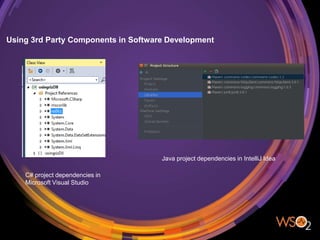
Using 3rd Party Components in Software Development
C# project dependencies in
Microsoft Visual Studio
Java project dependencies in IntelliJ Idea
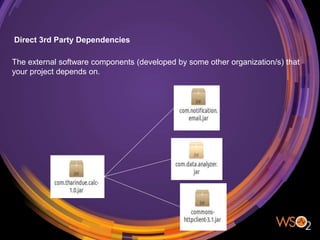
Direct 3rd Party Dependencies
The external software components (developed by some other organization/s) that
your project depends on.
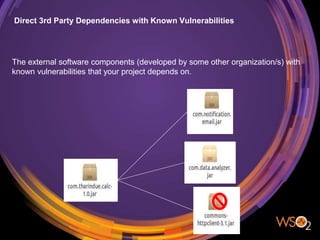
Direct 3rd Party Dependencies with Known Vulnerabilities
The external software components (developed by some other organization/s) with
known vulnerabilities that your project depends on.
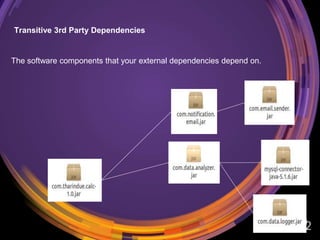
Transitive 3rd Party Dependencies
The software components that your external dependencies depend on.
Transitive 3rd Party Dependencies with Known Vulnerabilities
The software components with known vulnerabilities that your external
dependencies depend on.
Common Vulnerabilities and Exposures (CVE)
What is CVE ?
CVE is a list of information security vulnerabilities and exposures that aims to
provide common names for publicly known cyber security issues. The goal of CVE
is to make it easier to share data across separate vulnerability capabilities (tools,
repositories, and services) with this "common enumeration."
Who owns CVE ?
CVE is sponsored by US-CERT (United States Computer Emergency Readiness
Team) the office of Cybersecurity and Communications at the U.S. Department of
Homeland Security.
Source : https://cve.mitre.org/about/faqs.html
CVE Example
ID : CVE-2015-5262
Overview :
http/conn/ssl/SSLConnectionSocketFactory.java in Apache HttpComponents
HttpClient before 4.3.6 ignores the http.socket.timeout configuration setting during
an SSL handshake, which allows remote attackers to cause a denial of service
(HTTPS call hang) via unspecified vectors.
Severity: Medium
CVSS Score: 4.3
Source : https://web.nvd.nist.gov/view/vuln/detail?vulnId=CVE-2015-5262
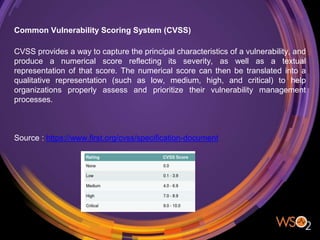
Common Vulnerability Scoring System (CVSS)
CVSS provides a way to capture the principal characteristics of a vulnerability, and
produce a numerical score reflecting its severity, as well as a textual
representation of that score. The numerical score can then be translated into a
qualitative representation (such as low, medium, high, and critical) to help
organizations properly assess and prioritize their vulnerability management
processes.
Source : https://www.first.org/cvss/specification-document
National Vulnerability Database (NVD)
NVD is the U.S. government repository of standards based vulnerability
management data represented using the Security Content Automation Protocol
(SCAP). This data enables automation of vulnerability management, security
measurement, and compliance. NVD includes databases of security checklists,
security related software flaws, misconfigurations, product names, and impact
metrics.
Source : https://nvd.nist.gov/
Using 3rd Party Dependencies Securely - The Big Picture
NVD
3rd Party Dependencies
In-house Development
All the 3rd party dependencies (including 3rd party transitive dependencies)
should be checked in NVD for identifying vulnerabilities.
CVE-2015-5262
CVE-2014-3577
CVE-2012-6153
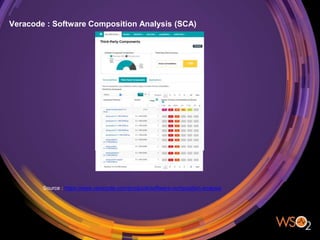
Veracode : Software Composition Analysis (SCA)
Source : https://www.veracode.com/products/software-composition-analysis
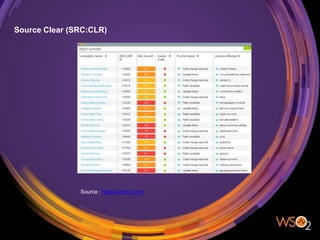
Source Clear (SRC:CLR)
Source : https://srcclr.com/
OWASP Dependency Check
Dependency-Check is a utility that identifies project dependencies and checks if
there are any known, publicly disclosed, vulnerabilities. Currently Java, .NET,
Ruby, Node.js, and Python projects are supported; additionally, limited support for
C/C++ projects is available for projects using CMake or autoconf. This tool can be
part of a solution to the OWASP Top 10 2013 A9 - Using Components with Known
Vulnerabilities.
Source : https://www.owasp.org/index.php/OWASP_Dependency_Check
OWASP Dependency Check - Useful Resources
Official Website
https://www.owasp.org/index.php/OWASP_Dependency_Check
Vulnerability Detection
http://dontpanic.42.nl/2014/06/checking-framework-vulnerabilities.html
Command Line Tool (CLI)
https://jeremylong.github.io/DependencyCheck/dependency-check-cli/index.html
http://tharindue.blogspot.com/2016/10/owasp-dependency-check-cli-analyzing.html
Suppressing False Positives
https://jeremylong.github.io/DependencyCheck/general/suppression.html
Continuous Vulnerability Detection with Jenkins Integration
https://medium.com/@PrakhashS/checking-vulnerabilities-in-3rd-party-dependencies-using-owasp-
dependency-check-plugin-in-jenkins-bedfe8de6ba8#.cvgwcptjm
OWASP Dependency Check - Demo
- Using Maven plugin for Java based projects
- Using Command Line (CLI) tool for identifying vulnerable dependencies
- Analyzing generated reports
- Suppressing vulnerabilities for avoiding false positives
- Dependency Check integration with Jenkins
More Info : http://tharindue.blogspot.com/2016/10/owasp-dependency-check-cli-analyzing.html
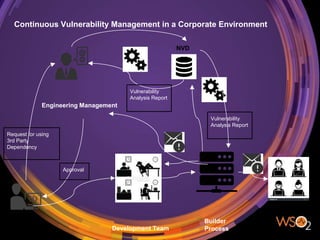
Continuous Vulnerability Management in a Corporate Environment
Request for using
3rd Party
Dependency
Engineering
Engineering Management
NVD
Vulnerability
Analysis Report
Approval
Development Team QA Team
Builder
Process
Vulnerability
Analysis Report
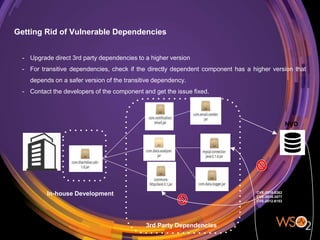
Getting Rid of Vulnerable Dependencies
NVD
3rd Party Dependencies
In-house Development
- Upgrade direct 3rd party dependencies to a higher version
- For transitive dependencies, check if the directly dependent component has a higher version that
depends on a safer version of the transitive dependency.
- Contact the developers of the component and get the issue fixed.
CVE-2015-5262
CVE-2014-3577
CVE-2012-6153
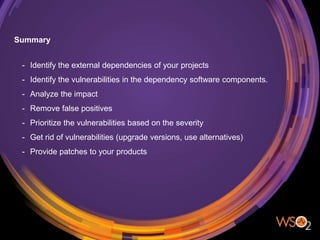
Summary
- Identify the external dependencies of your projects
- Identify the vulnerabilities in the dependency software components.
- Analyze the impact
- Remove false positives
- Prioritize the vulnerabilities based on the severity
- Get rid of vulnerabilities (upgrade versions, use alternatives)
- Provide patches to your products
THANKS!
tharindue.blogspot.com @thariyarox https://lk.linkedin.com/in/ediri ediri@live.com

Managing Security in External Software Dependencies

  • 1.
    Managing Security inExternal Software Dependencies By Tharindu Edirisinghe http://www.meetup.com/wso2srilanka/events/233915649/ tharindue.blogspot.com @thariyarox https://lk.linkedin.com/in/ediri ediri@live.com
  • 2.
    What is a3rd Party Library ? A reusable software component developed to be either freely distributed or sold by an entity other than the original vendor of the development platform. The third-party software component market thrives because many programmers believe that component-oriented development improves the efficiency and the quality of developing custom applications. Common third-party software includes macros, bots, and software/scripts to be run as add-ons for popular developing software. Source : https://en.wikipedia.org/wiki/Third-party_software_component
  • 3.
    Using 3rd PartyComponents in Software Development C# project dependencies in Microsoft Visual Studio Java project dependencies in IntelliJ Idea
  • 4.
    Direct 3rd PartyDependencies The external software components (developed by some other organization/s) that your project depends on.
  • 5.
    Direct 3rd PartyDependencies with Known Vulnerabilities The external software components (developed by some other organization/s) with known vulnerabilities that your project depends on.
  • 6.
    Transitive 3rd PartyDependencies The software components that your external dependencies depend on.
  • 7.
    Transitive 3rd PartyDependencies with Known Vulnerabilities The software components with known vulnerabilities that your external dependencies depend on.
  • 8.
    Common Vulnerabilities andExposures (CVE) What is CVE ? CVE is a list of information security vulnerabilities and exposures that aims to provide common names for publicly known cyber security issues. The goal of CVE is to make it easier to share data across separate vulnerability capabilities (tools, repositories, and services) with this "common enumeration." Who owns CVE ? CVE is sponsored by US-CERT (United States Computer Emergency Readiness Team) the office of Cybersecurity and Communications at the U.S. Department of Homeland Security. Source : https://cve.mitre.org/about/faqs.html
  • 9.
    CVE Example ID :CVE-2015-5262 Overview : http/conn/ssl/SSLConnectionSocketFactory.java in Apache HttpComponents HttpClient before 4.3.6 ignores the http.socket.timeout configuration setting during an SSL handshake, which allows remote attackers to cause a denial of service (HTTPS call hang) via unspecified vectors. Severity: Medium CVSS Score: 4.3 Source : https://web.nvd.nist.gov/view/vuln/detail?vulnId=CVE-2015-5262
  • 10.
    Common Vulnerability ScoringSystem (CVSS) CVSS provides a way to capture the principal characteristics of a vulnerability, and produce a numerical score reflecting its severity, as well as a textual representation of that score. The numerical score can then be translated into a qualitative representation (such as low, medium, high, and critical) to help organizations properly assess and prioritize their vulnerability management processes. Source : https://www.first.org/cvss/specification-document
  • 11.
    National Vulnerability Database(NVD) NVD is the U.S. government repository of standards based vulnerability management data represented using the Security Content Automation Protocol (SCAP). This data enables automation of vulnerability management, security measurement, and compliance. NVD includes databases of security checklists, security related software flaws, misconfigurations, product names, and impact metrics. Source : https://nvd.nist.gov/
  • 12.
    Using 3rd PartyDependencies Securely - The Big Picture NVD 3rd Party Dependencies In-house Development All the 3rd party dependencies (including 3rd party transitive dependencies) should be checked in NVD for identifying vulnerabilities. CVE-2015-5262 CVE-2014-3577 CVE-2012-6153
  • 13.
    Veracode : SoftwareComposition Analysis (SCA) Source : https://www.veracode.com/products/software-composition-analysis
  • 14.
    Source Clear (SRC:CLR) Source: https://srcclr.com/
  • 15.
    OWASP Dependency Check Dependency-Checkis a utility that identifies project dependencies and checks if there are any known, publicly disclosed, vulnerabilities. Currently Java, .NET, Ruby, Node.js, and Python projects are supported; additionally, limited support for C/C++ projects is available for projects using CMake or autoconf. This tool can be part of a solution to the OWASP Top 10 2013 A9 - Using Components with Known Vulnerabilities. Source : https://www.owasp.org/index.php/OWASP_Dependency_Check
  • 16.
    OWASP Dependency Check- Useful Resources Official Website https://www.owasp.org/index.php/OWASP_Dependency_Check Vulnerability Detection http://dontpanic.42.nl/2014/06/checking-framework-vulnerabilities.html Command Line Tool (CLI) https://jeremylong.github.io/DependencyCheck/dependency-check-cli/index.html http://tharindue.blogspot.com/2016/10/owasp-dependency-check-cli-analyzing.html Suppressing False Positives https://jeremylong.github.io/DependencyCheck/general/suppression.html Continuous Vulnerability Detection with Jenkins Integration https://medium.com/@PrakhashS/checking-vulnerabilities-in-3rd-party-dependencies-using-owasp- dependency-check-plugin-in-jenkins-bedfe8de6ba8#.cvgwcptjm
  • 17.
    OWASP Dependency Check- Demo - Using Maven plugin for Java based projects - Using Command Line (CLI) tool for identifying vulnerable dependencies - Analyzing generated reports - Suppressing vulnerabilities for avoiding false positives - Dependency Check integration with Jenkins More Info : http://tharindue.blogspot.com/2016/10/owasp-dependency-check-cli-analyzing.html
  • 18.
    Continuous Vulnerability Managementin a Corporate Environment Request for using 3rd Party Dependency Engineering Engineering Management NVD Vulnerability Analysis Report Approval Development Team QA Team Builder Process Vulnerability Analysis Report
  • 19.
    Getting Rid ofVulnerable Dependencies NVD 3rd Party Dependencies In-house Development - Upgrade direct 3rd party dependencies to a higher version - For transitive dependencies, check if the directly dependent component has a higher version that depends on a safer version of the transitive dependency. - Contact the developers of the component and get the issue fixed. CVE-2015-5262 CVE-2014-3577 CVE-2012-6153
  • 20.
    Summary - Identify theexternal dependencies of your projects - Identify the vulnerabilities in the dependency software components. - Analyze the impact - Remove false positives - Prioritize the vulnerabilities based on the severity - Get rid of vulnerabilities (upgrade versions, use alternatives) - Provide patches to your products
  • 21.