Hiba Naffaa
Under the direction of Prof. Michael Driscoll
and Doctor Koroush Shirvan
MIT, Department of Nuclear Engineering
Advanced Solar Power Tower
Coupled to a Supercritical
CO₂ Turbine Cycle
Objectives
• Evaluate the use of the supercritical CO₂ cycle (S-CO₂) in solar power
tower plant designs
• Generate 100 MW of solar power
• Generate electricity for Lebanon
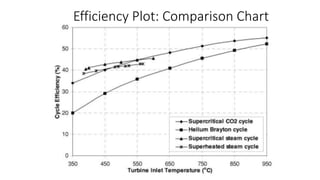
• Heat-to-electricity efficiency on the order of 50%
• Improved compatibility with the use of dry cooling tower
• More compact and cheaper equipment
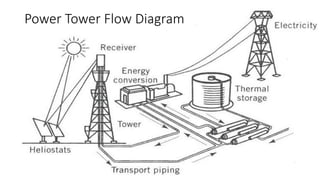
Power Tower Flow Diagram
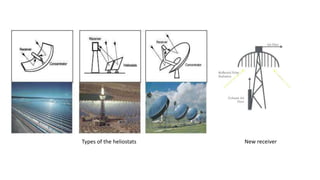
Types of the heliostats New receiver
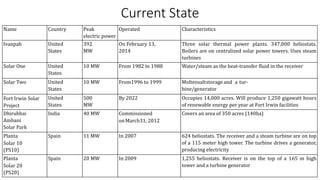
Name Country Peak
electric power
Operated Characteristics
Ivanpah United
States
392
MW
On February 13,
2014
Three solar thermal power plants. 347,000 heliostats.
Boilers are on centralized solar power towers. Uses steam
turbines
Solar One United
States
10 MW From 1982 to 1988 Water/steam as the heat-transfer fluid in the receiver
Solar Two United
States
10 MW From1996 to 1999 Moltensaltstorageand a tur-
bine/generator
Fort Irwin Solar
Project
United
States
500
MW
By 2022 Occupies 14,000 acres. Will produce 1,250 gigawatt hours
of renewable energy per year at Fort Irwin facilities
Dhirubhai
Ambani
Solar Park
India 40 MW Commissioned
onMarch31, 2012
Covers an area of 350 acres (140ha)
Planta
Solar 10
(PS10)
Spain 11 MW In 2007 624 heliostats. The receiver and a steam turbine are on top
of a 115 meter high tower. The turbine drives a generator,
producing electricity
Planta
Solar 20
(PS20)
Spain 20 MW In 2009 1,255 heliostats. Receiver is on the top of a 165 m high
tower and a turbine generator
Current State
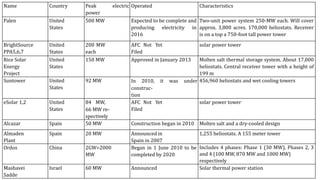
Name Country Peak electric
power
Operated Characteristics
Palen United
States
500 MW Expected to be complete and
producing electricity in
2016
Two-unit power system 250-MW each. Will cover
approx. 3,800 acres. 170,000 heliostats. Receiver
is on a top a 750-foot tall power tower
BrightSource
PPA5,6,7
United
States
200 MW
each
AFC Not Yet
Filed
solar power tower
Rice Solar
Energy
Project
United
States
150 MW Approved in January 2013 Molten salt thermal storage system. About 17,000
heliostats. Central receiver tower with a height of
199 m
Suntower United
States
92 MW In 2010, it was under
construc-
tion
456,960 heliostats and wet cooling towers
eSolar 1,2 United
States
84 MW,
66 MW re-
spectively
AFC Not Yet
Filed
solar power tower
Alcazar Spain 50 MW Construction began in 2010 Molten salt and a dry-cooled design
Almaden
Plant
Spain 20 MW Announced in
Spain in 2007
1,255 heliostats. A 155 meter tower
Ordos China 2GW=2000
MW
Began in 1 June 2010 to be
completed by 2020
Includes 4 phases: Phase 1 (30 MW), Phases 2, 3
and 4 (100 MW, 870 MW and 1000 MW)
respectively
Mashavei
Sadde
Israel 60 MW Announced Solar thermal power station
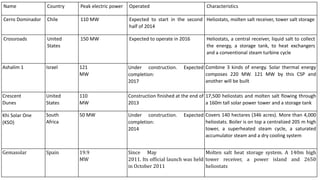
Name Country Peak electric power Operated Characteristics
Cerro Dominador Chile 110 MW Expected to start in the second
half of 2014
Heliostats, molten salt receiver, tower salt storage
Crossroads United
States
150 MW Expected to operate in 2016 Heliostats, a central receiver, liquid salt to collect
the energy, a storage tank, to heat exchangers
and a conventional steam turbine cycle
Ashalim 1 Israel 121
MW
Under construction. Expected
completion:
2017
Combine 3 kinds of energy. Solar thermal energy
composes 220 MW. 121 MW by this CSP and
another will be built
Crescent
Dunes
United
States
110
MW
Construction finished at the end of
2013
17,500 heliostats and molten salt flowing through
a 160m tall solar power tower and a storage tank
Khi Solar One
(KSO)
South
Africa
50 MW Under construction. Expected
completion:
2014
Covers 140 hectares (346 acres). More than 4,000
heliostats. Boiler is on top a centralized 205 m high
tower, a superheated steam cycle, a saturated
accumulator steam and a dry cooling system
Gemasolar Spain 19.9
MW
Since May
2011. Its official launch was held
in October 2011
Molten salt heat storage system. A 140m high
tower receiver, a power island and 2650
heliostats
Efficiency Plot: Comparison Chart
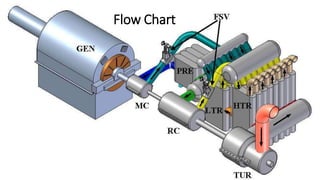
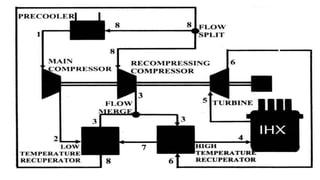
Flow Chart
Power Cycle Efficiency
Theoretical maximum: Carnot Cycle
The real efficient is given by: npc = nL.n
Where
• W is the work done by the system,
• QH is the heat put into the system,
• TC is the absolute temperature of the cold reservoir,
• TH is the absolute temperature of the hot reservoir, and
• nis the maximum efficiency.
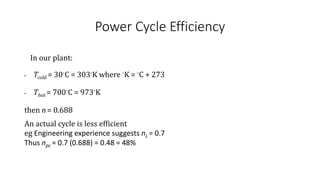
Power Cycle Efficiency
In our plant:
• Tcold = 30◦C = 303◦K where ◦K = ◦C + 273
• Thot = 700◦C = 973◦K
then n = 0.688
An actual cycle is less efficient
eg Engineering experience suggests nL = 0.7
Thus npc = 0.7 (0.688) = 0.48 = 48%
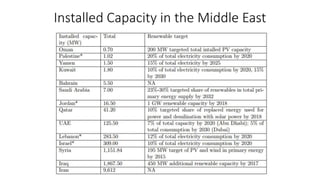
Installed Capacity in the Middle East
Conclusion
• An advanced form of power tower conversion using S-CO2 has
advantages
• Move on to tests of physical systems
• Julich, the best option to test
Acknowledgement
• Professor Michael Driscoll
• Doctor Koroush Shirvan
• Marie Herring
• Jessica Shi and Raj Vatsa
• The entire staff of RSI
• Research Science Institute
• Center for Excellence in Education
• Massachusetts Institute of Technology
• Mr. Rafic A. Bizri
• Mrs. Bahia Hariri
• David Thompson

Advanced Solar Power Tower Coupled to a Supercritical CO2 Turbine Cycle

  • 1.
    Hiba Naffaa Under thedirection of Prof. Michael Driscoll and Doctor Koroush Shirvan MIT, Department of Nuclear Engineering Advanced Solar Power Tower Coupled to a Supercritical CO₂ Turbine Cycle
  • 2.
    Objectives • Evaluate theuse of the supercritical CO₂ cycle (S-CO₂) in solar power tower plant designs • Generate 100 MW of solar power • Generate electricity for Lebanon • Heat-to-electricity efficiency on the order of 50% • Improved compatibility with the use of dry cooling tower • More compact and cheaper equipment
  • 3.
  • 4.
    Types of theheliostats New receiver
  • 5.
    Name Country Peak electricpower Operated Characteristics Ivanpah United States 392 MW On February 13, 2014 Three solar thermal power plants. 347,000 heliostats. Boilers are on centralized solar power towers. Uses steam turbines Solar One United States 10 MW From 1982 to 1988 Water/steam as the heat-transfer fluid in the receiver Solar Two United States 10 MW From1996 to 1999 Moltensaltstorageand a tur- bine/generator Fort Irwin Solar Project United States 500 MW By 2022 Occupies 14,000 acres. Will produce 1,250 gigawatt hours of renewable energy per year at Fort Irwin facilities Dhirubhai Ambani Solar Park India 40 MW Commissioned onMarch31, 2012 Covers an area of 350 acres (140ha) Planta Solar 10 (PS10) Spain 11 MW In 2007 624 heliostats. The receiver and a steam turbine are on top of a 115 meter high tower. The turbine drives a generator, producing electricity Planta Solar 20 (PS20) Spain 20 MW In 2009 1,255 heliostats. Receiver is on the top of a 165 m high tower and a turbine generator Current State
  • 6.
    Name Country Peakelectric power Operated Characteristics Palen United States 500 MW Expected to be complete and producing electricity in 2016 Two-unit power system 250-MW each. Will cover approx. 3,800 acres. 170,000 heliostats. Receiver is on a top a 750-foot tall power tower BrightSource PPA5,6,7 United States 200 MW each AFC Not Yet Filed solar power tower Rice Solar Energy Project United States 150 MW Approved in January 2013 Molten salt thermal storage system. About 17,000 heliostats. Central receiver tower with a height of 199 m Suntower United States 92 MW In 2010, it was under construc- tion 456,960 heliostats and wet cooling towers eSolar 1,2 United States 84 MW, 66 MW re- spectively AFC Not Yet Filed solar power tower Alcazar Spain 50 MW Construction began in 2010 Molten salt and a dry-cooled design Almaden Plant Spain 20 MW Announced in Spain in 2007 1,255 heliostats. A 155 meter tower Ordos China 2GW=2000 MW Began in 1 June 2010 to be completed by 2020 Includes 4 phases: Phase 1 (30 MW), Phases 2, 3 and 4 (100 MW, 870 MW and 1000 MW) respectively Mashavei Sadde Israel 60 MW Announced Solar thermal power station
  • 7.
    Name Country Peakelectric power Operated Characteristics Cerro Dominador Chile 110 MW Expected to start in the second half of 2014 Heliostats, molten salt receiver, tower salt storage Crossroads United States 150 MW Expected to operate in 2016 Heliostats, a central receiver, liquid salt to collect the energy, a storage tank, to heat exchangers and a conventional steam turbine cycle Ashalim 1 Israel 121 MW Under construction. Expected completion: 2017 Combine 3 kinds of energy. Solar thermal energy composes 220 MW. 121 MW by this CSP and another will be built Crescent Dunes United States 110 MW Construction finished at the end of 2013 17,500 heliostats and molten salt flowing through a 160m tall solar power tower and a storage tank Khi Solar One (KSO) South Africa 50 MW Under construction. Expected completion: 2014 Covers 140 hectares (346 acres). More than 4,000 heliostats. Boiler is on top a centralized 205 m high tower, a superheated steam cycle, a saturated accumulator steam and a dry cooling system Gemasolar Spain 19.9 MW Since May 2011. Its official launch was held in October 2011 Molten salt heat storage system. A 140m high tower receiver, a power island and 2650 heliostats
  • 8.
  • 9.
  • 11.
    Power Cycle Efficiency Theoreticalmaximum: Carnot Cycle The real efficient is given by: npc = nL.n Where • W is the work done by the system, • QH is the heat put into the system, • TC is the absolute temperature of the cold reservoir, • TH is the absolute temperature of the hot reservoir, and • nis the maximum efficiency.
  • 12.
    Power Cycle Efficiency Inour plant: • Tcold = 30◦C = 303◦K where ◦K = ◦C + 273 • Thot = 700◦C = 973◦K then n = 0.688 An actual cycle is less efficient eg Engineering experience suggests nL = 0.7 Thus npc = 0.7 (0.688) = 0.48 = 48%
  • 13.
    Installed Capacity inthe Middle East
  • 14.
    Conclusion • An advancedform of power tower conversion using S-CO2 has advantages • Move on to tests of physical systems • Julich, the best option to test
  • 15.
    Acknowledgement • Professor MichaelDriscoll • Doctor Koroush Shirvan • Marie Herring • Jessica Shi and Raj Vatsa • The entire staff of RSI • Research Science Institute • Center for Excellence in Education • Massachusetts Institute of Technology • Mr. Rafic A. Bizri • Mrs. Bahia Hariri • David Thompson