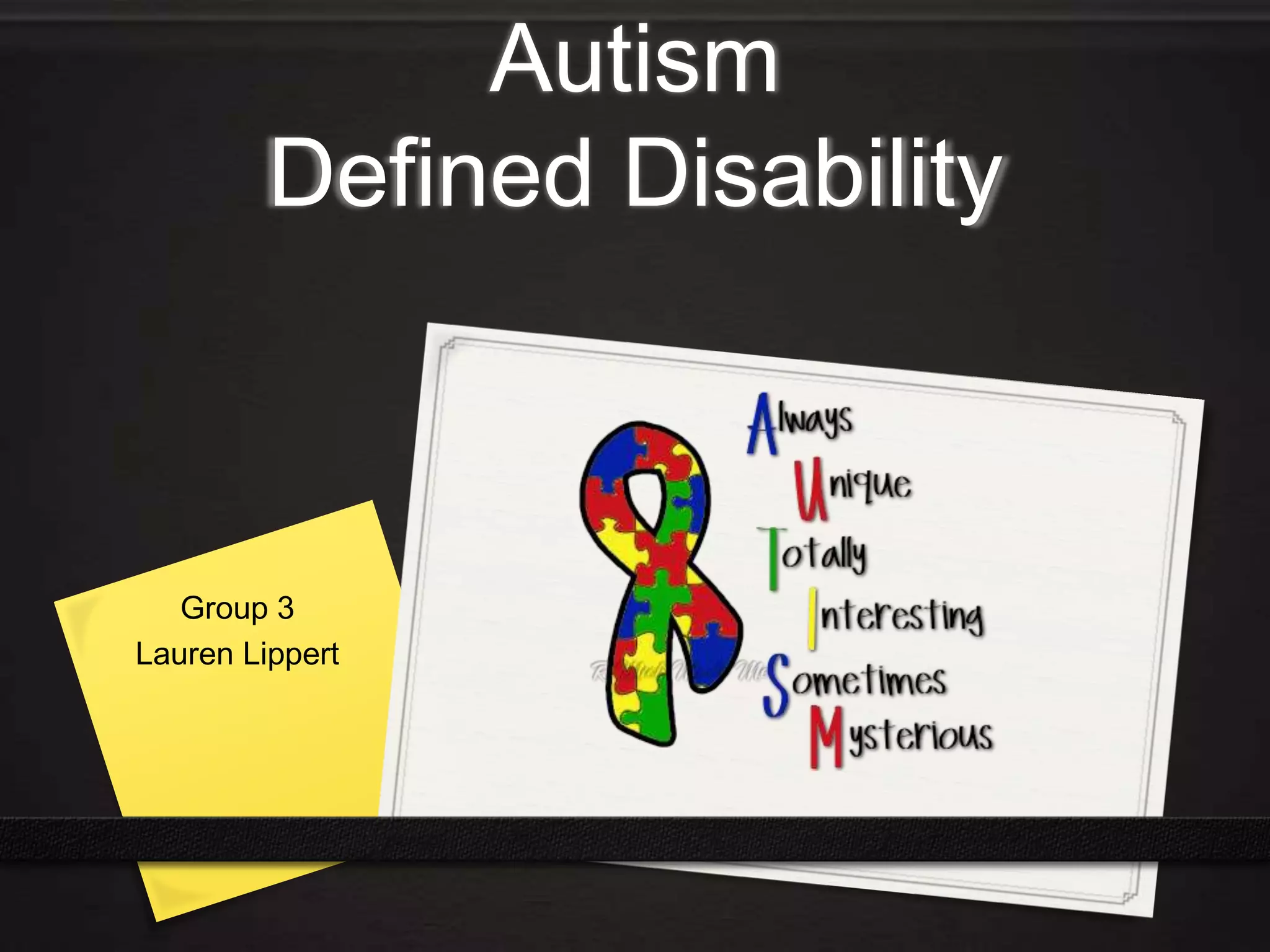
AutismDefined DisabilityGroup 3Lauren Lippert
IntroductionWhat is IDEA?Who Qualifies?The Individuals with Disabilities Education Act (IDEA) was enacted in 1990, and reauthorized in 1997. It is a federal law that was created to ensure that everyone receives a free appropriate public education, regardless of ability, promotes increased parental participation and protection for students. IDEA also strives to offer additional special education services, and procedural safeguards. The special education services are uniquely designed to meet the needs in the least restrictive environment for the students with disabilities. Special education includes a variety of services: individual/small group instruction, curriculum/teaching modifications, assistive technology, transition services, and specialized therapy services. IDEA services are offered at no cost to the parent or child (National Resource Center on AD/HD).Children, between the ages of three through twenty-one, who meet the criteria for one of the thirteen qualifying disabilities and require special education services because of their disability qualify for services with IDEA. The thirteen categories are: autism, deaf/blind, deafness, hearing impaired, mental retardation, multiple disabilities, orthopedic impairment, serious emotional disturbance, specific learning disabilities, speech or language impairment, traumatic brain injury, visual impairment including blindness, and other health impairments (National Resource Center on AD/HD).
Autism as defined by IDEAAccording I.D.E.A. Individuals with Disabilities Education Act 	Special Education Lawyers Protecting Your Child’s Educational 	Rights, “Autism means a developmental disability significantly 	affecting verbal and nonverbal communication and social 	interaction, generally evident before age 3, that adversely 	affects a child's educational performance. Other characteristics 	often associated with autism are engagement in repetitive 	activities and stereotyped movements, resistance to 	environmental change or change in daily routines, and 	unusual 	responses to sensory experiences. The term does not apply if 	a child's educational performance is adversely affected 	primarily because the child has an emotional disturbance.”
Another DefinitionClick this link to listen to the definition of autism by the Centers for Disease Control and Prevention (2010)http://www.cdc.gov/NCBDDD/autism/videos/whatisautism.html
DiagnosisAutistic disorders are discovered gradually because the range of behaviors is so broad; therefore, autism is rarely diagnosed before the age of two or three. There are no medical tests to determine if a child has autism, so doctors will diagnose autism through elimination of other disorders, this process is called differential diagnosis. Many doctors will reassure parents that their infants will grow out of their disturbing behaviors, because most infants do. Autism is more evident when the child’s language and social development is not at the same place as other children’s. The social skills of a child with autism will seem strange and the child may not interact with others, or do so in an awkward manner. The motor development will also vary from other children in that a child with autism may engage in repetitive acts, sometimes self-injurious. The process to diagnosing autism usually goes from the pediatrician, who refers them to a child psychiatrist, or an early intervention program including a team of professionals. The team would then diagnose the autism (Advameg, Inc., 2011).
Three Categories of DiagnosisDSM-IV-TR specifies three diagnostic categories, each with four components, that are used to make a diagnosis of autistic disorder: Communication, Social, and Pattern Behaviors (Advameg, Inc., 2011).
Communication Development: Qualitative impairments in communicating in at least one of the following four areas: Abnormal development of language, making no attempts to communicate through different means like gestures or mime Decreased ability to initiate or maintain a conversation with others Repetitive use of language, or use of words in unusual, idiosyncratic ways Lack of imaginative play, such as make-believe or social imitative play (Advameg, Inc., 2011)
Behavior: Restricted, repetitive, and stereotyped patterns of behavior, interests, and activities, as demonstrated by at least one of the following: Unusual and overly absorbing preoccupation with one or more interests or activities Need for adherence to routines and ritualsStereotyped and repetitive motor behaviorsPersistent preoccupation with parts of objects (Advameg, Inc., 2011)
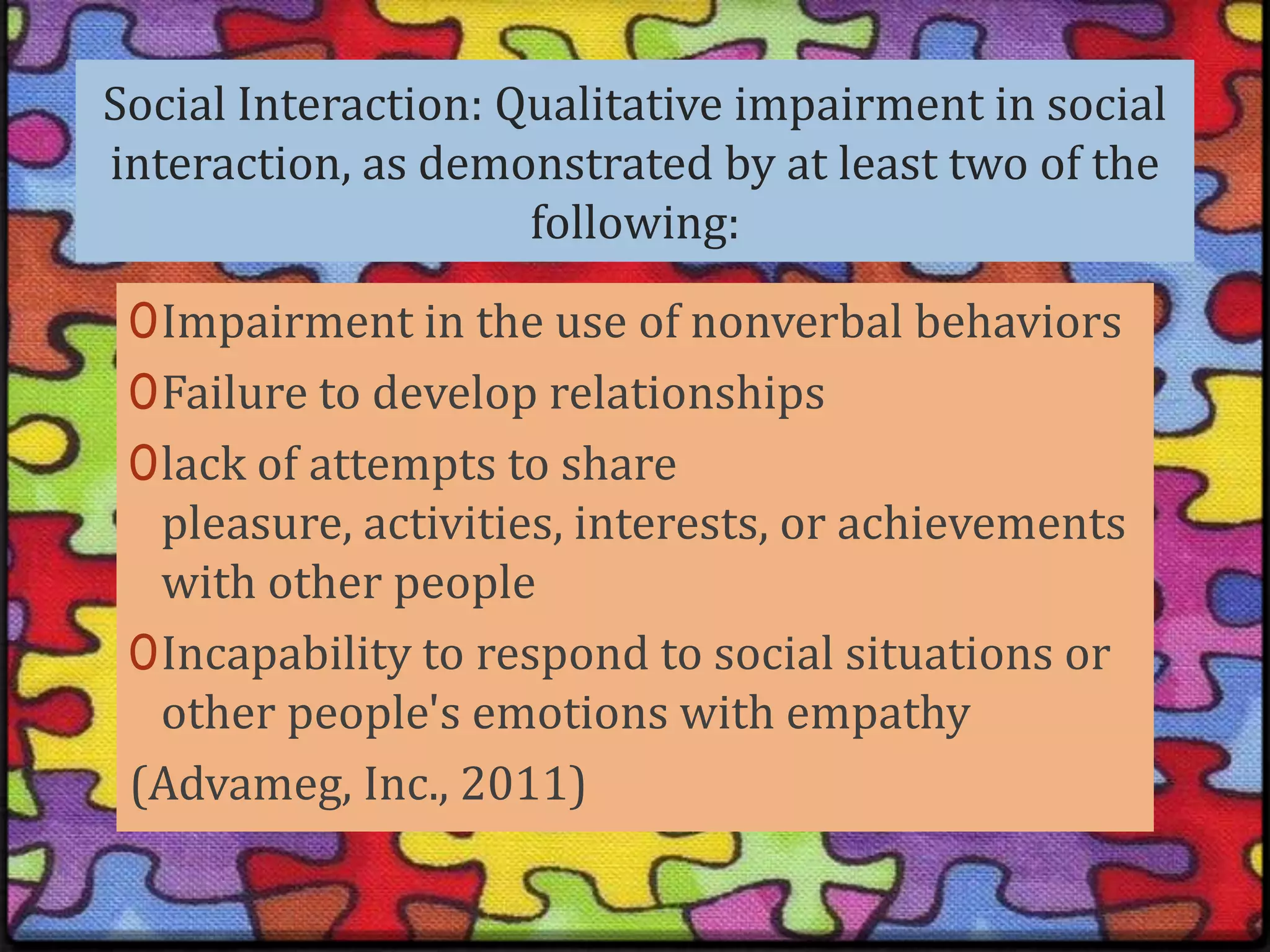
Social Interaction: Qualitative impairment in social interaction, as demonstrated by at least two of the following:Impairment in the use of nonverbal behaviorsFailure to develop relationships lack of attempts to share pleasure, activities, interests, or achievements with other people Incapability to respond to social situations or other people's emotions with empathy(Advameg, Inc., 2011)
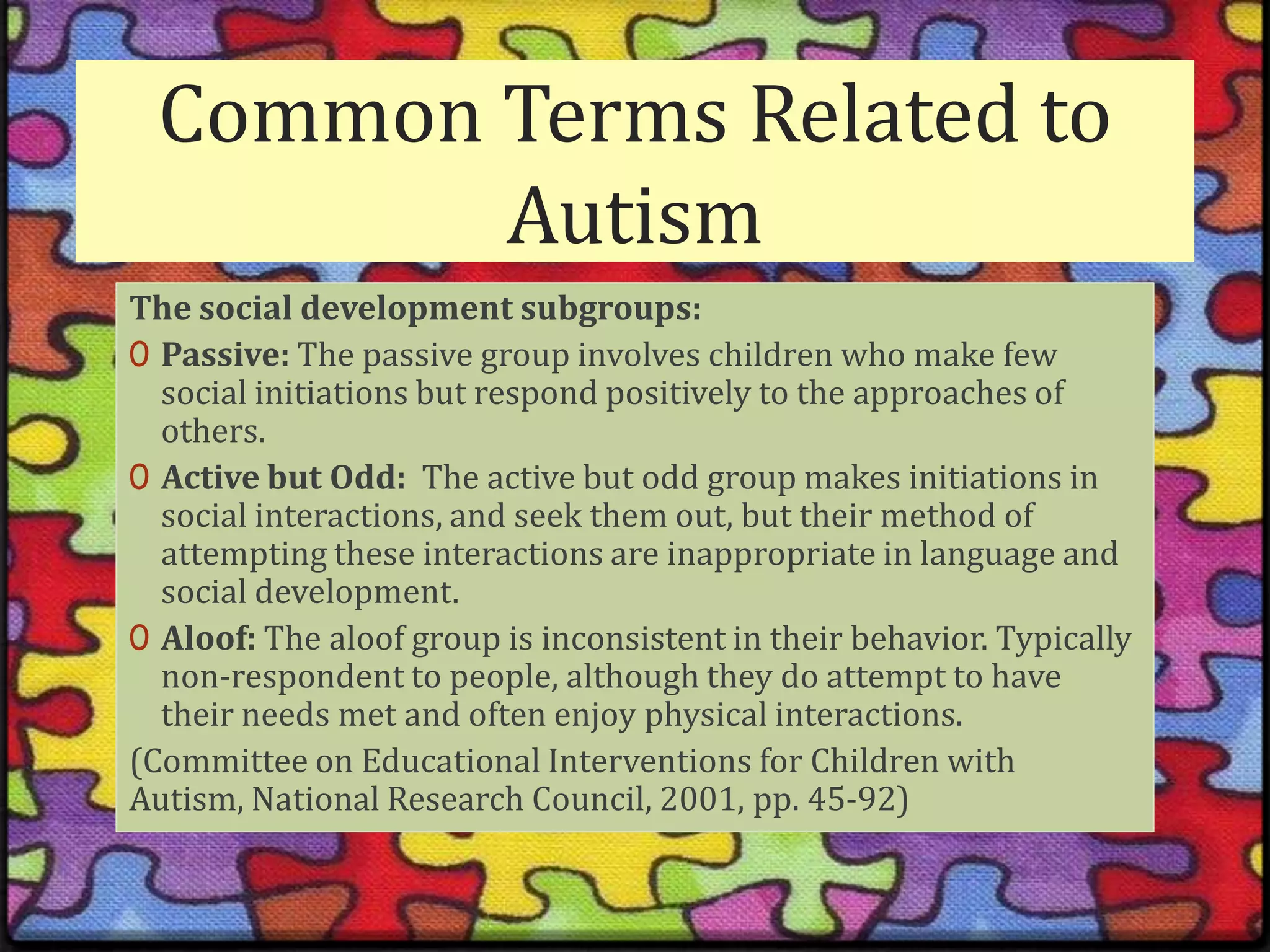
Common Terms Related to AutismThe social development subgroups:Passive: The passive group involves children who make few social initiations but respond positively to the approaches of others.Active but Odd:  The active but odd group makes initiations in social interactions, and seek them out, but their method of attempting these interactions are inappropriate in language and social development.Aloof: The aloof group is inconsistent in their behavior. Typically non-respondent to people, although they do attempt to have their needs met and often enjoy physical interactions.(Committee on Educational Interventions for Children with Autism, National Research Council, 2001, pp. 45-92)
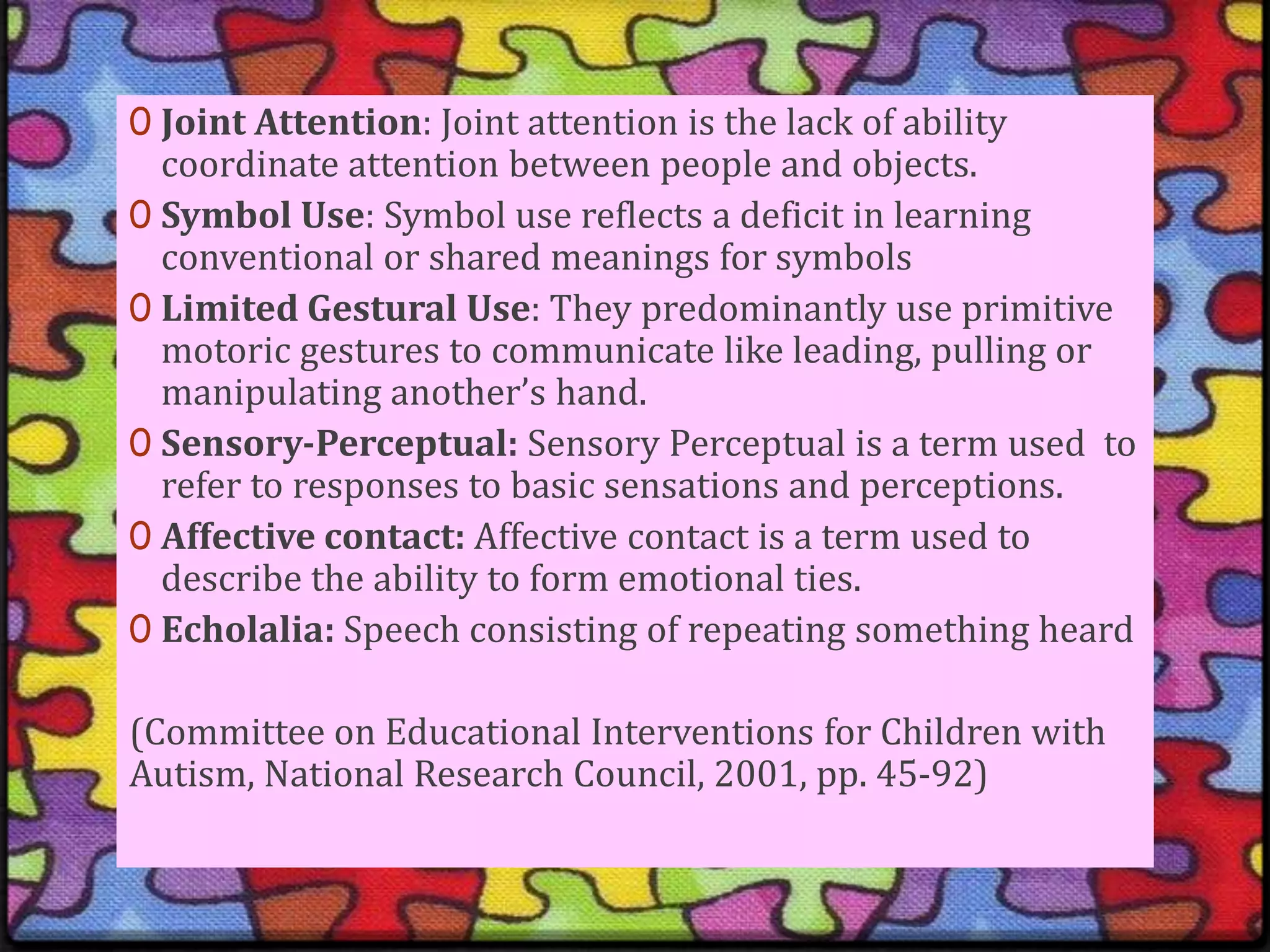
Joint Attention: Joint attention is the lack of ability coordinate attention between people and objects.Symbol Use: Symbol use reflects a deficit in learning conventional or shared meanings for symbols Limited Gestural Use: They predominantly use primitive motoric gestures to communicate like leading, pulling or manipulating another’s hand.Sensory-Perceptual: Sensory Perceptual is a term used  to refer to responses to basic sensations and perceptions.Affective contact: Affective contact is a term used to describe the ability to form emotional ties.Echolalia: Speech consisting of repeating something heard(Committee on Educational Interventions for Children with Autism, National Research Council, 2001, pp. 45-92)
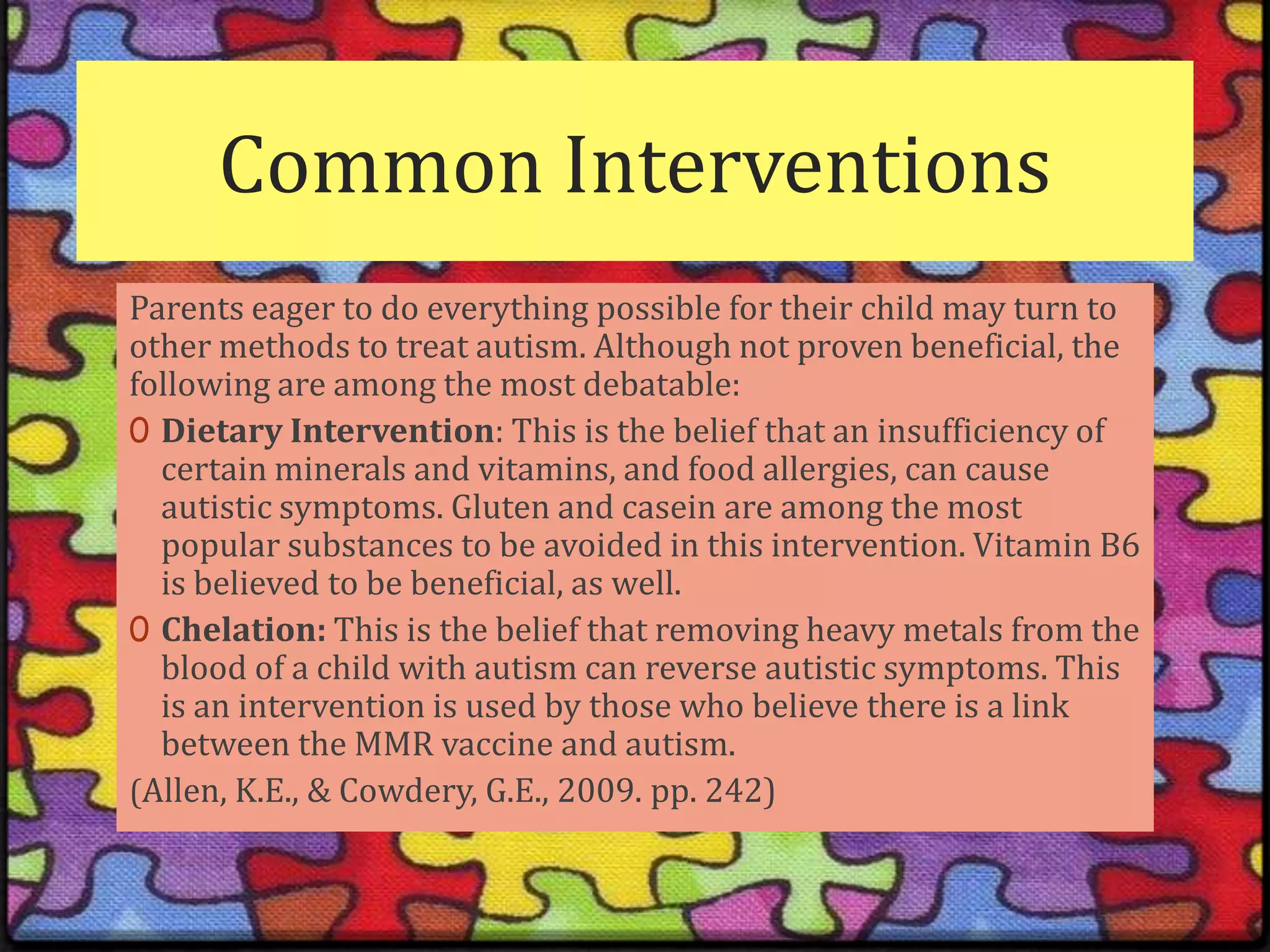
Common InterventionsParents eager to do everything possible for their child may turn to other methods to treat autism. Although not proven beneficial, the following are among the most debatable:Dietary Intervention: This is the belief that an insufficiency of certain minerals and vitamins, and food allergies, can cause autistic symptoms. Gluten and casein are among the most popular substances to be avoided in this intervention. Vitamin B6 is believed to be beneficial, as well.Chelation: This is the belief that removing heavy metals from the blood of a child with autism can reverse autistic symptoms. This is an intervention is used by those who believe there is a link between the MMR vaccine and autism.(Allen, K.E., & Cowdery, G.E., 2009. pp. 242)
Common BehaviorsEating Behaviors: Onset in the first year of life, continuing invariablyAbnormal appetites of food due to texture, color, and tasteAbnormal appetites of food due to rituals surrounding mealsSleep Behaviors: Onset after the age of oneConstant insomnia, rather than episodicIncreases likelihood of depressionSelf-Injury: Peaks in toddler years, typically gone by age 4Head bangingHitting one’s selfBiting one’s selfAggression: Peaks in toddler years, typically gone by age 5In homeOutside of homeTowards parents and siblings most oftenTemper Tantrums: Onset by age three, continuing invariablyOn daily basis, rather than episodicRestricted and repetitive interests and activities: Onset as soon as birth, continuing invariablyUnusual sensory responses: over sensitive to certain sounds or visual stimuliInflexibility to change: needing things to occur the same way each time, creating routinesRepetitive play activities: focus on unusual interests, for example, the knowledge of all information and statistics on one type of car(Child-Autism-Parent-Cafe.com, May 2, 2011)
Speech Behaviors: Onset at birth, continuing invariablyNo speechDelayed speech developmentEcholaliaDelayed echolaliaConfusion between “I” and “You”Social Behaviors: Onset at birth, continuing invariablyLack of interaction or response to peopleLack of eye contactStiff bodies when picked up as babiesDislike of human touchPassive behaviorNo fear of dangerInappropriate laughingPhysical BehaviorsWalking on tiptoesPreoccupation with handsPoor balanceFlapping handsSpinningOther Common BehaviorsLack of interest in toysAdvanced competence in drawing, music, arithmetic, calendar arithmetic, memory, and pitch.(Child-Autism-Parent-Cafe.com, May 2, 2011)
Individual Learning Needs for Students with AutismBuild on your child's interestsIf a child is fixated on Ford trucks, calculate how long it takes a Ford truck to drive from A to BOffer a predictable scheduleTeach tasks as a series of simple stepsToo many steps equals too much stimulation and confusionActively engage your child's attention in highly structured activitiesPrint black ink on colored paper to reduce the contrast and make it easier to readEspecially important for those with visual processing problemsTeach a theory in multiple locationsLook both ways at all streets, it is not a rule only at the one street by the playgroundProvide regular reinforcement of positive behaviorSpeak in different tonesPeople with autism are very sensitive to noise, offer a variety of tones, volumes, or singing to see where they fitALWAYS involve the parents(Grandin, T., December 2002)
Individual Learning Needs for Students with AutismShow what you are sayingWhen explaining how to open a milk carton, demonstratePromote spoken languageGive the child what they’re asking for AFTER they have spoken their requestProvide time for child with autism to interact with children who have no disabilitiesThey will see “normal” social and language developmentUse tangible reinforcement along with attentionProvide an optimal setting in the classroom to minimize distractionsArrange and rearrange seating charts until the best arrangement has been made(Allen, K.E., & Cowdery, G.E., 2009. pp. 241)
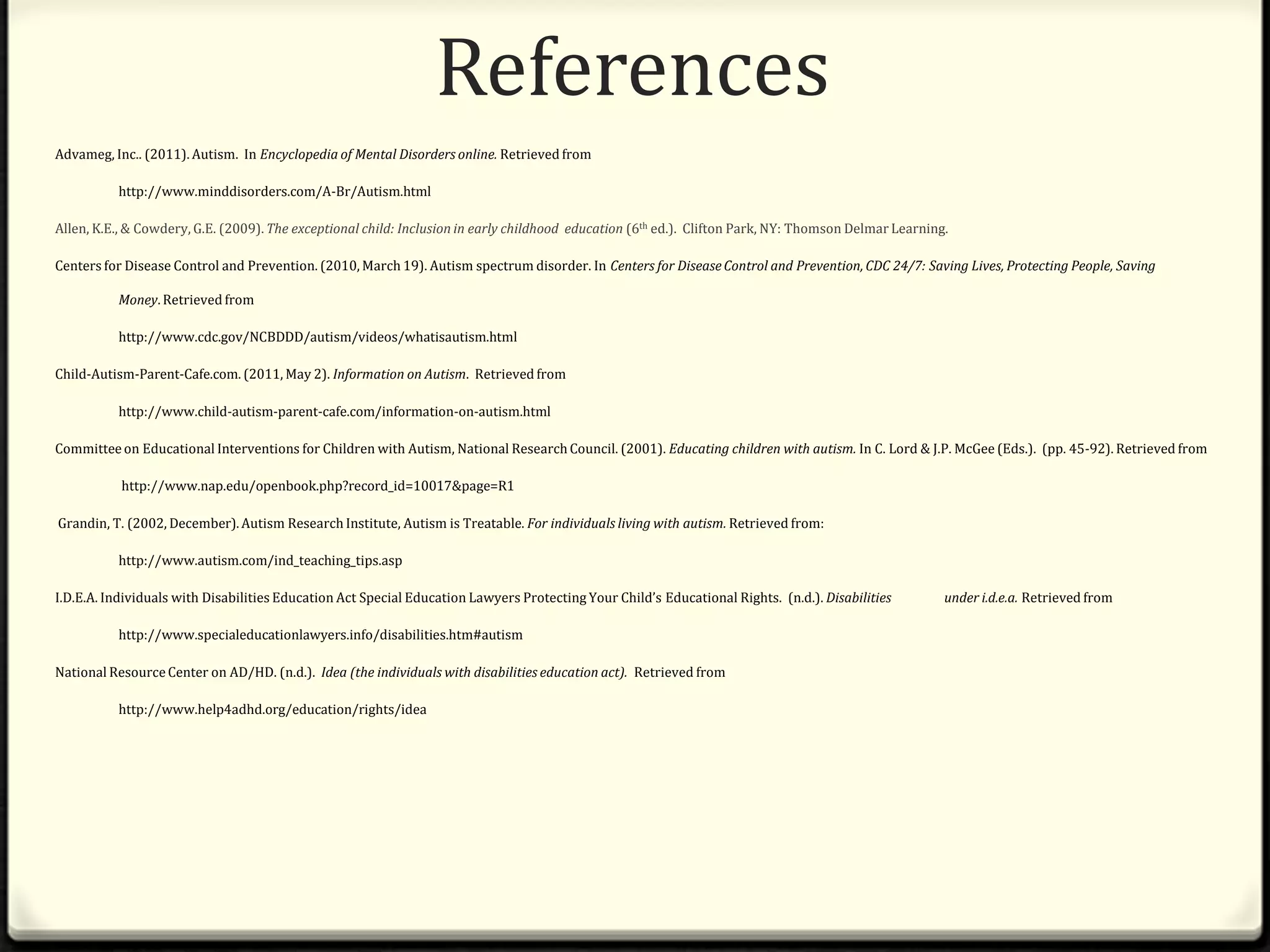
ReferencesAdvameg, Inc.. (2011). Autism.  In Encyclopedia of Mental Disorders online. Retrieved from 	http://www.minddisorders.com/A-Br/Autism.htmlAllen, K.E., & Cowdery, G.E. (2009). The exceptional child: Inclusion in early childhood  education (6thed.).  Clifton Park, NY: Thomson Delmar Learning.	Centers for Disease Control and Prevention. (2010, March 19). Autism spectrum disorder. In Centers for Disease Control and Prevention, CDC 24/7: Saving Lives, Protecting People, Saving 	Money. Retrieved from	http://www.cdc.gov/NCBDDD/autism/videos/whatisautism.htmlChild-Autism-Parent-Cafe.com. (2011, May 2). Information on Autism.  Retrieved from	http://www.child-autism-parent-cafe.com/information-on-autism.html Committee on Educational Interventions for Children with Autism, National Research Council. (2001). Educating children with autism. In C. Lord & J.P. McGee (Eds.).  (pp. 45-92). Retrieved fromhttp://www.nap.edu/openbook.php?record_id=10017&page=R1 Grandin, T. (2002, December). Autism Research Institute, Autism is Treatable. For individuals living with autism. Retrieved from:	http://www.autism.com/ind_teaching_tips.aspI.D.E.A. Individuals with Disabilities Education Act Special Education Lawyers Protecting Your Child’s Educational Rights. (n.d.). Disabilities 	under i.d.e.a. Retrieved from 	http://www.specialeducationlawyers.info/disabilities.htm#autism National Resource Center on AD/HD. (n.d.).  Idea (the individuals with disabilities education act). Retrieved from http://www.help4adhd.org/education/rights/idea

Autism: Defined Disability

  • 1.
  • 2.
    IntroductionWhat is IDEA?WhoQualifies?The Individuals with Disabilities Education Act (IDEA) was enacted in 1990, and reauthorized in 1997. It is a federal law that was created to ensure that everyone receives a free appropriate public education, regardless of ability, promotes increased parental participation and protection for students. IDEA also strives to offer additional special education services, and procedural safeguards. The special education services are uniquely designed to meet the needs in the least restrictive environment for the students with disabilities. Special education includes a variety of services: individual/small group instruction, curriculum/teaching modifications, assistive technology, transition services, and specialized therapy services. IDEA services are offered at no cost to the parent or child (National Resource Center on AD/HD).Children, between the ages of three through twenty-one, who meet the criteria for one of the thirteen qualifying disabilities and require special education services because of their disability qualify for services with IDEA. The thirteen categories are: autism, deaf/blind, deafness, hearing impaired, mental retardation, multiple disabilities, orthopedic impairment, serious emotional disturbance, specific learning disabilities, speech or language impairment, traumatic brain injury, visual impairment including blindness, and other health impairments (National Resource Center on AD/HD).
  • 3.
    Autism as definedby IDEAAccording I.D.E.A. Individuals with Disabilities Education Act Special Education Lawyers Protecting Your Child’s Educational Rights, “Autism means a developmental disability significantly affecting verbal and nonverbal communication and social interaction, generally evident before age 3, that adversely affects a child's educational performance. Other characteristics often associated with autism are engagement in repetitive activities and stereotyped movements, resistance to environmental change or change in daily routines, and unusual responses to sensory experiences. The term does not apply if a child's educational performance is adversely affected primarily because the child has an emotional disturbance.”
  • 4.
    Another DefinitionClick thislink to listen to the definition of autism by the Centers for Disease Control and Prevention (2010)http://www.cdc.gov/NCBDDD/autism/videos/whatisautism.html
  • 5.
    DiagnosisAutistic disorders arediscovered gradually because the range of behaviors is so broad; therefore, autism is rarely diagnosed before the age of two or three. There are no medical tests to determine if a child has autism, so doctors will diagnose autism through elimination of other disorders, this process is called differential diagnosis. Many doctors will reassure parents that their infants will grow out of their disturbing behaviors, because most infants do. Autism is more evident when the child’s language and social development is not at the same place as other children’s. The social skills of a child with autism will seem strange and the child may not interact with others, or do so in an awkward manner. The motor development will also vary from other children in that a child with autism may engage in repetitive acts, sometimes self-injurious. The process to diagnosing autism usually goes from the pediatrician, who refers them to a child psychiatrist, or an early intervention program including a team of professionals. The team would then diagnose the autism (Advameg, Inc., 2011).
  • 6.
    Three Categories ofDiagnosisDSM-IV-TR specifies three diagnostic categories, each with four components, that are used to make a diagnosis of autistic disorder: Communication, Social, and Pattern Behaviors (Advameg, Inc., 2011).
  • 7.
    Communication Development: Qualitativeimpairments in communicating in at least one of the following four areas: Abnormal development of language, making no attempts to communicate through different means like gestures or mime Decreased ability to initiate or maintain a conversation with others Repetitive use of language, or use of words in unusual, idiosyncratic ways Lack of imaginative play, such as make-believe or social imitative play (Advameg, Inc., 2011)
  • 8.
    Behavior: Restricted, repetitive,and stereotyped patterns of behavior, interests, and activities, as demonstrated by at least one of the following: Unusual and overly absorbing preoccupation with one or more interests or activities Need for adherence to routines and ritualsStereotyped and repetitive motor behaviorsPersistent preoccupation with parts of objects (Advameg, Inc., 2011)
  • 9.
    Social Interaction: Qualitativeimpairment in social interaction, as demonstrated by at least two of the following:Impairment in the use of nonverbal behaviorsFailure to develop relationships lack of attempts to share pleasure, activities, interests, or achievements with other people Incapability to respond to social situations or other people's emotions with empathy(Advameg, Inc., 2011)
  • 10.
    Common Terms Relatedto AutismThe social development subgroups:Passive: The passive group involves children who make few social initiations but respond positively to the approaches of others.Active but Odd: The active but odd group makes initiations in social interactions, and seek them out, but their method of attempting these interactions are inappropriate in language and social development.Aloof: The aloof group is inconsistent in their behavior. Typically non-respondent to people, although they do attempt to have their needs met and often enjoy physical interactions.(Committee on Educational Interventions for Children with Autism, National Research Council, 2001, pp. 45-92)
  • 11.
    Joint Attention: Jointattention is the lack of ability coordinate attention between people and objects.Symbol Use: Symbol use reflects a deficit in learning conventional or shared meanings for symbols Limited Gestural Use: They predominantly use primitive motoric gestures to communicate like leading, pulling or manipulating another’s hand.Sensory-Perceptual: Sensory Perceptual is a term used to refer to responses to basic sensations and perceptions.Affective contact: Affective contact is a term used to describe the ability to form emotional ties.Echolalia: Speech consisting of repeating something heard(Committee on Educational Interventions for Children with Autism, National Research Council, 2001, pp. 45-92)
  • 12.
    Common InterventionsParents eagerto do everything possible for their child may turn to other methods to treat autism. Although not proven beneficial, the following are among the most debatable:Dietary Intervention: This is the belief that an insufficiency of certain minerals and vitamins, and food allergies, can cause autistic symptoms. Gluten and casein are among the most popular substances to be avoided in this intervention. Vitamin B6 is believed to be beneficial, as well.Chelation: This is the belief that removing heavy metals from the blood of a child with autism can reverse autistic symptoms. This is an intervention is used by those who believe there is a link between the MMR vaccine and autism.(Allen, K.E., & Cowdery, G.E., 2009. pp. 242)
  • 13.
    Common BehaviorsEating Behaviors:Onset in the first year of life, continuing invariablyAbnormal appetites of food due to texture, color, and tasteAbnormal appetites of food due to rituals surrounding mealsSleep Behaviors: Onset after the age of oneConstant insomnia, rather than episodicIncreases likelihood of depressionSelf-Injury: Peaks in toddler years, typically gone by age 4Head bangingHitting one’s selfBiting one’s selfAggression: Peaks in toddler years, typically gone by age 5In homeOutside of homeTowards parents and siblings most oftenTemper Tantrums: Onset by age three, continuing invariablyOn daily basis, rather than episodicRestricted and repetitive interests and activities: Onset as soon as birth, continuing invariablyUnusual sensory responses: over sensitive to certain sounds or visual stimuliInflexibility to change: needing things to occur the same way each time, creating routinesRepetitive play activities: focus on unusual interests, for example, the knowledge of all information and statistics on one type of car(Child-Autism-Parent-Cafe.com, May 2, 2011)
  • 14.
    Speech Behaviors: Onsetat birth, continuing invariablyNo speechDelayed speech developmentEcholaliaDelayed echolaliaConfusion between “I” and “You”Social Behaviors: Onset at birth, continuing invariablyLack of interaction or response to peopleLack of eye contactStiff bodies when picked up as babiesDislike of human touchPassive behaviorNo fear of dangerInappropriate laughingPhysical BehaviorsWalking on tiptoesPreoccupation with handsPoor balanceFlapping handsSpinningOther Common BehaviorsLack of interest in toysAdvanced competence in drawing, music, arithmetic, calendar arithmetic, memory, and pitch.(Child-Autism-Parent-Cafe.com, May 2, 2011)
  • 15.
    Individual Learning Needsfor Students with AutismBuild on your child's interestsIf a child is fixated on Ford trucks, calculate how long it takes a Ford truck to drive from A to BOffer a predictable scheduleTeach tasks as a series of simple stepsToo many steps equals too much stimulation and confusionActively engage your child's attention in highly structured activitiesPrint black ink on colored paper to reduce the contrast and make it easier to readEspecially important for those with visual processing problemsTeach a theory in multiple locationsLook both ways at all streets, it is not a rule only at the one street by the playgroundProvide regular reinforcement of positive behaviorSpeak in different tonesPeople with autism are very sensitive to noise, offer a variety of tones, volumes, or singing to see where they fitALWAYS involve the parents(Grandin, T., December 2002)
  • 16.
    Individual Learning Needsfor Students with AutismShow what you are sayingWhen explaining how to open a milk carton, demonstratePromote spoken languageGive the child what they’re asking for AFTER they have spoken their requestProvide time for child with autism to interact with children who have no disabilitiesThey will see “normal” social and language developmentUse tangible reinforcement along with attentionProvide an optimal setting in the classroom to minimize distractionsArrange and rearrange seating charts until the best arrangement has been made(Allen, K.E., & Cowdery, G.E., 2009. pp. 241)
  • 17.
    ReferencesAdvameg, Inc.. (2011).Autism. In Encyclopedia of Mental Disorders online. Retrieved from http://www.minddisorders.com/A-Br/Autism.htmlAllen, K.E., & Cowdery, G.E. (2009). The exceptional child: Inclusion in early childhood education (6thed.). Clifton Park, NY: Thomson Delmar Learning. Centers for Disease Control and Prevention. (2010, March 19). Autism spectrum disorder. In Centers for Disease Control and Prevention, CDC 24/7: Saving Lives, Protecting People, Saving Money. Retrieved from http://www.cdc.gov/NCBDDD/autism/videos/whatisautism.htmlChild-Autism-Parent-Cafe.com. (2011, May 2). Information on Autism. Retrieved from http://www.child-autism-parent-cafe.com/information-on-autism.html Committee on Educational Interventions for Children with Autism, National Research Council. (2001). Educating children with autism. In C. Lord & J.P. McGee (Eds.). (pp. 45-92). Retrieved fromhttp://www.nap.edu/openbook.php?record_id=10017&page=R1 Grandin, T. (2002, December). Autism Research Institute, Autism is Treatable. For individuals living with autism. Retrieved from: http://www.autism.com/ind_teaching_tips.aspI.D.E.A. Individuals with Disabilities Education Act Special Education Lawyers Protecting Your Child’s Educational Rights. (n.d.). Disabilities under i.d.e.a. Retrieved from http://www.specialeducationlawyers.info/disabilities.htm#autism National Resource Center on AD/HD. (n.d.). Idea (the individuals with disabilities education act). Retrieved from http://www.help4adhd.org/education/rights/idea