GGGV3324
TEACHING WRITING IN AN ESL CONTEXT
DONE BY :
REBECCA LYDIAANAK RICHMOND
(A150386)
LESSON PLAN FOR PRIMARY SCHOOL
TASK 2 : LESSON PLAN FOR PRIMARY SCHOOL
Primary : 6
No. of students : 20 students
Day : Tuesday
Date : 9 May 2017
Time : 2.00 p.m. – 2.45 p.m.
Subject : English Language
Topic : Creative Writing
Previous Knowledge : Students have learnt about writing in previous class.
General Objectives : 1. Students are able to write.
2. Students are able to know what creative writing is.
3. Students are able to use creative writing.
Specific Objectives : At the end of the lesson, students should be able to:
1. Write creatively.
2. Think critically.
3. Enhance creativity.
Creative & Critical Thinking : 1. Analyze text.
2. Change plot of text creatively.
Teaching Aids :Whiteboard, marker pen, handouts and papers
Teaching Methods : 1. Direct method.
2. Communicative language teaching.
Moral Values : 1. Listening to a friend talking and paying attention to
them will make them feel appreciated.
References : 1. Tom and Jerry Pictures from Google
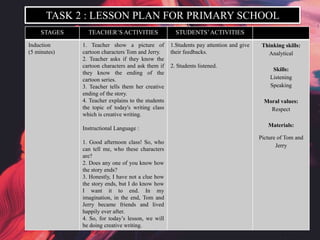
TASK 2 : LESSON PLAN FOR PRIMARY SCHOOL
STAGES TEACHER’S ACTIVITIES STUDENTS’ACTIVITIES
Induction
(5 minutes)
1. Teacher show a picture of
cartoon characters Tom and Jerry.
2. Teacher asks if they know the
cartoon characters and ask them if
they know the ending of the
cartoon series.
3. Teacher tells them her creative
ending of the story.
4. Teacher explains to the students
the topic of today's writing class
which is creative writing.
Instructional Language :
1. Good afternoon class! So, who
can tell me, who these characters
are?
2. Does any one of you know how
the story ends?
3. Honestly, I have not a clue how
the story ends, but I do know how
I want it to end. In my
imagination, in the end, Tom and
Jerry became friends and lived
happily ever after.
4. So, for today’s lesson, we will
be doing creative writing.
1.Students pay attention and give
their feedbacks.
2. Students listened.
Thinking skills:
Analytical
Skills:
Listening
Speaking
Moral values:
Respect
Materials:
Picture of Tom and
Jerry
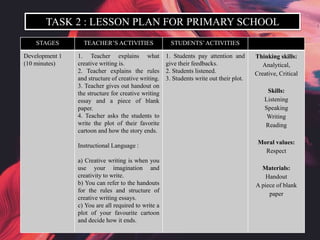
TASK 2 : LESSON PLAN FOR PRIMARY SCHOOL
STAGES TEACHER’S ACTIVITIES STUDENTS’ACTIVITIES
Development 1
(10 minutes)
1. Teacher explains what
creative writing is.
2. Teacher explains the rules
and structure of creative writing.
3. Teacher gives out handout on
the structure for creative writing
essay and a piece of blank
paper.
4. Teacher asks the students to
write the plot of their favorite
cartoon and how the story ends.
Instructional Language :
a) Creative writing is when you
use your imagination and
creativity to write.
b) You can refer to the handouts
for the rules and structure of
creative writing essays.
c) You are all required to write a
plot of your favourite cartoon
and decide how it ends.
1. Students pay attention and
give their feedbacks.
2. Students listened.
3. Students write out their plot.
Thinking skills:
Analytical,
Creative, Critical
Skills:
Listening
Speaking
Writing
Reading
Moral values:
Respect
Materials:
Handout
A piece of blank
paper
TASK 2 : LESSON PLAN FOR PRIMARY SCHOOL
STAGES TEACHER’S ACTIVITIES STUDENTS’ACTIVITIES
Development 2
(15 minutes)
1. Teacher hands out papers to
students.
2. Teacher explains today lesson
which is students have to come
up with a creative ending for
Tom and Jerry cartoon series.
3. Teacher asks four students to
read their creative ending.
Instructional Language :
a) For our next activity,
everyone should take one piece
of paper each as our next
activity requires you to write.
b) You are required to come up
with a creative ending for the
Tom and Jerry series.
c) Now, I assume that you have
all done writing. Let’s call upon
four students to read their
endings.
1. Students pay attention and
give their feedbacks.
2. Students listened.
3. Students write out their plot.
4. Students read out their
creative ending.
Thinking skills:
Analytical,
Creative, Critical
Skills:
Listening
Speaking
Writing
Reading
Moral values:
Respect
Materials:
Handouts
TASK 2 : LESSON PLAN FOR PRIMARY SCHOOL
STAGES TEACHER’S ACTIVITIES STUDENTS’ACTIVITIES
Closure
(5 minutes)
1. Teacher asks students to
recall today’s lesson and the
types of creative writing.
2. Teacher sums up today's
lesson.
3. Teacher explains why
creative writing is important.
Instructional Language :
a) So, what have you learn
today? How many types of
creative writing there is?
b) Overall, creative writing is
well-known for examination
questions and each and all of
you should practice it.
c) Creative writing is important
not only in terms of exam but
also to enhance your
imagination and creativity.
1. Students pay attention and
give their feedbacks.
2. Students listened.
Thinking skills:
Analytical, Critical
Skills:
Listening
Speaking
Moral values:
Respect
Materials:
-
TASK 3 : LESSON PLAN FOR SECONDARY SCHOOL
Form : 4
No. of students : 20 students’
Level : Intermediate
Day : Monday
Date : 15 May 2017
Time : 2.00 p.m. – 2.45 p.m.
Subject : English Language
Topic : Creative Writing
Previous Knowledge : Students have learnt about writing in previous class.
General Objectives : 1. Students are able to write.
2. Students are able to know what creative writing is.
Specific Objectives : At the end of the lesson, students should be able to:
1. Write creatively.
2. Think critically.
3. Enhance creativity.
Creative & Critical Thinking : 1. Analyze text.
2. Think out of the box for ideas.
Teaching Aids : Whiteboard, marker pen, SPM paper
Teaching Methods : 1. Direct method.
2. Communicative language teaching.
Moral Values : 1. Listening to a friend talking and paying attention to
them will make them feel appreciated.
References : 1. SPM paper 2015.
TASK 3 : LESSON PLAN FOR SECONDARY SCHOOL
STAGES TEACHER’S ACTIVITIES STUDENTS’ACTIVITIES
Induction
(5 minutes)
1. Teacher writes a word “holiday” on
the whiteboard.
2. Teacher asks the students to make
two link sentences using the word.
3. Teacher explains that the sentences
are creative writing.
4. Teacher introduces the topic of
today’s lesson; creative descriptive
essay.
Instructional Language :
a) Good afternoon class! Let us start
our class by looking at this word;
Holiday.
b) Each student is required to make
two sentences referring to this word.
c) So, did everyone come up with
their sentences? These sentences are
a part of creative writing.
d) Hence, today’s lesson will be on
creative descriptive essay.
1. Students pay attention and give
their feedbacks.
2. Students listen.
Thinking skills:
Analytical, Creative
Critical
Skills:
Listening
Speaking
Writing
Reading
Moral values:
Respect
Materials:
Whiteboard
Marker
TASK 3 : LESSON PLAN FOR SECONDARY SCHOOL
STAGES TEACHER’S ACTIVITIES STUDENTS’ACTIVITIES
Development 1
(10 minutes)
1. Teacher hands out 2015 SPM
paper.
2. Teacher asks the students to
read out the first question.
3. Teacher tells the students the
outline for a descriptive essay.
Instructional Language :
1. Each student is required to
take the handouts given. The
handouts are example of
question asked in the 2015 SPM
examination.
2. Can someone read out the
question for the class?
3. So, basically these are the
outline in writing a descriptive
essay.
1. Students pay attention and
give their feedbacks.
2. Students listen.
Thinking skills:
Analytical
Skills:
Listening
Speaking
Moral values:
Respect
Materials:
SPM Paper
TASK 3 : LESSON PLAN FOR SECONDARY SCHOOL
STAGES TEACHER’S ACTIVITIES STUDENTS’ACTIVITIES
Development 2
(15 minutes)
1. Teacher writes an opening
sentence on the whiteboard.
2. Teacher asks students to write
an introduction paragraph using
the opening sentence.
3. Teacher asks three students to
read their paragraphs.
Instructional Language :
a) Referring to the word;
holiday just now; I have come
up with an opening sentence.
b) Each student are required to
write an introduction paragraph
based on the opening sentence
written on the board.
c) I assumed that each student
are done with their introductory
sentence, let us call upon three
students to read out their
paragraphs.
1. Students pay attention and
give their feedbacks.
2. Students listen.
3. Students write their
paragraphs.
4. Students read out their
paragraphs.
Thinking skills:
Analytical,
Creative, Critical
Skills:
Listening
Speaking
Writing
Reading
Moral values:
Respect
Materials:
Whiteboard
Marker
TASK 3 : LESSON PLAN FOR SECONDARY SCHOOL
STAGES TEACHER’S ACTIVITIES STUDENTS’ACTIVITIES
Closure
(5 minutes)
1. Teacher asks students to sum
up the lesson for the day.
2. Teacher sums up the lesson
and tells the student the
importance of descriptive essay
outline.
Instructional Language :
a) So, what did we learn today?
Can anyone give their views?
b) Overall, descriptive essay is
important and you should all
remember the outline given.
1. Students pay attention and
give their feedbacks.
2. Students listened.
Thinking skills:
Analytical, Critical
Skills:
Listening
Speaking
Moral values:
Respect
Materials:
-

LESSON PLAN - A150386

  • 1.
    GGGV3324 TEACHING WRITING INAN ESL CONTEXT DONE BY : REBECCA LYDIAANAK RICHMOND (A150386) LESSON PLAN FOR PRIMARY SCHOOL
  • 2.
    TASK 2 :LESSON PLAN FOR PRIMARY SCHOOL Primary : 6 No. of students : 20 students Day : Tuesday Date : 9 May 2017 Time : 2.00 p.m. – 2.45 p.m. Subject : English Language Topic : Creative Writing Previous Knowledge : Students have learnt about writing in previous class. General Objectives : 1. Students are able to write. 2. Students are able to know what creative writing is. 3. Students are able to use creative writing. Specific Objectives : At the end of the lesson, students should be able to: 1. Write creatively. 2. Think critically. 3. Enhance creativity. Creative & Critical Thinking : 1. Analyze text. 2. Change plot of text creatively. Teaching Aids :Whiteboard, marker pen, handouts and papers Teaching Methods : 1. Direct method. 2. Communicative language teaching. Moral Values : 1. Listening to a friend talking and paying attention to them will make them feel appreciated. References : 1. Tom and Jerry Pictures from Google
  • 3.
    TASK 2 :LESSON PLAN FOR PRIMARY SCHOOL STAGES TEACHER’S ACTIVITIES STUDENTS’ACTIVITIES Induction (5 minutes) 1. Teacher show a picture of cartoon characters Tom and Jerry. 2. Teacher asks if they know the cartoon characters and ask them if they know the ending of the cartoon series. 3. Teacher tells them her creative ending of the story. 4. Teacher explains to the students the topic of today's writing class which is creative writing. Instructional Language : 1. Good afternoon class! So, who can tell me, who these characters are? 2. Does any one of you know how the story ends? 3. Honestly, I have not a clue how the story ends, but I do know how I want it to end. In my imagination, in the end, Tom and Jerry became friends and lived happily ever after. 4. So, for today’s lesson, we will be doing creative writing. 1.Students pay attention and give their feedbacks. 2. Students listened. Thinking skills: Analytical Skills: Listening Speaking Moral values: Respect Materials: Picture of Tom and Jerry
  • 4.
    TASK 2 :LESSON PLAN FOR PRIMARY SCHOOL STAGES TEACHER’S ACTIVITIES STUDENTS’ACTIVITIES Development 1 (10 minutes) 1. Teacher explains what creative writing is. 2. Teacher explains the rules and structure of creative writing. 3. Teacher gives out handout on the structure for creative writing essay and a piece of blank paper. 4. Teacher asks the students to write the plot of their favorite cartoon and how the story ends. Instructional Language : a) Creative writing is when you use your imagination and creativity to write. b) You can refer to the handouts for the rules and structure of creative writing essays. c) You are all required to write a plot of your favourite cartoon and decide how it ends. 1. Students pay attention and give their feedbacks. 2. Students listened. 3. Students write out their plot. Thinking skills: Analytical, Creative, Critical Skills: Listening Speaking Writing Reading Moral values: Respect Materials: Handout A piece of blank paper
  • 5.
    TASK 2 :LESSON PLAN FOR PRIMARY SCHOOL STAGES TEACHER’S ACTIVITIES STUDENTS’ACTIVITIES Development 2 (15 minutes) 1. Teacher hands out papers to students. 2. Teacher explains today lesson which is students have to come up with a creative ending for Tom and Jerry cartoon series. 3. Teacher asks four students to read their creative ending. Instructional Language : a) For our next activity, everyone should take one piece of paper each as our next activity requires you to write. b) You are required to come up with a creative ending for the Tom and Jerry series. c) Now, I assume that you have all done writing. Let’s call upon four students to read their endings. 1. Students pay attention and give their feedbacks. 2. Students listened. 3. Students write out their plot. 4. Students read out their creative ending. Thinking skills: Analytical, Creative, Critical Skills: Listening Speaking Writing Reading Moral values: Respect Materials: Handouts
  • 6.
    TASK 2 :LESSON PLAN FOR PRIMARY SCHOOL STAGES TEACHER’S ACTIVITIES STUDENTS’ACTIVITIES Closure (5 minutes) 1. Teacher asks students to recall today’s lesson and the types of creative writing. 2. Teacher sums up today's lesson. 3. Teacher explains why creative writing is important. Instructional Language : a) So, what have you learn today? How many types of creative writing there is? b) Overall, creative writing is well-known for examination questions and each and all of you should practice it. c) Creative writing is important not only in terms of exam but also to enhance your imagination and creativity. 1. Students pay attention and give their feedbacks. 2. Students listened. Thinking skills: Analytical, Critical Skills: Listening Speaking Moral values: Respect Materials: -
  • 7.
    TASK 3 :LESSON PLAN FOR SECONDARY SCHOOL Form : 4 No. of students : 20 students’ Level : Intermediate Day : Monday Date : 15 May 2017 Time : 2.00 p.m. – 2.45 p.m. Subject : English Language Topic : Creative Writing Previous Knowledge : Students have learnt about writing in previous class. General Objectives : 1. Students are able to write. 2. Students are able to know what creative writing is. Specific Objectives : At the end of the lesson, students should be able to: 1. Write creatively. 2. Think critically. 3. Enhance creativity. Creative & Critical Thinking : 1. Analyze text. 2. Think out of the box for ideas. Teaching Aids : Whiteboard, marker pen, SPM paper Teaching Methods : 1. Direct method. 2. Communicative language teaching. Moral Values : 1. Listening to a friend talking and paying attention to them will make them feel appreciated. References : 1. SPM paper 2015.
  • 8.
    TASK 3 :LESSON PLAN FOR SECONDARY SCHOOL STAGES TEACHER’S ACTIVITIES STUDENTS’ACTIVITIES Induction (5 minutes) 1. Teacher writes a word “holiday” on the whiteboard. 2. Teacher asks the students to make two link sentences using the word. 3. Teacher explains that the sentences are creative writing. 4. Teacher introduces the topic of today’s lesson; creative descriptive essay. Instructional Language : a) Good afternoon class! Let us start our class by looking at this word; Holiday. b) Each student is required to make two sentences referring to this word. c) So, did everyone come up with their sentences? These sentences are a part of creative writing. d) Hence, today’s lesson will be on creative descriptive essay. 1. Students pay attention and give their feedbacks. 2. Students listen. Thinking skills: Analytical, Creative Critical Skills: Listening Speaking Writing Reading Moral values: Respect Materials: Whiteboard Marker
  • 9.
    TASK 3 :LESSON PLAN FOR SECONDARY SCHOOL STAGES TEACHER’S ACTIVITIES STUDENTS’ACTIVITIES Development 1 (10 minutes) 1. Teacher hands out 2015 SPM paper. 2. Teacher asks the students to read out the first question. 3. Teacher tells the students the outline for a descriptive essay. Instructional Language : 1. Each student is required to take the handouts given. The handouts are example of question asked in the 2015 SPM examination. 2. Can someone read out the question for the class? 3. So, basically these are the outline in writing a descriptive essay. 1. Students pay attention and give their feedbacks. 2. Students listen. Thinking skills: Analytical Skills: Listening Speaking Moral values: Respect Materials: SPM Paper
  • 10.
    TASK 3 :LESSON PLAN FOR SECONDARY SCHOOL STAGES TEACHER’S ACTIVITIES STUDENTS’ACTIVITIES Development 2 (15 minutes) 1. Teacher writes an opening sentence on the whiteboard. 2. Teacher asks students to write an introduction paragraph using the opening sentence. 3. Teacher asks three students to read their paragraphs. Instructional Language : a) Referring to the word; holiday just now; I have come up with an opening sentence. b) Each student are required to write an introduction paragraph based on the opening sentence written on the board. c) I assumed that each student are done with their introductory sentence, let us call upon three students to read out their paragraphs. 1. Students pay attention and give their feedbacks. 2. Students listen. 3. Students write their paragraphs. 4. Students read out their paragraphs. Thinking skills: Analytical, Creative, Critical Skills: Listening Speaking Writing Reading Moral values: Respect Materials: Whiteboard Marker
  • 11.
    TASK 3 :LESSON PLAN FOR SECONDARY SCHOOL STAGES TEACHER’S ACTIVITIES STUDENTS’ACTIVITIES Closure (5 minutes) 1. Teacher asks students to sum up the lesson for the day. 2. Teacher sums up the lesson and tells the student the importance of descriptive essay outline. Instructional Language : a) So, what did we learn today? Can anyone give their views? b) Overall, descriptive essay is important and you should all remember the outline given. 1. Students pay attention and give their feedbacks. 2. Students listened. Thinking skills: Analytical, Critical Skills: Listening Speaking Moral values: Respect Materials: -