Lesson 3: Free
Writing: Some
Suggested
Procedures
X. Writing at the Post-intermediate Level
Free Writing
✘ Is a writing strategy developed by Peter Elbow
in 1973, is similar to brainstorming but is
written in sentence and paragraph
form without stopping. Thus, it increases the
flow of ideas and reduces the chance that
you’ll accidentally censor a good idea.
2 problems faced in free writing:
1. Who we are writing for
>it gives them some purpose for writing
about the topic in the first place and can
serve to stimulate some ideas on it
2. How we write and what we write
3
4
1. List possible ideas
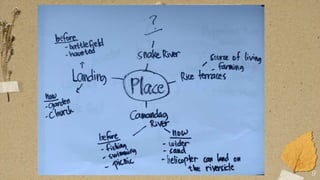
 Making an 'ideas’ chart is one way of
getting started.
5
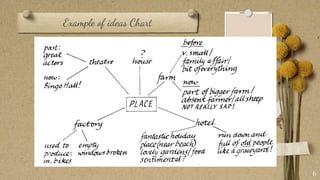
Example of ideas Chart
6
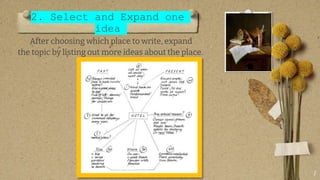
2. Select and Expand one
idea
7
 After choosing which place to write, expand
the topic by listing out more ideas about the place.
3. Make an outline
✘ helpful for organizing ideas,
especially for identifying and
developing an opening and closing
paragraph, which will make a great
impression on the reader
8
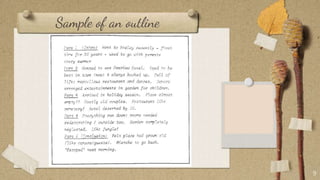
Sample of an outline
9
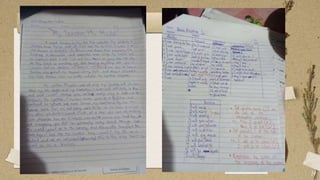
 Writing a draft is a key stage in the production
of a text and the students should normally be
required to do this as a matter of course.
 Generally drafts should be written quite quickly
because they will be reworked and corrected
afterwards.
4. Write a draft
10
11
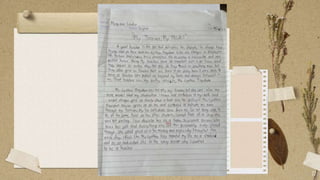
5. Correct and Improve the
draft
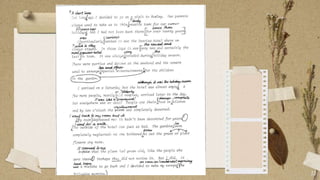
✘ In particular the students should check for
mistakes through a careful reading of what
they have written. They should also review the
text from the point of view of expression and
organization.
12
13
14
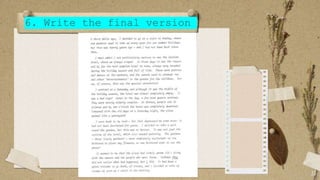
6. Write the final version
15
17
Lesson 4: It is Story
Time: Teacher Tested
Ideas for Telling
and Writing Stories
18
Writing Stories
1. Character
To start your story unit, read to your class some
stories that you have already read as a class. Ask
your students what they like about the stories.
Is there anything they would like to change about
them?
How do they feel about the main characters?
20
• Character building is one of the most
important pieces of a story.
A successful author knows that an outlandish
story can be successful if it centers around
believable characters. To help your students
develop these types of characters for their
stories, start with a brainstorming activity.
21
• Have each student make a list of at least
ten personality characteristics that he
admires.
This list might include intelligence, honesty
or bravery.
22
• Have each student make a list of at least
five personality characteristics that he
dislikes.
This list may include untruthful, selfish or
jealous.
23
2. Plot
• Ask your students what they think of
when they hear the word plot (or define it
if they are unfamiliar with the term).
• If your students suggest specific
examples, point out that any plot can be
categorized into one of four basic
conflicts.
(man vs man, man vs society , man vs
himself and man vs environment/nature)
24
 Have each of your students exchange a
story he has written with a partner in the
class. Then challenge each student to
illustrate the story his classmate has
written.
 Suggest each person limit his
illustrations to between four and six, and
then display the homemade picture
books on a bulletin board for your class
to read at leisure!
25
3. Setting and Resolution
* Spend a few minutes as a
class brainstorming a list of different
possible settings for a story they might
write. The setting could be a city, a building,
or a person’s home. There are limitless
possibilities for strong settings in a story.
26
Quick activities:
1. Have your students imagine a story set in a backyard.
2. Ask each person to make a quick list of different animals
who might play the main character in that story.
3. have each person think of a problem (conflict) that each
character might have.
4. explain to your class that the resolution is how the
problem is solved.
5. ask each person to write down the solution to each of his
character/problem scenarios he did in the previous activity.
6. Then have each student choose one and write an original
story using the plot outline he has constructed.
27
Story Telling
Activities
28
Activity 1: Story Ball
Why it’s great: The cooperative and spontaneous nature of this
game assures that there will be unexpected surprises around
the corner. Some stories will be gems, and others will be
“klunkers.” It’s perfect practice for the mindset that authors
don’t have to love everything they compose.
How it’s done: Let the students sit or stand in a circle. Roll or
throw a ball back and forth. Whoever catches the ball tells the
next sentence of the story. Throw the ball to continue the story
until the group has finished. You can start the class off with a
prompt, or you can just let things go as they will.
Activity 2: Anecdotal Storytelling
Why it’s great: Telling anecdotes reinforces the idea that people are
better at crafting stories than they think. It also creates a space for
personal narrative and makes it easier for those who are
uncomfortable with the genre.
How it’s done: Choose a prompt that kids can talk about. I’m providing
several for you here, and you’re welcome to use any of them! Keep in
mind that I choose my prompts with trauma-informed teaching in
place. If I know that there are some of these questions that are
emotionally difficult for my students, I will choose another topic.
30
✘ What was something fun you did this weekend?
✘ Tell about a time you were really proud of yourself.
✘ What’s a time you’ve been disappointed?
✘ Tell something funny a pet or sibling did.
✘ Talk about a recent trip to the dentist.
✘ Talk about a scar you got.
✘ Tell about a time you lost something important to you.
✘ What’s a birthday you remember?
✘ What happened the first time you rode a bicycle?
✘ What’s the best gift you ever received?
31
prompts
References
https://writingprocess.mit.edu/process/step-
1-generate-ideas/instructions/freewriting
https://twowritingteachers.org/2022/03/10/it
s-time-for-play-and-fun-storytelling-in-
writing-workshop/
32

Lesson 3 and 4 Free Writing PowerPoint presentation

  • 1.
    Lesson 3: Free Writing:Some Suggested Procedures X. Writing at the Post-intermediate Level
  • 2.
    Free Writing ✘ Isa writing strategy developed by Peter Elbow in 1973, is similar to brainstorming but is written in sentence and paragraph form without stopping. Thus, it increases the flow of ideas and reduces the chance that you’ll accidentally censor a good idea.
  • 3.
    2 problems facedin free writing: 1. Who we are writing for >it gives them some purpose for writing about the topic in the first place and can serve to stimulate some ideas on it 2. How we write and what we write 3
  • 4.
  • 5.
    1. List possibleideas  Making an 'ideas’ chart is one way of getting started. 5
  • 6.
  • 7.
    2. Select andExpand one idea 7  After choosing which place to write, expand the topic by listing out more ideas about the place.
  • 8.
    3. Make anoutline ✘ helpful for organizing ideas, especially for identifying and developing an opening and closing paragraph, which will make a great impression on the reader 8
  • 9.
    Sample of anoutline 9
  • 10.
     Writing adraft is a key stage in the production of a text and the students should normally be required to do this as a matter of course.  Generally drafts should be written quite quickly because they will be reworked and corrected afterwards. 4. Write a draft 10
  • 11.
  • 12.
    5. Correct andImprove the draft ✘ In particular the students should check for mistakes through a careful reading of what they have written. They should also review the text from the point of view of expression and organization. 12
  • 13.
  • 14.
  • 15.
    6. Write thefinal version 15
  • 17.
  • 18.
    Lesson 4: Itis Story Time: Teacher Tested Ideas for Telling and Writing Stories 18
  • 19.
  • 20.
    1. Character To startyour story unit, read to your class some stories that you have already read as a class. Ask your students what they like about the stories. Is there anything they would like to change about them? How do they feel about the main characters? 20
  • 21.
    • Character buildingis one of the most important pieces of a story. A successful author knows that an outlandish story can be successful if it centers around believable characters. To help your students develop these types of characters for their stories, start with a brainstorming activity. 21
  • 22.
    • Have eachstudent make a list of at least ten personality characteristics that he admires. This list might include intelligence, honesty or bravery. 22
  • 23.
    • Have eachstudent make a list of at least five personality characteristics that he dislikes. This list may include untruthful, selfish or jealous. 23
  • 24.
    2. Plot • Askyour students what they think of when they hear the word plot (or define it if they are unfamiliar with the term). • If your students suggest specific examples, point out that any plot can be categorized into one of four basic conflicts. (man vs man, man vs society , man vs himself and man vs environment/nature) 24
  • 25.
     Have eachof your students exchange a story he has written with a partner in the class. Then challenge each student to illustrate the story his classmate has written.  Suggest each person limit his illustrations to between four and six, and then display the homemade picture books on a bulletin board for your class to read at leisure! 25
  • 26.
    3. Setting andResolution * Spend a few minutes as a class brainstorming a list of different possible settings for a story they might write. The setting could be a city, a building, or a person’s home. There are limitless possibilities for strong settings in a story. 26
  • 27.
    Quick activities: 1. Haveyour students imagine a story set in a backyard. 2. Ask each person to make a quick list of different animals who might play the main character in that story. 3. have each person think of a problem (conflict) that each character might have. 4. explain to your class that the resolution is how the problem is solved. 5. ask each person to write down the solution to each of his character/problem scenarios he did in the previous activity. 6. Then have each student choose one and write an original story using the plot outline he has constructed. 27
  • 28.
  • 29.
    Activity 1: StoryBall Why it’s great: The cooperative and spontaneous nature of this game assures that there will be unexpected surprises around the corner. Some stories will be gems, and others will be “klunkers.” It’s perfect practice for the mindset that authors don’t have to love everything they compose. How it’s done: Let the students sit or stand in a circle. Roll or throw a ball back and forth. Whoever catches the ball tells the next sentence of the story. Throw the ball to continue the story until the group has finished. You can start the class off with a prompt, or you can just let things go as they will.
  • 30.
    Activity 2: AnecdotalStorytelling Why it’s great: Telling anecdotes reinforces the idea that people are better at crafting stories than they think. It also creates a space for personal narrative and makes it easier for those who are uncomfortable with the genre. How it’s done: Choose a prompt that kids can talk about. I’m providing several for you here, and you’re welcome to use any of them! Keep in mind that I choose my prompts with trauma-informed teaching in place. If I know that there are some of these questions that are emotionally difficult for my students, I will choose another topic. 30
  • 31.
    ✘ What wassomething fun you did this weekend? ✘ Tell about a time you were really proud of yourself. ✘ What’s a time you’ve been disappointed? ✘ Tell something funny a pet or sibling did. ✘ Talk about a recent trip to the dentist. ✘ Talk about a scar you got. ✘ Tell about a time you lost something important to you. ✘ What’s a birthday you remember? ✘ What happened the first time you rode a bicycle? ✘ What’s the best gift you ever received? 31 prompts
  • 32.