
Vyāghra is the Sanskrit word for Tiger
Vyāghranomics in Space and Time:
Estimating Habitat Threats for Bengal, Indochinese,
          Malayan and Sumatran Tigers
 Susmita Dasgupta, Dan Hammer, Robin Kraft, David Wheeler

                    The World Bank
                          2012
Endangered Tigers

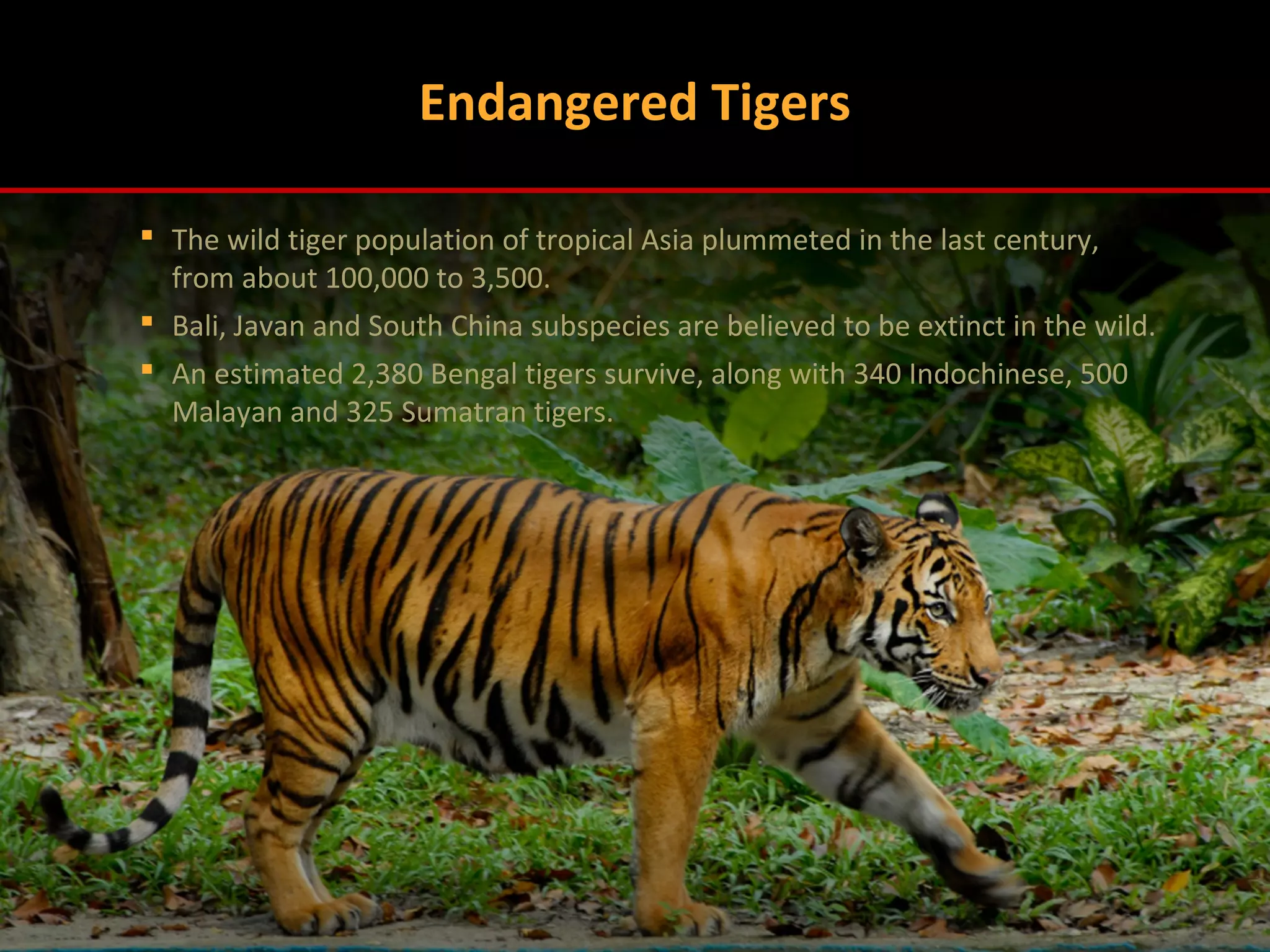
 The wild tiger population of tropical Asia plummeted in the last century,
  from about 100,000 to 3,500.
 Bali, Javan and South China subspecies are believed to be extinct in the wild.
 An estimated 2,380 Bengal tigers survive, along with 340 Indochinese, 500
  Malayan and 325 Sumatran tigers.
Research Focus


This research focuses
on forest habitat loss,
but we recognize that
poaching and illegal
trade in tiger parts can
devastate remaining
tiger populations,
even when forest
habitat is intact.
Tiger Habitats

                                           Tiger Subspecies Landscapes
Tiger habitats withered significantly
over time.
Remaining habitat forms a scattered
arc from southwest India to northwest
Indonesia, much of it in upland areas.
Long term survival of the tiger is
dependent on conservation of tiger
habitats.


Habitat conservation is primarily a development problem. Success of conservation
initiatives will require program designs tailored to the economic dynamics of forest
clearing in tropical forest countries.
Economic Dynamics of Forest Habitat Loss


This research links forest habitat
loss and forest clearing to
profitability calculations that are
affected by market expectations,
environmental conditions
evolving patterns of settlement,
economic activity, infrastructure
provision and regulatory activity -
following previous empirical
research on conversion of
forested land.
Data


 High-resolution monthly data on forest
   clearing for 74 tiger habitat areas in 10
   countries: Bangladesh, Bhutan,
   Cambodia, India, Indonesian Sumatra,
   Lao PDR, Peninsular Malaysia,
   Myanmar, Nepal, Thailand and Vietnam
   were used to investigate habitat
   threats for Bengal, Indochinese,
   Malayan and Sumatran tigers.

 Forest clearing information was from
   FORMA (Forest Monitoring for Action),
   a satellite-based system.
Estimation

 Forest clearing data was gridded to 100 km2
   – typical area to support survival and
   breeding of tigers for econometric analysis
 Determinants of forest clearing included
   Cost of Land, Expected Revenue from
   Production on Cleared Land, Distance from
   Markets, Quality of Transport
   Infrastructure, Cost of Capital, Agricultural
   Input Price, Population Density,
   Topography, Precipitation, Soil Quality and
   Forest Protection Measures
 For each country, the model was estimated
   using new spatial panel estimation
   methods that allow for temporal and
   spatial autocorrelation.
Econometric Findings

 Over time, the spread of clearing into new or contiguous areas is reducing the
   number of 100 km2 forest blocks that can support breeding tigers.
 Current clearing activity is significantly related to past forest clearing in 2000-
   2005.
 Clearing increases with increase in the opportunity cost of forested land.
 Clearing is greater in areas that are relatively remote from major transport
   links.
 Over time, clearing is positively related to the expected prices of forest
   products and expected future exchange rates (denominated in local
   currencies/dollar).
 Clearing is negatively related to rainfall, real interest rate, and to the
   elevation of the terrain.
 After controlling for all these, significant unexplained drivers remain.
Difference across Countries

 A negative trend in forest clearing is more pronounced in Bangladesh, India, Nepal
   - Bengal tiger countries, and less pronounced in Indonesian Sumatra, Cambodia
   and Vietnam.
 Trend clearing is positive and highly significant in Peninsular Malaysia, Myanmar
   and Lao PDR.
 In the export-oriented economies of Indonesia and Malaysia, the habitat countries
   of Sumatran and Malayan tigers, forest clearing is highly sensitive to changes in
   exchange rates, real interest rates and the prices of forest products.
 In contrast, sensitivity to these variables is lower in India, Bangladesh and Nepal --
   habitat countries of the Bengal tiger.
 Responsiveness to agricultural product prices varies across fivefold across
   countries.
 Protected Areas have no measured effects in the Sumatran and Malayan habitat
   countries in general.
 Protected Areas have significant effects in the habitat countries of Bengal tigers.
Critical Message


 Changes in world forest product markets and national financial policies
   have significant, measurable effects on tropical forest clearing, but with
   variable time lags and differing degrees of responsiveness across
   countries.


 Measuring these effects and pinpointing areas at high risk can provide
   valuable guidance for policymakers, conservation managers, and donor
   institutions about the challenges to be overcome in offsetting incentives
   for forest clearing, and about potential responses tailored to the
   circumstances of different countries and habitat areas.
Thank You
Graphic Design by Pritthijit (Raja) Kundu   email: kpritthijit@yahoo.com

Habitat Threats for Tigers

  • 1.
    Vyāghra is theSanskrit word for Tiger
  • 2.
    Vyāghranomics in Spaceand Time: Estimating Habitat Threats for Bengal, Indochinese, Malayan and Sumatran Tigers Susmita Dasgupta, Dan Hammer, Robin Kraft, David Wheeler The World Bank 2012
  • 3.
    Endangered Tigers  Thewild tiger population of tropical Asia plummeted in the last century, from about 100,000 to 3,500.  Bali, Javan and South China subspecies are believed to be extinct in the wild.  An estimated 2,380 Bengal tigers survive, along with 340 Indochinese, 500 Malayan and 325 Sumatran tigers.
  • 4.
    Research Focus This researchfocuses on forest habitat loss, but we recognize that poaching and illegal trade in tiger parts can devastate remaining tiger populations, even when forest habitat is intact.
  • 5.
    Tiger Habitats Tiger Subspecies Landscapes Tiger habitats withered significantly over time. Remaining habitat forms a scattered arc from southwest India to northwest Indonesia, much of it in upland areas. Long term survival of the tiger is dependent on conservation of tiger habitats. Habitat conservation is primarily a development problem. Success of conservation initiatives will require program designs tailored to the economic dynamics of forest clearing in tropical forest countries.
  • 6.
    Economic Dynamics ofForest Habitat Loss This research links forest habitat loss and forest clearing to profitability calculations that are affected by market expectations, environmental conditions evolving patterns of settlement, economic activity, infrastructure provision and regulatory activity - following previous empirical research on conversion of forested land.
  • 7.
    Data  High-resolution monthlydata on forest clearing for 74 tiger habitat areas in 10 countries: Bangladesh, Bhutan, Cambodia, India, Indonesian Sumatra, Lao PDR, Peninsular Malaysia, Myanmar, Nepal, Thailand and Vietnam were used to investigate habitat threats for Bengal, Indochinese, Malayan and Sumatran tigers.  Forest clearing information was from FORMA (Forest Monitoring for Action), a satellite-based system.
  • 8.
    Estimation  Forest clearingdata was gridded to 100 km2 – typical area to support survival and breeding of tigers for econometric analysis  Determinants of forest clearing included Cost of Land, Expected Revenue from Production on Cleared Land, Distance from Markets, Quality of Transport Infrastructure, Cost of Capital, Agricultural Input Price, Population Density, Topography, Precipitation, Soil Quality and Forest Protection Measures  For each country, the model was estimated using new spatial panel estimation methods that allow for temporal and spatial autocorrelation.
  • 9.
    Econometric Findings  Overtime, the spread of clearing into new or contiguous areas is reducing the number of 100 km2 forest blocks that can support breeding tigers.  Current clearing activity is significantly related to past forest clearing in 2000- 2005.  Clearing increases with increase in the opportunity cost of forested land.  Clearing is greater in areas that are relatively remote from major transport links.  Over time, clearing is positively related to the expected prices of forest products and expected future exchange rates (denominated in local currencies/dollar).  Clearing is negatively related to rainfall, real interest rate, and to the elevation of the terrain.  After controlling for all these, significant unexplained drivers remain.
  • 10.
    Difference across Countries A negative trend in forest clearing is more pronounced in Bangladesh, India, Nepal - Bengal tiger countries, and less pronounced in Indonesian Sumatra, Cambodia and Vietnam.  Trend clearing is positive and highly significant in Peninsular Malaysia, Myanmar and Lao PDR.  In the export-oriented economies of Indonesia and Malaysia, the habitat countries of Sumatran and Malayan tigers, forest clearing is highly sensitive to changes in exchange rates, real interest rates and the prices of forest products.  In contrast, sensitivity to these variables is lower in India, Bangladesh and Nepal -- habitat countries of the Bengal tiger.  Responsiveness to agricultural product prices varies across fivefold across countries.  Protected Areas have no measured effects in the Sumatran and Malayan habitat countries in general.  Protected Areas have significant effects in the habitat countries of Bengal tigers.
  • 11.
    Critical Message  Changesin world forest product markets and national financial policies have significant, measurable effects on tropical forest clearing, but with variable time lags and differing degrees of responsiveness across countries.  Measuring these effects and pinpointing areas at high risk can provide valuable guidance for policymakers, conservation managers, and donor institutions about the challenges to be overcome in offsetting incentives for forest clearing, and about potential responses tailored to the circumstances of different countries and habitat areas.
  • 12.
    Thank You Graphic Designby Pritthijit (Raja) Kundu email: kpritthijit@yahoo.com