 ‘Natural Vegetation’ refers to the plant community which has
grown naturally without any human intervention for a long
time.
 Those left undisturbed over a long period of time are known as
the ‘Virgin Vegetation’.
 Virgin vegetation are of two types ;
1] Endemic species: Originated in the country.
2] Exotic species: Originated outside the country.
 The major factors affecting the diversity in natural
vegetation are ;
1] Relief : a) Land
b) Soil
2] Climate : a) Temperature
b) Photoperiod
c)Precipitation
3] Ecosystem.
 It is a major community of plants and
animals having similar environmental
conditions.
 A biome is identified on the basis of plants
existing there .
 It is also termed as ‘major life zone’.
 Forests play a major role by ;
a] Influencing climate.
b] Reducing soil erosion.
c] Regulating steam flow.
d] Providing raw materials to industries.
e] Serving as livelihood for many.
 The major factors contributing to this change are ;
 Growing demand for cultivable land.
 Development of industries.
 Mining.
The vegetation cover of India in large parts is no
more natural in the real sense, except in some
inaccessible region like Himalayas, Marusthali, etc.
 There are five major types of vegetations, as
listed below;
1. Tropical Evergreen Forest
2. Tropical Deciduous Forest
3. Tropical Thorn Forest & Scrubs
4. Montane Forests
5. Mangrove Forests
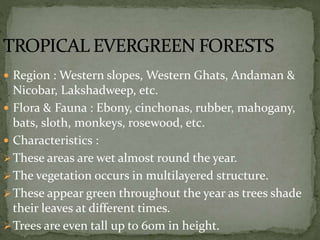
 Region : Western slopes, Western Ghats, Andaman &
Nicobar, Lakshadweep, etc.
 Flora & Fauna : Ebony, cinchonas, rubber, mahogany,
bats, sloth, monkeys, rosewood, etc.
 Characteristics :
These areas are wet almost round the year.
The vegetation occurs in multilayered structure.
These appear green throughout the year as trees shade
their leaves at different times.
Trees are even tall up to 60m in height.
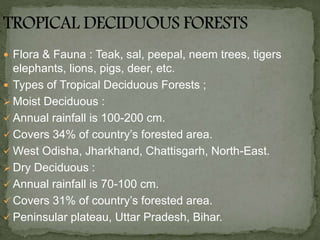
 Flora & Fauna : Teak, sal, peepal, neem trees, tigers
elephants, lions, pigs, deer, etc.
 Types of Tropical Deciduous Forests ;
 Moist Deciduous :
 Annual rainfall is 100-200 cm.
 Covers 34% of country’s forested area.
 West Odisha, Jharkhand, Chattisgarh, North-East.
 Dry Deciduous :
 Annual rainfall is 70-100 cm.
 Covers 31% of country’s forested area.
 Peninsular plateau, Uttar Pradesh, Bihar.
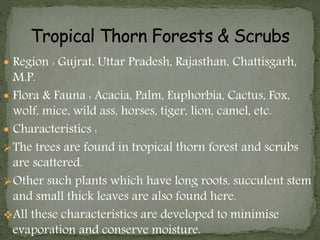
 Region : Gujrat, Uttar Pradesh, Rajasthan, Chattisgarh,
M.P.
 Flora & Fauna : Acacia, Palm, Euphorbia, Cactus, Fox,
wolf, mice, wild ass, horses, tiger, lion, camel, etc.
 Characteristics :
The trees are found in tropical thorn forest and scrubs
are scattered.
Other such plants which have long roots, succulent stem
and small thick leaves are also found here.
All these characteristics are developed to minimise
evaporation and conserve moisture.
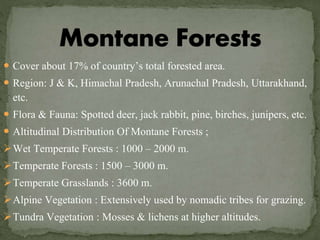
 Cover about 17% of country’s total forested area.
 Region: J & K, Himachal Pradesh, Arunachal Pradesh, Uttarakhand,
etc.
 Flora & Fauna: Spotted deer, jack rabbit, pine, birches, junipers, etc.
 Altitudinal Distribution Of Montane Forests ;
Wet Temperate Forests : 1000 – 2000 m.
Temperate Forests : 1500 – 3000 m.
Temperate Grasslands : 3600 m.
Alpine Vegetation : Extensively used by nomadic tribes for grazing.
Tundra Vegetation : Mosses & lichens at higher altitudes.
 Found in costal delta areas influenced by sea
tides.
 Also known as “Tidal Forests”.
 Region: Ganga, Brahmaputra, Mahanadi,
Krishna, Godavari, Kaveri, etc. due to mud &
silt brought by them.
 Flora & Fauna : Sundari trees, timber, palm,
coconut, Royal Bengal Tiger, snakes, turtles,
crocodiles, etc.
 It refers to the animal life of a particular area.
 India has 90,000 (approx.) animal species and about
2,000 species of birds.
 They constitute 13% of world’s total stock.
 There are about 2,546 species of fish, about 12% of
world’s total fish species.
 It also shares about 5-8% of world’s amphibians,
reptiles, mammals, etc.
 This existence in our country varies from place to place.
 In India about 1300 plant species are endangered and 20
species are extinct.
 Also the animal species are in the same situation. This is a
great threat to ecosystem.
 The major cause for this are :
 Hunting by greedy hunters for commercial purposes.
 Pollution due to chemical & industrial waste, acid deposits.
 Introduction to alien species.
 Reckless cutting of the forests to bring land under cultivation
and inhabitation.
Natural vegetation & wildlife

Natural vegetation & wildlife

  • 2.
     ‘Natural Vegetation’refers to the plant community which has grown naturally without any human intervention for a long time.  Those left undisturbed over a long period of time are known as the ‘Virgin Vegetation’.  Virgin vegetation are of two types ; 1] Endemic species: Originated in the country. 2] Exotic species: Originated outside the country.
  • 3.
     The majorfactors affecting the diversity in natural vegetation are ; 1] Relief : a) Land b) Soil 2] Climate : a) Temperature b) Photoperiod c)Precipitation 3] Ecosystem.
  • 4.
     It isa major community of plants and animals having similar environmental conditions.  A biome is identified on the basis of plants existing there .  It is also termed as ‘major life zone’.
  • 5.
     Forests playa major role by ; a] Influencing climate. b] Reducing soil erosion. c] Regulating steam flow. d] Providing raw materials to industries. e] Serving as livelihood for many.
  • 6.
     The majorfactors contributing to this change are ;  Growing demand for cultivable land.  Development of industries.  Mining. The vegetation cover of India in large parts is no more natural in the real sense, except in some inaccessible region like Himalayas, Marusthali, etc.
  • 7.
     There arefive major types of vegetations, as listed below; 1. Tropical Evergreen Forest 2. Tropical Deciduous Forest 3. Tropical Thorn Forest & Scrubs 4. Montane Forests 5. Mangrove Forests
  • 8.
     Region :Western slopes, Western Ghats, Andaman & Nicobar, Lakshadweep, etc.  Flora & Fauna : Ebony, cinchonas, rubber, mahogany, bats, sloth, monkeys, rosewood, etc.  Characteristics : These areas are wet almost round the year. The vegetation occurs in multilayered structure. These appear green throughout the year as trees shade their leaves at different times. Trees are even tall up to 60m in height.
  • 9.
     Flora &Fauna : Teak, sal, peepal, neem trees, tigers elephants, lions, pigs, deer, etc.  Types of Tropical Deciduous Forests ;  Moist Deciduous :  Annual rainfall is 100-200 cm.  Covers 34% of country’s forested area.  West Odisha, Jharkhand, Chattisgarh, North-East.  Dry Deciduous :  Annual rainfall is 70-100 cm.  Covers 31% of country’s forested area.  Peninsular plateau, Uttar Pradesh, Bihar.
  • 10.
     Region :Gujrat, Uttar Pradesh, Rajasthan, Chattisgarh, M.P.  Flora & Fauna : Acacia, Palm, Euphorbia, Cactus, Fox, wolf, mice, wild ass, horses, tiger, lion, camel, etc.  Characteristics : The trees are found in tropical thorn forest and scrubs are scattered. Other such plants which have long roots, succulent stem and small thick leaves are also found here. All these characteristics are developed to minimise evaporation and conserve moisture.
  • 11.
     Cover about17% of country’s total forested area.  Region: J & K, Himachal Pradesh, Arunachal Pradesh, Uttarakhand, etc.  Flora & Fauna: Spotted deer, jack rabbit, pine, birches, junipers, etc.  Altitudinal Distribution Of Montane Forests ; Wet Temperate Forests : 1000 – 2000 m. Temperate Forests : 1500 – 3000 m. Temperate Grasslands : 3600 m. Alpine Vegetation : Extensively used by nomadic tribes for grazing. Tundra Vegetation : Mosses & lichens at higher altitudes.
  • 12.
     Found incostal delta areas influenced by sea tides.  Also known as “Tidal Forests”.  Region: Ganga, Brahmaputra, Mahanadi, Krishna, Godavari, Kaveri, etc. due to mud & silt brought by them.  Flora & Fauna : Sundari trees, timber, palm, coconut, Royal Bengal Tiger, snakes, turtles, crocodiles, etc.
  • 13.
     It refersto the animal life of a particular area.  India has 90,000 (approx.) animal species and about 2,000 species of birds.  They constitute 13% of world’s total stock.  There are about 2,546 species of fish, about 12% of world’s total fish species.  It also shares about 5-8% of world’s amphibians, reptiles, mammals, etc.  This existence in our country varies from place to place.
  • 14.
     In Indiaabout 1300 plant species are endangered and 20 species are extinct.  Also the animal species are in the same situation. This is a great threat to ecosystem.  The major cause for this are :  Hunting by greedy hunters for commercial purposes.  Pollution due to chemical & industrial waste, acid deposits.  Introduction to alien species.  Reckless cutting of the forests to bring land under cultivation and inhabitation.