Working for the Many,
Public Services Fight Inequality
An Oxfam Report
Comments by
Dean Jolliffe
Comments prepared for “Fiscal Policies, Public Ser vices, and Inequality ”
World Bank, April 9, 2014
The views represented in these comments are those of the author and do not
necessarily ref lect the views of the World Bank.
The debate has changed
• In rich and poor countries, inequality is now part of policy
discussions
• At the World Bank, sharing in prosperity is now twinned with
eliminating poverty
• Oxfam and others, who have consistently argued this
point, deserve much positive credit
• Paper is a persuasive case for action, with singular prescription
Critique of user fees
• Well referenced, detailed critique
• The proposed solution: progressive taxation
• But how? In how many poor countries is participation in the
formal tax system sufficient?
• User fees and income taxes don’t exhaust revenue options. Many
poor countries accrue significant revenues from extractive
industry, and other sources. These resources could be better
targeted to reduce poverty and inequality.
Health and Education: Are they
equally effective?
• Health self assessments in poor countries can have a negative income
gradient. The poor sometimes report less frequency of being sick
(even when observationally more frequently sick).
• Free, universal healthcare doesn’t always result in free and universal
coverage.
• => Even in the presence of free basic health provisions, there can
be steep income gradient in access to health care
4
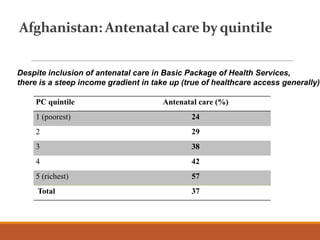
Afghanistan: Antenatal care by quintile
PC quintile Antenatal care (%)
1 (poorest) 24
2 29
3 38
4 42
5 (richest) 57
Total 37
Despite inclusion of antenatal care in Basic Package of Health Services,
there is a steep income gradient in take up (true of healthcare access generally)
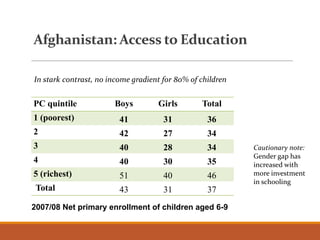
Afghanistan: Access to Education
2007/08 Net primary enrollment of children aged 6-9
PC quintile Boys Girls Total
1 (poorest) 41 31 36
2 42 27 34
3 40 28 34
4 40 30 35
5 (richest) 51 40 46
Total 43 31 37
In stark contrast, no income gradient for 80% of children
Cautionary note:
Gender gap has
increased with
more investment
in schooling
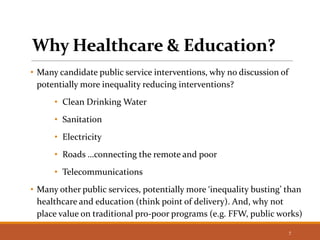
Why Healthcare & Education?
• Many candidate public service interventions, why no discussion of
potentially more inequality reducing interventions?
• Clean Drinking Water
• Sanitation
• Electricity
• Roads …connecting the remote and poor
• Telecommunications
• Many other public services, potentially more ‘inequality busting’ than
healthcare and education (think point of delivery). And, why not
place value on traditional pro-poor programs (e.g. FFW, public works)
7
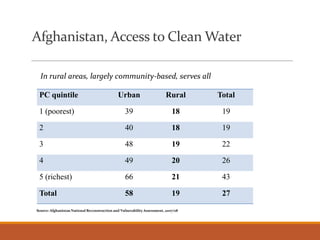
Afghanistan, Access to Clean Water
Source: Afghanistan National Reconstruction and Vulnerability Assessment, 2007/08
PC quintile Urban Rural Total
1 (poorest) 39 18 19
2 40 18 19
3 48 19 22
4 49 20 26
5 (richest) 66 21 43
Total 58 19 27
In rural areas, largely community-based, serves all
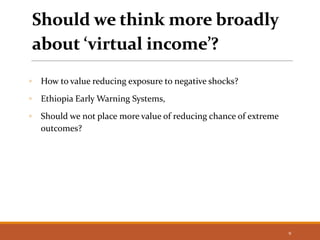
Should we think more broadly
about ‘virtual income’?
◦ How to value reducing exposure to negative shocks?
◦ Ethiopia Early Warning Systems,
◦ Should we not place more value of reducing chance of extreme
outcomes?
9
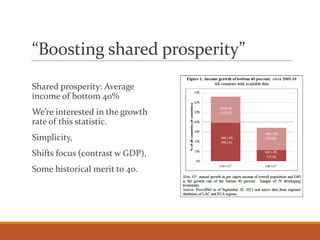
“Boosting shared prosperity”
Shared prosperity: Average
income of bottom 40%
We’re interested in the growth
rate of this statistic.
Simplicity,
Shifts focus (contrast w GDP),
Some historical merit to 40.
Bank focus on
“boosting shared prosperity”
So,
“…double imperative for governments: to ensure progressive
taxation that can redistribute once when collected and again
when spent on these inequality-busting public service services.”
(Oxfam)
The shared prosperity view aligns strongly with the latter, but
not with the view that there is inherent value in taking away
money from the rich.
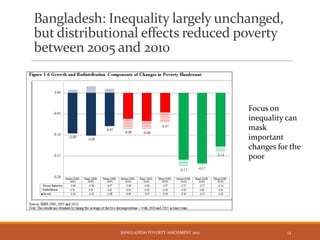
Bangladesh: Inequality largely unchanged,
but distributional effects reduced poverty
between 2005 and 2010
BANGLADESH POVERTY ASSESSMENT 2012 12
Focus on
inequality can
mask
important
changes for the
poor
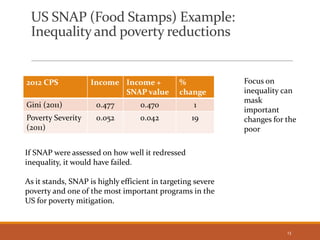
US SNAP (Food Stamps) Example:
Inequality and poverty reductions
13
Focus on
inequality can
mask
important
changes for the
poor
2012 CPS Income Income +
SNAP value
%
change
Gini (2011) 0.477 0.470 1
Poverty Severity
(2011)
0.052 0.042 19
If SNAP were assessed on how well it redressed
inequality, it would have failed.
As it stands, SNAP is highly efficient in targeting severe
poverty and one of the most important programs in the
US for poverty mitigation.
Bank focus on
eliminating extreme poverty
• Ravallion (2013, WPS6325) projects poverty reductions under a
series of assumed growth rates, based on 2008 inequality levels.
• The required growth rate is 1 percentage point less if inequality
is at levels observed in 1999.
• Current growth rates + no reductions in inequality ≠ 3%.
• Current growth rates + reductions in inequality => 3%.
• Achieving the twin goals requires attention to distributional
issues.