
HETNET
(Heterogeneous Network)
By– Kewal Sharma
Annu Sawaiyan
Swapnil Kantale
 The exponential increase in the use of interconnected
mobile devices will result in the growth of data traffic.
 This will force the network operators to increase the
capacity of the networks in a dramatic fashion to meet
the upcoming demands.
 The problem currently being faced by the networks
operators is not the coverage – which is now nearly
universal – but the capacity. Because there are too
many users demanding too much data.
Introduction
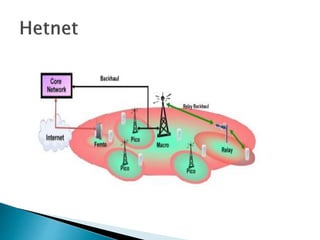
 HetNets are typically composed of a variety of formats
of base station, radio access networks, transmission
solutions and power levels.
 In this way HetNets have several aspects :
1.Use of multiple radio access technologies
2.Operation of different cell sizes and approaches
3.Backhaul
 It is a low-powered cellular radio access nodes that
operate in licensed and unlicensed spectrum.
 Small cells typically have a range varying from 10
meters to a few hundred meters.
 Mobile operator mainly use small –cells to extend
and maximize their service coverage or to increase
the network capacity.
 Femto-cells
 Pico cells
 Macro cells
 Macro cells
 A femtocell is a small low-power cellular base station.
 it is typically designed for use of small business and home.
 It connects to the service provider’s network via broadband
 Example- Cable,DSL
 A Pico-cell is a small cellular base
station typically covering a small area, such
as in-building, office.
 Pico-cells are typically used to extend
coverage to indoor areas where outdoor
signals do not reach well.
 To add network capacity in areas with very
dense phone usage, such as train stations or
stadiums.
 A macro-cell is a cell in a mobile
phone network that provides radio coverage
served by a high power cell site.
 Example-Tower
 It is also cell in a mobile phone network
served by a low power cellular base station
 It is covering a limited area.
 Example- Transportations hub
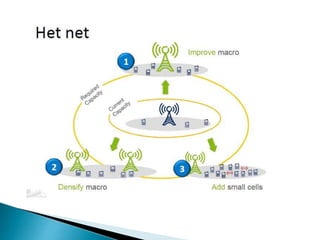
 Improve existing macro cells – by enhancing macro cells with more spectrum,
advanced antennae, increased order of diversity on the receiver and/or the
transmitter, and baseband processing capacity within and between nodes.
 Continued evolution of HSPA and LTE technology will drive macro network
efficiency through specialized features, such as higher-order modulation,
multi-carrier and multi-antenna solutions, as well as spectrum reframing,
using hybrid radio solutions.
 Densify the macro network – the capacity and data rates achieved
by enhancing the macro network alone, will eventually be
insufficient to meet demand.
 The targeted addition of cells strategically located can improve
capacity.
 This approach keeps the total number of sites relatively low, while
network performance becomes less sensitive to traffic location. A
simple way to densify a network could be a cell-split, which enables
a site from transitioning to a six-sector site from a three sector site.
 These strategic cells could use macro equipment, or even micro
equipment.
 Add small cells – by complementing macro cells with small cells
and dedicated indoor solutions, based on the 3GPP standard.
 This approach can include the use of micro cells, pico cells or
low- power remote radio units (RRUs), as well as Wi-Fi.
 It delivers high per-user capacity and rate coverage in areas
covered by the small cells, with the potential to improve
performance in the macro network by offloading traffic
generated in hotspots.
 The degree of integration that can be achieved throughout the
Heterogeneous Network will determine the overall network
performance.
• Enriched capacity and guaranteed spot-free coverage.
• The overlay of Small Cells onto existing networks ensures
high-speed, high-capacity communications for specific hot-
spot area.
• HetNet can also help maximize the cost efficiency of
introducing a new network.
 Heterogeneous deployment is seen as a pragmatic and cost-
effective way to significantly enhance the capacity of LTE
cellular networks. Macro nodes are used to ensure broad
coverage, and low-power nodes may be located close to
places with increased demand for data.
Thank You

Hetnet ppt

  • 1.
    HETNET (Heterogeneous Network) By– KewalSharma Annu Sawaiyan Swapnil Kantale
  • 2.
     The exponentialincrease in the use of interconnected mobile devices will result in the growth of data traffic.  This will force the network operators to increase the capacity of the networks in a dramatic fashion to meet the upcoming demands.  The problem currently being faced by the networks operators is not the coverage – which is now nearly universal – but the capacity. Because there are too many users demanding too much data. Introduction
  • 3.
     HetNets aretypically composed of a variety of formats of base station, radio access networks, transmission solutions and power levels.  In this way HetNets have several aspects : 1.Use of multiple radio access technologies 2.Operation of different cell sizes and approaches 3.Backhaul
  • 5.
     It isa low-powered cellular radio access nodes that operate in licensed and unlicensed spectrum.  Small cells typically have a range varying from 10 meters to a few hundred meters.  Mobile operator mainly use small –cells to extend and maximize their service coverage or to increase the network capacity.
  • 6.
     Femto-cells  Picocells  Macro cells  Macro cells
  • 7.
     A femtocellis a small low-power cellular base station.  it is typically designed for use of small business and home.  It connects to the service provider’s network via broadband  Example- Cable,DSL
  • 8.
     A Pico-cellis a small cellular base station typically covering a small area, such as in-building, office.  Pico-cells are typically used to extend coverage to indoor areas where outdoor signals do not reach well.  To add network capacity in areas with very dense phone usage, such as train stations or stadiums.
  • 9.
     A macro-cellis a cell in a mobile phone network that provides radio coverage served by a high power cell site.  Example-Tower
  • 10.
     It isalso cell in a mobile phone network served by a low power cellular base station  It is covering a limited area.  Example- Transportations hub
  • 12.
     Improve existingmacro cells – by enhancing macro cells with more spectrum, advanced antennae, increased order of diversity on the receiver and/or the transmitter, and baseband processing capacity within and between nodes.  Continued evolution of HSPA and LTE technology will drive macro network efficiency through specialized features, such as higher-order modulation, multi-carrier and multi-antenna solutions, as well as spectrum reframing, using hybrid radio solutions.
  • 13.
     Densify themacro network – the capacity and data rates achieved by enhancing the macro network alone, will eventually be insufficient to meet demand.  The targeted addition of cells strategically located can improve capacity.  This approach keeps the total number of sites relatively low, while network performance becomes less sensitive to traffic location. A simple way to densify a network could be a cell-split, which enables a site from transitioning to a six-sector site from a three sector site.  These strategic cells could use macro equipment, or even micro equipment.
  • 14.
     Add smallcells – by complementing macro cells with small cells and dedicated indoor solutions, based on the 3GPP standard.  This approach can include the use of micro cells, pico cells or low- power remote radio units (RRUs), as well as Wi-Fi.  It delivers high per-user capacity and rate coverage in areas covered by the small cells, with the potential to improve performance in the macro network by offloading traffic generated in hotspots.  The degree of integration that can be achieved throughout the Heterogeneous Network will determine the overall network performance.
  • 16.
    • Enriched capacityand guaranteed spot-free coverage. • The overlay of Small Cells onto existing networks ensures high-speed, high-capacity communications for specific hot- spot area. • HetNet can also help maximize the cost efficiency of introducing a new network.
  • 17.
     Heterogeneous deploymentis seen as a pragmatic and cost- effective way to significantly enhance the capacity of LTE cellular networks. Macro nodes are used to ensure broad coverage, and low-power nodes may be located close to places with increased demand for data.
  • 18.