Heterogeneous Network (HetNet): A paradigm shift in 
cellular networks 
Devendra Singh 
Under the Guidance of Mr. Ramesh Babu Battula 
MNIT,Jaipur 
November 17, 2014 
Devendra Singh (2013pcp5144) M.Tech CS 3rd Semester November 17, 2014 1 / 30
Table of Contents 
Introduction 
Growing demand of data 
Growth in Mobile Broadband 
What is HetNet ? 
Multiple cell sizes 
Requirements for Future Networks 
HetNets oer Promising Solution 
Deployment scenarios 
Changes/Challanges from Traditional Networks to HetNets 
Conclusion 
Devendra Singh (2013pcp5144) M.Tech CS 3rd Semester November 17, 2014 2 / 30
Introduction 
The use of mobile devices has been increasing in an exponential 
fashion from past few years. The exponential increase in the use of 
interconnected mobile devices will result in the growth of data trac. 
This will force the network operators to increase the capacity of the 
networks in a dramatic fashion to meet the upcoming demands. 
The problem currently being faced by the networks operators is not 
the coverage { which is now nearly universal { but the capacity. 
Because there are too many users demanding too much data. 
Devendra Singh (2013pcp5144) M.Tech CS 3rd Semester November 17, 2014 3 / 30
Growing demand of data 
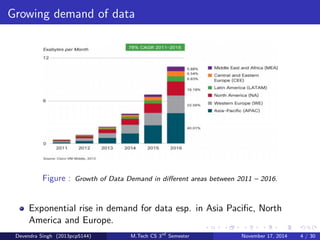
Figure : Growth of Data Demand in dierent areas between 2011 { 2016. 
Exponential rise in demand for data esp. in Asia Paci
c, North 
America and Europe. 
Devendra Singh (2013pcp5144) M.Tech CS 3rd Semester November 17, 2014 4 / 30
Growth in Mobile Broadband 
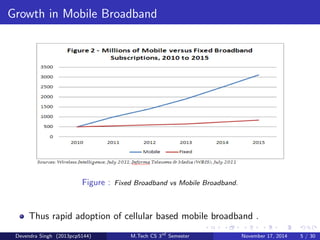
Figure : Fixed Broadband vs Mobile Broadband. 
Thus rapid adoption of cellular based mobile broadband . 
Devendra Singh (2013pcp5144) M.Tech CS 3rd Semester November 17, 2014 5 / 30
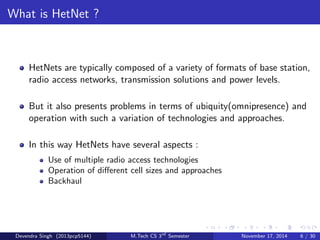
What is HetNet ? 
HetNets are typically composed of a variety of formats of base station, 
radio access networks, transmission solutions and power levels. 
But it also presents problems in terms of ubiquity(omnipresence) and 
operation with such a variation of technologies and approaches. 
In this way HetNets have several aspects : 
Use of multiple radio access technologies 
Operation of dierent cell sizes and approaches 
Backhaul 
Devendra Singh (2013pcp5144) M.Tech CS 3rd Semester November 17, 2014 6 / 30
What is HetNet ? 
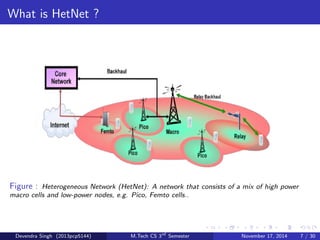
Figure : Heterogeneous Network (HetNet): A network that consists of a mix of high power 
macro cells and low-power nodes, e.g. Pico, Femto cells.. 
Devendra Singh (2013pcp5144) M.Tech CS 3rd Semester November 17, 2014 7 / 30
Multiple cell sizes 
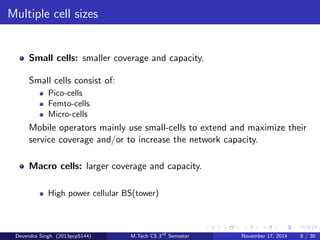
Small cells: smaller coverage and capacity. 
Small cells consist of: 
Pico-cells 
Femto-cells 
Micro-cells 
Mobile operators mainly use small-cells to extend and maximize their 
service coverage and/or to increase the network capacity. 
Macro cells: larger coverage and capacity. 
High power cellular BS(tower) 
Devendra Singh (2013pcp5144) M.Tech CS 3rd Semester November 17, 2014 8 / 30
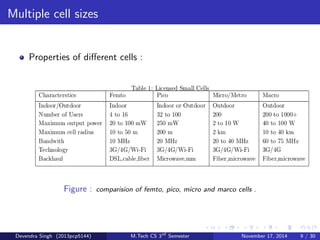
Multiple cell sizes 
Properties of dierent cells : 
Figure : comparision of femto, pico, micro and marco cells . 
Devendra Singh (2013pcp5144) M.Tech CS 3rd Semester November 17, 2014 9 / 30
Requirements for Future Networks 
Future networks should support explosive mobile data trac growth 
driven by :- 
Large screen devices 
Multimedia applications 
More connected users and devices 
Future networks should be optimized for mobile broadband trac :- 
Eciently support low-mobility trac, mobile video, internet 
applications 
Future networks should be low power, and environmentally friendly 
Future networks should interwork eciently with other radio 
technologies :- 
Converged multi-access networks and terminals 
Devendra Singh (2013pcp5144) M.Tech CS 3rd Semester November 17, 2014 10 / 30
HetNets oer Promising Solution 
Future networks should support explosive mobile data trac growth 
HetNets oer linear capacity scaling with number of BS nodes 
Future networks should be optimized for mobile broadband trac 
HetNets bring serving BS closer to user, eciently supporting low 
mobility and high rate trac 
Future networks should be low power, and environmentally friendly 
HetNets oer opportunity to lower transmission power, saving energy 
at BS and battery life at clients 
Future networks should interwork eciently with other radio 
technologies 
HetNets enable seamless integration of un-licensed LAN/PAN 
technologies into cellular networks 
Devendra Singh (2013pcp5144) M.Tech CS 3rd Semester November 17, 2014 11 / 30
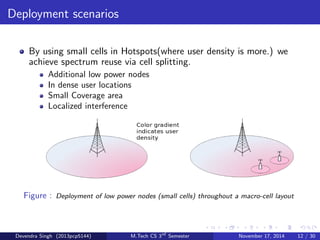
Deployment scenarios 
By using small cells in Hotspots(where user density is more.) we 
achieve spectrum reuse via cell splitting. 
Additional low power nodes 
In dense user locations 
Small Coverage area 
Localized interference 
Figure : Deployment of low power nodes (small cells) throughout a macro-cell layout 
Devendra Singh (2013pcp5144) M.Tech CS 3rd Semester November 17, 2014 12 / 30
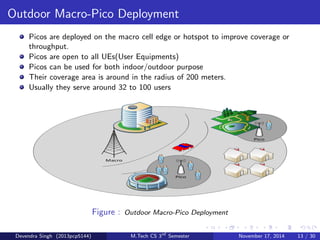
Outdoor Macro-Pico Deployment 
Picos are deployed on the macro cell edge or hotspot to improve coverage or 
throughput. 
Picos are open to all UEs(User Equipments) 
Picos can be used for both indoor/outdoor purpose 
Their coverage area is around in the radius of 200 meters. 
Usually they serve around 32 to 100 users 
Figure : Outdoor Macro-Pico Deployment 
Devendra Singh (2013pcp5144) M.Tech CS 3rd Semester November 17, 2014 13 / 30
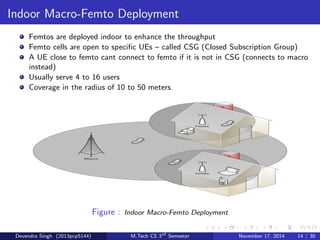
Indoor Macro-Femto Deployment 
Femtos are deployed indoor to enhance the throughput 
Femto cells are open to speci
c UEs { called CSG (Closed Subscription Group) 
A UE close to femto cant connect to femto if it is not in CSG (connects to macro 
instead) 
Usually serve 4 to 16 users 
Coverage in the radius of 10 to 50 meters. 
Figure : Indoor Macro-Femto Deployment 
Devendra Singh (2013pcp5144) M.Tech CS 3rd Semester November 17, 2014 14 / 30
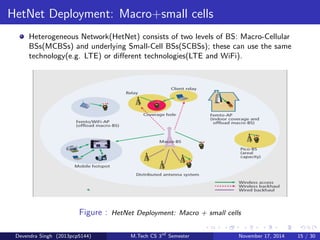
HetNet Deployment: Macro+small cells 
Heterogeneous Network(HetNet) consists of two levels of BS: Macro-Cellular 
BSs(MCBSs) and underlying Small-Cell BSs(SCBSs); these can use the same 
technology(e.g. LTE) or dierent technologies(LTE and WiFi). 
Figure : HetNet Deployment: Macro + small cells 
Devendra Singh (2013pcp5144) M.Tech CS 3rd Semester November 17, 2014 15 / 30
Changes/Challanges from Traditional Networks to HetNets 
HetNets require the changes in following important aspects : 
Performance Metrics 
Network Topology 
Cell Association 
Downlink{Uplink Relationship 
The Backhaul Bottleneck 
Mobility 
Interference Management 
Mobility and Interference Management are the most challanging 
issues in HetNets. 
Many of these issues are still under the research work for betterment. 
Devendra Singh (2013pcp5144) M.Tech CS 3rd Semester November 17, 2014 16 / 30
Performance Metrics 
Traditional Cellular: 
Outage/coverage probability distribution in terms of 
SINR(signal{to{interference{plus{noise{ratio) or spectral 
eciency(bps/Hz) 
HetNet: 
Outage/coverage probability distribution in terms of Rate or Area 
spectral eciency(bps/Hz/m2) 
Recommendation: Stop measuring performance with 
BER(bit{error{rate) or SINR distribution, or with spectral eciency. 
These metrics are no longer very relevant. Instead, use the rate 
distribution (user-perceived, i.e., accounting for load) or area spectral 
eciency. 
Devendra Singh (2013pcp5144) M.Tech CS 3rd Semester November 17, 2014 17 / 30
Performance Metrics 
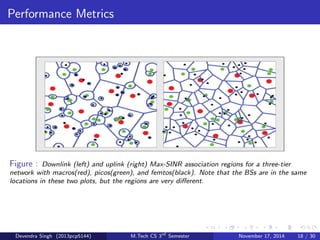
Figure : Downlink (left) and uplink (right) Max-SINR association regions for a three-tier 
network with macros(red), picos(green), and femtos(black). Note that the BSs are in the same 
locations in these two plots, but the regions are very dierent. 
Devendra Singh (2013pcp5144) M.Tech CS 3rd Semester November 17, 2014 18 / 30
Network Topology 
Traditional Cellular: 
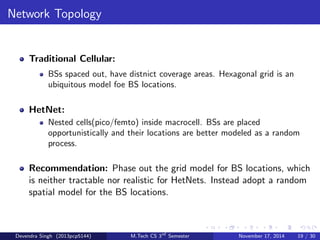
BSs spaced out, have distnict coverage areas. Hexagonal grid is an 
ubiquitous model foe BS locations. 
HetNet: 
Nested cells(pico/femto) inside macrocell. BSs are placed 
opportunistically and their locations are better modeled as a random 
process. 
Recommendation: Phase out the grid model for BS locations, which 
is neither tractable nor realistic for HetNets. Instead adopt a random 
spatial model for the BS locations. 
Devendra Singh (2013pcp5144) M.Tech CS 3rd Semester November 17, 2014 19 / 30
Network Topology 
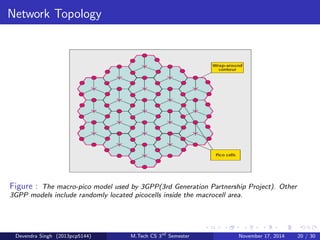
Figure : The macro-pico model used by 3GPP(3rd Generation Partnership Project). Other 
3GPP models include randomly located picocells inside the macrocell area. 
Devendra Singh (2013pcp5144) M.Tech CS 3rd Semester November 17, 2014 20 / 30
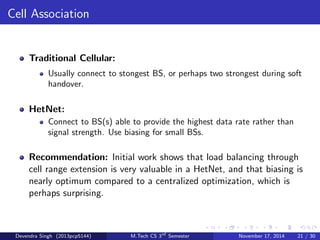
Cell Association 
Traditional Cellular: 
Usually connect to stongest BS, or perhaps two strongest during soft 
handover. 
HetNet: 
Connect to BS(s) able to provide the highest data rate rather than 
signal strength. Use biasing for small BSs. 
Recommendation: Initial work shows that load balancing through 
cell range extension is very valuable in a HetNet, and that biasing is 
nearly optimum compared to a centralized optimization, which is 
perhaps surprising. 
Devendra Singh (2013pcp5144) M.Tech CS 3rd Semester November 17, 2014 21 / 30
Cell Association 
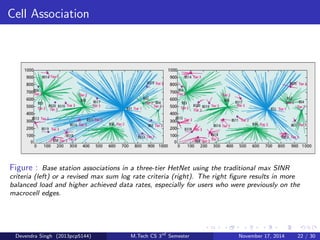
Figure : Base station associations in a three-tier HetNet using the traditional max SINR 
criteria (left) or a revised max sum log rate criteria (right). The right
gure results in more 
balanced load and higher achieved data rates, especially for users who were previously on the 
macrocell edges. 
Devendra Singh (2013pcp5144) M.Tech CS 3rd Semester November 17, 2014 22 / 30
Downlink{Uplink Relationship 
Traditional Cellular: 
Downlink and Uplink to a given BS have approximately the same SINR. 
The best DL BS is usually the best in UL too. 
HetNet: 
Downlink and Uplink can have very dierent SINRs; should not 
necessarily use the same BS in each direction. 
Recommendation:The DL and UL need to be considered as two 
dierent networks, and will require dierent models for interference, 
cell association, and throughput. 
Devendra Singh (2013pcp5144) M.Tech CS 3rd Semester November 17, 2014 23 / 30
The Backhaul Bottleneck 
Traditional Cellular: 
BSs have heavy{duty wired backhaul, are connected into the core 
network. BS to MS connection is the bottleneck. 
HetNet: 
BSs often will not have high speed wired connections. BS to core 
network (backhaul) link is often the bottleneck in terms of performance 
and cost. 
Recommendation: One clever approach is the idea of caching 
popular content such as video clips or other common downloads at 
the small cells. Such content can be updated periodically at a time of 
low{backhaul load. The gain of such innovations on network 
performance can be large. 
Devendra Singh (2013pcp5144) M.Tech CS 3rd Semester November 17, 2014 24 / 30
Mobility 
Traditional Cellular: 
Hando to a stronger BS when entering its coverage area, involves 
signaling over wired core network. 
HetNet: 
Handos and dropped calls may be too frequent if use small cells when 
highly mobile, overhead is a major concern. 
Recommendation: Improved mobility modeling, handover 
optimization, and mobility-aware interference management are all 
challenging topics for future work. 
Devendra Singh (2013pcp5144) M.Tech CS 3rd Semester November 17, 2014 25 / 30
Interference Management 
Traditional Cellular: 
Employ (fractional) frequency reuse and/or simply tolerate very poor 
cell edge rates. All BSs are available for connection, i.e. open access. 
HetNet: 
Manage closed access interference through resource allocation; users 
may be in one cell while communicating with a dierent BS; 
interference management is hard due to irregular backhaul and sheer 
number of BSs 
Recommendation: Ecient interference management in a HetNet 
relies on reasonable models for all the previous topics discussed until 
now. Interference management is also another challenging topic for 
research and future work. 
Devendra Singh (2013pcp5144) M.Tech CS 3rd Semester November 17, 2014 26 / 30
Conclusion 
HetNets will play a key role in future of mobile broadband cellular 
networks. 
Support shift from spectral eciency to network eciency 
High capacity at low cost 
Flexible deployment and self-management 
Low power and emissions(Green) 
Enable mass devices to connect to cellular network 
Active area of research in enabling technologies: mobility, interference 
management, self-organization, topology etc. 
Standardization is under way to realize bene

Heterogeneous Networks(HetNets)

  • 1.
    Heterogeneous Network (HetNet):A paradigm shift in cellular networks Devendra Singh Under the Guidance of Mr. Ramesh Babu Battula MNIT,Jaipur November 17, 2014 Devendra Singh (2013pcp5144) M.Tech CS 3rd Semester November 17, 2014 1 / 30
  • 2.
    Table of Contents Introduction Growing demand of data Growth in Mobile Broadband What is HetNet ? Multiple cell sizes Requirements for Future Networks HetNets oer Promising Solution Deployment scenarios Changes/Challanges from Traditional Networks to HetNets Conclusion Devendra Singh (2013pcp5144) M.Tech CS 3rd Semester November 17, 2014 2 / 30
  • 3.
    Introduction The useof mobile devices has been increasing in an exponential fashion from past few years. The exponential increase in the use of interconnected mobile devices will result in the growth of data trac. This will force the network operators to increase the capacity of the networks in a dramatic fashion to meet the upcoming demands. The problem currently being faced by the networks operators is not the coverage { which is now nearly universal { but the capacity. Because there are too many users demanding too much data. Devendra Singh (2013pcp5144) M.Tech CS 3rd Semester November 17, 2014 3 / 30
  • 4.
    Growing demand ofdata Figure : Growth of Data Demand in dierent areas between 2011 { 2016. Exponential rise in demand for data esp. in Asia Paci
  • 5.
    c, North Americaand Europe. Devendra Singh (2013pcp5144) M.Tech CS 3rd Semester November 17, 2014 4 / 30
  • 6.
    Growth in MobileBroadband Figure : Fixed Broadband vs Mobile Broadband. Thus rapid adoption of cellular based mobile broadband . Devendra Singh (2013pcp5144) M.Tech CS 3rd Semester November 17, 2014 5 / 30
  • 7.
    What is HetNet? HetNets are typically composed of a variety of formats of base station, radio access networks, transmission solutions and power levels. But it also presents problems in terms of ubiquity(omnipresence) and operation with such a variation of technologies and approaches. In this way HetNets have several aspects : Use of multiple radio access technologies Operation of dierent cell sizes and approaches Backhaul Devendra Singh (2013pcp5144) M.Tech CS 3rd Semester November 17, 2014 6 / 30
  • 8.
    What is HetNet? Figure : Heterogeneous Network (HetNet): A network that consists of a mix of high power macro cells and low-power nodes, e.g. Pico, Femto cells.. Devendra Singh (2013pcp5144) M.Tech CS 3rd Semester November 17, 2014 7 / 30
  • 9.
    Multiple cell sizes Small cells: smaller coverage and capacity. Small cells consist of: Pico-cells Femto-cells Micro-cells Mobile operators mainly use small-cells to extend and maximize their service coverage and/or to increase the network capacity. Macro cells: larger coverage and capacity. High power cellular BS(tower) Devendra Singh (2013pcp5144) M.Tech CS 3rd Semester November 17, 2014 8 / 30
  • 10.
    Multiple cell sizes Properties of dierent cells : Figure : comparision of femto, pico, micro and marco cells . Devendra Singh (2013pcp5144) M.Tech CS 3rd Semester November 17, 2014 9 / 30
  • 11.
    Requirements for FutureNetworks Future networks should support explosive mobile data trac growth driven by :- Large screen devices Multimedia applications More connected users and devices Future networks should be optimized for mobile broadband trac :- Eciently support low-mobility trac, mobile video, internet applications Future networks should be low power, and environmentally friendly Future networks should interwork eciently with other radio technologies :- Converged multi-access networks and terminals Devendra Singh (2013pcp5144) M.Tech CS 3rd Semester November 17, 2014 10 / 30
  • 12.
    HetNets oer PromisingSolution Future networks should support explosive mobile data trac growth HetNets oer linear capacity scaling with number of BS nodes Future networks should be optimized for mobile broadband trac HetNets bring serving BS closer to user, eciently supporting low mobility and high rate trac Future networks should be low power, and environmentally friendly HetNets oer opportunity to lower transmission power, saving energy at BS and battery life at clients Future networks should interwork eciently with other radio technologies HetNets enable seamless integration of un-licensed LAN/PAN technologies into cellular networks Devendra Singh (2013pcp5144) M.Tech CS 3rd Semester November 17, 2014 11 / 30
  • 13.
    Deployment scenarios Byusing small cells in Hotspots(where user density is more.) we achieve spectrum reuse via cell splitting. Additional low power nodes In dense user locations Small Coverage area Localized interference Figure : Deployment of low power nodes (small cells) throughout a macro-cell layout Devendra Singh (2013pcp5144) M.Tech CS 3rd Semester November 17, 2014 12 / 30
  • 14.
    Outdoor Macro-Pico Deployment Picos are deployed on the macro cell edge or hotspot to improve coverage or throughput. Picos are open to all UEs(User Equipments) Picos can be used for both indoor/outdoor purpose Their coverage area is around in the radius of 200 meters. Usually they serve around 32 to 100 users Figure : Outdoor Macro-Pico Deployment Devendra Singh (2013pcp5144) M.Tech CS 3rd Semester November 17, 2014 13 / 30
  • 15.
    Indoor Macro-Femto Deployment Femtos are deployed indoor to enhance the throughput Femto cells are open to speci
  • 16.
    c UEs {called CSG (Closed Subscription Group) A UE close to femto cant connect to femto if it is not in CSG (connects to macro instead) Usually serve 4 to 16 users Coverage in the radius of 10 to 50 meters. Figure : Indoor Macro-Femto Deployment Devendra Singh (2013pcp5144) M.Tech CS 3rd Semester November 17, 2014 14 / 30
  • 17.
    HetNet Deployment: Macro+smallcells Heterogeneous Network(HetNet) consists of two levels of BS: Macro-Cellular BSs(MCBSs) and underlying Small-Cell BSs(SCBSs); these can use the same technology(e.g. LTE) or dierent technologies(LTE and WiFi). Figure : HetNet Deployment: Macro + small cells Devendra Singh (2013pcp5144) M.Tech CS 3rd Semester November 17, 2014 15 / 30
  • 18.
    Changes/Challanges from TraditionalNetworks to HetNets HetNets require the changes in following important aspects : Performance Metrics Network Topology Cell Association Downlink{Uplink Relationship The Backhaul Bottleneck Mobility Interference Management Mobility and Interference Management are the most challanging issues in HetNets. Many of these issues are still under the research work for betterment. Devendra Singh (2013pcp5144) M.Tech CS 3rd Semester November 17, 2014 16 / 30
  • 19.
    Performance Metrics TraditionalCellular: Outage/coverage probability distribution in terms of SINR(signal{to{interference{plus{noise{ratio) or spectral eciency(bps/Hz) HetNet: Outage/coverage probability distribution in terms of Rate or Area spectral eciency(bps/Hz/m2) Recommendation: Stop measuring performance with BER(bit{error{rate) or SINR distribution, or with spectral eciency. These metrics are no longer very relevant. Instead, use the rate distribution (user-perceived, i.e., accounting for load) or area spectral eciency. Devendra Singh (2013pcp5144) M.Tech CS 3rd Semester November 17, 2014 17 / 30
  • 20.
    Performance Metrics Figure: Downlink (left) and uplink (right) Max-SINR association regions for a three-tier network with macros(red), picos(green), and femtos(black). Note that the BSs are in the same locations in these two plots, but the regions are very dierent. Devendra Singh (2013pcp5144) M.Tech CS 3rd Semester November 17, 2014 18 / 30
  • 21.
    Network Topology TraditionalCellular: BSs spaced out, have distnict coverage areas. Hexagonal grid is an ubiquitous model foe BS locations. HetNet: Nested cells(pico/femto) inside macrocell. BSs are placed opportunistically and their locations are better modeled as a random process. Recommendation: Phase out the grid model for BS locations, which is neither tractable nor realistic for HetNets. Instead adopt a random spatial model for the BS locations. Devendra Singh (2013pcp5144) M.Tech CS 3rd Semester November 17, 2014 19 / 30
  • 22.
    Network Topology Figure: The macro-pico model used by 3GPP(3rd Generation Partnership Project). Other 3GPP models include randomly located picocells inside the macrocell area. Devendra Singh (2013pcp5144) M.Tech CS 3rd Semester November 17, 2014 20 / 30
  • 23.
    Cell Association TraditionalCellular: Usually connect to stongest BS, or perhaps two strongest during soft handover. HetNet: Connect to BS(s) able to provide the highest data rate rather than signal strength. Use biasing for small BSs. Recommendation: Initial work shows that load balancing through cell range extension is very valuable in a HetNet, and that biasing is nearly optimum compared to a centralized optimization, which is perhaps surprising. Devendra Singh (2013pcp5144) M.Tech CS 3rd Semester November 17, 2014 21 / 30
  • 24.
    Cell Association Figure: Base station associations in a three-tier HetNet using the traditional max SINR criteria (left) or a revised max sum log rate criteria (right). The right
  • 25.
    gure results inmore balanced load and higher achieved data rates, especially for users who were previously on the macrocell edges. Devendra Singh (2013pcp5144) M.Tech CS 3rd Semester November 17, 2014 22 / 30
  • 26.
    Downlink{Uplink Relationship TraditionalCellular: Downlink and Uplink to a given BS have approximately the same SINR. The best DL BS is usually the best in UL too. HetNet: Downlink and Uplink can have very dierent SINRs; should not necessarily use the same BS in each direction. Recommendation:The DL and UL need to be considered as two dierent networks, and will require dierent models for interference, cell association, and throughput. Devendra Singh (2013pcp5144) M.Tech CS 3rd Semester November 17, 2014 23 / 30
  • 27.
    The Backhaul Bottleneck Traditional Cellular: BSs have heavy{duty wired backhaul, are connected into the core network. BS to MS connection is the bottleneck. HetNet: BSs often will not have high speed wired connections. BS to core network (backhaul) link is often the bottleneck in terms of performance and cost. Recommendation: One clever approach is the idea of caching popular content such as video clips or other common downloads at the small cells. Such content can be updated periodically at a time of low{backhaul load. The gain of such innovations on network performance can be large. Devendra Singh (2013pcp5144) M.Tech CS 3rd Semester November 17, 2014 24 / 30
  • 28.
    Mobility Traditional Cellular: Hando to a stronger BS when entering its coverage area, involves signaling over wired core network. HetNet: Handos and dropped calls may be too frequent if use small cells when highly mobile, overhead is a major concern. Recommendation: Improved mobility modeling, handover optimization, and mobility-aware interference management are all challenging topics for future work. Devendra Singh (2013pcp5144) M.Tech CS 3rd Semester November 17, 2014 25 / 30
  • 29.
    Interference Management TraditionalCellular: Employ (fractional) frequency reuse and/or simply tolerate very poor cell edge rates. All BSs are available for connection, i.e. open access. HetNet: Manage closed access interference through resource allocation; users may be in one cell while communicating with a dierent BS; interference management is hard due to irregular backhaul and sheer number of BSs Recommendation: Ecient interference management in a HetNet relies on reasonable models for all the previous topics discussed until now. Interference management is also another challenging topic for research and future work. Devendra Singh (2013pcp5144) M.Tech CS 3rd Semester November 17, 2014 26 / 30
  • 30.
    Conclusion HetNets willplay a key role in future of mobile broadband cellular networks. Support shift from spectral eciency to network eciency High capacity at low cost Flexible deployment and self-management Low power and emissions(Green) Enable mass devices to connect to cellular network Active area of research in enabling technologies: mobility, interference management, self-organization, topology etc. Standardization is under way to realize bene