PRESENTED BY Dr IQRA 
DAUD AWAN 
(DENTAL SURGEON HIMS 
MPH 2ND SEMESTER)
INTRODUCTION 
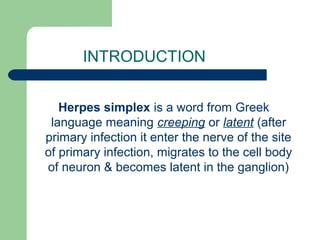
Herpes simplex is a word from Greek 
language meaning creeping or latent (after 
primary infection it enter the nerve of the site 
of primary infection, migrates to the cell body 
of neuron & becomes latent in the ganglion)
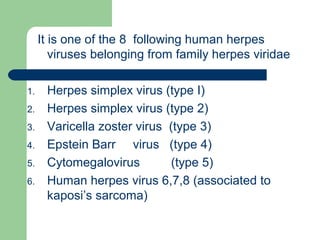
It is one of the 8 following human herpes 
viruses belonging from family herpes viridae 
1. Herpes simplex virus (type I) 
2. Herpes simplex virus (type 2) 
3. Varicella zoster virus (type 3) 
4. Epstein Barr virus (type 4) 
5. Cytomegalovirus (type 5) 
6. Human herpes virus 6,7,8 (associated to 
kaposi’s sarcoma)
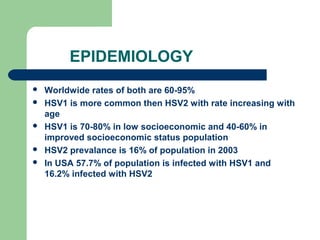
EPIDEMIOLOGY 
 Worldwide rates of both are 60-95% 
 HSV1 is more common then HSV2 with rate increasing with 
age 
 HSV1 is 70-80% in low socioeconomic and 40-60% in 
improved socioeconomic status population 
 HSV2 prevalance is 16% of population in 2003 
 In USA 57.7% of population is infected with HSV1 and 
16.2% infected with HSV2
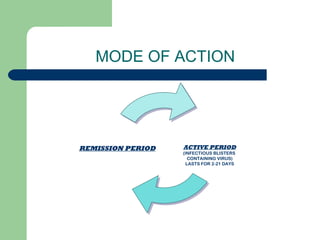
MODE OF ACTION 
ACTIVE PERIOD 
(INFECTIOUS BLISTERS 
CONTAINING VIRUS) 
LASTS FOR 2-21 DAYS 
REMISSION PERIOD
MODE OF TRANSMISSION 
 Direct contact with the lesion or infected body 
fluid 
 Skin to skin contact 
 Transmission between discordant partners; 
person with history of infection (HSV 
seropositive) can pass the virus to HSV 
seronegative person. 
 Via infected saliva, semen and vaginal fluids
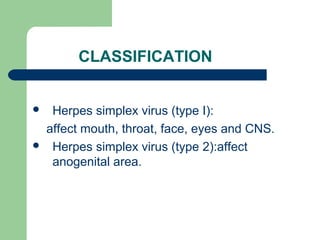
CLASSIFICATION 
 Herpes simplex virus (type I): 
affect mouth, throat, face, eyes and CNS. 
 Herpes simplex virus (type 2):affect 
anogenital area.
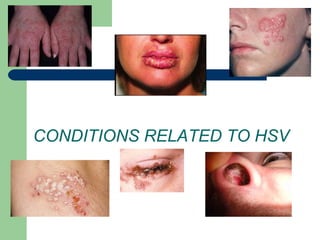
CONDITIONS RELATED TO HSV
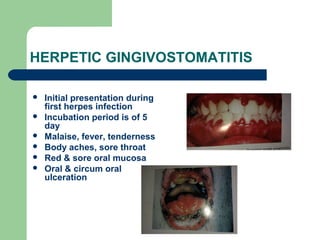
HERPETIC GINGIVOSTOMATITIS 
 Initial presentation during 
first herpes infection 
 Incubation period is of 5 
day 
 Malaise, fever, tenderness 
 Body aches, sore throat 
 Red & sore oral mucosa 
 Oral & circum oral 
ulceration
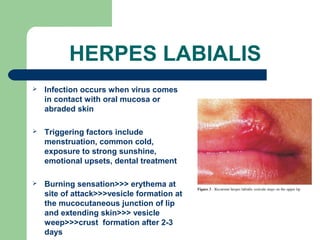
HERPES LABIALIS 
 Infection occurs when virus comes 
in contact with oral mucosa or 
abraded skin 
 Triggering factors include 
menstruation, common cold, 
exposure to strong sunshine, 
emotional upsets, dental treatment 
 Burning sensation>>> erythema at 
site of attack>>>vesicle formation at 
the mucocutaneous junction of lip 
and extending skin>>> vesicle 
weep>>>crust formation after 2-3 
days
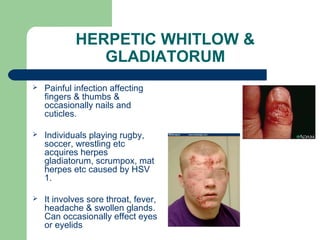
HERPETIC WHITLOW & 
GLADIATORUM 
 Painful infection affecting 
fingers & thumbs & 
occasionally nails and 
cuticles. 
 Individuals playing rugby, 
soccer, wrestling etc 
acquires herpes 
gladiatorum, scrumpox, mat 
herpes etc caused by HSV 
1. 
 It involves sore throat, fever, 
headache & swollen glands. 
Can occasionally effect eyes 
or eyelids
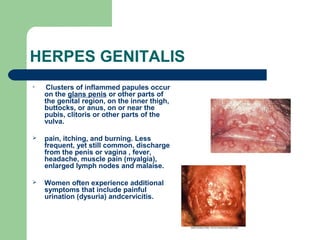
HERPES GENITALIS 
 Clusters of inflammed papules occur 
on the glans penis or other parts of 
the genital region, on the inner thigh, 
buttocks, or anus, on or near the 
pubis, clitoris or other parts of the 
vulva. 
 pain, itching, and burning. Less 
frequent, yet still common, discharge 
from the penis or vagina , fever, 
headache, muscle pain (myalgia), 
enlarged lymph nodes and malaise. 
 Women often experience additional 
symptoms that include painful 
urination (dysuria) andcervicitis.
HERPES KERATITIS 
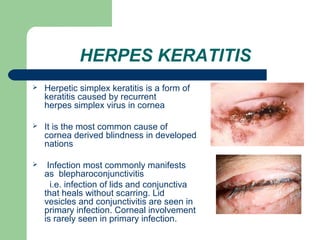
 Herpetic simplex keratitis is a form of 
keratitis caused by recurrent 
herpes simplex virus in cornea 
 It is the most common cause of 
cornea derived blindness in developed 
nations 
 Infection most commonly manifests 
as blepharoconjunctivitis 
i.e. infection of lids and conjunctiva 
that heals without scarring. Lid 
vesicles and conjunctivitis are seen in 
primary infection. Corneal involvement 
is rarely seen in primary infection.
HERPES VIRAL ENCEPHALITIS 
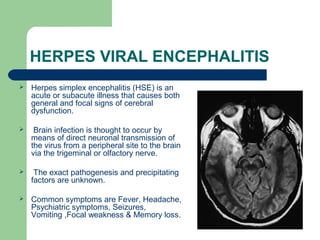
 Herpes simplex encephalitis (HSE) is an 
acute or subacute illness that causes both 
general and focal signs of cerebral 
dysfunction. 
 Brain infection is thought to occur by 
means of direct neuronal transmission of 
the virus from a peripheral site to the brain 
via the trigeminal or olfactory nerve. 
 The exact pathogenesis and precipitating 
factors are unknown. 
 Common symptoms are Fever, Headache, 
Psychiatric symptoms, Seizures, 
Vomiting ,Focal weakness & Memory loss.
HERPES VIRAL MENINGITUS 
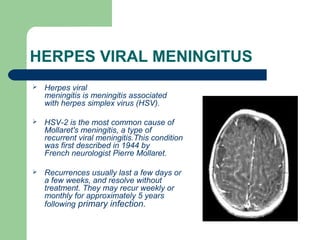
 Herpes viral 
meningitis is meningitis associated 
with herpes simplex virus (HSV). 
 HSV-2 is the most common cause of 
Mollaret's meningitis, a type of 
recurrent viral meningitis.This condition 
was first described in 1944 by 
French neurologist Pierre Mollaret. 
 Recurrences usually last a few days or 
a few weeks, and resolve without 
treatment. They may recur weekly or 
monthly for approximately 5 years 
following primary infection.
HERPES ESOPHAGITIS 
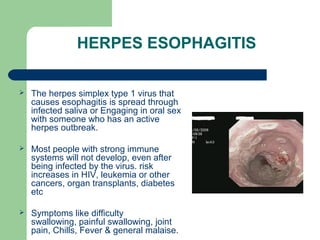
 The herpes simplex type 1 virus that 
causes esophagitis is spread through 
infected saliva or Engaging in oral sex 
with someone who has an active 
herpes outbreak. 
 Most people with strong immune 
systems will not develop, even after 
being infected by the virus. risk 
increases in HIV, leukemia or other 
cancers, organ transplants, diabetes 
etc 
 Symptoms like difficulty 
swallowing, painful swallowing, joint 
pain, Chills, Fever & general malaise.
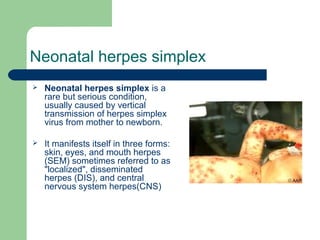
Neonatal herpes simplex 
 Neonatal herpes simplex is a 
rare but serious condition, 
usually caused by vertical 
transmission of herpes simplex 
virus from mother to newborn. 
 It manifests itself in three forms: 
skin, eyes, and mouth herpes 
(SEM) sometimes referred to as 
"localized", disseminated 
herpes (DIS), and central 
nervous system herpes(CNS)
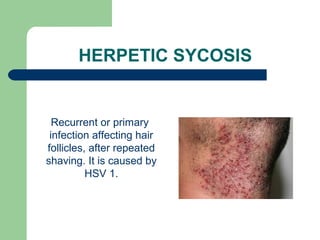
HERPETIC SYCOSIS 
Recurrent or primary 
infection affecting hair 
follicles, after repeated 
shaving. It is caused by 
HSV 1.
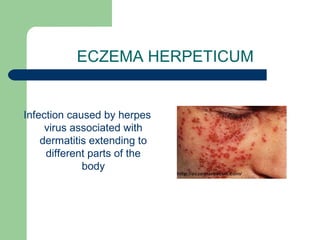
ECZEMA HERPETICUM 
Infection caused by herpes 
virus associated with 
dermatitis extending to 
different parts of the 
body
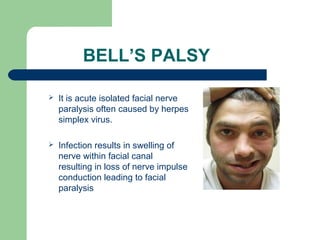
BELL’S PALSY 
 It is acute isolated facial nerve 
paralysis often caused by herpes 
simplex virus. 
 Infection results in swelling of 
nerve within facial canal 
resulting in loss of nerve impulse 
conduction leading to facial 
paralysis
ALZEIMER’S DISEASE 
HSV-1 causes this 
disease due to 
damage to the 
nervous system
PATHOPHYSIOLOGY 
 Cure for herpes is not yet been developed, once infected it 
remains in the body throughout life. 
 Treatment can reduce viral shedding and alleviate the the 
severity of symptoms 
 HSV asymptomatic shedding occurs at some time in most of 
the infected individuals. 
 Virus enters into susceptible cells via entry receptors 
 Infected person showing no visible symptom may still shed & 
transmit the virus through skin. 
 Antibodies formed as a result of primary infection with type of 
HSV prevents reinfection with the same virus type.
DIAGNOSIS 
APPEARANCE AND DISTRIBUTION 
 Multiple round superficial oral ulcers accompanied by 
acute gingivitis. 
 Aphthous ulcers also resemble intra oral herpes but donot 
have vesicular stage 
 Genital herpes caused by HSV-2 are more difficult to diagnose 
as they donot have classical symptoms. 
 Genital herpes resemble several other conditions e.g. lichen 
planus, fungal infections etc . Therefore it is difficult to diagnose
LABORTARY TESTS 
 Virus culture 
 Direct flourescent antibody (DFA) 
 Skin biopsy 
 Polymerase chain reaction (PCR) 
 Immunodot glycoprotein G-specific HSV test 
(98% specific in discriminating HSV-1 from 
HSV-2)
PREVENTION 
WOMEN ARE MORE SUSCEPTIBLE THEN MEN 
METHODS 
 BARRIER METHOD: use of condoms or dental 
dams 
 ANTIVIRALS: reduce asymptomatic shedding 
 PREGNANCY: Since the risk of transmission from 
mother to baby is more therefore suppressive 
therapy of antiviral are given during last months of 
pregnancy
MANAGEMENT 
HERPES CANNOT BE ERADICATED FROM BODY 
 ANTIVIRALS: reduce the frequency, severity and 
duration of disease .e.g. Acyclovir, Famciclovir, 
Penciclovir etc 
 ANALGESICS: To relieve pain and fever (Ibuprofen, 
paracetamol etc) 
 TOPICAL ANESTHETICS: to relieve pain and 
itching( lidocaine, benzocaine etc)
PROGNOSIS 
MANY HSV INFECTED PEOPLE 
EXPERIENCE THE RECURRENCE 
DURING FIRST YEAR OF INFECTION
Herpes simplex

Herpes simplex

  • 1.
    PRESENTED BY DrIQRA DAUD AWAN (DENTAL SURGEON HIMS MPH 2ND SEMESTER)
  • 2.
    INTRODUCTION Herpes simplexis a word from Greek language meaning creeping or latent (after primary infection it enter the nerve of the site of primary infection, migrates to the cell body of neuron & becomes latent in the ganglion)
  • 3.
    It is oneof the 8 following human herpes viruses belonging from family herpes viridae 1. Herpes simplex virus (type I) 2. Herpes simplex virus (type 2) 3. Varicella zoster virus (type 3) 4. Epstein Barr virus (type 4) 5. Cytomegalovirus (type 5) 6. Human herpes virus 6,7,8 (associated to kaposi’s sarcoma)
  • 4.
    EPIDEMIOLOGY  Worldwiderates of both are 60-95%  HSV1 is more common then HSV2 with rate increasing with age  HSV1 is 70-80% in low socioeconomic and 40-60% in improved socioeconomic status population  HSV2 prevalance is 16% of population in 2003  In USA 57.7% of population is infected with HSV1 and 16.2% infected with HSV2
  • 5.
    MODE OF ACTION ACTIVE PERIOD (INFECTIOUS BLISTERS CONTAINING VIRUS) LASTS FOR 2-21 DAYS REMISSION PERIOD
  • 6.
    MODE OF TRANSMISSION  Direct contact with the lesion or infected body fluid  Skin to skin contact  Transmission between discordant partners; person with history of infection (HSV seropositive) can pass the virus to HSV seronegative person.  Via infected saliva, semen and vaginal fluids
  • 7.
    CLASSIFICATION  Herpessimplex virus (type I): affect mouth, throat, face, eyes and CNS.  Herpes simplex virus (type 2):affect anogenital area.
  • 8.
  • 9.
    HERPETIC GINGIVOSTOMATITIS Initial presentation during first herpes infection  Incubation period is of 5 day  Malaise, fever, tenderness  Body aches, sore throat  Red & sore oral mucosa  Oral & circum oral ulceration
  • 10.
    HERPES LABIALIS Infection occurs when virus comes in contact with oral mucosa or abraded skin  Triggering factors include menstruation, common cold, exposure to strong sunshine, emotional upsets, dental treatment  Burning sensation>>> erythema at site of attack>>>vesicle formation at the mucocutaneous junction of lip and extending skin>>> vesicle weep>>>crust formation after 2-3 days
  • 11.
    HERPETIC WHITLOW & GLADIATORUM  Painful infection affecting fingers & thumbs & occasionally nails and cuticles.  Individuals playing rugby, soccer, wrestling etc acquires herpes gladiatorum, scrumpox, mat herpes etc caused by HSV 1.  It involves sore throat, fever, headache & swollen glands. Can occasionally effect eyes or eyelids
  • 12.
    HERPES GENITALIS Clusters of inflammed papules occur on the glans penis or other parts of the genital region, on the inner thigh, buttocks, or anus, on or near the pubis, clitoris or other parts of the vulva.  pain, itching, and burning. Less frequent, yet still common, discharge from the penis or vagina , fever, headache, muscle pain (myalgia), enlarged lymph nodes and malaise.  Women often experience additional symptoms that include painful urination (dysuria) andcervicitis.
  • 13.
    HERPES KERATITIS Herpetic simplex keratitis is a form of keratitis caused by recurrent herpes simplex virus in cornea  It is the most common cause of cornea derived blindness in developed nations  Infection most commonly manifests as blepharoconjunctivitis i.e. infection of lids and conjunctiva that heals without scarring. Lid vesicles and conjunctivitis are seen in primary infection. Corneal involvement is rarely seen in primary infection.
  • 14.
    HERPES VIRAL ENCEPHALITIS  Herpes simplex encephalitis (HSE) is an acute or subacute illness that causes both general and focal signs of cerebral dysfunction.  Brain infection is thought to occur by means of direct neuronal transmission of the virus from a peripheral site to the brain via the trigeminal or olfactory nerve.  The exact pathogenesis and precipitating factors are unknown.  Common symptoms are Fever, Headache, Psychiatric symptoms, Seizures, Vomiting ,Focal weakness & Memory loss.
  • 15.
    HERPES VIRAL MENINGITUS  Herpes viral meningitis is meningitis associated with herpes simplex virus (HSV).  HSV-2 is the most common cause of Mollaret's meningitis, a type of recurrent viral meningitis.This condition was first described in 1944 by French neurologist Pierre Mollaret.  Recurrences usually last a few days or a few weeks, and resolve without treatment. They may recur weekly or monthly for approximately 5 years following primary infection.
  • 16.
    HERPES ESOPHAGITIS The herpes simplex type 1 virus that causes esophagitis is spread through infected saliva or Engaging in oral sex with someone who has an active herpes outbreak.  Most people with strong immune systems will not develop, even after being infected by the virus. risk increases in HIV, leukemia or other cancers, organ transplants, diabetes etc  Symptoms like difficulty swallowing, painful swallowing, joint pain, Chills, Fever & general malaise.
  • 17.
    Neonatal herpes simplex  Neonatal herpes simplex is a rare but serious condition, usually caused by vertical transmission of herpes simplex virus from mother to newborn.  It manifests itself in three forms: skin, eyes, and mouth herpes (SEM) sometimes referred to as "localized", disseminated herpes (DIS), and central nervous system herpes(CNS)
  • 18.
    HERPETIC SYCOSIS Recurrentor primary infection affecting hair follicles, after repeated shaving. It is caused by HSV 1.
  • 19.
    ECZEMA HERPETICUM Infectioncaused by herpes virus associated with dermatitis extending to different parts of the body
  • 20.
    BELL’S PALSY It is acute isolated facial nerve paralysis often caused by herpes simplex virus.  Infection results in swelling of nerve within facial canal resulting in loss of nerve impulse conduction leading to facial paralysis
  • 21.
    ALZEIMER’S DISEASE HSV-1causes this disease due to damage to the nervous system
  • 22.
    PATHOPHYSIOLOGY  Curefor herpes is not yet been developed, once infected it remains in the body throughout life.  Treatment can reduce viral shedding and alleviate the the severity of symptoms  HSV asymptomatic shedding occurs at some time in most of the infected individuals.  Virus enters into susceptible cells via entry receptors  Infected person showing no visible symptom may still shed & transmit the virus through skin.  Antibodies formed as a result of primary infection with type of HSV prevents reinfection with the same virus type.
  • 23.
    DIAGNOSIS APPEARANCE ANDDISTRIBUTION  Multiple round superficial oral ulcers accompanied by acute gingivitis.  Aphthous ulcers also resemble intra oral herpes but donot have vesicular stage  Genital herpes caused by HSV-2 are more difficult to diagnose as they donot have classical symptoms.  Genital herpes resemble several other conditions e.g. lichen planus, fungal infections etc . Therefore it is difficult to diagnose
  • 24.
    LABORTARY TESTS Virus culture  Direct flourescent antibody (DFA)  Skin biopsy  Polymerase chain reaction (PCR)  Immunodot glycoprotein G-specific HSV test (98% specific in discriminating HSV-1 from HSV-2)
  • 25.
    PREVENTION WOMEN AREMORE SUSCEPTIBLE THEN MEN METHODS  BARRIER METHOD: use of condoms or dental dams  ANTIVIRALS: reduce asymptomatic shedding  PREGNANCY: Since the risk of transmission from mother to baby is more therefore suppressive therapy of antiviral are given during last months of pregnancy
  • 26.
    MANAGEMENT HERPES CANNOTBE ERADICATED FROM BODY  ANTIVIRALS: reduce the frequency, severity and duration of disease .e.g. Acyclovir, Famciclovir, Penciclovir etc  ANALGESICS: To relieve pain and fever (Ibuprofen, paracetamol etc)  TOPICAL ANESTHETICS: to relieve pain and itching( lidocaine, benzocaine etc)
  • 27.
    PROGNOSIS MANY HSVINFECTED PEOPLE EXPERIENCE THE RECURRENCE DURING FIRST YEAR OF INFECTION