College Transition for
    Students at Risk
 Challenges and Opportunities for
     At-Risk & Special Needs
College Bound High School Seniors
Introductions
O Jeff Brain, MA, CTS, CEP
  Dean of Admissions
  The Bridge Program at The Family Foundation
School

O Mike Kowalchick, MA
  Assistant Head of School for Internal Affairs
  The Forman School

O Jeff Dvorak, M.Ed.
  Educational Consultant & College Counselor
  Educo Consulting
Challenges
O Readiness for College


O Managing independence, responsibilities
  (academically, emotionally, behaviorally)

O Drop-out/failure rates
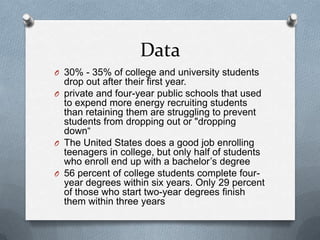
Data
O 30% - 35% of college and university students
  drop out after their first year.
O private and four-year public schools that used
  to expend more energy recruiting students
  than retaining them are struggling to prevent
  students from dropping out or "dropping
  down“
O The United States does a good job enrolling
  teenagers in college, but only half of students
  who enroll end up with a bachelor’s degree
O 56 percent of college students complete four-
  year degrees within six years. Only 29 percent
  of those who start two-year degrees finish
  them within three years
Solutions – Preparing Students
 O Exposure to college level work and
   academic expectations
 O Exposure to freedoms/independence
 O Opportunities for decision making
 O Experience with managing
   failure, loneliness, and finding supportive
   peer group
Solutions – Preparing Parents
O Balancing support with room to
  experience realities
O Manage expectations
O Learning to trust
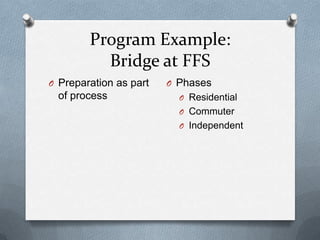
Program Example:
          Bridge at FFS
O Preparation as part   O Phases
  of process              O Residential
                          O Commuter
                          O Independent
Preparing
O Be honest. Student performance, class
  content, course
  offerings, grades, activities.
O Start the college/career process early. Do
  college tours, career days, parent
  workshops.
O Create a process for evaluating college
  readiness
O Provide extra support and get outside help
  when necessary
Applying
• GPA and course rigor. The number one
    indicator of potential college success is good
    grades
•    Standardized test: ACT vs. SAT. I like ACT
•   Activities. All students need to show interests
    other then school. These should be sustained
    and focused
•   Leadership. Start a club, captain the soccer
    team, be a manager at work, compete in a
    science fair
•   Good essays that tell something unique about
    you. Be honest about your LD or past
    struggles
Wrap Up
O Share experiences
O Be realistic about the challenges
O Be pro-active in talking about and
  addressing those challenges
O Consider what your school is doing to
  prepare students for success
References
O 1
www.usnews.com/education/articles/2009/08/19
/dropouts-loom-large-for-schools
O 2
http://www.brighthub.com/education/college/artic
les/82378.aspx
O 3
http://www.nytimes.com/2009/09/09/business/ec
onomy/09leonhardt.html?_r=0
O 4
http://www.reuters.com/article/2012/03/27/us-
attn-andrea-education-dropouts-
idUSBRE82Q0Y120120327

College transition for students at risk

  • 1.
    College Transition for Students at Risk Challenges and Opportunities for At-Risk & Special Needs College Bound High School Seniors
  • 2.
    Introductions O Jeff Brain,MA, CTS, CEP Dean of Admissions The Bridge Program at The Family Foundation School O Mike Kowalchick, MA Assistant Head of School for Internal Affairs The Forman School O Jeff Dvorak, M.Ed. Educational Consultant & College Counselor Educo Consulting
  • 3.
    Challenges O Readiness forCollege O Managing independence, responsibilities (academically, emotionally, behaviorally) O Drop-out/failure rates
  • 4.
    Data O 30% -35% of college and university students drop out after their first year. O private and four-year public schools that used to expend more energy recruiting students than retaining them are struggling to prevent students from dropping out or "dropping down“ O The United States does a good job enrolling teenagers in college, but only half of students who enroll end up with a bachelor’s degree O 56 percent of college students complete four- year degrees within six years. Only 29 percent of those who start two-year degrees finish them within three years
  • 5.
    Solutions – PreparingStudents O Exposure to college level work and academic expectations O Exposure to freedoms/independence O Opportunities for decision making O Experience with managing failure, loneliness, and finding supportive peer group
  • 6.
    Solutions – PreparingParents O Balancing support with room to experience realities O Manage expectations O Learning to trust
  • 7.
    Program Example: Bridge at FFS O Preparation as part O Phases of process O Residential O Commuter O Independent
  • 8.
    Preparing O Be honest.Student performance, class content, course offerings, grades, activities. O Start the college/career process early. Do college tours, career days, parent workshops. O Create a process for evaluating college readiness O Provide extra support and get outside help when necessary
  • 9.
    Applying • GPA andcourse rigor. The number one indicator of potential college success is good grades • Standardized test: ACT vs. SAT. I like ACT • Activities. All students need to show interests other then school. These should be sustained and focused • Leadership. Start a club, captain the soccer team, be a manager at work, compete in a science fair • Good essays that tell something unique about you. Be honest about your LD or past struggles
  • 10.
    Wrap Up O Shareexperiences O Be realistic about the challenges O Be pro-active in talking about and addressing those challenges O Consider what your school is doing to prepare students for success
  • 11.
    References O 1 www.usnews.com/education/articles/2009/08/19 /dropouts-loom-large-for-schools O 2 http://www.brighthub.com/education/college/artic les/82378.aspx O3 http://www.nytimes.com/2009/09/09/business/ec onomy/09leonhardt.html?_r=0 O 4 http://www.reuters.com/article/2012/03/27/us- attn-andrea-education-dropouts- idUSBRE82Q0Y120120327