Mastering a New Language for Student Development
Considering a Broader Theoretical Model and Practical Applications
Mary Ogburn, Boston University
Craig Rinker, Georgetown University
Alissa Kramer, Boston University
Small group discussion
(five minutes)
 What interested you most about this today’s
session/what do you hope to get out of it?
 What student development theories are you already
familiar with (and how does it guide your practice?)
Current Tools for Student
Development in Study Abroad
Bennett:
DMIS: Developmental Model of Intercultural Sensitivity (Milton Bennett):
A research-based model which looks at how individuals view and
understand cultural differences between ourselves and others. It
places people’s mindsets on a continuum, from the most ethnocentric,
to the most ethnorelative viewpoints.
IDI: Intercultural Development Inventory: An instrument that means a
person not just where they are located on the DMIS, but also where a
person thinks they are located. It measures both our perceptions of
ourselves, and also how we really think about and interact with those
from different cultures.
Kolb: Learning Style Inventory and Experiential Learning : the idea that learning
preferences can be described using two continuums: active experimentation-
reflective observation and abstract conceptualization-concrete experience
Hofstede: Dimensions of culture
http://languageandculture.com/blog/?p=639
https://en.wikipedia.org/wiki/David_A._Kolb
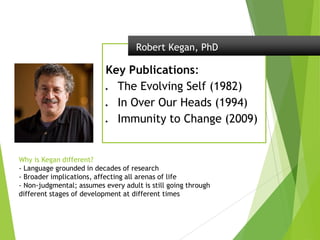
Why is Kegan different?
- Language grounded in decades of research
- Broader implications, affecting all arenas of life
- Non-judgmental; assumes every adult is still going through
different stages of development at different times
Key Publications:
 The Evolving Self (1982)
 In Over Our Heads (1994)
 Immunity to Change (2009)
Robert Kegan, PhD
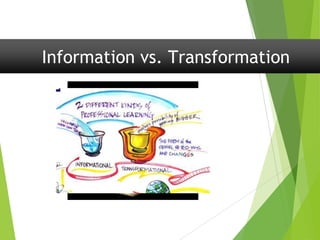
Information vs. Transformation
 We constantly make meaning of our surroundings
and experiences
 Other people may make very different meanings
from the same surroundings or experiences
Constructivism
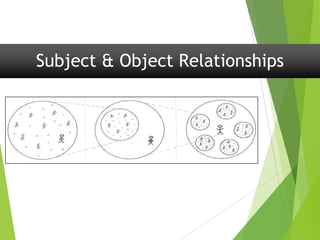
Subject & Object Relationships
“Once I began to do research with Black study abroad
alumni, I realized that most of the beliefs I had
previously held about their pathways to study abroad,
experiences abroad, and outcomes were
inaccurate….We as individuals also need to do the
uncomfortable work of identifying and confronting our
biases and educating ourselves regarding the
populations we hope to serve before we can effect
change.”
-Karyn L. Sweeney
“Reframing Diversity: Inclusive Excellence and Education Abroad.” The Forum Focus. October
2015, Volume 2.
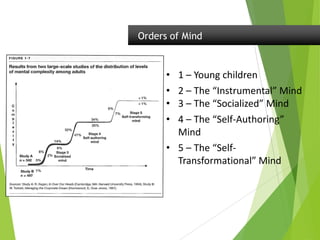
• 1 – Young children
• 2 – The “Instrumental” Mind
• 3 – The “Socialized” Mind
• 4 – The “Self-Authoring”
Mind
• 5 – The “Self-
Transformational” Mind
Orders of Mind
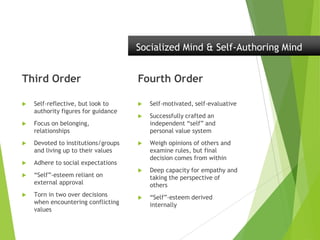
Third Order
 Self-reflective, but look to
authority figures for guidance
 Focus on belonging,
relationships
 Devoted to institutions/groups
and living up to their values
 Adhere to social expectations
 “Self”-esteem reliant on
external approval
 Torn in two over decisions
when encountering conflicting
values
Fourth Order
 Self-motivated, self-evaluative
 Successfully crafted an
independent “self” and
personal value system
 Weigh opinions of others and
examine rules, but final
decision comes from within
 Deep capacity for empathy and
taking the perspective of
others
 “Self”-esteem derived
internally
Socialized Mind & Self-Authoring Mind
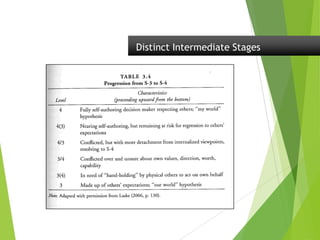
Distinct Intermediate Stages
Fourth Order
 “I’m not a pawn in a cookie-cutter system any longer.”
 “I realized something for the first time. As silly and
simple a realization it may be,…I finally understood that
being an adult means making decisions…I am the one
who makes the decisions that will direct my life.”
(Quotes from study abroad alumni blog posts.)
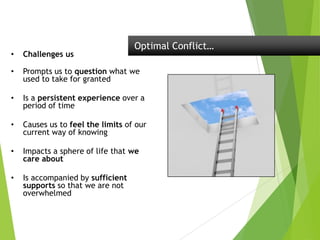
• Challenges us
• Prompts us to question what we
used to take for granted
• Is a persistent experience over a
period of time
• Causes us to feel the limits of our
current way of knowing
• Impacts a sphere of life that we
care about
• Is accompanied by sufficient
supports so that we are not
overwhelmed
Optimal Conflict…
Holding Environments
 Safe spaces that are also
challenging
 Where people can feel safe
addressing difficult issues
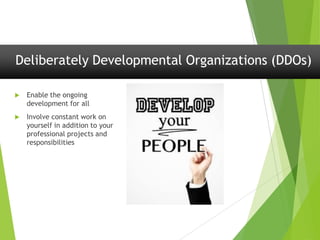
Deliberately Developmental Organizations (DDOs)
 Enable the ongoing
development for all
 Involve constant work on
yourself in addition to your
professional projects and
responsibilities
K
“Paying attention to someone’s particular form of
mind is not going to change the world. Paying
attention to the sense-making of yourself and others,
however, might change the course of your life. Those
of us who work in this space find ourselves being more
gentle with those around us, less frustrated by the
foibles of humanity, and more filled with admiration
and affection for those who are doing their best.
…Adult development theories exist to give us a
glimpse into what sense the world makes to us and to
others in the present and to show us all a path to a
different set of possibilities for the future.”
-Dr. Jennifer Garvey Berger
Practical Applications
“Away from their primary culture, [students] are freed to a large degree from the
socializing pressures of home, with little replacement pressure in their new
environment. What a relief: out of the pressure cooker and into a fascinating new
environment with little adult supervision!
Is it any wonder, then, that many students abroad might choose to minimize
unfamiliar challenges to whatever degree possible by:
a) clustering with their compatriots,
b) avoiding the language challenge, and
c) exploring the host culture in like-minded groups of other expatriate
adolescents?”*
What is our job?
*Excerpt from Stuart, D. K. (2012). “Taking stage development theory seriously.”
Case Study: Boston University Arabic Language and
Internship/Service Learning Programs
 Runs summer and fall only
 Rabat, Morocco
 Center for Cross Cultural Learning (CCCL)
 Homestays, internships and service learning placements
 8-14 students
Case Study
Fall, 2013:
“The CCCL is very incompetent, unable to understand students needs, and
had extremely unfair and un-based (sic) grading.”
“The host institution, Center for Cross-Cultural Learning, did not meet our
expectations”
“The internship course was ridiculous and our internships were not really
internships. We were rarely given tasks and were all very disappointed in
this aspect of the program. I personally was forced to switch NGOs half way
through the course because I was never given a task. Many of the other
students also spent most of their time at their "internship" observing and
doing nothing.”
“it's employees lack academic integrity, competence, and compassion”
“I felt very deceived by the program as to what was promised to me
versus the reality.”
Only 45% of the students at that time would have recommended
the program to a friend
 Students in over their heads?
What are the benefits of Volunteering?
For yourself:
 To gain a sense of purpose
 To develop personal skills
 To get work experience
 To hone language skills
 Sense of comradery
 Learn decision making
For the organization:
 Free labor
 “Be inspired by the
volunteer”
 Cultural exchange
 Advance the cause
 Improve conditions
Students were asked:
“According to you, what are the
elements of a successful (study
abroad/internship) experience?”
 US Students
 Being open-minded
 Being patient
 Having a positive attitude
and a dynamic personality
 Moroccan Students
 Being ambitious
 Ability to integrate
 Commitment
 Flexibility
 Being a good public
speaker
 Being a good listener
Changes Made:
 Moving assumptions from subject to object: Comprehensive pre-
departure presentation with site-specific handbook and transformational
culture slides
 Optimal conflict: Continuous cultural reflection done on site through
CCCL and BU
 Development of the holding environment: In depth cultural knowledge
for students before, during and re-entry debrief upon return to campus
 Measurement: Early and mid-semester check in and evaluations as well
as re-entry
 Application: short-answer including question about previous adversity
and perceived cultural differences as opposed to one short answer
question
 Recommendations: changed from content courses instead of language
evaluation, which help better assess students development as opposed to
only language level, which is fairly unhelpful outside of the classroom for
this program
Evaluations, 2014:
 “While my internship tasks were unchallenging and
tedious, I learned a lot just from observing the
work and flow of my office. I really enjoyed the
opportunity and definitely gained a new
perspective.”
 “I really enjoyed being able to engage in dialogue
with different individuals and not only change my
own perceptions, but start to help them uncover that
stereotypes about Americans are not always true.”
 100% of students recommended the program
As we now also know, the development doesn’t happen
right away or right when we want it.
The development of the students in this inaugural group
is still happening today!
 “At the time, it seemed like all the bad overshadowed
that good but now I only remember the good. Thank you
for providing us with an educational semester, both in
and out of the classroom. Whenever I look through
pictures or remember details about my experience, all I
do is smile. From this opportunity, I have grown as an
individual and know I am a better person because of my
experience.”
-Former student, in an e-mail dated April, 2015
 Walking the Walk after Talking the Talk…
 Signs of a Culture Committed to the Development of Individuals
 Mission and vision – development of the individual – ALL constituents (students,
staff, etc.)
 Articulation through core activities – How do activities support development? Are
activities transformational?
 Strategies for developing a culture that embraces individual transformation
Practical Applications: For Organizations Working with Students
• Programming
• Policy and process
• Support services
• Hiring
• Training and development
• Intentional
• Challenging
• Supportive
• Teamwork (Group work)
• Leaders and followers – Coaching
• Acknowledgement of Individual (while
also appreciated the central themes of
culture)
 Strategies for Developing a Team
 Develop an Organizational Strategy for Staffing
 Hiring “ethos”
 Understanding the skills and experience needed for positions
 Active training and development program that challenges and
provides opportunity for elevation
 Understanding limitations -> it’s about what your do next
 As an Individual
 As a professional, seek out opportunities to work in
organizations that match your professional ideals -> student-
center approach
 Promote a culture of transformative learning
 Strategies for Developing a Team continued…
 Training and Development
 Understanding of limitations -> supervisor/supervisee
relationship
 Mentoring and coaching
 Opportunities
 How can we identify ways for professionals to see their world
differently?
 Creating situations that are ambiguous and challenging
 Leadership development
 Importance of Kegan’s self-authorization stage -> ability to
create a value system
 Successful leadership
 What was your main takeaway from this presentation?
 (Please jot down on a piece of paper and talk at your table
for a few minutes about main themes. We will collect and
discuss as a group after second question.)
 What are some other ways we can help “meet students
where they are” and also support their transition from
one Order of Mind to the next?
Discussion
 Thank you!

Mastering a New Language for Student Development: Considering a Broader Theoretical Model and Practical Applications

  • 1.
    Mastering a NewLanguage for Student Development Considering a Broader Theoretical Model and Practical Applications Mary Ogburn, Boston University Craig Rinker, Georgetown University Alissa Kramer, Boston University
  • 2.
    Small group discussion (fiveminutes)  What interested you most about this today’s session/what do you hope to get out of it?  What student development theories are you already familiar with (and how does it guide your practice?)
  • 3.
    Current Tools forStudent Development in Study Abroad Bennett: DMIS: Developmental Model of Intercultural Sensitivity (Milton Bennett): A research-based model which looks at how individuals view and understand cultural differences between ourselves and others. It places people’s mindsets on a continuum, from the most ethnocentric, to the most ethnorelative viewpoints. IDI: Intercultural Development Inventory: An instrument that means a person not just where they are located on the DMIS, but also where a person thinks they are located. It measures both our perceptions of ourselves, and also how we really think about and interact with those from different cultures. Kolb: Learning Style Inventory and Experiential Learning : the idea that learning preferences can be described using two continuums: active experimentation- reflective observation and abstract conceptualization-concrete experience Hofstede: Dimensions of culture http://languageandculture.com/blog/?p=639 https://en.wikipedia.org/wiki/David_A._Kolb
  • 4.
    Why is Kegandifferent? - Language grounded in decades of research - Broader implications, affecting all arenas of life - Non-judgmental; assumes every adult is still going through different stages of development at different times Key Publications:  The Evolving Self (1982)  In Over Our Heads (1994)  Immunity to Change (2009) Robert Kegan, PhD
  • 5.
  • 6.
     We constantlymake meaning of our surroundings and experiences  Other people may make very different meanings from the same surroundings or experiences Constructivism
  • 10.
    Subject & ObjectRelationships
  • 11.
    “Once I beganto do research with Black study abroad alumni, I realized that most of the beliefs I had previously held about their pathways to study abroad, experiences abroad, and outcomes were inaccurate….We as individuals also need to do the uncomfortable work of identifying and confronting our biases and educating ourselves regarding the populations we hope to serve before we can effect change.” -Karyn L. Sweeney “Reframing Diversity: Inclusive Excellence and Education Abroad.” The Forum Focus. October 2015, Volume 2.
  • 12.
    • 1 –Young children • 2 – The “Instrumental” Mind • 3 – The “Socialized” Mind • 4 – The “Self-Authoring” Mind • 5 – The “Self- Transformational” Mind Orders of Mind
  • 13.
    Third Order  Self-reflective,but look to authority figures for guidance  Focus on belonging, relationships  Devoted to institutions/groups and living up to their values  Adhere to social expectations  “Self”-esteem reliant on external approval  Torn in two over decisions when encountering conflicting values Fourth Order  Self-motivated, self-evaluative  Successfully crafted an independent “self” and personal value system  Weigh opinions of others and examine rules, but final decision comes from within  Deep capacity for empathy and taking the perspective of others  “Self”-esteem derived internally Socialized Mind & Self-Authoring Mind
  • 14.
  • 15.
    Fourth Order  “I’mnot a pawn in a cookie-cutter system any longer.”  “I realized something for the first time. As silly and simple a realization it may be,…I finally understood that being an adult means making decisions…I am the one who makes the decisions that will direct my life.” (Quotes from study abroad alumni blog posts.)
  • 16.
    • Challenges us •Prompts us to question what we used to take for granted • Is a persistent experience over a period of time • Causes us to feel the limits of our current way of knowing • Impacts a sphere of life that we care about • Is accompanied by sufficient supports so that we are not overwhelmed Optimal Conflict…
  • 17.
    Holding Environments  Safespaces that are also challenging  Where people can feel safe addressing difficult issues
  • 18.
    Deliberately Developmental Organizations(DDOs)  Enable the ongoing development for all  Involve constant work on yourself in addition to your professional projects and responsibilities
  • 21.
  • 22.
    “Paying attention tosomeone’s particular form of mind is not going to change the world. Paying attention to the sense-making of yourself and others, however, might change the course of your life. Those of us who work in this space find ourselves being more gentle with those around us, less frustrated by the foibles of humanity, and more filled with admiration and affection for those who are doing their best. …Adult development theories exist to give us a glimpse into what sense the world makes to us and to others in the present and to show us all a path to a different set of possibilities for the future.” -Dr. Jennifer Garvey Berger
  • 23.
    Practical Applications “Away fromtheir primary culture, [students] are freed to a large degree from the socializing pressures of home, with little replacement pressure in their new environment. What a relief: out of the pressure cooker and into a fascinating new environment with little adult supervision! Is it any wonder, then, that many students abroad might choose to minimize unfamiliar challenges to whatever degree possible by: a) clustering with their compatriots, b) avoiding the language challenge, and c) exploring the host culture in like-minded groups of other expatriate adolescents?”* What is our job? *Excerpt from Stuart, D. K. (2012). “Taking stage development theory seriously.”
  • 24.
    Case Study: BostonUniversity Arabic Language and Internship/Service Learning Programs  Runs summer and fall only  Rabat, Morocco  Center for Cross Cultural Learning (CCCL)  Homestays, internships and service learning placements  8-14 students Case Study
  • 25.
    Fall, 2013: “The CCCLis very incompetent, unable to understand students needs, and had extremely unfair and un-based (sic) grading.” “The host institution, Center for Cross-Cultural Learning, did not meet our expectations” “The internship course was ridiculous and our internships were not really internships. We were rarely given tasks and were all very disappointed in this aspect of the program. I personally was forced to switch NGOs half way through the course because I was never given a task. Many of the other students also spent most of their time at their "internship" observing and doing nothing.” “it's employees lack academic integrity, competence, and compassion” “I felt very deceived by the program as to what was promised to me versus the reality.” Only 45% of the students at that time would have recommended the program to a friend  Students in over their heads?
  • 26.
    What are thebenefits of Volunteering? For yourself:  To gain a sense of purpose  To develop personal skills  To get work experience  To hone language skills  Sense of comradery  Learn decision making For the organization:  Free labor  “Be inspired by the volunteer”  Cultural exchange  Advance the cause  Improve conditions Students were asked: “According to you, what are the elements of a successful (study abroad/internship) experience?”  US Students  Being open-minded  Being patient  Having a positive attitude and a dynamic personality  Moroccan Students  Being ambitious  Ability to integrate  Commitment  Flexibility  Being a good public speaker  Being a good listener
  • 27.
    Changes Made:  Movingassumptions from subject to object: Comprehensive pre- departure presentation with site-specific handbook and transformational culture slides  Optimal conflict: Continuous cultural reflection done on site through CCCL and BU  Development of the holding environment: In depth cultural knowledge for students before, during and re-entry debrief upon return to campus  Measurement: Early and mid-semester check in and evaluations as well as re-entry  Application: short-answer including question about previous adversity and perceived cultural differences as opposed to one short answer question  Recommendations: changed from content courses instead of language evaluation, which help better assess students development as opposed to only language level, which is fairly unhelpful outside of the classroom for this program
  • 28.
    Evaluations, 2014:  “Whilemy internship tasks were unchallenging and tedious, I learned a lot just from observing the work and flow of my office. I really enjoyed the opportunity and definitely gained a new perspective.”  “I really enjoyed being able to engage in dialogue with different individuals and not only change my own perceptions, but start to help them uncover that stereotypes about Americans are not always true.”  100% of students recommended the program
  • 29.
    As we nowalso know, the development doesn’t happen right away or right when we want it. The development of the students in this inaugural group is still happening today!  “At the time, it seemed like all the bad overshadowed that good but now I only remember the good. Thank you for providing us with an educational semester, both in and out of the classroom. Whenever I look through pictures or remember details about my experience, all I do is smile. From this opportunity, I have grown as an individual and know I am a better person because of my experience.” -Former student, in an e-mail dated April, 2015
  • 30.
     Walking theWalk after Talking the Talk…  Signs of a Culture Committed to the Development of Individuals  Mission and vision – development of the individual – ALL constituents (students, staff, etc.)  Articulation through core activities – How do activities support development? Are activities transformational?  Strategies for developing a culture that embraces individual transformation Practical Applications: For Organizations Working with Students • Programming • Policy and process • Support services • Hiring • Training and development • Intentional • Challenging • Supportive • Teamwork (Group work) • Leaders and followers – Coaching • Acknowledgement of Individual (while also appreciated the central themes of culture)
  • 31.
     Strategies forDeveloping a Team  Develop an Organizational Strategy for Staffing  Hiring “ethos”  Understanding the skills and experience needed for positions  Active training and development program that challenges and provides opportunity for elevation  Understanding limitations -> it’s about what your do next  As an Individual  As a professional, seek out opportunities to work in organizations that match your professional ideals -> student- center approach  Promote a culture of transformative learning
  • 32.
     Strategies forDeveloping a Team continued…  Training and Development  Understanding of limitations -> supervisor/supervisee relationship  Mentoring and coaching  Opportunities  How can we identify ways for professionals to see their world differently?  Creating situations that are ambiguous and challenging  Leadership development  Importance of Kegan’s self-authorization stage -> ability to create a value system  Successful leadership
  • 33.
     What wasyour main takeaway from this presentation?  (Please jot down on a piece of paper and talk at your table for a few minutes about main themes. We will collect and discuss as a group after second question.)  What are some other ways we can help “meet students where they are” and also support their transition from one Order of Mind to the next? Discussion
  • 34.