Jennifer Melton
THE EFFECT OF STUDENT LOANS ON
MCCCD STUDENT COMPLETION &
PERSISTENCE
INTRODUCTION
• Traditionally, community colleges have
provided affordable, open access to higher
education
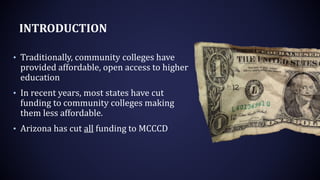
• In recent years, most states have cut
funding to community colleges making
them less affordable.
• Arizona has cut all funding to MCCCD
INTRODUCTION
• More community college students are borrowing to afford
schooling
– 30% of students at public community colleges had loans in 2003-2004
– 41% of students at public community colleges had loans in 2011-2012
• Community College students who borrow are at greater risk of
defaulting on loans
– 23% default rate for public community college students 2011-2012
– 9% default rate for students at public 4-year universities
• Community College students who borrow are at greater risk of
not completing their educational goals
STUDIES TO DATE
• Research has been limited
• Results have been contradictory
– Some studies show a positive effect
– Some studies show loans have no discernible
effect (St. John & Starkey, 1994)
– Some studies show borrowing hinders student
attainment and persistence rates
SOME STUDIES SHOW A POSITIVE EFFECT
• Two studies showed students with higher loan amounts were
more likely to persist than those with smaller loan amounts
(Cofer & Somers, 2000; Cofer & Somers 2001)
• A study of Oklahoma community college students showed loans
had a positive effect on persistence when part of overall financial
aid package (Mendoza, Mendez, & Malcolm, 2009)
SOME STUDIES SHOW A NEGATIVE EFFECT
• Hippensteel, St. John, & Starkey, 1996
• Dowd & Coury, 2006
• McKinney & Burridge, 2014
QUANTITATIVE VS QUALITATIVE
• One theory for inconclusive results is due to fact most studies
have only focused on quantitative aspects of borrowing
• Need to look at multiple factors that influence decision to
borrow:
– Socio-economic status
– Racial/ethnic background
– Messages from parents, teachers, counselors
– Effectiveness of college financial aid advisement
QUALITATIVE STUDIES
• Two studies surveyed financial aid office counselors to identify
best practices for administering student loans (Burdman, 2012;
McKinney, Roberts, & Shefman, 2013)
• Best practices identified include one-on-one counseling, financial
management workshops, budget planning templates
• Concerns identified:
– Student lack of understanding of debt management
– Large financial aid staff-to-student ratios
– Part-time students borrowing maximum loan amounts
QUALITATIVE STUDIES
• One study measured community college students’ self-
assessment of their loan debt (McKinney, Mukherjee, Wade,
Shefman, & Breed, 2015)
– Lack of adequate financial aid guidance/advisement
– Lack of debt management skills
– Unrealistic expectations of future earnings potential and how long it
would take to pay of loans
METHODOLOGY
• Reviewed required disclosure reports for full-time, first-time
students
• Limitations – Disclosures do not include information about:
– Part-time students
– Students with unsubsidized or private loans
– Loan amounts taken by students
– Gender or race/ethnicity of students who borrowed
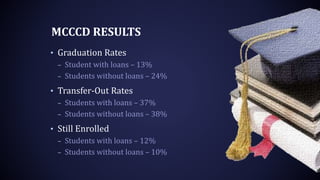
MCCCD RESULTS
• Graduation Rates
– Student with loans – 13%
– Students without loans – 24%
• Transfer-Out Rates
– Students with loans – 37%
– Students without loans – 38%
• Still Enrolled
– Students with loans – 12%
– Students without loans – 10%
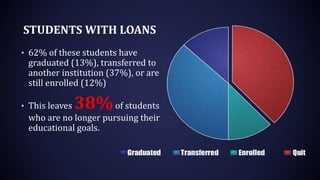
STUDENTS WITH LOANS
• 62% of these students have
graduated (13%), transferred to
another institution (37%), or are
still enrolled (12%)
• This leaves 38%of students
who are no longer pursuing their
educational goals.
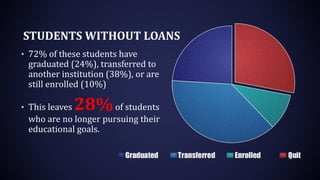
STUDENTS WITHOUT LOANS
• 72% of these students have
graduated (24%), transferred to
another institution (38%), or are
still enrolled (10%)
• This leaves 28%of students
who are no longer pursuing their
educational goals.
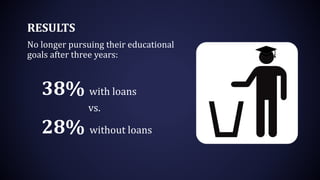
RESULTS
No longer pursuing their educational
goals after three years:
38% with loans
vs.
28% without loans
DISCUSSION
• Factors that qualify student for subsidized loan such as great
financial need may be limiting beneficial effects of getting loans
• A similar effect regarding Pell Grants was found in a previous
study (Dowd & Coury, 2006)
DISCUSSION
• Loan did not meet all the financial
needs of the student
DISCUSSION
• As found in a previous study, students who take out loans may be
more likely to give up after assessing their loan debt and what it
will take to accomplish their educational goals (McKinney &
Burridge 2014)
• “When you’re in a hole, stop digging” mentality
DISCUSSION
• Very few students in this cohort took out loans
– 4% on average
• Risk aversion to debt?
• Students may self-select to attend community college for the
express purpose of not having to take on loans to pay for school
DISCUSSION
• GateWay Community College had the highest completion rate
– 77% of students with loans graduated or transferred out
– 74% of students without loans graduated or transferred out
• GateWay had the smallest cohort of all 10 colleges
– 246 full-time, first-time students
• Did the smaller cohort affect results?
– Smaller cohort allowed more individualized counseling and contact?
FUTURE RESEARCH
• Effect of loans
– Part-time students
– Gender / Race / Ethnicity
– Unsubsidized and Private loans
– Loan amount
• Best practices for financial aid counseling across the colleges
Loan pp presentation slides

Loan pp presentation slides

  • 1.
    Jennifer Melton THE EFFECTOF STUDENT LOANS ON MCCCD STUDENT COMPLETION & PERSISTENCE
  • 2.
    INTRODUCTION • Traditionally, communitycolleges have provided affordable, open access to higher education • In recent years, most states have cut funding to community colleges making them less affordable. • Arizona has cut all funding to MCCCD
  • 3.
    INTRODUCTION • More communitycollege students are borrowing to afford schooling – 30% of students at public community colleges had loans in 2003-2004 – 41% of students at public community colleges had loans in 2011-2012 • Community College students who borrow are at greater risk of defaulting on loans – 23% default rate for public community college students 2011-2012 – 9% default rate for students at public 4-year universities • Community College students who borrow are at greater risk of not completing their educational goals
  • 4.
    STUDIES TO DATE •Research has been limited • Results have been contradictory – Some studies show a positive effect – Some studies show loans have no discernible effect (St. John & Starkey, 1994) – Some studies show borrowing hinders student attainment and persistence rates
  • 5.
    SOME STUDIES SHOWA POSITIVE EFFECT • Two studies showed students with higher loan amounts were more likely to persist than those with smaller loan amounts (Cofer & Somers, 2000; Cofer & Somers 2001) • A study of Oklahoma community college students showed loans had a positive effect on persistence when part of overall financial aid package (Mendoza, Mendez, & Malcolm, 2009)
  • 6.
    SOME STUDIES SHOWA NEGATIVE EFFECT • Hippensteel, St. John, & Starkey, 1996 • Dowd & Coury, 2006 • McKinney & Burridge, 2014
  • 7.
    QUANTITATIVE VS QUALITATIVE •One theory for inconclusive results is due to fact most studies have only focused on quantitative aspects of borrowing • Need to look at multiple factors that influence decision to borrow: – Socio-economic status – Racial/ethnic background – Messages from parents, teachers, counselors – Effectiveness of college financial aid advisement
  • 8.
    QUALITATIVE STUDIES • Twostudies surveyed financial aid office counselors to identify best practices for administering student loans (Burdman, 2012; McKinney, Roberts, & Shefman, 2013) • Best practices identified include one-on-one counseling, financial management workshops, budget planning templates • Concerns identified: – Student lack of understanding of debt management – Large financial aid staff-to-student ratios – Part-time students borrowing maximum loan amounts
  • 9.
    QUALITATIVE STUDIES • Onestudy measured community college students’ self- assessment of their loan debt (McKinney, Mukherjee, Wade, Shefman, & Breed, 2015) – Lack of adequate financial aid guidance/advisement – Lack of debt management skills – Unrealistic expectations of future earnings potential and how long it would take to pay of loans
  • 10.
    METHODOLOGY • Reviewed requireddisclosure reports for full-time, first-time students • Limitations – Disclosures do not include information about: – Part-time students – Students with unsubsidized or private loans – Loan amounts taken by students – Gender or race/ethnicity of students who borrowed
  • 11.
    MCCCD RESULTS • GraduationRates – Student with loans – 13% – Students without loans – 24% • Transfer-Out Rates – Students with loans – 37% – Students without loans – 38% • Still Enrolled – Students with loans – 12% – Students without loans – 10%
  • 12.
    STUDENTS WITH LOANS •62% of these students have graduated (13%), transferred to another institution (37%), or are still enrolled (12%) • This leaves 38%of students who are no longer pursuing their educational goals.
  • 13.
    STUDENTS WITHOUT LOANS •72% of these students have graduated (24%), transferred to another institution (38%), or are still enrolled (10%) • This leaves 28%of students who are no longer pursuing their educational goals.
  • 14.
    RESULTS No longer pursuingtheir educational goals after three years: 38% with loans vs. 28% without loans
  • 15.
    DISCUSSION • Factors thatqualify student for subsidized loan such as great financial need may be limiting beneficial effects of getting loans • A similar effect regarding Pell Grants was found in a previous study (Dowd & Coury, 2006)
  • 16.
    DISCUSSION • Loan didnot meet all the financial needs of the student
  • 17.
    DISCUSSION • As foundin a previous study, students who take out loans may be more likely to give up after assessing their loan debt and what it will take to accomplish their educational goals (McKinney & Burridge 2014) • “When you’re in a hole, stop digging” mentality
  • 18.
    DISCUSSION • Very fewstudents in this cohort took out loans – 4% on average • Risk aversion to debt? • Students may self-select to attend community college for the express purpose of not having to take on loans to pay for school
  • 19.
    DISCUSSION • GateWay CommunityCollege had the highest completion rate – 77% of students with loans graduated or transferred out – 74% of students without loans graduated or transferred out • GateWay had the smallest cohort of all 10 colleges – 246 full-time, first-time students • Did the smaller cohort affect results? – Smaller cohort allowed more individualized counseling and contact?
  • 20.
    FUTURE RESEARCH • Effectof loans – Part-time students – Gender / Race / Ethnicity – Unsubsidized and Private loans – Loan amount • Best practices for financial aid counseling across the colleges