talk about testing
Washington’s Educators
WEA believes a high-quality education inspires students’ natural curiosity and
supports their desire to learn. Problem solving, collaboration, critical thinking
and deep understanding of a wide variety of subjects should be the focus
of teaching and learning. Broad-based coursework that includes academic,
technical and enrichment classes is essential to a good education. It is
Washington’s paramount duty to provide these building blocks for all students
in every public school.
Unfortunately, we have become overly reliant on standardized tests, which has
taken the focus away from student learning and onto test preparation. Since
1997 when the Washington Assessment of Student Learning (WASL) was first
administered, we’ve seen the number of standardized tests balloon as districts,
and the state and federal governments each require more tests.
WEA supports a Student Testing Bill of Rights to ensure that all
students regardless of color, economic status, language, special
needs or other differences have the opportunities to learn and
thrive in their schools.
As educators, we agree that tests are necessary but advocate for a
more rational approach.
Student testing should:
•	 Provide timely and meaningful feedback to students and teachers
•	 Measure progress and learning over time
•	 Reflect content that students have been exposed to in their class
•	 Serve basic learning goals in the context of a broad and engaging curriculum
•	 Be used to identify, rectify, or realign resources or priorities and monitor
progress to meet student needs
Student testing should not:
•	 Be the sole tool used to determine if a child will move to the next grade or
graduate high school
•	 Penalize students for lack of computer skills or English proficiency, cultural
differences, developmental differences or the effects of poverty
•	 Be disruptive to learning
Washington Education Association | www.washingtonea.org | 800-622-3393
1
While WEA members have generally been supportive of the new state learning
standards, they continue to express concerns about assessments. The Smarter
Balanced Assessment (SBA) is the new test to measure progress towards meeting
these standards. With the first year of SBA behind us, WEA surveyed members to
learn more about their experience administering it.
Top Findings from the 2015 WEA Educator Survey on SBA
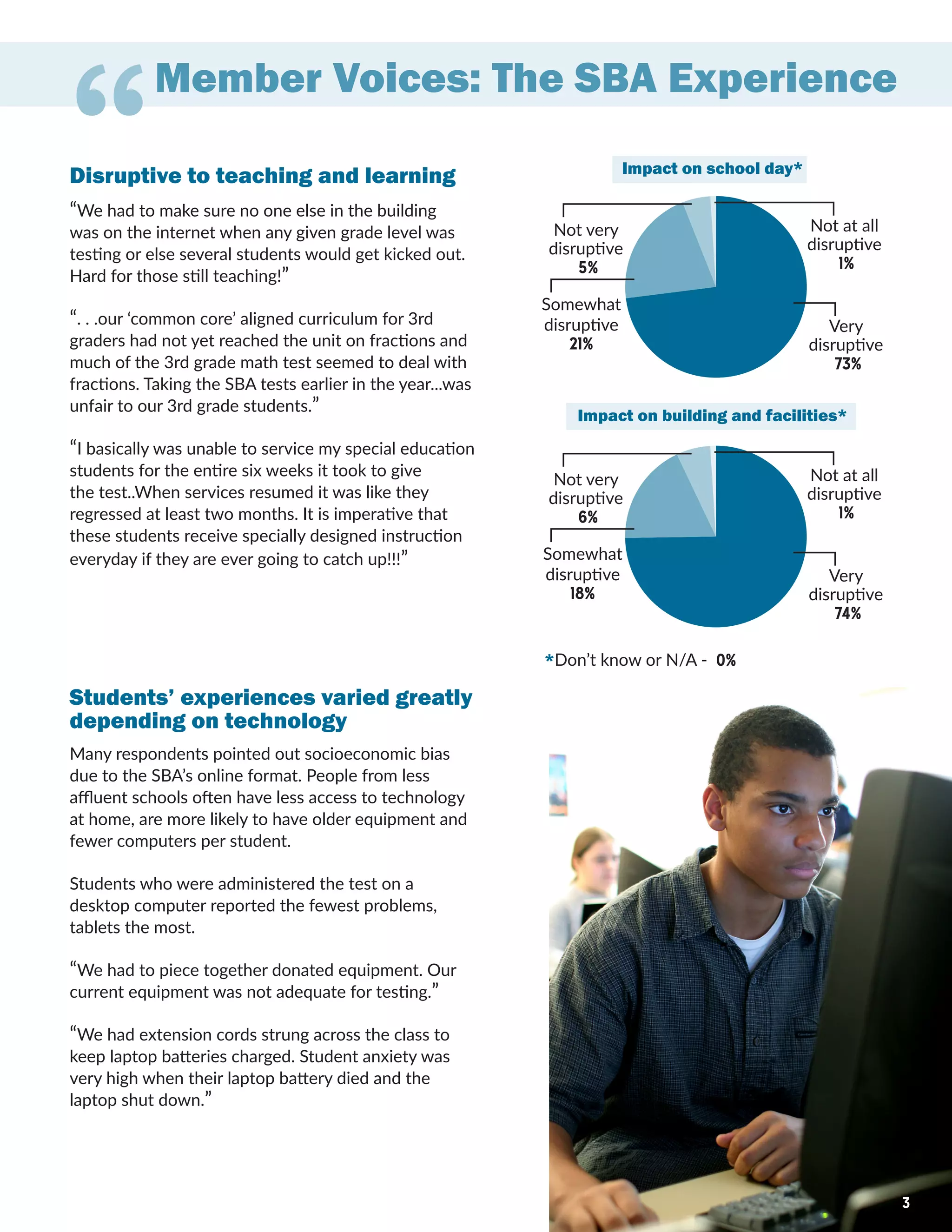
A majority of respondents found Smarter Balanced testing disruptive
to teaching and learning.
Students’ experiences with the test varied greatly from school to
school, often due to inequitable resources to administer the new on-
line assessment.
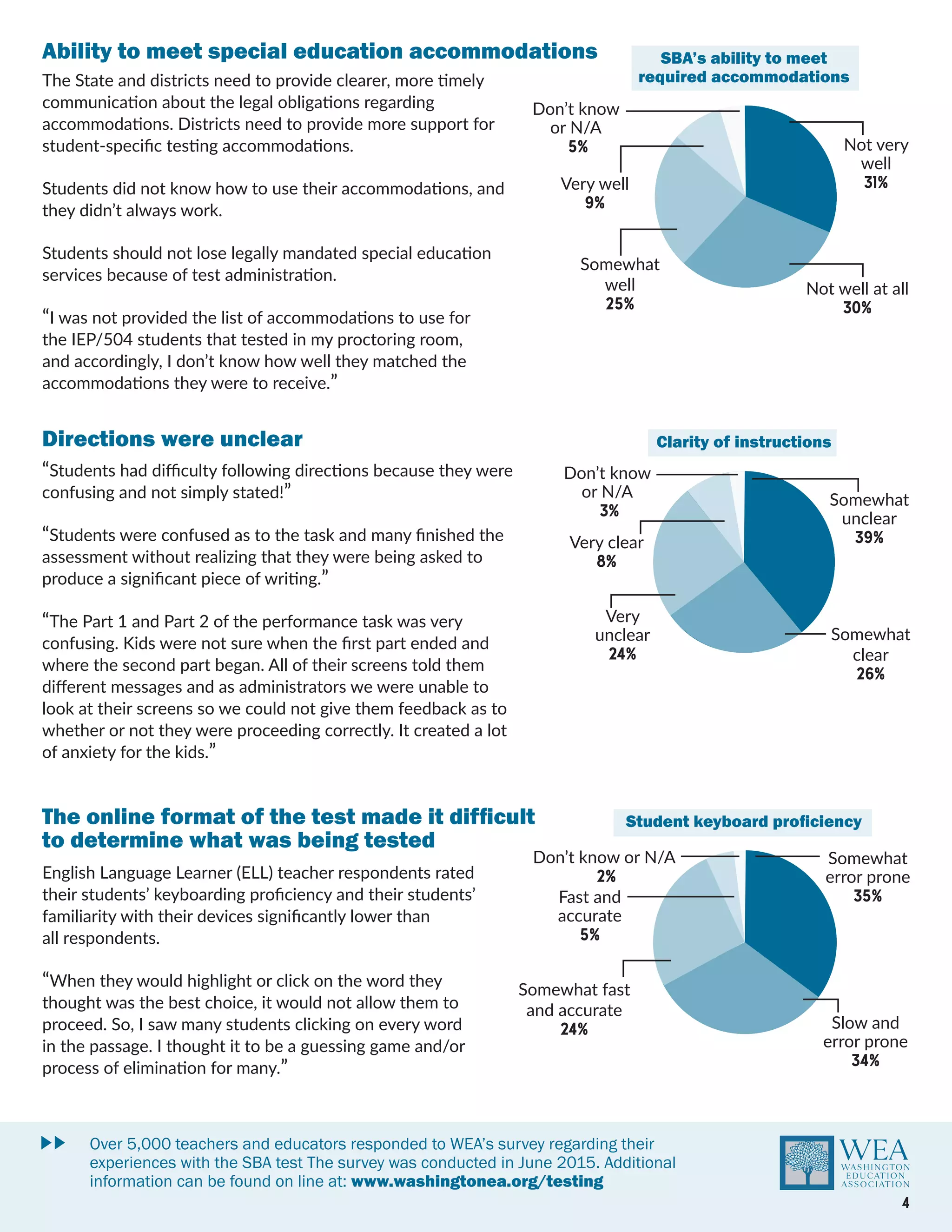
Accommodations for special education students weren’t always
provided as required by law.
Student directions were unnecessarily complicated and created
confusion for many students.
The on-line delivery of the test made it difficult to determine if this
was a test of ELA and math skills, or one of computer skills.
1
2
3
4
5
2
Member Voices: The SBA Experience
“Disruptive to teaching and learning
Students’ experiences varied greatly
depending on technology
Impact on building and facilities*
Very
disruptive
74%
Somewhat
disruptive
18%
Not at all
disruptive
1%
Not very
disruptive
6%
“We had to make sure no one else in the building
was on the internet when any given grade level was
testing or else several students would get kicked out.
Hard for those still teaching!”
“. . .our ‘common core’ aligned curriculum for 3rd
graders had not yet reached the unit on fractions and
much of the 3rd grade math test seemed to deal with
fractions. Taking the SBA tests earlier in the year...was
unfair to our 3rd grade students.”
“I basically was unable to service my special education
students for the entire six weeks it took to give
the test..When services resumed it was like they
regressed at least two months. It is imperative that
these students receive specially designed instruction
everyday if they are ever going to catch up!!!”
Many respondents pointed out socioeconomic bias
due to the SBA’s online format. People from less
affluent schools often have less access to technology
at home, are more likely to have older equipment and
fewer computers per student.
Students who were administered the test on a
desktop computer reported the fewest problems,
tablets the most.
“We had to piece together donated equipment. Our
current equipment was not adequate for testing.”
“We had extension cords strung across the class to
keep laptop batteries charged. Student anxiety was
very high when their laptop battery died and the
laptop shut down.”
*Don’t know or N/A - 0%
Very
disruptive
73%
Somewhat
disruptive
21%
Not at all
disruptive
1%
Not very
disruptive
5%
Impact on school day*
3
“Students had difficulty following directions because they were
confusing and not simply stated!”
“Students were confused as to the task and many finished the
assessment without realizing that they were being asked to
produce a significant piece of writing.”
“The Part 1 and Part 2 of the performance task was very
confusing. Kids were not sure when the first part ended and
where the second part began. All of their screens told them
different messages and as administrators we were unable to
look at their screens so we could not give them feedback as to
whether or not they were proceeding correctly. It created a lot
of anxiety for the kids.”
The State and districts need to provide clearer, more timely
communication about the legal obligations regarding
accommodations. Districts need to provide more support for
student-specific testing accommodations.
Students did not know how to use their accommodations, and
they didn’t always work.
Students should not lose legally mandated special education
services because of test administration.
“I was not provided the list of accommodations to use for
the IEP/504 students that tested in my proctoring room,
and accordingly, I don’t know how well they matched the
accommodations they were to receive.”
English Language Learner (ELL) teacher respondents rated
their students’ keyboarding proficiency and their students’
familiarity with their devices significantly lower than
all respondents.
“When they would highlight or click on the word they
thought was the best choice, it would not allow them to
proceed. So, I saw many students clicking on every word
in the passage. I thought it to be a guessing game and/or
process of elimination for many.”
Ability to meet special education accommodations
Directions were unclear
The online format of the test made it difficult
to determine what was being tested
SBA’s ability to meet
required accommodations
Clarity of instructions
Student keyboard proficiency
Not well at all
30%
Not very
well
31%
Somewhat
well
25%
Don’t know
or N/A
5%
Very well
9%
Somewhat
unclear
39%
Very
unclear
24%
Somewhat
clear
26%
Don’t know
or N/A
3%
Very clear
8%
Somewhat
error prone
35%
Slow and
error prone
34%
Somewhat fast
and accurate
24%
Don’t know or N/A
2%
Fast and
accurate
5%
Over 5,000 teachers and educators responded to WEA’s survey regarding their
experiences with the SBA test The survey was conducted in June 2015. Additional
information can be found on line at: www.washingtonea.org/testing
4

Washington's educators talk about testing

  • 1.
    talk about testing Washington’sEducators WEA believes a high-quality education inspires students’ natural curiosity and supports their desire to learn. Problem solving, collaboration, critical thinking and deep understanding of a wide variety of subjects should be the focus of teaching and learning. Broad-based coursework that includes academic, technical and enrichment classes is essential to a good education. It is Washington’s paramount duty to provide these building blocks for all students in every public school. Unfortunately, we have become overly reliant on standardized tests, which has taken the focus away from student learning and onto test preparation. Since 1997 when the Washington Assessment of Student Learning (WASL) was first administered, we’ve seen the number of standardized tests balloon as districts, and the state and federal governments each require more tests. WEA supports a Student Testing Bill of Rights to ensure that all students regardless of color, economic status, language, special needs or other differences have the opportunities to learn and thrive in their schools. As educators, we agree that tests are necessary but advocate for a more rational approach. Student testing should: • Provide timely and meaningful feedback to students and teachers • Measure progress and learning over time • Reflect content that students have been exposed to in their class • Serve basic learning goals in the context of a broad and engaging curriculum • Be used to identify, rectify, or realign resources or priorities and monitor progress to meet student needs Student testing should not: • Be the sole tool used to determine if a child will move to the next grade or graduate high school • Penalize students for lack of computer skills or English proficiency, cultural differences, developmental differences or the effects of poverty • Be disruptive to learning Washington Education Association | www.washingtonea.org | 800-622-3393 1
  • 2.
    While WEA membershave generally been supportive of the new state learning standards, they continue to express concerns about assessments. The Smarter Balanced Assessment (SBA) is the new test to measure progress towards meeting these standards. With the first year of SBA behind us, WEA surveyed members to learn more about their experience administering it. Top Findings from the 2015 WEA Educator Survey on SBA A majority of respondents found Smarter Balanced testing disruptive to teaching and learning. Students’ experiences with the test varied greatly from school to school, often due to inequitable resources to administer the new on- line assessment. Accommodations for special education students weren’t always provided as required by law. Student directions were unnecessarily complicated and created confusion for many students. The on-line delivery of the test made it difficult to determine if this was a test of ELA and math skills, or one of computer skills. 1 2 3 4 5 2
  • 3.
    Member Voices: TheSBA Experience “Disruptive to teaching and learning Students’ experiences varied greatly depending on technology Impact on building and facilities* Very disruptive 74% Somewhat disruptive 18% Not at all disruptive 1% Not very disruptive 6% “We had to make sure no one else in the building was on the internet when any given grade level was testing or else several students would get kicked out. Hard for those still teaching!” “. . .our ‘common core’ aligned curriculum for 3rd graders had not yet reached the unit on fractions and much of the 3rd grade math test seemed to deal with fractions. Taking the SBA tests earlier in the year...was unfair to our 3rd grade students.” “I basically was unable to service my special education students for the entire six weeks it took to give the test..When services resumed it was like they regressed at least two months. It is imperative that these students receive specially designed instruction everyday if they are ever going to catch up!!!” Many respondents pointed out socioeconomic bias due to the SBA’s online format. People from less affluent schools often have less access to technology at home, are more likely to have older equipment and fewer computers per student. Students who were administered the test on a desktop computer reported the fewest problems, tablets the most. “We had to piece together donated equipment. Our current equipment was not adequate for testing.” “We had extension cords strung across the class to keep laptop batteries charged. Student anxiety was very high when their laptop battery died and the laptop shut down.” *Don’t know or N/A - 0% Very disruptive 73% Somewhat disruptive 21% Not at all disruptive 1% Not very disruptive 5% Impact on school day* 3
  • 4.
    “Students had difficultyfollowing directions because they were confusing and not simply stated!” “Students were confused as to the task and many finished the assessment without realizing that they were being asked to produce a significant piece of writing.” “The Part 1 and Part 2 of the performance task was very confusing. Kids were not sure when the first part ended and where the second part began. All of their screens told them different messages and as administrators we were unable to look at their screens so we could not give them feedback as to whether or not they were proceeding correctly. It created a lot of anxiety for the kids.” The State and districts need to provide clearer, more timely communication about the legal obligations regarding accommodations. Districts need to provide more support for student-specific testing accommodations. Students did not know how to use their accommodations, and they didn’t always work. Students should not lose legally mandated special education services because of test administration. “I was not provided the list of accommodations to use for the IEP/504 students that tested in my proctoring room, and accordingly, I don’t know how well they matched the accommodations they were to receive.” English Language Learner (ELL) teacher respondents rated their students’ keyboarding proficiency and their students’ familiarity with their devices significantly lower than all respondents. “When they would highlight or click on the word they thought was the best choice, it would not allow them to proceed. So, I saw many students clicking on every word in the passage. I thought it to be a guessing game and/or process of elimination for many.” Ability to meet special education accommodations Directions were unclear The online format of the test made it difficult to determine what was being tested SBA’s ability to meet required accommodations Clarity of instructions Student keyboard proficiency Not well at all 30% Not very well 31% Somewhat well 25% Don’t know or N/A 5% Very well 9% Somewhat unclear 39% Very unclear 24% Somewhat clear 26% Don’t know or N/A 3% Very clear 8% Somewhat error prone 35% Slow and error prone 34% Somewhat fast and accurate 24% Don’t know or N/A 2% Fast and accurate 5% Over 5,000 teachers and educators responded to WEA’s survey regarding their experiences with the SBA test The survey was conducted in June 2015. Additional information can be found on line at: www.washingtonea.org/testing 4