Herbal therapy in Veterinary
Medicine
Presented by
Dr Ajith Y. MVSc
Division of Medicine
IVRI, Izatnagar, UP, India
Basic Terminology
• Alternative medicine refers to
treatments or therapies that are
outside accepted conventional
medicine
• Complementary medicine refers to
the use of alternative therapies with
or in addition to conventional
treatment
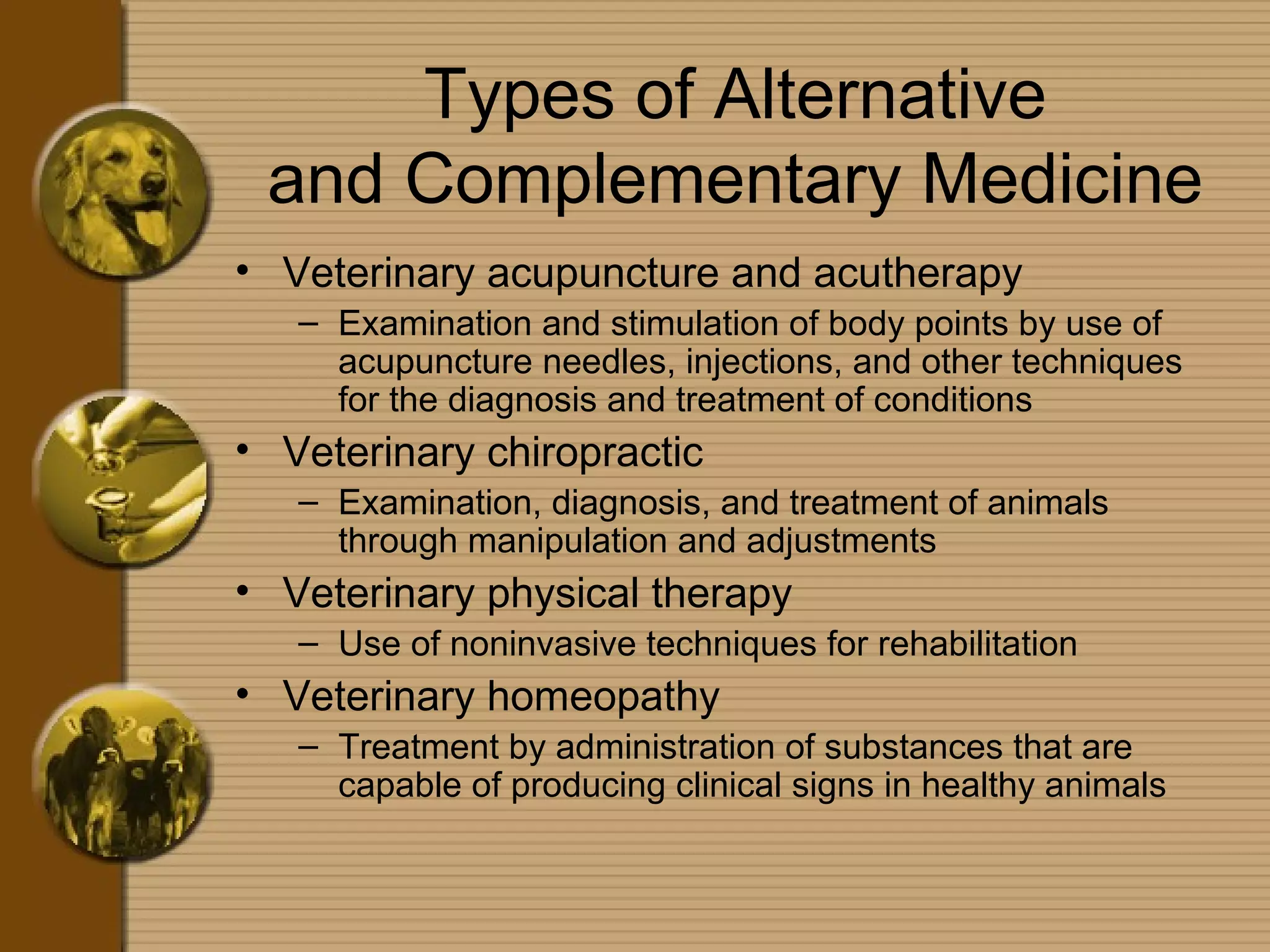
Types of Alternative
and Complementary Medicine
• Veterinary acupuncture and acutherapy
– Examination and stimulation of body points by use of
acupuncture needles, injections, and other techniques
for the diagnosis and treatment of conditions
• Veterinary chiropractic
– Examination, diagnosis, and treatment of animals
through manipulation and adjustments
• Veterinary physical therapy
– Use of noninvasive techniques for rehabilitation
• Veterinary homeopathy
– Treatment by administration of substances that are
capable of producing clinical signs in healthy animals
Types of Alternative
and Complementary Medicine
• Veterinary botanical medicine
– Uses plants and plant derivatives as
therapeutic agents
• Nutraceutical medicine
– Uses micronutrients, macronutrients, and
other nutritional supplements as therapeutic
agents
• Holistic veterinary medicine
– Comprehensive approach to health care using
both alternative and conventional diagnostic
techniques and therapeutic approaches
Herbal Supplements
• Herbal supplements are one of the fastest
growing segments of the dietary supplement
market
– One reason may be the desire for a more holistic
approach to health care
– Another reason may be that people believe
conventional treatments have real or perceived
limitations
– Another reason may be that people believe natural
products do not have side effects
– Herbs have been used for a long time
– Advertising methods have influenced people’s buying
behavior
CONSTRAINTS
• The absence of any breakthrough in
this area has various reasons: -
• Lack of standardization.
• Some synthetic compounds are too
toxic.
• Severe side effects.
• Unknown mechanism of action .
SOME OF THE HERBAL PRODUCT AVAILABLE IN MARKET
Quality Control
• Herbal supplements do not require FDA approval
because they are considered food supplements
• Herbal supplements may have active ingredients
that vary among dose forms
• The FDA is working with several trade
organizations to develop guidelines for herbal
supplements
• Table 23-1 covers other factors affecting herb
quality
• See Table 23-2 for information on herbal forms
Ginkgo
Ginkgo biloba
• Active ingredients are
ginkgo flavone
glycosides and
terpene lactones
• Used to reduce aging
effects of the nervous
system, to reduce
hypertension, and as
a general tonic in
animals
• May inhibit
cytochrome P450 and
induce hypoglycemia
St. John’s Wort
Hypericum perforatum
• Active component,
hyperforin, regulates the
effects of serotonin
• Used to treat behavior
disorders such as lick
granulomas, aggression,
separation anxiety, and
obsessive-compulsive
disorders
• May inhibit cytochrome
P450, affect blood
pressure, and cause
photosensitivity
Ginseng
Panax ginseng
• Active component,
ginsenosides, are
responsible for increasing
energy, countering stress,
and enhancing physical
performance
• Also seems to stimulate
natural killer cell activity
• Used to treat weight loss,
anorexia, and systemic
infections
• May affect blood glucose
levels, increase blood
pressure and heart rate,
increase GI motility, and
induce seizures at high
levels
Garlic
Allium sativum
• Active component, allicin,
causes reduction of
cholesterol, triglyceride
levels, and hypertension
• Believed to have
anticarcinogenic properties
• Used to treat parasitic
infections, fungal infections,
and respiratory problems,
and to acidify urine (some
with limited success)
• May cause inhibition of
platelet aggregation,
prolonged bleeding times, GI
upset, and Heinz body
anemia
Echinacea
Echinacea purpurea
• Active components,
fructofuranosides,
contribute to tissue
regeneration, regulation of
the inflammatory
response, and a mild
cortisone-like effect
• Stimulates phagocytosis
and natural killer cell
activity
• Used to shorten the
severity and duration of
infections
• Side effects are minimal
Saw palmetto
Serenoa repens
• Fatty acids from the
berries produce an
enzyme to prevent
the conversion of
testosterone to
dihydrotestosterone
• Used to treat benign
prostatic hyperplasia,
to stimulate appetite,
and as a mild diuretic
• Side effects are
minimal other than
gastrointestinal
problems
Evening primrose
Oenothera biennis
• Contains gamma-linolenic
acid, an acid in the
omega-6 family
• Used to treat premenstrual
syndrome, rheumatoid
arthritis, diabetic
neuropathy, and eczema
in humans
• Side effects include loose
stools and abdominal
cramps
• May lower the seizure
threshold in some on
phenothiazine medication;
use caution in animals
Goldenseal
Hydrastis canadensis
• Active ingredient,
berberine, gives
goldenseal its
antibacterial and
antiparasitic
properties
• Used to treat bacterial
and parasitic
infections
• Side effects include
cardiac problems, and
stimulation of the
CNS and uterine
contractions
Cranberry
Vaccinium macrocarpon
• Interferes with the
attachment of urinary
pathogens to the
urinary bladder wall
• Used to treat urinary
tract infections
• Side effects include
diarrhea, stomach
problems, and the
development of
kidney stones
Valerian
Valeriana officinalis
• Volatile oils in valerian
break down the
inhibitory substance
GABA
• Used to treat
hyperactivity in dogs,
for mild tranquilization,
and as a sleep aid
• Side effects include
hepatotoxicity with
long-term use and
interaction with other
depressant drugs
Echinacea (Echinacea
species)
• Extracts from shoot, root and
rhizome
• Acts as immunostimulant
• Speeds up cycle of cold virus
and flu
Garlic (Allium sativum)
Onion (Allium cepa)
• Organo-sulfur
compounds from leaves
• Anti-carcinogenic and
anti-microbial
• Anti-atherosclerosis and
anti-hypertensive
• Toxic in high amounts
Green Tea (Camellia sinensis)
• Polyphenols from leaves
• anti-cancer inhibiting tumor
initiation and cell proliferation
• anti-oxidant
Wine Grape (Vitis vinifera)
• Contains over 50 different flavonoid
phenolics including resveratrol and
catechins
• Reduces heart disease by inhibiting
platelet aggregation, lowering LDL
(low density lipoproteins) and acting
as antioxidants
Ginger (Zingiber officinale)
• From the rhizome
• Over 12 compounds
with anti-oxidant
activities greater
than vitamin E
• anti-tumor
• anti-emetic (inhibits
vomiting)
IMMUNOSTIMULATORY PLANTS OF INDIA
Advice Regarding Herbs
• The National Animal Supplement
Council has developed a
“Compliance Plus” program to
develop standards for the herbal
supplement and product industry
– Provides reliable information to clients
about possible side effects or
interactions
• Follow general guidelines listed
General Guidelines for Herbs
• Ask all clients whether they give herbs or other
supplements to their animals
• Inform clients that herb-drug interactions exist
• Encourage the use of standardized products from
respected manufacturers
• Use herbal therapies in recommended doses
• Avoid herbs with known toxicities
• Do not use herbs in pregnant or nursing animals,
the very young, or the very old
• Accurate diagnosis of the animal’s condition is
essential to evaluate all therapeutic options
• Document all herb or supplement use in the
animal’s medical record
Herbal therapy in veterinary Medicine

Herbal therapy in veterinary Medicine

  • 1.
    Herbal therapy inVeterinary Medicine Presented by Dr Ajith Y. MVSc Division of Medicine IVRI, Izatnagar, UP, India
  • 2.
    Basic Terminology • Alternativemedicine refers to treatments or therapies that are outside accepted conventional medicine • Complementary medicine refers to the use of alternative therapies with or in addition to conventional treatment
  • 3.
    Types of Alternative andComplementary Medicine • Veterinary acupuncture and acutherapy – Examination and stimulation of body points by use of acupuncture needles, injections, and other techniques for the diagnosis and treatment of conditions • Veterinary chiropractic – Examination, diagnosis, and treatment of animals through manipulation and adjustments • Veterinary physical therapy – Use of noninvasive techniques for rehabilitation • Veterinary homeopathy – Treatment by administration of substances that are capable of producing clinical signs in healthy animals
  • 4.
    Types of Alternative andComplementary Medicine • Veterinary botanical medicine – Uses plants and plant derivatives as therapeutic agents • Nutraceutical medicine – Uses micronutrients, macronutrients, and other nutritional supplements as therapeutic agents • Holistic veterinary medicine – Comprehensive approach to health care using both alternative and conventional diagnostic techniques and therapeutic approaches
  • 5.
    Herbal Supplements • Herbalsupplements are one of the fastest growing segments of the dietary supplement market – One reason may be the desire for a more holistic approach to health care – Another reason may be that people believe conventional treatments have real or perceived limitations – Another reason may be that people believe natural products do not have side effects – Herbs have been used for a long time – Advertising methods have influenced people’s buying behavior
  • 6.
    CONSTRAINTS • The absenceof any breakthrough in this area has various reasons: - • Lack of standardization. • Some synthetic compounds are too toxic. • Severe side effects. • Unknown mechanism of action .
  • 7.
    SOME OF THEHERBAL PRODUCT AVAILABLE IN MARKET
  • 8.
    Quality Control • Herbalsupplements do not require FDA approval because they are considered food supplements • Herbal supplements may have active ingredients that vary among dose forms • The FDA is working with several trade organizations to develop guidelines for herbal supplements • Table 23-1 covers other factors affecting herb quality • See Table 23-2 for information on herbal forms
  • 9.
    Ginkgo Ginkgo biloba • Activeingredients are ginkgo flavone glycosides and terpene lactones • Used to reduce aging effects of the nervous system, to reduce hypertension, and as a general tonic in animals • May inhibit cytochrome P450 and induce hypoglycemia
  • 10.
    St. John’s Wort Hypericumperforatum • Active component, hyperforin, regulates the effects of serotonin • Used to treat behavior disorders such as lick granulomas, aggression, separation anxiety, and obsessive-compulsive disorders • May inhibit cytochrome P450, affect blood pressure, and cause photosensitivity
  • 11.
    Ginseng Panax ginseng • Activecomponent, ginsenosides, are responsible for increasing energy, countering stress, and enhancing physical performance • Also seems to stimulate natural killer cell activity • Used to treat weight loss, anorexia, and systemic infections • May affect blood glucose levels, increase blood pressure and heart rate, increase GI motility, and induce seizures at high levels
  • 12.
    Garlic Allium sativum • Activecomponent, allicin, causes reduction of cholesterol, triglyceride levels, and hypertension • Believed to have anticarcinogenic properties • Used to treat parasitic infections, fungal infections, and respiratory problems, and to acidify urine (some with limited success) • May cause inhibition of platelet aggregation, prolonged bleeding times, GI upset, and Heinz body anemia
  • 13.
    Echinacea Echinacea purpurea • Activecomponents, fructofuranosides, contribute to tissue regeneration, regulation of the inflammatory response, and a mild cortisone-like effect • Stimulates phagocytosis and natural killer cell activity • Used to shorten the severity and duration of infections • Side effects are minimal
  • 14.
    Saw palmetto Serenoa repens •Fatty acids from the berries produce an enzyme to prevent the conversion of testosterone to dihydrotestosterone • Used to treat benign prostatic hyperplasia, to stimulate appetite, and as a mild diuretic • Side effects are minimal other than gastrointestinal problems
  • 15.
    Evening primrose Oenothera biennis •Contains gamma-linolenic acid, an acid in the omega-6 family • Used to treat premenstrual syndrome, rheumatoid arthritis, diabetic neuropathy, and eczema in humans • Side effects include loose stools and abdominal cramps • May lower the seizure threshold in some on phenothiazine medication; use caution in animals
  • 16.
    Goldenseal Hydrastis canadensis • Activeingredient, berberine, gives goldenseal its antibacterial and antiparasitic properties • Used to treat bacterial and parasitic infections • Side effects include cardiac problems, and stimulation of the CNS and uterine contractions
  • 17.
    Cranberry Vaccinium macrocarpon • Interfereswith the attachment of urinary pathogens to the urinary bladder wall • Used to treat urinary tract infections • Side effects include diarrhea, stomach problems, and the development of kidney stones
  • 18.
    Valerian Valeriana officinalis • Volatileoils in valerian break down the inhibitory substance GABA • Used to treat hyperactivity in dogs, for mild tranquilization, and as a sleep aid • Side effects include hepatotoxicity with long-term use and interaction with other depressant drugs
  • 19.
    Echinacea (Echinacea species) • Extractsfrom shoot, root and rhizome • Acts as immunostimulant • Speeds up cycle of cold virus and flu
  • 20.
    Garlic (Allium sativum) Onion(Allium cepa) • Organo-sulfur compounds from leaves • Anti-carcinogenic and anti-microbial • Anti-atherosclerosis and anti-hypertensive • Toxic in high amounts
  • 21.
    Green Tea (Camelliasinensis) • Polyphenols from leaves • anti-cancer inhibiting tumor initiation and cell proliferation • anti-oxidant
  • 22.
    Wine Grape (Vitisvinifera) • Contains over 50 different flavonoid phenolics including resveratrol and catechins • Reduces heart disease by inhibiting platelet aggregation, lowering LDL (low density lipoproteins) and acting as antioxidants
  • 23.
    Ginger (Zingiber officinale) •From the rhizome • Over 12 compounds with anti-oxidant activities greater than vitamin E • anti-tumor • anti-emetic (inhibits vomiting)
  • 24.
  • 26.
    Advice Regarding Herbs •The National Animal Supplement Council has developed a “Compliance Plus” program to develop standards for the herbal supplement and product industry – Provides reliable information to clients about possible side effects or interactions • Follow general guidelines listed
  • 27.
    General Guidelines forHerbs • Ask all clients whether they give herbs or other supplements to their animals • Inform clients that herb-drug interactions exist • Encourage the use of standardized products from respected manufacturers • Use herbal therapies in recommended doses • Avoid herbs with known toxicities • Do not use herbs in pregnant or nursing animals, the very young, or the very old • Accurate diagnosis of the animal’s condition is essential to evaluate all therapeutic options • Document all herb or supplement use in the animal’s medical record