DEVELOPMENT
OF
PERSONALITY
SHELI DUYA
Your best quote that reflects your
approach… “It’s one small step for
man, one giant leap for mankind.”
- NEIL ARMSTRONG
PERSONALITY DEVELOPMENT
The behaviors that make people different from one another
are those behaviors that psychologists consider to be at the
root of personality.
Personality is what makes a person a unique person and it
is recognizable soon after birth.
Personality
•Personality: Refers to the relatively enduring characteristics that differentiate
one person from another and that lead people to act in a consistent and
predictable manner, both in different situations and over extended periods of
time.
•It is a distinctive and relatively stable pattern of behaviors, thoughts, motives,
and emotions that characterizes an individual.
Personality
Personality development is the development of the organized pattern of
behaviours and attitudes that makes a person distinctive.
This development occurs due to ongoing interaction of temperament,
character and environment.
Personality
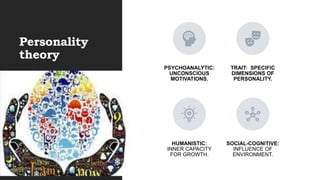
theory
PSYCHOANALYTIC:
UNCONSCIOUS
MOTIVATIONS.
TRAIT: SPECIFIC
DIMENSIONS OF
PERSONALITY.
HUMANISTIC:
INNER CAPACITY
FOR GROWTH.
SOCIAL-COGNITIVE:
INFLUENCE OF
ENVIRONMENT.
Sigmund Freud pioneered
personality psychology!
 What is the structure and development of personality,
according to Sigmund Freud and his successors
(i.e.,psychoanalysts)?
 According to psychoanalysts, much of behaviour is caused
by parts of personality which are found in the unconscious
and of which we are unaware.
 Freud’s 3 levels of awareness/consciousness:
 the conscious mind;
 the preconscious mind; and
 the unconscious mind.
Psychoanalysis:
Freud’s Theory of Personality
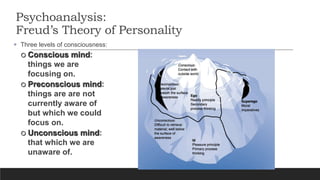
 Three levels of consciousness:
 Conscious mind:
things we are
focusing on.
 Preconscious mind:
things are are not
currently aware of
but which we could
focus on.
 Unconscious mind:
that which we are
unaware of.
Psychoanalysis:
Freud’s Theory of Personality
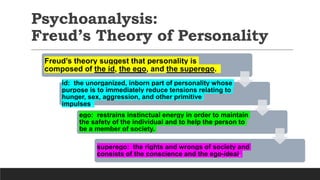
Freud’s theory suggest that personality is
composed of the id, the ego, and the superego.
id: the unorganized, inborn part of personality whose
purpose is to immediately reduce tensions relating to
hunger, sex, aggression, and other primitive
impulses.
ego: restrains instinctual energy in order to maintain
the safety of the individual and to help the person to
be a member of society.
superego: the rights and wrongs of society and
consists of the conscience and the ego-ideal.
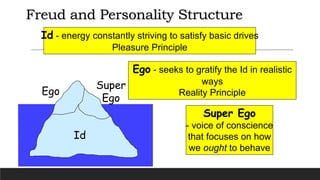
Freud and Personality Structure
Id - energy constantly striving to satisfy basic drives
Pleasure Principle
Ego - seeks to gratify the Id in realistic
ways
Reality Principle
Super Ego
- voice of conscience
that focuses on how
we ought to behave
Ego
Super
Ego
Id
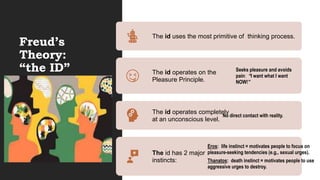
Freud’s
Theory:
“the ID”
The id uses the most primitive of thinking process.
The id operates on the
Pleasure Principle.
Seeks pleasure and avoids
pain: “I want what I want
NOW!”
The id operates completely
at an unconscious level.
No direct contact with reality.
The id has 2 major
instincts:
Eros: life instinct = motivates people to focus on
pleasure-seeking tendencies (e.g., sexual urges).
Thanatos: death instinct = motivates people to use
aggressive urges to destroy.
Freud: superego, id, and ego
According to Freud, an individual’s feelings,
thoughts, and behaviors are the result of the
interaction of the id, the superego, and
the ego.
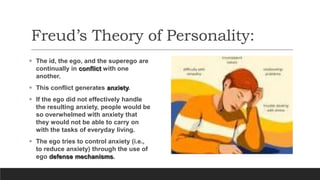
Freud’s Theory of Personality:
 The id, the ego, and the superego are
continually in conflict with one
another.
 This conflict generates anxiety.
 If the ego did not effectively handle
the resulting anxiety, people would be
so overwhelmed with anxiety that
they would not be able to carry on
with the tasks of everyday living.
 The ego tries to control anxiety (i.e.,
to reduce anxiety) through the use of
ego defense mechanisms.
Freud:
Stages of Personality Development
More specifically, Freud theorized that as people age, they pass through several
systematic stages of psychosexual development in their personality.
.
Freud’s psychoanalytic theory of personality suggests that personality develops through
a series of stages, each of which is associated with a major biological function.
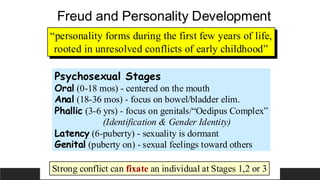
Freud and Personality Development
“personality forms during the first few years of life,
rooted in unresolved conflicts of early childhood”
“personality forms during the first few years of life,
rooted in unresolved conflicts of early childhood”
Psychosexual Stages
Oral (0-18 mos) - centered on the mouth
Anal (18-36 mos) - focus on bowel/bladder elim.

Phallic (3-6 yrs) - focus on genitals/“Oedipus Complex”
(Identification & Gender Identity)
Latency (6-puberty) - sexuality is dormant
Genital (puberty on) - sexual feelings toward others
Strong conflict can fixate an individual at Stages 1,2 or 3
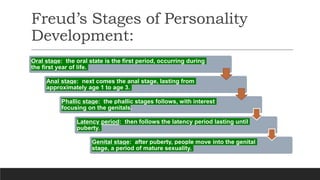
Freud’s Stages of Personality
Development:
Oral stage: the oral state is the first period, occurring during
the first year of life.

Anal stage: next comes the anal stage, lasting from
approximately age 1 to age 3.
Phallic stage: the phallic stages follows, with interest
focusing on the genitals.
Latency period: then follows the latency period lasting until
puberty.
Genital stage: after puberty, people move into the genital
stage, a period of mature sexuality.
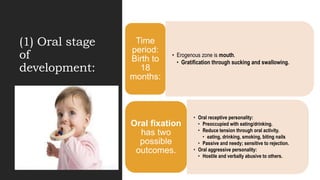
(1) Oral stage
of
development:
• Erogenous zone is mouth.
• Gratification through sucking and swallowing.
Time
period:
Birth to
18
months:
• Oral receptive personality:
• Preoccupied with eating/drinking.
• Reduce tension through oral activity.
• eating, drinking, smoking, biting nails
• Passive and needy; sensitive to rejection.
• Oral aggressive personality:
• Hostile and verbally abusive to others.
Oral fixation
has two
possible
outcomes.
CONT..
CONT..
DEVELOPMENT      OF     PERSONALITY.pptx

DEVELOPMENT OF PERSONALITY.pptx

  • 1.
  • 2.
    Your best quotethat reflects your approach… “It’s one small step for man, one giant leap for mankind.” - NEIL ARMSTRONG
  • 3.
    PERSONALITY DEVELOPMENT The behaviorsthat make people different from one another are those behaviors that psychologists consider to be at the root of personality. Personality is what makes a person a unique person and it is recognizable soon after birth.
  • 4.
    Personality •Personality: Refers tothe relatively enduring characteristics that differentiate one person from another and that lead people to act in a consistent and predictable manner, both in different situations and over extended periods of time. •It is a distinctive and relatively stable pattern of behaviors, thoughts, motives, and emotions that characterizes an individual.
  • 5.
    Personality Personality development isthe development of the organized pattern of behaviours and attitudes that makes a person distinctive. This development occurs due to ongoing interaction of temperament, character and environment.
  • 6.
  • 7.
    Sigmund Freud pioneered personalitypsychology!  What is the structure and development of personality, according to Sigmund Freud and his successors (i.e.,psychoanalysts)?  According to psychoanalysts, much of behaviour is caused by parts of personality which are found in the unconscious and of which we are unaware.  Freud’s 3 levels of awareness/consciousness:  the conscious mind;  the preconscious mind; and  the unconscious mind.
  • 8.
    Psychoanalysis: Freud’s Theory ofPersonality  Three levels of consciousness:  Conscious mind: things we are focusing on.  Preconscious mind: things are are not currently aware of but which we could focus on.  Unconscious mind: that which we are unaware of.
  • 9.
    Psychoanalysis: Freud’s Theory ofPersonality Freud’s theory suggest that personality is composed of the id, the ego, and the superego. id: the unorganized, inborn part of personality whose purpose is to immediately reduce tensions relating to hunger, sex, aggression, and other primitive impulses. ego: restrains instinctual energy in order to maintain the safety of the individual and to help the person to be a member of society. superego: the rights and wrongs of society and consists of the conscience and the ego-ideal.
  • 10.
    Freud and PersonalityStructure Id - energy constantly striving to satisfy basic drives Pleasure Principle Ego - seeks to gratify the Id in realistic ways Reality Principle Super Ego - voice of conscience that focuses on how we ought to behave Ego Super Ego Id
  • 11.
    Freud’s Theory: “the ID” The iduses the most primitive of thinking process. The id operates on the Pleasure Principle. Seeks pleasure and avoids pain: “I want what I want NOW!” The id operates completely at an unconscious level. No direct contact with reality. The id has 2 major instincts: Eros: life instinct = motivates people to focus on pleasure-seeking tendencies (e.g., sexual urges). Thanatos: death instinct = motivates people to use aggressive urges to destroy.
  • 12.
    Freud: superego, id,and ego According to Freud, an individual’s feelings, thoughts, and behaviors are the result of the interaction of the id, the superego, and the ego.
  • 13.
    Freud’s Theory ofPersonality:  The id, the ego, and the superego are continually in conflict with one another.  This conflict generates anxiety.  If the ego did not effectively handle the resulting anxiety, people would be so overwhelmed with anxiety that they would not be able to carry on with the tasks of everyday living.  The ego tries to control anxiety (i.e., to reduce anxiety) through the use of ego defense mechanisms.
  • 14.
    Freud: Stages of PersonalityDevelopment More specifically, Freud theorized that as people age, they pass through several systematic stages of psychosexual development in their personality. . Freud’s psychoanalytic theory of personality suggests that personality develops through a series of stages, each of which is associated with a major biological function.
  • 15.
    Freud and PersonalityDevelopment “personality forms during the first few years of life, rooted in unresolved conflicts of early childhood” “personality forms during the first few years of life, rooted in unresolved conflicts of early childhood” Psychosexual Stages Oral (0-18 mos) - centered on the mouth Anal (18-36 mos) - focus on bowel/bladder elim. Phallic (3-6 yrs) - focus on genitals/“Oedipus Complex” (Identification & Gender Identity) Latency (6-puberty) - sexuality is dormant Genital (puberty on) - sexual feelings toward others Strong conflict can fixate an individual at Stages 1,2 or 3
  • 16.
    Freud’s Stages ofPersonality Development: Oral stage: the oral state is the first period, occurring during the first year of life. Anal stage: next comes the anal stage, lasting from approximately age 1 to age 3. Phallic stage: the phallic stages follows, with interest focusing on the genitals. Latency period: then follows the latency period lasting until puberty. Genital stage: after puberty, people move into the genital stage, a period of mature sexuality.
  • 17.
    (1) Oral stage of development: •Erogenous zone is mouth. • Gratification through sucking and swallowing. Time period: Birth to 18 months: • Oral receptive personality: • Preoccupied with eating/drinking. • Reduce tension through oral activity. • eating, drinking, smoking, biting nails • Passive and needy; sensitive to rejection. • Oral aggressive personality: • Hostile and verbally abusive to others. Oral fixation has two possible outcomes.
  • 19.
  • 20.