Hematology, Chemistry,
Coagulation
Helpful Hints
Hematology
• A good check to see if your
Complete Blood Counts on your
patient results are valid is the
“RULE OF THREE”
Hematology
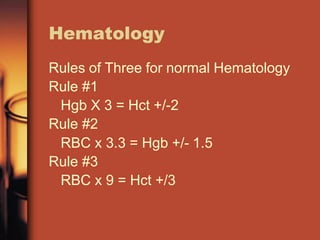
Rules of Three for normal Hematology
Rule #1
Hgb X 3 = Hct +/-2
Rule #2
RBC x 3.3 = Hgb +/- 1.5
Rule #3
RBC x 9 = Hct +/3
Hematology
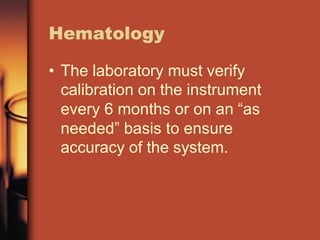
• The laboratory must verify
calibration on the instrument
every 6 months or on an “as
needed” basis to ensure
accuracy of the system.
Hematology
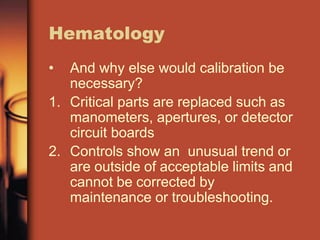
• And why else would calibration be
necessary?
1. Critical parts are replaced such as
manometers, apertures, or detector
circuit boards
2. Controls show an unusual trend or
are outside of acceptable limits and
cannot be corrected by
maintenance or troubleshooting.
Hematology
• Low platelet counts on an individual
that has no bleeding symptoms, try
checking the blood smear for platelet
clumping or platelets satelliting
around the neutrophils
Hematology
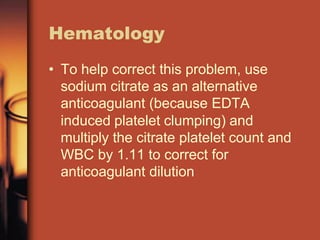
• To help correct this problem, use
sodium citrate as an alternative
anticoagulant (because EDTA
induced platelet clumping) and
multiply the citrate platelet count and
WBC by 1.11 to correct for
anticoagulant dilution
Hematology
• What should you be doing if you
have two different hematology
instruments?
• Or if you have two instruments that
are the same
Hematology
• Comparison check
Hematology
Do not use non Clorox bleach or any
scented Clorox bleach for cleaning
the instruments.
If you can not get Clorox, then
Chemistry
• The laboratory must very calibration
every six months or on an “as
needed” basis to ensure accuracy of
the system.
Chemistry
• And why else would calibration be
necessary?
1.Critical parts are replaced
2.Controls show an unusual trend or
are outside of acceptable limits and
cannot be corrected by maintenance
or troubleshooting.
Coagulation
• If you are using a manual or semi-
automated method for your APTTs,
the timing of the incubation of your
“patient plasma + reagent” is critical.
The Timing of your duplicate testing
needs to be precise. Any deviations
in timing will usually result in the
duplicate test results not matching.
• The tests needs to be run with the
same timing limits as the controls.
• So what does that mean you should
be checking?
Coagulation
• Your timer!
• Controls (normal and abnormal) are
typically valid for one year.
• Ranges are not established so you
must establish your own ranges.
• Run the controls a minimum of 30
times to establish the mean and
SDs.
Quality Control
• Internal Quality Control
• Reagent Check (Parallel Testing)
• External Quality Control (proficiency
programs)
• Blind Samples
• Competency Checks
• Quality control material
• Quality control ranges
• Plotting results (Levey-Jennings
Graphs)
• Reviewing Results
• Corrective Action Logs
• Reagent Checks (parallel testing)
• Review & Signature
• Do you have appropriate controls for
each procedure?
Quantitative: low (normal) & high
normal & abnormal
• Do you treat your control material
like the patient samples?
• Are the control results verified
BEFORE patient results are
released?
• How often do you run your controls?
*per manufacturers instructions
*per laboratory guidelines
*can always run more than
recommendation
*balance time, cost and efficacy
“General Guidelines”
CBC: per 8 hour shift
Manual Differentials/BPS: per day
(stain check)
Chemistry: per 8 hour shift
• Document results on run sheet or QC log
• Include lot #’s & expiration dates
• Include tech initials & run date
• For QT assays,
Manufacturers Mean & Range (~+2.5
SD)
Internal Mean + 2 & 3 SD
Levey-Jennings Control Charts
• Why use Levey-Jennings control
charts?
• Patterns
1:2s, 1:3s
Dispersion (loss of precision)
Trend
Shift
• Lab supervisor review if exceeded
(*before patient results are
released)
• Corrective action if needed
(document)
• Retest if required
• QC ‘failures’ must be reviewed and
signed off by lab supervisor or higher
• All unexpected or failed QC results must
be documented – Corrective Action Log
• Final action must demonstrate problem
was resolved
• Lab Sup/Mgr must review/sign CA Logs
at least monthly
• Must have CA log for every
test/equipment/system
• Why do parallel testing?
Consistency of patient results
Transition of control
• Chemistry: New control lot in
parallelàmean/SD
• CBC/FBC: New control lot in
parallel 3-5 days
• At the October Meeting:
– Westgard Rules
– Normal Values
– QC and corrective action
– QA
– Instrument Validation
– Carryover Studies

Hematology Chemistry Coagulation

  • 1.
  • 2.
    Hematology • A goodcheck to see if your Complete Blood Counts on your patient results are valid is the “RULE OF THREE”
  • 3.
    Hematology Rules of Threefor normal Hematology Rule #1 Hgb X 3 = Hct +/-2 Rule #2 RBC x 3.3 = Hgb +/- 1.5 Rule #3 RBC x 9 = Hct +/3
  • 4.
    Hematology • The laboratorymust verify calibration on the instrument every 6 months or on an “as needed” basis to ensure accuracy of the system.
  • 5.
    Hematology • And whyelse would calibration be necessary? 1. Critical parts are replaced such as manometers, apertures, or detector circuit boards 2. Controls show an unusual trend or are outside of acceptable limits and cannot be corrected by maintenance or troubleshooting.
  • 6.
    Hematology • Low plateletcounts on an individual that has no bleeding symptoms, try checking the blood smear for platelet clumping or platelets satelliting around the neutrophils
  • 7.
    Hematology • To helpcorrect this problem, use sodium citrate as an alternative anticoagulant (because EDTA induced platelet clumping) and multiply the citrate platelet count and WBC by 1.11 to correct for anticoagulant dilution
  • 8.
    Hematology • What shouldyou be doing if you have two different hematology instruments? • Or if you have two instruments that are the same
  • 9.
  • 10.
    Hematology Do not usenon Clorox bleach or any scented Clorox bleach for cleaning the instruments. If you can not get Clorox, then
  • 11.
    Chemistry • The laboratorymust very calibration every six months or on an “as needed” basis to ensure accuracy of the system.
  • 12.
    Chemistry • And whyelse would calibration be necessary? 1.Critical parts are replaced 2.Controls show an unusual trend or are outside of acceptable limits and cannot be corrected by maintenance or troubleshooting.
  • 13.
    Coagulation • If youare using a manual or semi- automated method for your APTTs, the timing of the incubation of your “patient plasma + reagent” is critical. The Timing of your duplicate testing needs to be precise. Any deviations in timing will usually result in the duplicate test results not matching.
  • 14.
    • The testsneeds to be run with the same timing limits as the controls. • So what does that mean you should be checking?
  • 15.
  • 16.
    • Controls (normaland abnormal) are typically valid for one year. • Ranges are not established so you must establish your own ranges. • Run the controls a minimum of 30 times to establish the mean and SDs.
  • 17.
    Quality Control • InternalQuality Control • Reagent Check (Parallel Testing) • External Quality Control (proficiency programs) • Blind Samples • Competency Checks
  • 18.
    • Quality controlmaterial • Quality control ranges • Plotting results (Levey-Jennings Graphs) • Reviewing Results • Corrective Action Logs • Reagent Checks (parallel testing) • Review & Signature
  • 19.
    • Do youhave appropriate controls for each procedure? Quantitative: low (normal) & high normal & abnormal
  • 20.
    • Do youtreat your control material like the patient samples? • Are the control results verified BEFORE patient results are released?
  • 21.
    • How oftendo you run your controls? *per manufacturers instructions *per laboratory guidelines *can always run more than recommendation *balance time, cost and efficacy
  • 22.
    “General Guidelines” CBC: per8 hour shift Manual Differentials/BPS: per day (stain check) Chemistry: per 8 hour shift
  • 23.
    • Document resultson run sheet or QC log • Include lot #’s & expiration dates • Include tech initials & run date • For QT assays, Manufacturers Mean & Range (~+2.5 SD) Internal Mean + 2 & 3 SD Levey-Jennings Control Charts
  • 24.
    • Why useLevey-Jennings control charts? • Patterns 1:2s, 1:3s Dispersion (loss of precision) Trend Shift
  • 25.
    • Lab supervisorreview if exceeded (*before patient results are released) • Corrective action if needed (document) • Retest if required
  • 26.
    • QC ‘failures’must be reviewed and signed off by lab supervisor or higher • All unexpected or failed QC results must be documented – Corrective Action Log • Final action must demonstrate problem was resolved • Lab Sup/Mgr must review/sign CA Logs at least monthly • Must have CA log for every test/equipment/system
  • 27.
    • Why doparallel testing? Consistency of patient results Transition of control
  • 28.
    • Chemistry: Newcontrol lot in parallelàmean/SD • CBC/FBC: New control lot in parallel 3-5 days
  • 29.
    • At theOctober Meeting: – Westgard Rules – Normal Values – QC and corrective action – QA – Instrument Validation – Carryover Studies