GREEK
CLASSICISM AND
HELLENISM
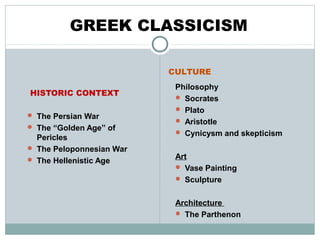
HISTORIC CONTEXT
 The Persian War
 The “Golden Age” of
Pericles
 The Peloponnesian War
 The Hellenistic Age
Philosophy
 Socrates
 Plato
 Aristotle
 Cynicysm and skepticism
Art
 Vase Painting
 Sculpture
Architecture
 The Parthenon
CULTURE
GREEK CLASSICISM
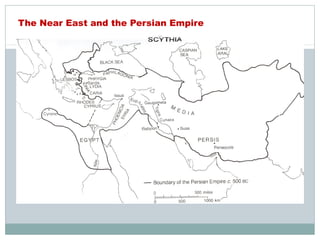
The Near East and the Persian Empire
PERSIAN WAR TIMELINE
 Sometimes after 1000 BCE, Greeks from the main land settled in
Asia Minor.
 546 BCE the Persians annexed the Greek states (Ionia, Aeolia,
Troy, and all the other).
 499 BCE the Ionian cities revolted against the Persian
domination.
 498 BCE a combined Greek and Ionian force marched on Sardis
 490 BCE Darius (the Persian king) mounted an expedition against
the mainland Greeks.
 The Persians army then arrived at the Bay of Marathon.
 The Athenians won. The Persians lost 6000 the Greeks lost 192.
 The Persians returned home abandoning the expedition.
Ancient Greece
THE GOLDEN AGE OF PERICLES
The Delian League
 Following the victory at the battle of Salamis the Ionian cities
joined together in the Delian League for mutual protection.
 They placed Athens at the head (hegemon)
 This free confederation (symmachia) of autonomous cities,
founded in 478 BCE, consisted of: representatives, an
admiral, and treasurers appointed by Athens.
 It was called the Delian League because its treasury was
located at Delos
 The league liberated Greek cities around the Aegean and
conquered several islands populated by non-Greeks.
 The Delian League developed into a prosperous Athenian
empire.
 The league’s formation propelled Athens into prosperity, and
artistic and cultural achevement.
 Pericles came to power in 461 BCE and in 454 BCE moved the
treasure from Delos to Athens and used it to cover the cost of
reconstruction.
 The Delian League was finally broken up by the capture of Athens
by Sparta in 404 BCE.
 It was revived in 378-7 BCE (the "Second Athenian Confederacy")
as a protection against Spartan aggression.
 It was revived in 378-7 BCE (the "Second Athenian Confederacy")
as a protection against Spartan aggression.
 The first league is the first example in recorded history of self-
conscious imperialism in which the subordinate units enjoyed a
specified local autonomy with an organized system, financial,
military and judicial.
THE PELOPNNESIAN WARS TIMELINE
 451 BCE - Athens and Sparta sign five year Treaty.
 449 BCE - Persia and Athens sign peace treaty.
 446 B.C. - Athens and Sparta sign 30 Years Peace.
 431 BCE - Peloponnesian War begins.
 430 BCE - Plague in Athens
 429 BCE. - Pericles dies
 421 BCE - Peace of Nicias.
 415-413 BCE - Athenian expedition to Syracuse. Sicily.
 404 BCE. - Athens surrenders. Peloponnesian War ends. Thirty
Tyrants rule Athens.
 403 BCE - Democracy is restored.
HELLENISTIC AGE
Scientific Thought
Euclid (c. 335-270 BCE)
 founder of modern geometry
 his text, Elements, is the basis for most modern geometry texts
today
 established the logical progression of truths
Aristarchus (310-230 BCE) - first to propose the Heliocentric theory
Archimedes (287-212 BCE)
 most original and versatile thinker of ancient Greece
 calculated Pi
 explained the concept of the lever and catapult
 most famous for his theory of displacement as demonstrated by
the Eureka story (principle of buoyancy).
Eratosthenes (275-195 BCE)
 head of the great library of Alexandria, Egypt
 founded the discipline of geography
 proposed the earth was a sphere and even calculated its
diameter within 1%
Hipparchus (165-125 BCE)
 mathematician, formed most of the trigonometric functions
 explained eclipses
PHILOSOPHY IN THE HELLENISTIC ERA
Skepticism
a. founded by Pyrho (c. 360-270 BCE)
b. denied possibility of finding truth
c. everything is discerned through the senses, which are totally
unreliable
Cynicism
a. founded by Diogenes (400-325 BCE)
b. belief that humans should seek virtue only, scorning pleasure,
wealth or power
c. question motives of others as insincere or selfish
Stoicism
a. founded by Zeno (335-270 BCE)
b. belief that the world was full of divine spirit contained in
everything
c. humans should be governed by reason rather than passion
d. humans should accept fate as part of nature's plan and thus
should be indifferent to whatever befalls them had a profound
effect on early Christianity
Epicurreanism
 founded by Epicureus (341-270 BCE), a former Stoic
 belief that one should achieve virtue by seeking pleasure and
avoiding pain
 only true sense of knowledge comes from the senses
Sophism
 At the core of Sophism is the belief in the power of rhetoric
 the Sophists demonstrated the contemporary concern of
humankind, thinking in a relativistic way, challenging the existence
of truth.
 The Sophists, with their belief in the influence of rhetoric and the
power of persuasion, transformed our concept of truth.
 The movement of sophism, a philosophical and religious term,
began around the 5th
century BCE as a group of teachers, speakers,
and philosophers who were paid to use rhetoric.
 They relied upon wisdom tested and gained by experience.
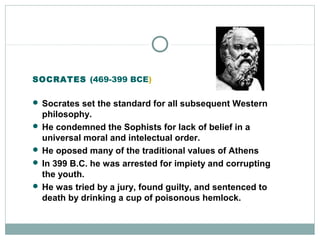
SOCRATES (469-399 BCE)
 Socrates set the standard for all subsequent Western
philosophy.
 He condemned the Sophists for lack of belief in a
universal moral and intelectual order.
 He oposed many of the traditional values of Athens
 In 399 B.C. he was arrested for impiety and corrupting
the youth.
 He was tried by a jury, found guilty, and sentenced to
death by drinking a cup of poisonous hemlock.
PLATO ( 427-347
BCE)
 Plato was born in Athens, about 427 BCE, and died there
about 347 BCE.
 In early life Plato saw war service and had political
ambitions. However, he was never really sympathetic to the
Athenian democracy and he could not join wholeheartedly
in its government.
 He was a devoted follower of Socrates, whose disciple he
became in 409 BCE, and the execution of that philosopher
by the democrats in 399 BCE was a crushing blow.
 He left Athens, believing that until "kings were
philosophers or philosophers were kings" things would
never go well with the world.
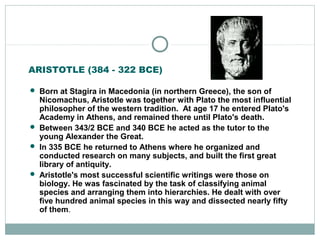
ARISTOTLE (384 - 322 BCE)
 Born at Stagira in Macedonia (in northern Greece), the son of
Nicomachus, Aristotle was together with Plato the most influential
philosopher of the western tradition. At age 17 he entered Plato's
Academy in Athens, and remained there until Plato's death.
 Between 343/2 BCE and 340 BCE he acted as the tutor to the
young Alexander the Great.
 In 335 BCE he returned to Athens where he organized and
conducted research on many subjects, and built the first great
library of antiquity.
 Aristotle's most successful scientific writings were those on
biology. He was fascinated by the task of classifying animal
species and arranging them into hierarchies. He dealt with over
five hundred animal species in this way and dissected nearly fifty
of them.
GREEK ART
CLASSICISM (480 - 323 BCE)
 Transitional Period: 480 – 450 BCE
 Early classical Period: 450 – 400 BCE
 Late Classical Period: 400 – 323 BCE
 The Classical Age of Greece begins with the Persian War (490-479
BCE) and ends with the death of Alexander the Great (323 BCE).
 Greek Classicism is the foundation of Western Civilization.
Classicism believes in the power of reason and searches for
rational principles.
1. Simplicity
2. Harmony
3. Restraint (form)
4. Proportion
5. Reason
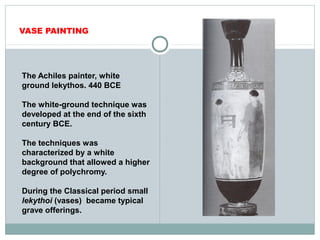
The Achiles painter, white
ground lekythos. 440 BCE
The white-ground technique was
developed at the end of the sixth
century BCE.
The techniques was
characterized by a white
background that allowed a higher
degree of polychromy.
During the Classical period small
lekythoi (vases) became typical
grave offerings.
VASE PAINTING
SCULPTURE
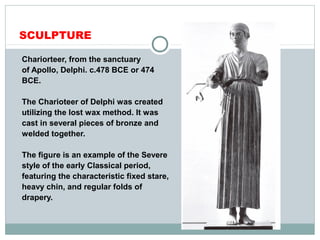
Chariorteer, from the sanctuary
of Apollo, Delphi. c.478 BCE or 474
BCE.
The Charioteer of Delphi was created
utilizing the lost wax method. It was
cast in several pieces of bronze and
welded together.
The figure is an example of the Severe
style of the early Classical period,
featuring the characteristic fixed stare,
heavy chin, and regular folds of
drapery.
SCULPTURE
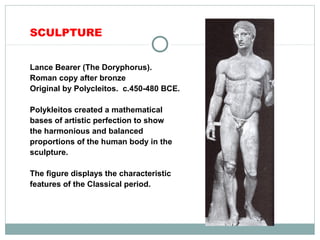
Lance Bearer (The Doryphorus).
Roman copy after bronze
Original by Polycleitos. c.450-480 BCE.
Polykleitos created a mathematical
bases of artistic perfection to show
the harmonious and balanced
proportions of the human body in the
sculpture.
The figure displays the characteristic
features of the Classical period.
SCULPTURE
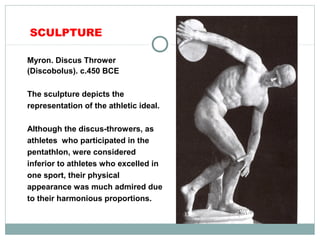
Myron. Discus Thrower
(Discobolus). c.450 BCE
The sculpture depicts the
representation of the athletic ideal.
Although the discus-throwers, as
athletes who participated in the
pentathlon, were considered
inferior to athletes who excelled in
one sport, their physical
appearance was much admired due
to their harmonious proportions.
SCULPTURE
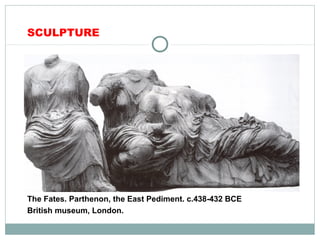
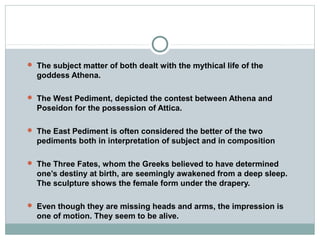
The Fates. Parthenon, the East Pediment. c.438-432 BCE
British museum, London.
 The subject matter of both dealt with the mythical life of the
goddess Athena.
 The West Pediment, depicted the contest between Athena and
Poseidon for the possession of Attica.
 The East Pediment is often considered the better of the two
pediments both in interpretation of subject and in composition
 The Three Fates, whom the Greeks believed to have determined
one’s destiny at birth, are seemingly awakened from a deep sleep.
The sculpture shows the female form under the drapery.
 Even though they are missing heads and arms, the impression is
one of motion. They seem to be alive.
SCULPTURE
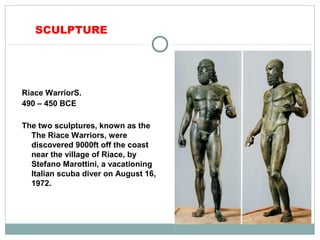
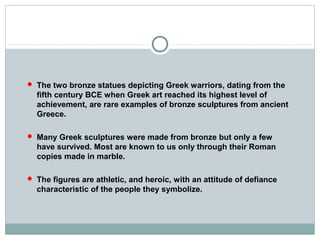
Riace WarriorS.
490 – 450 BCE
The two sculptures, known as the
The Riace Warriors, were
discovered 9000ft off the coast
near the village of Riace, by
Stefano Marottini, a vacationing
Italian scuba diver on August 16,
1972.
 The two bronze statues depicting Greek warriors, dating from the
fifth century BCE when Greek art reached its highest level of
achievement, are rare examples of bronze sculptures from ancient
Greece.
 Many Greek sculptures were made from bronze but only a few
have survived. Most are known to us only through their Roman
copies made in marble.
 The figures are athletic, and heroic, with an attitude of defiance
characteristic of the people they symbolize.
SCULPTURE
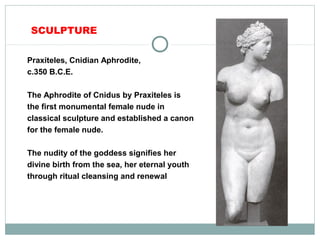
Praxiteles, Cnidian Aphrodite,
c.350 B.C.E.
The Aphrodite of Cnidus by Praxiteles is
the first monumental female nude in
classical sculpture and established a canon
for the female nude.
The nudity of the goddess signifies her
divine birth from the sea, her eternal youth
through ritual cleansing and renewal
SCULPTURE
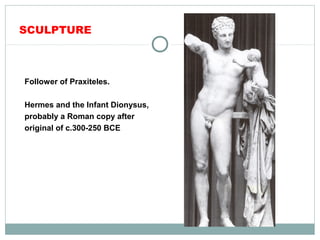
Follower of Praxiteles.
Hermes and the Infant Dionysus,
probably a Roman copy after
original of c.300-250 BCE
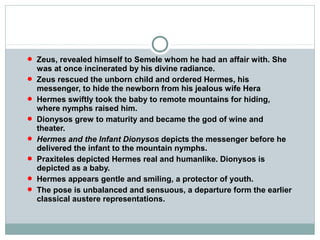
 Zeus, revealed himself to Semele whom he had an affair with. She
was at once incinerated by his divine radiance.
 Zeus rescued the unborn child and ordered Hermes, his
messenger, to hide the newborn from his jealous wife Hera
 Hermes swiftly took the baby to remote mountains for hiding,
where nymphs raised him.
 Dionysos grew to maturity and became the god of wine and
theater.
 Hermes and the Infant Dionysos depicts the messenger before he
delivered the infant to the mountain nymphs.
 Praxiteles depicted Hermes real and humanlike. Dionysos is
depicted as a baby.
 Hermes appears gentle and smiling, a protector of youth.
 The pose is unbalanced and sensuous, a departure form the earlier
classical austere representations.
SCULPTURE
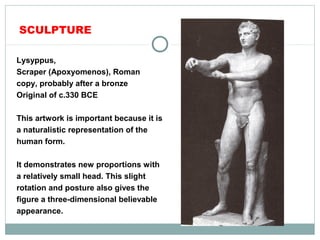
Lysyppus,
Scraper (Apoxyomenos), Roman
copy, probably after a bronze
Original of c.330 BCE
This artwork is important because it is
a naturalistic representation of the
human form.
It demonstrates new proportions with
a relatively small head. This slight
rotation and posture also gives the
figure a three-dimensional believable
appearance.
SCULPTURE
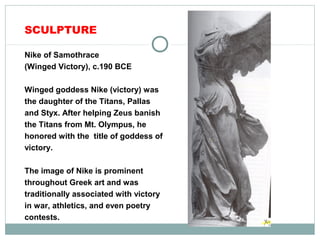
Nike of Samothrace
(Winged Victory), c.190 BCE
Winged goddess Nike (victory) was
the daughter of the Titans, Pallas
and Styx. After helping Zeus banish
the Titans from Mt. Olympus, he
honored with the title of goddess of
victory.
The image of Nike is prominent
throughout Greek art and was
traditionally associated with victory
in war, athletics, and even poetry
contests.
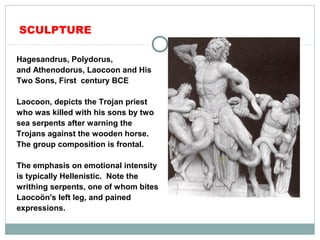
SCULPTURE
Hagesandrus, Polydorus,
and Athenodorus, Laocoon and His
Two Sons, First century BCE
Laocoon, depicts the Trojan priest
who was killed with his sons by two
sea serpents after warning the
Trojans against the wooden horse.
The group composition is frontal.
The emphasis on emotional intensity
is typically Hellenistic. Note the
writhing serpents, one of whom bites
Laocoön's left leg, and pained
expressions.
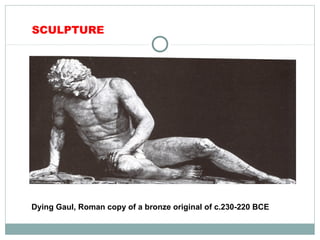
SCULPTURE
Dying Gaul, Roman copy of a bronze original of c.230-220 BCE
 In 278 BCE, migrating Celtic tribes from Gaul crossed the
Hellespont and settled in Anatolia.
 In a series of campaigns fought some fifty years later, they were
defeated.
 Hellenistic sculpture commemorates that victory.
 The warrior is portrayed reclining on his left arm, with head down;
 The figure is depicted with remarkable realism, particularly in the
face.
 He is represented as a warrior with a typically Gallic hairstyle and
moustache.
 He lies on his fallen shield while his sword and other objects lie
beside him.
His shield resembles those found in cemeteries in the Marne
valley.
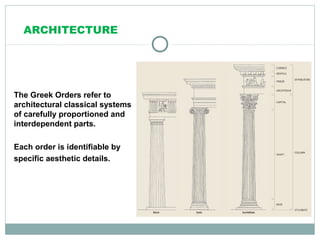
ARCHITECTURE
The Greek Orders refer to
architectural classical systems
of carefully proportioned and
interdependent parts.
Each order is identifiable by
specific aesthetic details.
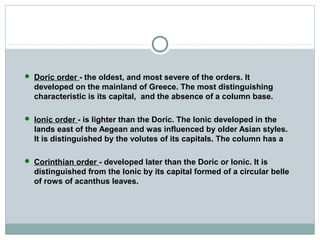
 Doric order - the oldest, and most severe of the orders. It
developed on the mainland of Greece. The most distinguishing
characteristic is its capital, and the absence of a column base.
 Ionic order - is lighter than the Doric. The Ionic developed in the
lands east of the Aegean and was influenced by older Asian styles.
It is distinguished by the volutes of its capitals. The column has a
 Corinthian order - developed later than the Doric or Ionic. It is
distinguished from the Ionic by its capital formed of a circular belle
of rows of acanthus leaves.
ARCHITECTURE
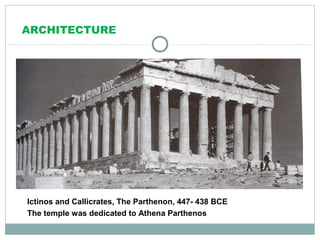
Ictinos and Callicrates, The Parthenon, 447- 438 BCE
The temple was dedicated to Athena Parthenos
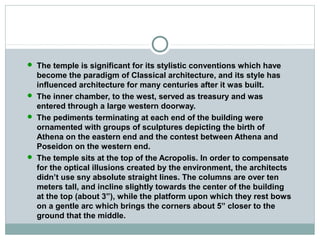
 The temple is significant for its stylistic conventions which have
become the paradigm of Classical architecture, and its style has
influenced architecture for many centuries after it was built.
 The inner chamber, to the west, served as treasury and was
entered through a large western doorway.
 The pediments terminating at each end of the building were
ornamented with groups of sculptures depicting the birth of
Athena on the eastern end and the contest between Athena and
Poseidon on the western end.
 The temple sits at the top of the Acropolis. In order to compensate
for the optical illusions created by the environment, the architects
didn’t use sny absolute straight lines. The columns are over ten
meters tall, and incline slightly towards the center of the building
at the top (about 3”), while the platform upon which they rest bows
on a gentle arc which brings the corners about 5” closer to the
ground that the middle.
ARCHITECTURE
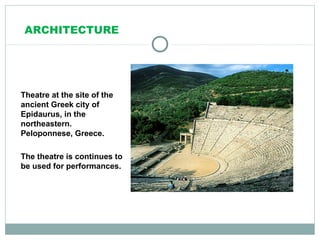
Theatre at the site of the
ancient Greek city of
Epidaurus, in the
northeastern.
Peloponnese, Greece.
The theatre is continues to
be used for performances.

10 greek classicism and hellenism v2018

  • 1.
  • 2.
    HISTORIC CONTEXT  ThePersian War  The “Golden Age” of Pericles  The Peloponnesian War  The Hellenistic Age Philosophy  Socrates  Plato  Aristotle  Cynicysm and skepticism Art  Vase Painting  Sculpture Architecture  The Parthenon CULTURE GREEK CLASSICISM
  • 3.
    The Near Eastand the Persian Empire
  • 4.
    PERSIAN WAR TIMELINE Sometimes after 1000 BCE, Greeks from the main land settled in Asia Minor.  546 BCE the Persians annexed the Greek states (Ionia, Aeolia, Troy, and all the other).  499 BCE the Ionian cities revolted against the Persian domination.  498 BCE a combined Greek and Ionian force marched on Sardis  490 BCE Darius (the Persian king) mounted an expedition against the mainland Greeks.  The Persians army then arrived at the Bay of Marathon.  The Athenians won. The Persians lost 6000 the Greeks lost 192.  The Persians returned home abandoning the expedition.
  • 5.
  • 6.
    THE GOLDEN AGEOF PERICLES The Delian League  Following the victory at the battle of Salamis the Ionian cities joined together in the Delian League for mutual protection.  They placed Athens at the head (hegemon)  This free confederation (symmachia) of autonomous cities, founded in 478 BCE, consisted of: representatives, an admiral, and treasurers appointed by Athens.  It was called the Delian League because its treasury was located at Delos  The league liberated Greek cities around the Aegean and conquered several islands populated by non-Greeks.  The Delian League developed into a prosperous Athenian empire.
  • 7.
     The league’sformation propelled Athens into prosperity, and artistic and cultural achevement.  Pericles came to power in 461 BCE and in 454 BCE moved the treasure from Delos to Athens and used it to cover the cost of reconstruction.  The Delian League was finally broken up by the capture of Athens by Sparta in 404 BCE.  It was revived in 378-7 BCE (the "Second Athenian Confederacy") as a protection against Spartan aggression.  It was revived in 378-7 BCE (the "Second Athenian Confederacy") as a protection against Spartan aggression.  The first league is the first example in recorded history of self- conscious imperialism in which the subordinate units enjoyed a specified local autonomy with an organized system, financial, military and judicial.
  • 8.
    THE PELOPNNESIAN WARSTIMELINE  451 BCE - Athens and Sparta sign five year Treaty.  449 BCE - Persia and Athens sign peace treaty.  446 B.C. - Athens and Sparta sign 30 Years Peace.  431 BCE - Peloponnesian War begins.  430 BCE - Plague in Athens  429 BCE. - Pericles dies  421 BCE - Peace of Nicias.  415-413 BCE - Athenian expedition to Syracuse. Sicily.  404 BCE. - Athens surrenders. Peloponnesian War ends. Thirty Tyrants rule Athens.  403 BCE - Democracy is restored.
  • 9.
    HELLENISTIC AGE Scientific Thought Euclid(c. 335-270 BCE)  founder of modern geometry  his text, Elements, is the basis for most modern geometry texts today  established the logical progression of truths Aristarchus (310-230 BCE) - first to propose the Heliocentric theory Archimedes (287-212 BCE)  most original and versatile thinker of ancient Greece  calculated Pi  explained the concept of the lever and catapult  most famous for his theory of displacement as demonstrated by the Eureka story (principle of buoyancy).
  • 10.
    Eratosthenes (275-195 BCE) head of the great library of Alexandria, Egypt  founded the discipline of geography  proposed the earth was a sphere and even calculated its diameter within 1% Hipparchus (165-125 BCE)  mathematician, formed most of the trigonometric functions  explained eclipses
  • 11.
    PHILOSOPHY IN THEHELLENISTIC ERA Skepticism a. founded by Pyrho (c. 360-270 BCE) b. denied possibility of finding truth c. everything is discerned through the senses, which are totally unreliable Cynicism a. founded by Diogenes (400-325 BCE) b. belief that humans should seek virtue only, scorning pleasure, wealth or power c. question motives of others as insincere or selfish Stoicism a. founded by Zeno (335-270 BCE) b. belief that the world was full of divine spirit contained in everything c. humans should be governed by reason rather than passion d. humans should accept fate as part of nature's plan and thus should be indifferent to whatever befalls them had a profound effect on early Christianity
  • 12.
    Epicurreanism  founded byEpicureus (341-270 BCE), a former Stoic  belief that one should achieve virtue by seeking pleasure and avoiding pain  only true sense of knowledge comes from the senses Sophism  At the core of Sophism is the belief in the power of rhetoric  the Sophists demonstrated the contemporary concern of humankind, thinking in a relativistic way, challenging the existence of truth.  The Sophists, with their belief in the influence of rhetoric and the power of persuasion, transformed our concept of truth.  The movement of sophism, a philosophical and religious term, began around the 5th century BCE as a group of teachers, speakers, and philosophers who were paid to use rhetoric.  They relied upon wisdom tested and gained by experience.
  • 13.
    SOCRATES (469-399 BCE) Socrates set the standard for all subsequent Western philosophy.  He condemned the Sophists for lack of belief in a universal moral and intelectual order.  He oposed many of the traditional values of Athens  In 399 B.C. he was arrested for impiety and corrupting the youth.  He was tried by a jury, found guilty, and sentenced to death by drinking a cup of poisonous hemlock.
  • 14.
    PLATO ( 427-347 BCE) Plato was born in Athens, about 427 BCE, and died there about 347 BCE.  In early life Plato saw war service and had political ambitions. However, he was never really sympathetic to the Athenian democracy and he could not join wholeheartedly in its government.  He was a devoted follower of Socrates, whose disciple he became in 409 BCE, and the execution of that philosopher by the democrats in 399 BCE was a crushing blow.  He left Athens, believing that until "kings were philosophers or philosophers were kings" things would never go well with the world.
  • 15.
    ARISTOTLE (384 -322 BCE)  Born at Stagira in Macedonia (in northern Greece), the son of Nicomachus, Aristotle was together with Plato the most influential philosopher of the western tradition. At age 17 he entered Plato's Academy in Athens, and remained there until Plato's death.  Between 343/2 BCE and 340 BCE he acted as the tutor to the young Alexander the Great.  In 335 BCE he returned to Athens where he organized and conducted research on many subjects, and built the first great library of antiquity.  Aristotle's most successful scientific writings were those on biology. He was fascinated by the task of classifying animal species and arranging them into hierarchies. He dealt with over five hundred animal species in this way and dissected nearly fifty of them.
  • 16.
    GREEK ART CLASSICISM (480- 323 BCE)  Transitional Period: 480 – 450 BCE  Early classical Period: 450 – 400 BCE  Late Classical Period: 400 – 323 BCE  The Classical Age of Greece begins with the Persian War (490-479 BCE) and ends with the death of Alexander the Great (323 BCE).  Greek Classicism is the foundation of Western Civilization. Classicism believes in the power of reason and searches for rational principles. 1. Simplicity 2. Harmony 3. Restraint (form) 4. Proportion 5. Reason
  • 17.
    The Achiles painter,white ground lekythos. 440 BCE The white-ground technique was developed at the end of the sixth century BCE. The techniques was characterized by a white background that allowed a higher degree of polychromy. During the Classical period small lekythoi (vases) became typical grave offerings. VASE PAINTING
  • 18.
    SCULPTURE Chariorteer, from thesanctuary of Apollo, Delphi. c.478 BCE or 474 BCE. The Charioteer of Delphi was created utilizing the lost wax method. It was cast in several pieces of bronze and welded together. The figure is an example of the Severe style of the early Classical period, featuring the characteristic fixed stare, heavy chin, and regular folds of drapery.
  • 19.
    SCULPTURE Lance Bearer (TheDoryphorus). Roman copy after bronze Original by Polycleitos. c.450-480 BCE. Polykleitos created a mathematical bases of artistic perfection to show the harmonious and balanced proportions of the human body in the sculpture. The figure displays the characteristic features of the Classical period.
  • 20.
    SCULPTURE Myron. Discus Thrower (Discobolus).c.450 BCE The sculpture depicts the representation of the athletic ideal. Although the discus-throwers, as athletes who participated in the pentathlon, were considered inferior to athletes who excelled in one sport, their physical appearance was much admired due to their harmonious proportions.
  • 21.
    SCULPTURE The Fates. Parthenon,the East Pediment. c.438-432 BCE British museum, London.
  • 22.
     The subjectmatter of both dealt with the mythical life of the goddess Athena.  The West Pediment, depicted the contest between Athena and Poseidon for the possession of Attica.  The East Pediment is often considered the better of the two pediments both in interpretation of subject and in composition  The Three Fates, whom the Greeks believed to have determined one’s destiny at birth, are seemingly awakened from a deep sleep. The sculpture shows the female form under the drapery.  Even though they are missing heads and arms, the impression is one of motion. They seem to be alive.
  • 23.
    SCULPTURE Riace WarriorS. 490 –450 BCE The two sculptures, known as the The Riace Warriors, were discovered 9000ft off the coast near the village of Riace, by Stefano Marottini, a vacationing Italian scuba diver on August 16, 1972.
  • 24.
     The twobronze statues depicting Greek warriors, dating from the fifth century BCE when Greek art reached its highest level of achievement, are rare examples of bronze sculptures from ancient Greece.  Many Greek sculptures were made from bronze but only a few have survived. Most are known to us only through their Roman copies made in marble.  The figures are athletic, and heroic, with an attitude of defiance characteristic of the people they symbolize.
  • 25.
    SCULPTURE Praxiteles, Cnidian Aphrodite, c.350B.C.E. The Aphrodite of Cnidus by Praxiteles is the first monumental female nude in classical sculpture and established a canon for the female nude. The nudity of the goddess signifies her divine birth from the sea, her eternal youth through ritual cleansing and renewal
  • 26.
    SCULPTURE Follower of Praxiteles. Hermesand the Infant Dionysus, probably a Roman copy after original of c.300-250 BCE
  • 27.
     Zeus, revealedhimself to Semele whom he had an affair with. She was at once incinerated by his divine radiance.  Zeus rescued the unborn child and ordered Hermes, his messenger, to hide the newborn from his jealous wife Hera  Hermes swiftly took the baby to remote mountains for hiding, where nymphs raised him.  Dionysos grew to maturity and became the god of wine and theater.  Hermes and the Infant Dionysos depicts the messenger before he delivered the infant to the mountain nymphs.  Praxiteles depicted Hermes real and humanlike. Dionysos is depicted as a baby.  Hermes appears gentle and smiling, a protector of youth.  The pose is unbalanced and sensuous, a departure form the earlier classical austere representations.
  • 28.
    SCULPTURE Lysyppus, Scraper (Apoxyomenos), Roman copy,probably after a bronze Original of c.330 BCE This artwork is important because it is a naturalistic representation of the human form. It demonstrates new proportions with a relatively small head. This slight rotation and posture also gives the figure a three-dimensional believable appearance.
  • 29.
    SCULPTURE Nike of Samothrace (WingedVictory), c.190 BCE Winged goddess Nike (victory) was the daughter of the Titans, Pallas and Styx. After helping Zeus banish the Titans from Mt. Olympus, he honored with the title of goddess of victory. The image of Nike is prominent throughout Greek art and was traditionally associated with victory in war, athletics, and even poetry contests.
  • 30.
    SCULPTURE Hagesandrus, Polydorus, and Athenodorus,Laocoon and His Two Sons, First century BCE Laocoon, depicts the Trojan priest who was killed with his sons by two sea serpents after warning the Trojans against the wooden horse. The group composition is frontal. The emphasis on emotional intensity is typically Hellenistic. Note the writhing serpents, one of whom bites Laocoön's left leg, and pained expressions.
  • 31.
    SCULPTURE Dying Gaul, Romancopy of a bronze original of c.230-220 BCE
  • 32.
     In 278BCE, migrating Celtic tribes from Gaul crossed the Hellespont and settled in Anatolia.  In a series of campaigns fought some fifty years later, they were defeated.  Hellenistic sculpture commemorates that victory.  The warrior is portrayed reclining on his left arm, with head down;  The figure is depicted with remarkable realism, particularly in the face.  He is represented as a warrior with a typically Gallic hairstyle and moustache.  He lies on his fallen shield while his sword and other objects lie beside him. His shield resembles those found in cemeteries in the Marne valley.
  • 33.
    ARCHITECTURE The Greek Ordersrefer to architectural classical systems of carefully proportioned and interdependent parts. Each order is identifiable by specific aesthetic details.
  • 34.
     Doric order- the oldest, and most severe of the orders. It developed on the mainland of Greece. The most distinguishing characteristic is its capital, and the absence of a column base.  Ionic order - is lighter than the Doric. The Ionic developed in the lands east of the Aegean and was influenced by older Asian styles. It is distinguished by the volutes of its capitals. The column has a  Corinthian order - developed later than the Doric or Ionic. It is distinguished from the Ionic by its capital formed of a circular belle of rows of acanthus leaves.
  • 35.
    ARCHITECTURE Ictinos and Callicrates,The Parthenon, 447- 438 BCE The temple was dedicated to Athena Parthenos
  • 36.
     The templeis significant for its stylistic conventions which have become the paradigm of Classical architecture, and its style has influenced architecture for many centuries after it was built.  The inner chamber, to the west, served as treasury and was entered through a large western doorway.  The pediments terminating at each end of the building were ornamented with groups of sculptures depicting the birth of Athena on the eastern end and the contest between Athena and Poseidon on the western end.  The temple sits at the top of the Acropolis. In order to compensate for the optical illusions created by the environment, the architects didn’t use sny absolute straight lines. The columns are over ten meters tall, and incline slightly towards the center of the building at the top (about 3”), while the platform upon which they rest bows on a gentle arc which brings the corners about 5” closer to the ground that the middle.
  • 37.
    ARCHITECTURE Theatre at thesite of the ancient Greek city of Epidaurus, in the northeastern. Peloponnese, Greece. The theatre is continues to be used for performances.