
MODES OF HEAT TRANSFER
Amaljo Joju E
s3 EEE
1
EEE Dept. SCET
2
How ‘Heat’ Moves
• Define “Heat”:
Heat is the movement of
thermal energy from a
substance at a higher
temperature to another
substance at a lower
temperature.
EEE Dept. SCET
3
How ‘Heat’ Moves
Thermal energy in the form of
heat can move in three ways.
Conduction
Convection
Radiation
EEE Dept. SCET
4
Conduction
CONDUCTION:
• The transfer of heat from one
particle of matter to another by
direct particle to particle contact.
– Conduction occurs primarily in solids because
the particles are tightly packed together.
– The particles themselves DO NOT change
positions.
EEE Dept. SCET
Metals are different
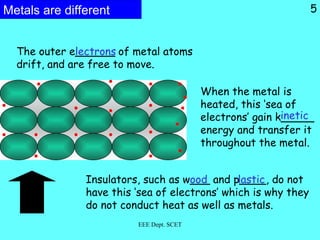
The outer e______ of metal atoms
drift, and are free to move.
When the metal is
heated, this ‘sea of
electrons’ gain k_____
energy and transfer it
throughout the metal.
Insulators, such as w___ and p____, do not
have this ‘sea of electrons’ which is why they
do not conduct heat as well as metals.
lectrons
inetic
ood lastic
EEE Dept. SCET
5
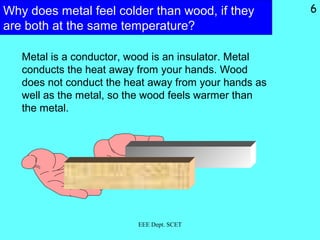
Why does metal feel colder than wood, if they
are both at the same temperature?
Metal is a conductor, wood is an insulator. Metal
conducts the heat away from your hands. Wood
does not conduct the heat away from your hands as
well as the metal, so the wood feels warmer than
the metal.
EEE Dept. SCET
6
7
Convection
Convection: the transfer of
thermal energy (heat) through
the bulk movement of matter.
– Convection occurs in FLUIDS (liquids
and gases).
– Convection produces CURRENTS in
both gases and liquids.
– Thermal Energy heat is carried by the
particles as they move from one location to
another.
EEE Dept. SCET
Convection
What happens to the particles in a liquid or a
gas when you heat them?
The particles spread out and
become less dense.
This effects fluid movement.What is a fluid?A liquid or gas.
EEE Dept. SCET
8
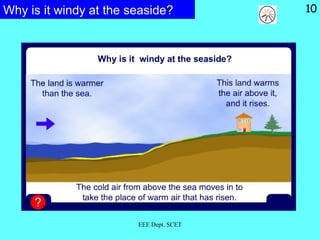
Fluid movement
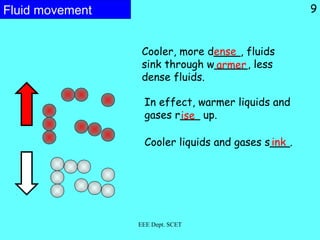
Cooler, more d____, fluids
sink through w_____, less
dense fluids.
In effect, warmer liquids and
gases r___ up.
Cooler liquids and gases s___.
ense
armer
ise
ink
EEE Dept. SCET
9
Why is it windy at the seaside?
EEE Dept. SCET
10
11
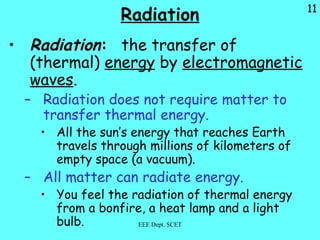
Radiation
• Radiation: the transfer of
(thermal) energy by electromagnetic
waves.
– Radiation does not require matter to
transfer thermal energy.
• All the sun’s energy that reaches Earth
travels through millions of kilometers of
empty space (a vacuum).
– All matter can radiate energy.
• You feel the radiation of thermal energy
from a bonfire, a heat lamp and a light
bulb. EEE Dept. SCET
The third method of heat transfer
How does heat energy get
from the Sun to the Earth?
There are no particles
between the Sun and the
Earth so it CANNOT
travel by conduction or
by convection.
?
RADIATION
EEE Dept. SCET
12
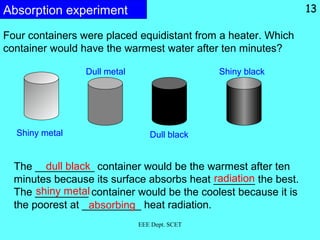
Absorption experiment
Four containers were placed equidistant from a heater. Which
container would have the warmest water after ten minutes?
The __________ container would be the warmest after ten
minutes because its surface absorbs heat _______ the best.
The _________ container would be the coolest because it is
the poorest at __________ heat radiation.
dull black
radiation
shiny metal
absorbing
Shiny metal
Dull metal
Dull black
Shiny black
EEE Dept. SCET
13
14
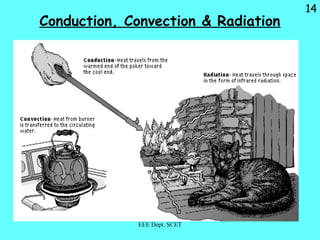
Conduction, Convection & Radiation
EEE Dept. SCET
15
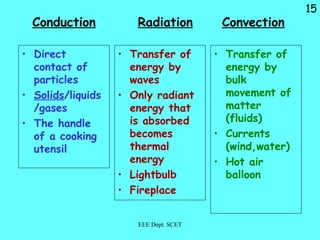
Conduction
• Direct
contact of
particles
• Solids/liquids
/gases
• The handle
of a cooking
utensil
• Transfer of
energy by
waves
• Only radiant
energy that
is absorbed
becomes
thermal
energy
• Lightbulb
• Fireplace
• Transfer of
energy by
bulk
movement of
matter
(fluids)
• Currents
(wind,water)
• Hot air
balloon
Radiation Convection
EEE Dept. SCET
EEE Dept. SCET
16

Heat transfer seminar

  • 1.
    MODES OF HEATTRANSFER Amaljo Joju E s3 EEE 1 EEE Dept. SCET
  • 2.
    2 How ‘Heat’ Moves •Define “Heat”: Heat is the movement of thermal energy from a substance at a higher temperature to another substance at a lower temperature. EEE Dept. SCET
  • 3.
    3 How ‘Heat’ Moves Thermalenergy in the form of heat can move in three ways. Conduction Convection Radiation EEE Dept. SCET
  • 4.
    4 Conduction CONDUCTION: • The transferof heat from one particle of matter to another by direct particle to particle contact. – Conduction occurs primarily in solids because the particles are tightly packed together. – The particles themselves DO NOT change positions. EEE Dept. SCET
  • 5.
    Metals are different Theouter e______ of metal atoms drift, and are free to move. When the metal is heated, this ‘sea of electrons’ gain k_____ energy and transfer it throughout the metal. Insulators, such as w___ and p____, do not have this ‘sea of electrons’ which is why they do not conduct heat as well as metals. lectrons inetic ood lastic EEE Dept. SCET 5
  • 6.
    Why does metalfeel colder than wood, if they are both at the same temperature? Metal is a conductor, wood is an insulator. Metal conducts the heat away from your hands. Wood does not conduct the heat away from your hands as well as the metal, so the wood feels warmer than the metal. EEE Dept. SCET 6
  • 7.
    7 Convection Convection: the transferof thermal energy (heat) through the bulk movement of matter. – Convection occurs in FLUIDS (liquids and gases). – Convection produces CURRENTS in both gases and liquids. – Thermal Energy heat is carried by the particles as they move from one location to another. EEE Dept. SCET
  • 8.
    Convection What happens tothe particles in a liquid or a gas when you heat them? The particles spread out and become less dense. This effects fluid movement.What is a fluid?A liquid or gas. EEE Dept. SCET 8
  • 9.
    Fluid movement Cooler, mored____, fluids sink through w_____, less dense fluids. In effect, warmer liquids and gases r___ up. Cooler liquids and gases s___. ense armer ise ink EEE Dept. SCET 9
  • 10.
    Why is itwindy at the seaside? EEE Dept. SCET 10
  • 11.
    11 Radiation • Radiation: thetransfer of (thermal) energy by electromagnetic waves. – Radiation does not require matter to transfer thermal energy. • All the sun’s energy that reaches Earth travels through millions of kilometers of empty space (a vacuum). – All matter can radiate energy. • You feel the radiation of thermal energy from a bonfire, a heat lamp and a light bulb. EEE Dept. SCET
  • 12.
    The third methodof heat transfer How does heat energy get from the Sun to the Earth? There are no particles between the Sun and the Earth so it CANNOT travel by conduction or by convection. ? RADIATION EEE Dept. SCET 12
  • 13.
    Absorption experiment Four containerswere placed equidistant from a heater. Which container would have the warmest water after ten minutes? The __________ container would be the warmest after ten minutes because its surface absorbs heat _______ the best. The _________ container would be the coolest because it is the poorest at __________ heat radiation. dull black radiation shiny metal absorbing Shiny metal Dull metal Dull black Shiny black EEE Dept. SCET 13
  • 14.
    14 Conduction, Convection &Radiation EEE Dept. SCET
  • 15.
    15 Conduction • Direct contact of particles •Solids/liquids /gases • The handle of a cooking utensil • Transfer of energy by waves • Only radiant energy that is absorbed becomes thermal energy • Lightbulb • Fireplace • Transfer of energy by bulk movement of matter (fluids) • Currents (wind,water) • Hot air balloon Radiation Convection EEE Dept. SCET
  • 16.