 
Kanchan Ramteke
 Introduction:- Heat pump
 Working of heat pump
 COP of Heat pump
 Introduction:- Heat engine
 Efficiency of Heat engine
 Applications
 A heat pump is device that extracts heat from one place and
transfers it to another by using mechanical energy. Examples:
air conditioner
 In modern time heat pump is an essential part of a heating and
cooling system.
 It is work consuming device.
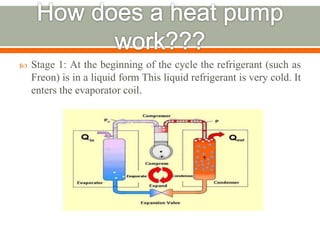
 Stage 1: At the beginning of the cycle the refrigerant (such as
Freon) is in a liquid form This liquid refrigerant is very cold. It
enters the evaporator coil.
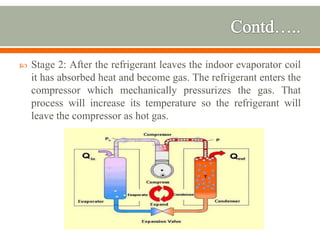
 Stage 2: After the refrigerant leaves the indoor evaporator coil
it has absorbed heat and become gas. The refrigerant enters the
compressor which mechanically pressurizes the gas. That
process will increase its temperature so the refrigerant will
leave the compressor as hot gas.
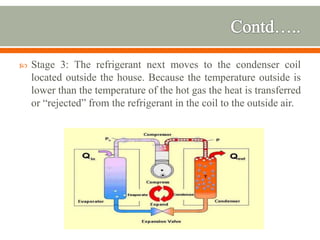
 Stage 3: The refrigerant next moves to the condenser coil
located outside the house. Because the temperature outside is
lower than the temperature of the hot gas the heat is transferred
or “rejected” from the refrigerant in the coil to the outside air.
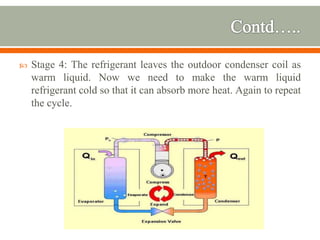
 Stage 4: The refrigerant leaves the outdoor condenser coil as
warm liquid. Now we need to make the warm liquid
refrigerant cold so that it can absorb more heat. Again to repeat
the cycle.
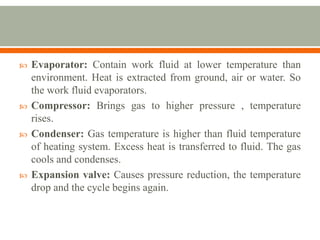
 Evaporator: Contain work fluid at lower temperature than
environment. Heat is extracted from ground, air or water. So
the work fluid evaporators.
 Compressor: Brings gas to higher pressure , temperature
rises.
 Condenser: Gas temperature is higher than fluid temperature
of heating system. Excess heat is transferred to fluid. The gas
cools and condenses.
 Expansion valve: Causes pressure reduction, the temperature
drop and the cycle begins again.
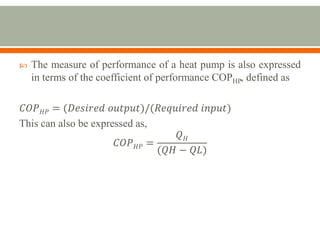
 The measure of performance of a heat pump is also expressed
in terms of the coefficient of performance COPHP, defined as
𝐶𝑂𝑃 𝐻𝑃 = (𝐷𝑒𝑠𝑖𝑟𝑒𝑑 𝑜𝑢𝑡𝑝𝑢𝑡)/(𝑅𝑒𝑞𝑢𝑖𝑟𝑒𝑑 𝑖𝑛𝑝𝑢𝑡)
This can also be expressed as,
𝐶𝑂𝑃 𝐻𝑃 =
𝑄 𝐻
(𝑄𝐻 − 𝑄𝐿)
HEAT ENGINE
 A heat engine is a device that absorbs heat (Q) and uses
it to do useful work (W) on the surroundings when
operating in a cycle.
 It is work producing device.
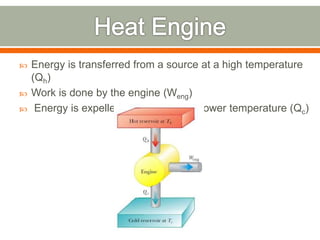
 Energy is transferred from a source at a high temperature
(Qh)
 Work is done by the engine (Weng)
 Energy is expelled to a source at a lower temperature (Qc)
 Thermal efficiency is defined as the ratio of the work done by
the engine to the energy absorbed at the higher temperature
Efficiency =
𝑊
𝑄ℎ
= 1 −
𝑄 𝑐
𝑄ℎ
 Efficiency = 1 (100% efficiency) only if Qc = 0
 No energy expelled to cold reservoir
 Heat pumps are used in many industries, to recover heat or as
an integral part of the process.
 Process heating: In industries, the heat pump is used to heat
the process fluid before the reactions.
 Heat recovery: Heat pump is used to recover process heat
from other reactions.
 Examples of everyday heat engines include the steam
engine and the internal combustion engine.
Heat pump and heat engine

Heat pump and heat engine

  • 1.
  • 2.
     Introduction:- Heatpump  Working of heat pump  COP of Heat pump  Introduction:- Heat engine  Efficiency of Heat engine  Applications
  • 3.
     A heatpump is device that extracts heat from one place and transfers it to another by using mechanical energy. Examples: air conditioner  In modern time heat pump is an essential part of a heating and cooling system.  It is work consuming device.
  • 4.
     Stage 1:At the beginning of the cycle the refrigerant (such as Freon) is in a liquid form This liquid refrigerant is very cold. It enters the evaporator coil.
  • 5.
     Stage 2:After the refrigerant leaves the indoor evaporator coil it has absorbed heat and become gas. The refrigerant enters the compressor which mechanically pressurizes the gas. That process will increase its temperature so the refrigerant will leave the compressor as hot gas.
  • 6.
     Stage 3:The refrigerant next moves to the condenser coil located outside the house. Because the temperature outside is lower than the temperature of the hot gas the heat is transferred or “rejected” from the refrigerant in the coil to the outside air.
  • 7.
     Stage 4:The refrigerant leaves the outdoor condenser coil as warm liquid. Now we need to make the warm liquid refrigerant cold so that it can absorb more heat. Again to repeat the cycle.
  • 8.
     Evaporator: Containwork fluid at lower temperature than environment. Heat is extracted from ground, air or water. So the work fluid evaporators.  Compressor: Brings gas to higher pressure , temperature rises.  Condenser: Gas temperature is higher than fluid temperature of heating system. Excess heat is transferred to fluid. The gas cools and condenses.  Expansion valve: Causes pressure reduction, the temperature drop and the cycle begins again.
  • 9.
     The measureof performance of a heat pump is also expressed in terms of the coefficient of performance COPHP, defined as 𝐶𝑂𝑃 𝐻𝑃 = (𝐷𝑒𝑠𝑖𝑟𝑒𝑑 𝑜𝑢𝑡𝑝𝑢𝑡)/(𝑅𝑒𝑞𝑢𝑖𝑟𝑒𝑑 𝑖𝑛𝑝𝑢𝑡) This can also be expressed as, 𝐶𝑂𝑃 𝐻𝑃 = 𝑄 𝐻 (𝑄𝐻 − 𝑄𝐿)
  • 10.
  • 11.
     A heatengine is a device that absorbs heat (Q) and uses it to do useful work (W) on the surroundings when operating in a cycle.  It is work producing device.
  • 12.
     Energy istransferred from a source at a high temperature (Qh)  Work is done by the engine (Weng)  Energy is expelled to a source at a lower temperature (Qc)
  • 13.
     Thermal efficiencyis defined as the ratio of the work done by the engine to the energy absorbed at the higher temperature Efficiency = 𝑊 𝑄ℎ = 1 − 𝑄 𝑐 𝑄ℎ  Efficiency = 1 (100% efficiency) only if Qc = 0  No energy expelled to cold reservoir
  • 14.
     Heat pumpsare used in many industries, to recover heat or as an integral part of the process.  Process heating: In industries, the heat pump is used to heat the process fluid before the reactions.  Heat recovery: Heat pump is used to recover process heat from other reactions.  Examples of everyday heat engines include the steam engine and the internal combustion engine.