PITZER & RK-ASPEN
Property Method
 Presented by,
 KANCHAN D. RAMTEKE
 MT17MCL011
Introduction
ASPEN plus
To optimize throughput, quality and energy use
Includes databases
Pure component data
Phase equilibrium data
for various electrolytes, solids and polymers.
PITZER Property Method
Introduction
The Pitzer model was developed as an improvement upon an
earlier model proposed by Guggenheim (1935, 1955).
The earlier model worked well at low electrolyte concentrations,
but contained discrepancies at higher concentrations (>0.1M).
The Pitzer model resolved these discrepancies, without resorting
to excessive arrays of higher-order terms.
It cannot be used for mixed solvent electrolyte systems.
 The PITZER property method is based on an aqueous electrolyte
activity coefficient model.
 It has no overlap with other activity coefficient models.
 It can accurately calculate the behavior of aqueous electrolyte
solutions with or without molecular solutes up to 6 molal ionic
strength.
 Many interaction parameters from regression of experimental data
are included in databanks and data packages
 Do not use this model if a non-aqueous solvent exists.
You can model the solubility of supercritical gases using Henry’s
law.
Heats of mixing are calculated using the Pitzer model.
The Redlich-Kwong-Soave equation of state is used for the vapor
phase fugacity coefficient, all other vapor phase properties are
assumed ideal. Redlich-Kwong-Soave cannot model association
behavior in the vapor phase (for example, carboxylic acids or HF).
For carboxylic acids, choose a non-electrolyte activity coefficient
model with Hayden-O’Connell or Nothnagel; for HF choose
ENRTL-HF or WILS-HF.
Mixture Types
You can use the Pitzer model for any aqueous electrolyte
solution up to 6M ionic strength, not showing association in
the vapor phase.
Range
Vapor phase fugacities are described accurately up to
medium pressures.
Interaction parameters should be fitted in the range of
operation.
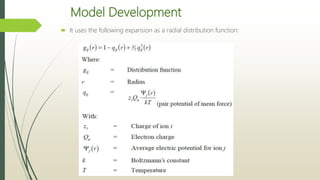
Model Development
 It uses the following expansion as a radial distribution function:
 Pitzer proposes a general equation for the excess Gibbs energy.
 The basic equation is:
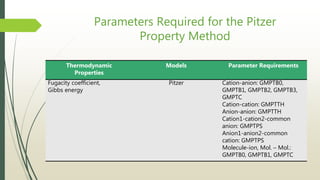
Parameters Required for the Pitzer
Property Method
Thermodynamic
Properties
Models Parameter Requirements
Fugacity coefficient,
Gibbs energy
Pitzer Cation-anion: GMPTB0,
GMPTB1, GMPTB2, GMPTB3,
GMPTC
Cation-cation: GMPTTH
Anion-anion: GMPTTH
Cation1-cation2-common
anion: GMPTPS
Anion1-anion2-common
cation: GMPTPS
Molecule-ion, Mol. – Mol.:
GMPTB0, GMPTB1, GMPTC
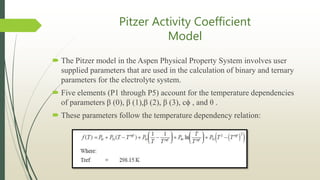
Pitzer Activity Coefficient
Model
 The Pitzer model in the Aspen Physical Property System involves user
supplied parameters that are used in the calculation of binary and ternary
parameters for the electrolyte system.
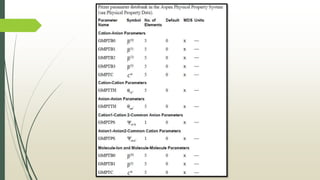
 Five elements (P1 through P5) account for the temperature dependencies
of parameters β (0), β (1),β (2), β (3), cϕ , and θ .
 These parameters follow the temperature dependency relation:
Application of the Pitzer Model to Aqueous Strong
Electrolyte Systems
 Pitzer modified his basic
equation to make it more
useful for data correlation
of aqueous strong
electrolytes.
 He defined a set of more
directly observable
parameters to represent
combinations of the
second and third virial
coefficients.
 The cation-anion parameters B and C are characteristic for an aqueous single electrolyte system.
 These parameters can be determined by the properties of pure (apparent) electrolytes.
 B is expressed as a function of β(0) and β(1), β(2) and β(3)
The modified Pitzer equation is:
 Subscripts c, c′ , and a, a′ denote cations and anions of the
solution.
 B, C, θ, and Ψ are interaction parameters.
 f(I) is an electrostatic term as a function of ionic strength.
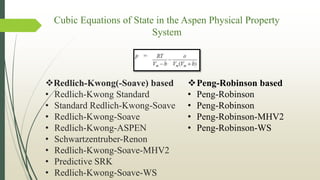
RK-ASPEN Property Method
Cubic Equations of State in the Aspen Physical Property
System
Peng-Robinson based
• Peng-Robinson
• Peng-Robinson
• Peng-Robinson-MHV2
• Peng-Robinson-WS
Redlich-Kwong(-Soave) based
• Redlich-Kwong Standard
• Standard Redlich-Kwong-Soave
• Redlich-Kwong-Soave
• Redlich-Kwong-ASPEN
• Schwartzentruber-Renon
• Redlich-Kwong-Soave-MHV2
• Predictive SRK
• Redlich-Kwong-Soave-WS
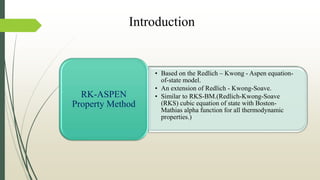
• Based on the Redlich – Kwong - Aspen equation-
of-state model.
• An extension of Redlich - Kwong-Soave.
• Similar to RKS-BM.(Redlich-Kwong-Soave
(RKS) cubic equation of state with Boston-
Mathias alpha function for all thermodynamic
properties.)
RK-ASPEN
Property Method
Introduction
Equations
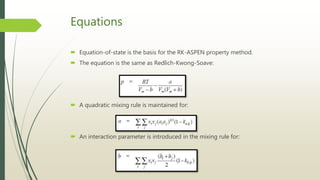
 Equation-of-state is the basis for the RK-ASPEN property method.
 The equation is the same as Redlich-Kwong-Soave:
 A quadratic mixing rule is maintained for:
 An interaction parameter is introduced in the mixing rule for:
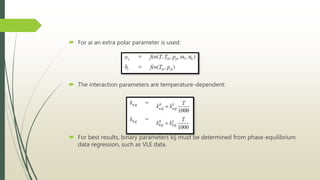
 For ai an extra polar parameter is used:
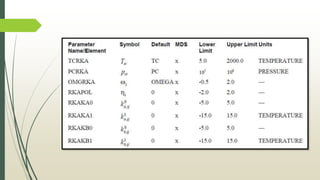
 The interaction parameters are temperature-dependent:
 For best results, binary parameters kij must be determined from phase-equilibrium
data regression, such as VLE data.
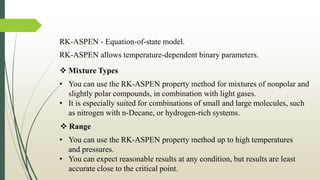
RK-ASPEN allows temperature-dependent binary parameters.
 Mixture Types
 Range
• You can use the RK-ASPEN property method for mixtures of nonpolar and
slightly polar compounds, in combination with light gases.
• It is especially suited for combinations of small and large molecules, such
as nitrogen with n-Decane, or hydrogen-rich systems.
RK-ASPEN - Equation-of-state model.
• You can use the RK-ASPEN property method up to high temperatures
and pressures.
• You can expect reasonable results at any condition, but results are least
accurate close to the critical point.
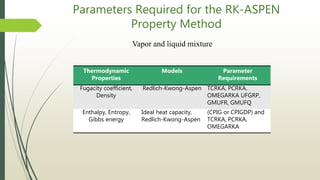
Parameters Required for the RK-ASPEN
Property Method
Thermodynamic
Properties
Models Parameter
Requirements
Fugacity coefficient,
Density
Redlich-Kwong-Aspen TCRKA, PCRKA,
OMEGARKA UFGRP,
GMUFR, GMUFQ
Enthalpy, Entropy,
Gibbs energy
Ideal heat capacity,
Redlich-Kwong-Aspen
(CPIG or CPIGDP) and
TCRKA, PCRKA,
OMEGARKA
Vapor and liquid mixture
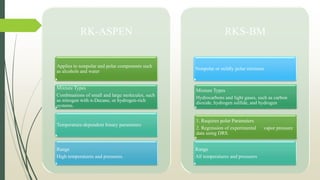
RK-ASPEN
Applies to nonpolar and polar components such
as alcohols and water
Mixture Types
Combinations of small and large molecules, such
as nitrogen with n-Decane, or hydrogen-rich
systems.
Temperature-dependent binary parameters
Range
High temperatures and pressures.
RKS-BM
Nonpolar or mildly polar mixtures
1. Requires polar Parameters
2. Regression of experimental vapor pressure
data using DRS.
Mixture Types
Hydrocarbons and light gases, such as carbon
dioxide, hydrogen sulfide, and hydrogen
Range
All temperatures and pressures
Application
 It can be used for hydrocarbon processing applications.
 It is also used for more polar components and mixtures of
hydrocarbons, and for light gases at medium to high
pressures.
PITZER & RK-ASPEN Property Method

PITZER & RK-ASPEN Property Method

  • 1.
    PITZER & RK-ASPEN PropertyMethod  Presented by,  KANCHAN D. RAMTEKE  MT17MCL011
  • 3.
    Introduction ASPEN plus To optimizethroughput, quality and energy use Includes databases Pure component data Phase equilibrium data for various electrolytes, solids and polymers.
  • 4.
  • 5.
    Introduction The Pitzer modelwas developed as an improvement upon an earlier model proposed by Guggenheim (1935, 1955). The earlier model worked well at low electrolyte concentrations, but contained discrepancies at higher concentrations (>0.1M). The Pitzer model resolved these discrepancies, without resorting to excessive arrays of higher-order terms. It cannot be used for mixed solvent electrolyte systems.
  • 6.
     The PITZERproperty method is based on an aqueous electrolyte activity coefficient model.  It has no overlap with other activity coefficient models.  It can accurately calculate the behavior of aqueous electrolyte solutions with or without molecular solutes up to 6 molal ionic strength.  Many interaction parameters from regression of experimental data are included in databanks and data packages  Do not use this model if a non-aqueous solvent exists.
  • 7.
    You can modelthe solubility of supercritical gases using Henry’s law. Heats of mixing are calculated using the Pitzer model. The Redlich-Kwong-Soave equation of state is used for the vapor phase fugacity coefficient, all other vapor phase properties are assumed ideal. Redlich-Kwong-Soave cannot model association behavior in the vapor phase (for example, carboxylic acids or HF). For carboxylic acids, choose a non-electrolyte activity coefficient model with Hayden-O’Connell or Nothnagel; for HF choose ENRTL-HF or WILS-HF.
  • 8.
    Mixture Types You canuse the Pitzer model for any aqueous electrolyte solution up to 6M ionic strength, not showing association in the vapor phase. Range Vapor phase fugacities are described accurately up to medium pressures. Interaction parameters should be fitted in the range of operation.
  • 9.
    Model Development  Ituses the following expansion as a radial distribution function:
  • 10.
     Pitzer proposesa general equation for the excess Gibbs energy.  The basic equation is:
  • 11.
    Parameters Required forthe Pitzer Property Method Thermodynamic Properties Models Parameter Requirements Fugacity coefficient, Gibbs energy Pitzer Cation-anion: GMPTB0, GMPTB1, GMPTB2, GMPTB3, GMPTC Cation-cation: GMPTTH Anion-anion: GMPTTH Cation1-cation2-common anion: GMPTPS Anion1-anion2-common cation: GMPTPS Molecule-ion, Mol. – Mol.: GMPTB0, GMPTB1, GMPTC
  • 12.
    Pitzer Activity Coefficient Model The Pitzer model in the Aspen Physical Property System involves user supplied parameters that are used in the calculation of binary and ternary parameters for the electrolyte system.  Five elements (P1 through P5) account for the temperature dependencies of parameters β (0), β (1),β (2), β (3), cϕ , and θ .  These parameters follow the temperature dependency relation:
  • 14.
    Application of thePitzer Model to Aqueous Strong Electrolyte Systems  Pitzer modified his basic equation to make it more useful for data correlation of aqueous strong electrolytes.  He defined a set of more directly observable parameters to represent combinations of the second and third virial coefficients.  The cation-anion parameters B and C are characteristic for an aqueous single electrolyte system.  These parameters can be determined by the properties of pure (apparent) electrolytes.  B is expressed as a function of β(0) and β(1), β(2) and β(3) The modified Pitzer equation is:  Subscripts c, c′ , and a, a′ denote cations and anions of the solution.  B, C, θ, and Ψ are interaction parameters.  f(I) is an electrostatic term as a function of ionic strength.
  • 15.
  • 16.
    Cubic Equations ofState in the Aspen Physical Property System Peng-Robinson based • Peng-Robinson • Peng-Robinson • Peng-Robinson-MHV2 • Peng-Robinson-WS Redlich-Kwong(-Soave) based • Redlich-Kwong Standard • Standard Redlich-Kwong-Soave • Redlich-Kwong-Soave • Redlich-Kwong-ASPEN • Schwartzentruber-Renon • Redlich-Kwong-Soave-MHV2 • Predictive SRK • Redlich-Kwong-Soave-WS
  • 17.
    • Based onthe Redlich – Kwong - Aspen equation- of-state model. • An extension of Redlich - Kwong-Soave. • Similar to RKS-BM.(Redlich-Kwong-Soave (RKS) cubic equation of state with Boston- Mathias alpha function for all thermodynamic properties.) RK-ASPEN Property Method Introduction
  • 18.
    Equations  Equation-of-state isthe basis for the RK-ASPEN property method.  The equation is the same as Redlich-Kwong-Soave:  A quadratic mixing rule is maintained for:  An interaction parameter is introduced in the mixing rule for:
  • 19.
     For aian extra polar parameter is used:  The interaction parameters are temperature-dependent:  For best results, binary parameters kij must be determined from phase-equilibrium data regression, such as VLE data.
  • 20.
    RK-ASPEN allows temperature-dependentbinary parameters.  Mixture Types  Range • You can use the RK-ASPEN property method for mixtures of nonpolar and slightly polar compounds, in combination with light gases. • It is especially suited for combinations of small and large molecules, such as nitrogen with n-Decane, or hydrogen-rich systems. RK-ASPEN - Equation-of-state model. • You can use the RK-ASPEN property method up to high temperatures and pressures. • You can expect reasonable results at any condition, but results are least accurate close to the critical point.
  • 21.
    Parameters Required forthe RK-ASPEN Property Method Thermodynamic Properties Models Parameter Requirements Fugacity coefficient, Density Redlich-Kwong-Aspen TCRKA, PCRKA, OMEGARKA UFGRP, GMUFR, GMUFQ Enthalpy, Entropy, Gibbs energy Ideal heat capacity, Redlich-Kwong-Aspen (CPIG or CPIGDP) and TCRKA, PCRKA, OMEGARKA Vapor and liquid mixture
  • 23.
    RK-ASPEN Applies to nonpolarand polar components such as alcohols and water Mixture Types Combinations of small and large molecules, such as nitrogen with n-Decane, or hydrogen-rich systems. Temperature-dependent binary parameters Range High temperatures and pressures. RKS-BM Nonpolar or mildly polar mixtures 1. Requires polar Parameters 2. Regression of experimental vapor pressure data using DRS. Mixture Types Hydrocarbons and light gases, such as carbon dioxide, hydrogen sulfide, and hydrogen Range All temperatures and pressures
  • 24.
    Application  It canbe used for hydrocarbon processing applications.  It is also used for more polar components and mixtures of hydrocarbons, and for light gases at medium to high pressures.