Alfa Chemistry
Biomaterials
Biomaterials are a class of high-tech materials used to diagnose,
repair, or enhance their function in human tissues and organs, that
is, natural or man-made materials used to replace and repair living
tissues, and their effects are irreplaceable. Biomaterials can perform,
enhance, or replace a function that is lost due to illness, injury, and
so on, but can not restore a defective site.
Category
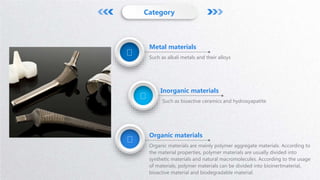
Metal materials
Such as alkali metals and their alloys
Inorganic materials
Such as bioactive ceramics and hydroxyapatite
Organic materials
Organic materials are mainly polymer aggregate materials. According to
the material properties, polymer materials are usually divided into
synthetic materials and natural macromolecules. According to the usage
of materials, polymer materials can be divided into bioinertmaterial,
bioactive material and biodegradable material.
Characteristics
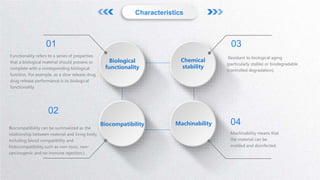
Biological
functionality
Biocompatibility Chemical
stability
Machinability
Characteristics
Functionality refers to a series of properties
that a biological material should possess or
complete with a corresponding biological
function. For example, as a slow release drug,
drug release performance is its biological
functionality.
01
Biocompatibility can be summarized as the
relationship between material and living body,
including blood compatibility and
histocompatibility such as non-toxic, non-
carcinogenic and no immune rejection.).
02
Resistant to biological aging
(particularly stable) or biodegradable
(controlled degradation).
Machinability means that
the material can be
molded and disinfected.
03
04
Biological
functionality
Biocompatibility
Chemical
stability
Machinability
Applications
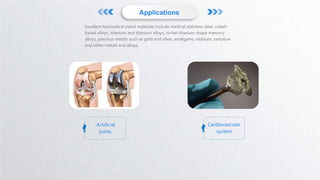
Artificial
joints
Cardiovascular
system
Excellent biomedical metal materials include medical stainless steel, cobalt-
based alloys, titanium and titanium alloys, nickel-titanium shape memory
alloys, precious metals such as gold and silver, amalgams, niobium, tantalum
and other metals and alloys.
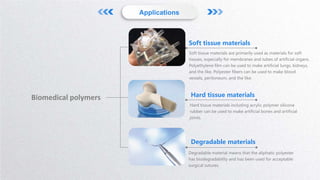
Soft tissue materials
Soft tissue materials are primarily used as materials for soft
tissues, especially for membranes and tubes of artificial organs.
Polyethylene film can be used to make artificial lungs, kidneys,
and the like. Polyester fibers can be used to make blood
vessels, peritoneum, and the like.
Hard tissue materials
Hard tissue materials including acrylic polymer silicone
rubber can be used to make artificial bones and artificial
joints.
Degradable materials
Degradable material means that the aliphatic polyester
has biodegradability and has been used for acceptable
surgical sutures.
Applications
Biomedical polymers
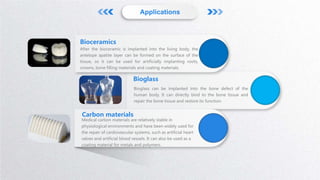
After the bioceramic is implanted into the living body, the
antelope apatite layer can be formed on the surface of the
tissue, so it can be used for artificially implanting roots,
crowns, bone filling materials and coating materials.
Bioceramics
Bioglass can be implanted into the bone defect of the
human body. It can directly bind to the bone tissue and
repair the bone tissue and restore its function.
Bioglass
Medical carbon materials are relatively stable in
physiological environments and have been widely used for
the repair of cardiovascular systems, such as artificial heart
valves and artificial blood vessels. It can also be used as a
coating material for metals and polymers.
Carbon materials
Applications
Example
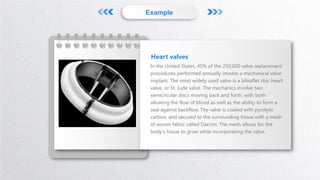
In the United States, 45% of the 250,000 valve replacement
procedures performed annually involve a mechanical valve
implant. The most widely used valve is a bileaflet disc heart
valve, or St. Jude valve. The mechanics involve two
semicircular discs moving back and forth, with both
allowing the flow of blood as well as the ability to form a
seal against backflow. The valve is coated with pyrolytic
carbon, and secured to the surrounding tissue with a mesh
of woven fabric called Dacron. The mesh allows for the
body's tissue to grow while incorporating the valve.
Heart valves
Example
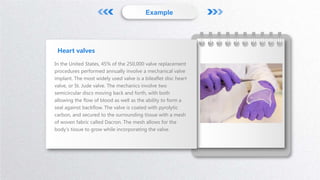
In the United States, 45% of the 250,000 valve replacement
procedures performed annually involve a mechanical valve
implant. The most widely used valve is a bileaflet disc heart
valve, or St. Jude valve. The mechanics involve two
semicircular discs moving back and forth, with both
allowing the flow of blood as well as the ability to form a
seal against backflow. The valve is coated with pyrolytic
carbon, and secured to the surrounding tissue with a mesh
of woven fabric called Dacron. The mesh allows for the
body's tissue to grow while incorporating the valve.
Heart valves
Information
Email
info@alfa-chemistry.com
Address
2200 Smithtown Avenue, Room 1
Ronkonkoma, NY 11779-7329
USA
Telephone
1-201-478-8534
1-516-662-5404
Fax
1-516-927-0118
汇报人:图网

Biomaterials

  • 1.
  • 2.
    Biomaterials are aclass of high-tech materials used to diagnose, repair, or enhance their function in human tissues and organs, that is, natural or man-made materials used to replace and repair living tissues, and their effects are irreplaceable. Biomaterials can perform, enhance, or replace a function that is lost due to illness, injury, and so on, but can not restore a defective site.
  • 3.
    Category Metal materials Such asalkali metals and their alloys Inorganic materials Such as bioactive ceramics and hydroxyapatite Organic materials Organic materials are mainly polymer aggregate materials. According to the material properties, polymer materials are usually divided into synthetic materials and natural macromolecules. According to the usage of materials, polymer materials can be divided into bioinertmaterial, bioactive material and biodegradable material.
  • 4.
  • 5.
    Characteristics Functionality refers toa series of properties that a biological material should possess or complete with a corresponding biological function. For example, as a slow release drug, drug release performance is its biological functionality. 01 Biocompatibility can be summarized as the relationship between material and living body, including blood compatibility and histocompatibility such as non-toxic, non- carcinogenic and no immune rejection.). 02 Resistant to biological aging (particularly stable) or biodegradable (controlled degradation). Machinability means that the material can be molded and disinfected. 03 04 Biological functionality Biocompatibility Chemical stability Machinability
  • 6.
    Applications Artificial joints Cardiovascular system Excellent biomedical metalmaterials include medical stainless steel, cobalt- based alloys, titanium and titanium alloys, nickel-titanium shape memory alloys, precious metals such as gold and silver, amalgams, niobium, tantalum and other metals and alloys.
  • 7.
    Soft tissue materials Softtissue materials are primarily used as materials for soft tissues, especially for membranes and tubes of artificial organs. Polyethylene film can be used to make artificial lungs, kidneys, and the like. Polyester fibers can be used to make blood vessels, peritoneum, and the like. Hard tissue materials Hard tissue materials including acrylic polymer silicone rubber can be used to make artificial bones and artificial joints. Degradable materials Degradable material means that the aliphatic polyester has biodegradability and has been used for acceptable surgical sutures. Applications Biomedical polymers
  • 8.
    After the bioceramicis implanted into the living body, the antelope apatite layer can be formed on the surface of the tissue, so it can be used for artificially implanting roots, crowns, bone filling materials and coating materials. Bioceramics Bioglass can be implanted into the bone defect of the human body. It can directly bind to the bone tissue and repair the bone tissue and restore its function. Bioglass Medical carbon materials are relatively stable in physiological environments and have been widely used for the repair of cardiovascular systems, such as artificial heart valves and artificial blood vessels. It can also be used as a coating material for metals and polymers. Carbon materials Applications
  • 9.
    Example In the UnitedStates, 45% of the 250,000 valve replacement procedures performed annually involve a mechanical valve implant. The most widely used valve is a bileaflet disc heart valve, or St. Jude valve. The mechanics involve two semicircular discs moving back and forth, with both allowing the flow of blood as well as the ability to form a seal against backflow. The valve is coated with pyrolytic carbon, and secured to the surrounding tissue with a mesh of woven fabric called Dacron. The mesh allows for the body's tissue to grow while incorporating the valve. Heart valves
  • 10.
    Example In the UnitedStates, 45% of the 250,000 valve replacement procedures performed annually involve a mechanical valve implant. The most widely used valve is a bileaflet disc heart valve, or St. Jude valve. The mechanics involve two semicircular discs moving back and forth, with both allowing the flow of blood as well as the ability to form a seal against backflow. The valve is coated with pyrolytic carbon, and secured to the surrounding tissue with a mesh of woven fabric called Dacron. The mesh allows for the body's tissue to grow while incorporating the valve. Heart valves
  • 11.
    Information Email info@alfa-chemistry.com Address 2200 Smithtown Avenue,Room 1 Ronkonkoma, NY 11779-7329 USA Telephone 1-201-478-8534 1-516-662-5404 Fax 1-516-927-0118
  • 12.