What is a heart?
It's the muscle at the centre of your circulationsystem. It pumps blood around
your body as your heart beats. This bloodsends oxygen and nutrients to all parts
of your body, and carbon dioxideand waste products.
Causes for heart
malfunction
• Holes in the heart
• Atrial septal defects
• Ventricular septal defects
Causes:
• In case like pulmonary stenosis, the valves of the major
vessels are narrow. When major vessels of the heart are
wrongly connected , then there is mixing of pure and
impure blood. This account for blue colour of baby.
• For young pepole,mitral valve and aortic valve can be
affected.
• Tricuspid valve may be affected at a later stage.
And affected valve can be replaced by artificial valve.
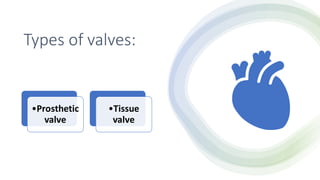
Types of valves:
•Prosthetic
valve
•Tissue
valve
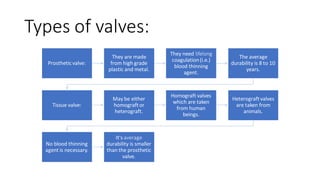
Types of valves:
Prostheticvalve:
They are made
from high grade
plastic and metal.
They need lifelong
coagulation(i.e.)
blood thinning
agent.
The average
durability is 8 to 10
years.
Tissue valve:
May be either
homograftor
heterograft.
Homograft valves
which are taken
from human
beings.
Heterograftvalves
are taken from
animals.
No blood thinning
agent is necessary.
It's average
durability is smaller
than the prosthetic
valve.
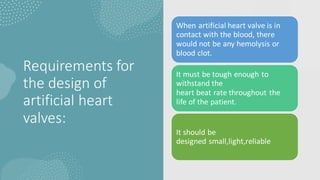
Requirements for
the design of
artificial heart
valves:
When artificial heart valve is in
contact with the blood, there
would not be any hemolysis or
blood clot.
It must be tough enough to
withstand the
heart beat rate throughout the
life of the patient.
It should be
designed small,light,reliable
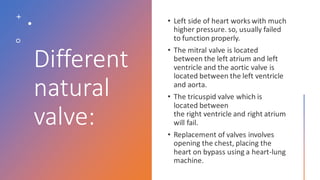
Different
natural
valve:
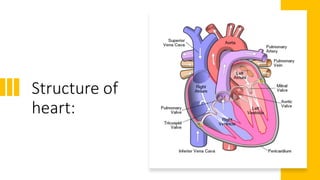
Structure of
heart:
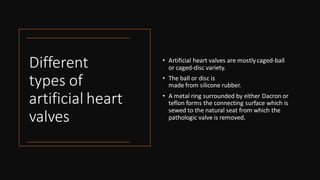
Different
types of
artificial heart
valves
• Artificial heart valves are mostlycaged-ball
or caged-disc variety.
• The ball or disc is
made from silicone rubber.
• A metal ring surrounded by either Dacron or
teflon forms the connecting surface which is
sewed to the natural seat from which the
pathologic valve is removed.
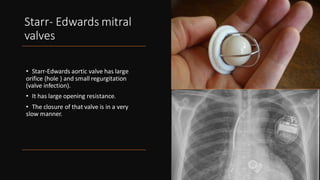
Starr- Edwards mitral
valves
• Starr-Edwards aortic valve has large
orifice (hole ) and small regurgitation
(valve infection).
• It has large opening resistance.
• The closure of that valve is in a very
slow manner.
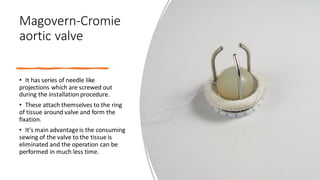
Magovern-Cromie
aortic valve
• It has series of needle like
projections which are screwed out
during the installation procedure.
• These attach themselves to the ring
of tissue around valve and form the
fixation.
• It's main advantageis the consuming
sewing of the valve to the tissue is
eliminated and the operation can be
performed in much less time.
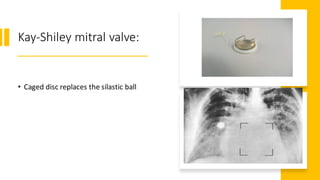
Kay-Shiley mitral valve:
• Caged disc replaces the silastic ball
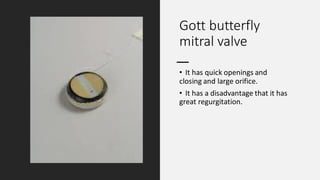
Gott butterfly
mitral valve
• It has quick openings and
closing and large orifice.
• It has a disadvantage that it has
great regurgitation.
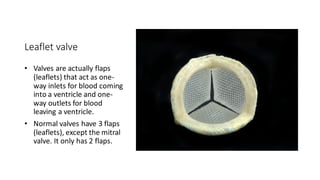
Leaflet valve
• Valves are actually flaps
(leaflets) that act as one-
way inlets for blood coming
into a ventricle and one-
way outlets for blood
leaving a ventricle.
• Normal valves have 3 flaps
(leaflets), except the mitral
valve. It only has 2 flaps.
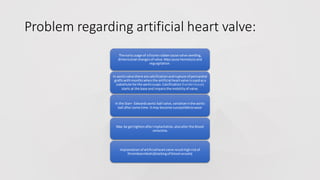
Problem regarding artificial heart valve:
The earlyusage of silicone rubbercause valve swelling,
dimensional changesof valve.Maycause hemolysisand
regurgitation.
In aorticvalve there are calcificationandrupture of pericardial
graftswithmonthswhenthe artificial heartvalve isusedasa
substitute forthe aorticcusps.Calcification (hardentissue)
starts at the base and impairsthe mobilityof valve.
In the Starr- Edwardsaortic ball valve,variationinthe aortic
ball aftersome time.Itmay become susceptibletowear
May be gettightenafterimplantation,alsoalterthe blood
velocities
Implantationof artificialheartvalve resulthighriskof
thromboembolic(blockingof bloodvessels)
In some case at the mitral site the blood is
slowly squeezing out which result clotting.
And also cause infection in the operation.
The ball
itself deformed causing incompetency, can
decreases normal efficiency.
Sometimes blood leaks around the
insertion site cusing a small degree of
insufficiency and clot formation.
So this can reduce opening and closing of
valves.
Thank you

artifical heart valve

  • 1.
    What is aheart? It's the muscle at the centre of your circulationsystem. It pumps blood around your body as your heart beats. This bloodsends oxygen and nutrients to all parts of your body, and carbon dioxideand waste products.
  • 2.
    Causes for heart malfunction •Holes in the heart • Atrial septal defects • Ventricular septal defects
  • 3.
    Causes: • In caselike pulmonary stenosis, the valves of the major vessels are narrow. When major vessels of the heart are wrongly connected , then there is mixing of pure and impure blood. This account for blue colour of baby. • For young pepole,mitral valve and aortic valve can be affected. • Tricuspid valve may be affected at a later stage. And affected valve can be replaced by artificial valve.
  • 4.
  • 5.
    Types of valves: Prostheticvalve: Theyare made from high grade plastic and metal. They need lifelong coagulation(i.e.) blood thinning agent. The average durability is 8 to 10 years. Tissue valve: May be either homograftor heterograft. Homograft valves which are taken from human beings. Heterograftvalves are taken from animals. No blood thinning agent is necessary. It's average durability is smaller than the prosthetic valve.
  • 6.
    Requirements for the designof artificial heart valves: When artificial heart valve is in contact with the blood, there would not be any hemolysis or blood clot. It must be tough enough to withstand the heart beat rate throughout the life of the patient. It should be designed small,light,reliable
  • 7.
  • 8.
  • 9.
    Different types of artificial heart valves •Artificial heart valves are mostlycaged-ball or caged-disc variety. • The ball or disc is made from silicone rubber. • A metal ring surrounded by either Dacron or teflon forms the connecting surface which is sewed to the natural seat from which the pathologic valve is removed.
  • 10.
    Starr- Edwards mitral valves •Starr-Edwards aortic valve has large orifice (hole ) and small regurgitation (valve infection). • It has large opening resistance. • The closure of that valve is in a very slow manner.
  • 11.
    Magovern-Cromie aortic valve • Ithas series of needle like projections which are screwed out during the installation procedure. • These attach themselves to the ring of tissue around valve and form the fixation. • It's main advantageis the consuming sewing of the valve to the tissue is eliminated and the operation can be performed in much less time.
  • 12.
    Kay-Shiley mitral valve: •Caged disc replaces the silastic ball
  • 13.
    Gott butterfly mitral valve •It has quick openings and closing and large orifice. • It has a disadvantage that it has great regurgitation.
  • 14.
    Leaflet valve • Valvesare actually flaps (leaflets) that act as one- way inlets for blood coming into a ventricle and one- way outlets for blood leaving a ventricle. • Normal valves have 3 flaps (leaflets), except the mitral valve. It only has 2 flaps.
  • 15.
    Problem regarding artificialheart valve: The earlyusage of silicone rubbercause valve swelling, dimensional changesof valve.Maycause hemolysisand regurgitation. In aorticvalve there are calcificationandrupture of pericardial graftswithmonthswhenthe artificial heartvalve isusedasa substitute forthe aorticcusps.Calcification (hardentissue) starts at the base and impairsthe mobilityof valve. In the Starr- Edwardsaortic ball valve,variationinthe aortic ball aftersome time.Itmay become susceptibletowear May be gettightenafterimplantation,alsoalterthe blood velocities Implantationof artificialheartvalve resulthighriskof thromboembolic(blockingof bloodvessels)
  • 16.
    In some caseat the mitral site the blood is slowly squeezing out which result clotting. And also cause infection in the operation. The ball itself deformed causing incompetency, can decreases normal efficiency. Sometimes blood leaks around the insertion site cusing a small degree of insufficiency and clot formation. So this can reduce opening and closing of valves.
  • 17.