Drugs used in HF
 BY
Dr. SamiaTasneem
MDThesis Part Student
Department of Cardiology
Dhaka Medical College Hospital
Definition of heart failure
 HF is a clinical syndrome characterized by typical
symptoms (e.g. breathlessness, ankle swelling
and fatigue) that may be accompanied by signs
(e.g. elevated jugular venous pressure,
pulmonary crackles and peripheral oedema)
caused by a structural and/or functional cardiac
abnormality, resulting in a reduced cardiac
output and/or elevated intracardiac pressures at
rest or during stress.
(Esc Guideline 2016)
ESC 2016 guidelines `
AHA 2016
Global trend in Heart failure
A Contemporary Appraisal of the HF
Epidemic
 prevalence of HF is approximately 1–2% of the
adult population in developed countries, rising to
10% among people >70 years of age.
 Among people >65 years of age one in six will
have unrecognized HF (mainly HFpEF).
 The lifetime risk of HF at age 55 years is 33% for
men and 28% for women.
 The proportion of patients with HFpEF ranges
from 22 to 73%.
Treatment Objective
To improve
 Clinical Status
 Functional capacity
 Quality of life
To reduce
 Deteorioration
 Recurrent hospital
admission
 Progression
 Mortality
Goals of Pharmacotherapy
Relief of congestion/low cardiac output symptoms &
restoration of cardiac performance:
 Inotropic drugs-digoxin, dobutamine,amrinone/milrinone.
 Diuretics: furosemide, thiazides.
 Vasodilators:ACE inhibitors/AT1 antagonist, hydralazine,
nitrate.
 Beta blockers: metoprolol,bisprolol,carvedilol
Arrest/reversal of disease progression & prolongation of
survival
 ACE inhibitors/AT1 antagonist (ARBs)
 Beta-blockers
 Aldosterone antagonist- spironolactone
 ARNI
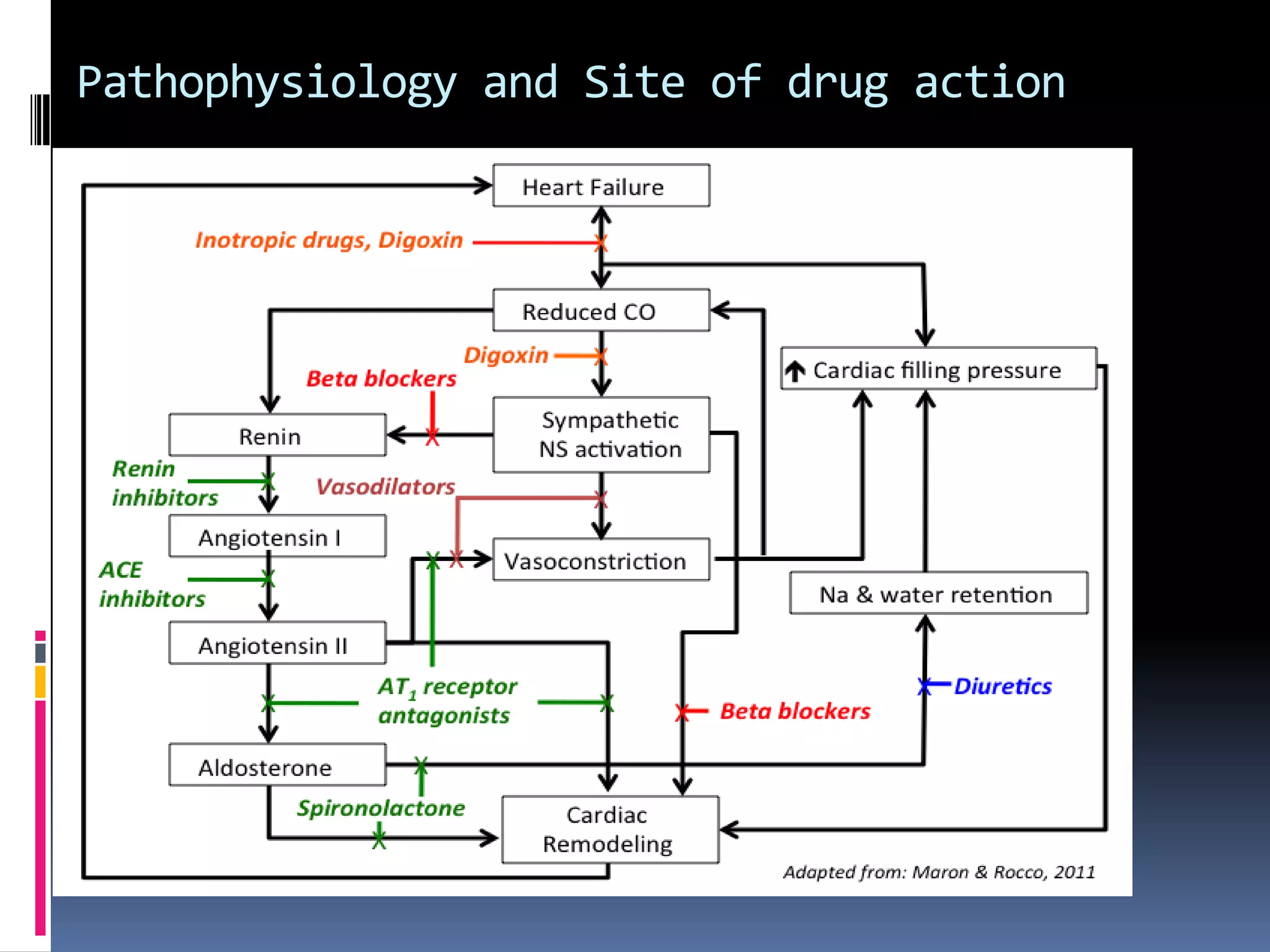
Pathophysiology and Site of drug action
M/A of Aldosterone
Pharmacological treatment of heart
failure with reduced ejection
fraction
Pharmacological treatments indicated in all
patients with symptomatic (NYHA Class II-IV) heart
failure with reduced ejection fraction
Beta Blocker and mortality
Other treatments recommended in
selected symptomatic patients with heart
failure with reduced ejection fraction
Treatment strategy for the use of drugs (and
devices) in patients with HFrEF (Esc 2016)
AHA 2016
Doses of diuretics commonly used in
patients with heart failure
Angiotensin receptor neprilysin
inhibitor
 Acts by inhibiting the If
channel, present in the
cardiac SA node
 •Reduces persistently
elevated heart rate
 •Evaluated as treatment of
HFrEF who have a resting
HR of at least 70 beats per
minute, in sinus rhythm,
and who are also taking the
highest tolerable dose of a
beta blocker
Ivabradine
Ivabradine
Indication To reduce the risk of hospitalization for worsening HF in patients with
stable, symptomatic chronic HF with LVEF ≤35% who are in sinus
rhythm with resting HR ≥70 bpm and either are on maximally
tolerated doses of beta-blockers or have a contraindication to beta-
blocker use.
Dosage Start with 5 mg twice daily.After 2 weeks of treatment, adjust dose
based on HR. Max is 7.5 mg twice daily. In patients with conduction
defects or in whom bradycardia could lead to hemodynamic
compromise, start with 2.5 mg twice daily.
Contraindications Acute decompensated HF; BP <90/50 mmHg; sick sinus syndrome or
third-degreeAV block, unless a functioning demand pacemaker is
present; resting HR <60 bpm prior to treatment; severe hepatic
impairment; pacemaker dependence.WARNING –fetal toxicity
Side effects Occurring in ≥1% of patients are bradycardia, hypertension, atrial
fibrillation, and luminous phenomena (phosphenes).
Practical Points on Use of
Ivabradine
 Starting dose is 5 mg twice daily
 •Target HR is 50-60 bpm
 •After 2 weeks:If HR >60 bpm: Increase dose to 7.5 mg
twice daily (Max dose)
 If HR 50-60 bpm: Maintain initial dose
 If HR <50 bpm or symptomatic bradycardia: Lower
dose to 2.5 mg twice daily
 If HR <50 bpm or symptomatic bradycardia and dose is
2.5 mg twice daily: Discontinue
Other treatments with less certain benefits
in symptomatic patients with heart failure
with reduced ejection fraction
Digoxin and other digitalis glycosides:
 may be considered in patients in sinus rhythm with symptomatic
HFrEF to reduce the risk of hospitalization
 In patients with symptomatic HF and AF, digoxin may be useful
 to slow a rapid ventricular rate, but it is only recommended for
the treatment of patients with HFrEF and AF with rapid
ventricular rate when other therapeutic options cannot be
pursued
 Caution should be exerted in females, in the elderly and in
patients with reduced renal function.
n-3 polyunsaturated fatty acids:
 Only preparations with eicosapentaenoic acid (EPA)
and docosahexaenoic acid (DHA)
 preparations containing > 850 mg/g has been shown
in either HFrEF or post-myocardial infarction.
 May be considered as an adjunctive therapy in
patients with symptomatic HFrEF who are already
receiving optimized recommended therapy with an
ACEI (or ARB), a beta-blocker and an MRA.
Treatments not recommended (unproven
benefit) in symptomatic patients with heart
failure with reduced ejection fraction
Statins:
 The two major trials that studied the effect of statin
treatment in patients with chronic HF did not demonstrate
any evidence of benefit.
 In patients who already receive a statin because of
underlying CAD or/and hyperlipidaemia, a continuation of
this therapy should be considered.
Oral anticoagulants and antiplatelet therapy:
 There is no evidence that an oral anticoagulant reduces
mortality/morbidity compared with placebo or aspirin.
 Patients with HFrEF receiving oral anticoagulation
because of concurrentAF or risk of venous
thromboembolism should continue anticoagulation
Renin inhibitors:
 Not presently recommended as an alternative to an ACEI
orARB as failed to improve outcomes for patients
hospitalized for HF.
Treatments (or combinations of treatments) that may cause
harm in patients with symptomatic (NYHA Class II–IV) heart
failure with reduced ejection fraction
Treatment of heart failure with
preserved ejection fraction
Recommendations for treatment of patients with heart
failure with preserved ejection fraction and heart
failure with mid-range ejection fraction
Drugs  in Heart Failure  samia

Drugs in Heart Failure samia

  • 1.
    Drugs used inHF  BY Dr. SamiaTasneem MDThesis Part Student Department of Cardiology Dhaka Medical College Hospital
  • 2.
    Definition of heartfailure  HF is a clinical syndrome characterized by typical symptoms (e.g. breathlessness, ankle swelling and fatigue) that may be accompanied by signs (e.g. elevated jugular venous pressure, pulmonary crackles and peripheral oedema) caused by a structural and/or functional cardiac abnormality, resulting in a reduced cardiac output and/or elevated intracardiac pressures at rest or during stress. (Esc Guideline 2016)
  • 3.
  • 4.
  • 5.
    Global trend inHeart failure
  • 6.
    A Contemporary Appraisalof the HF Epidemic  prevalence of HF is approximately 1–2% of the adult population in developed countries, rising to 10% among people >70 years of age.  Among people >65 years of age one in six will have unrecognized HF (mainly HFpEF).  The lifetime risk of HF at age 55 years is 33% for men and 28% for women.  The proportion of patients with HFpEF ranges from 22 to 73%.
  • 10.
    Treatment Objective To improve Clinical Status  Functional capacity  Quality of life To reduce  Deteorioration  Recurrent hospital admission  Progression  Mortality
  • 12.
    Goals of Pharmacotherapy Reliefof congestion/low cardiac output symptoms & restoration of cardiac performance:  Inotropic drugs-digoxin, dobutamine,amrinone/milrinone.  Diuretics: furosemide, thiazides.  Vasodilators:ACE inhibitors/AT1 antagonist, hydralazine, nitrate.  Beta blockers: metoprolol,bisprolol,carvedilol Arrest/reversal of disease progression & prolongation of survival  ACE inhibitors/AT1 antagonist (ARBs)  Beta-blockers  Aldosterone antagonist- spironolactone  ARNI
  • 13.
  • 16.
  • 18.
    Pharmacological treatment ofheart failure with reduced ejection fraction
  • 19.
    Pharmacological treatments indicatedin all patients with symptomatic (NYHA Class II-IV) heart failure with reduced ejection fraction
  • 22.
  • 24.
    Other treatments recommendedin selected symptomatic patients with heart failure with reduced ejection fraction
  • 25.
    Treatment strategy forthe use of drugs (and devices) in patients with HFrEF (Esc 2016)
  • 26.
  • 29.
    Doses of diureticscommonly used in patients with heart failure
  • 30.
  • 42.
     Acts byinhibiting the If channel, present in the cardiac SA node  •Reduces persistently elevated heart rate  •Evaluated as treatment of HFrEF who have a resting HR of at least 70 beats per minute, in sinus rhythm, and who are also taking the highest tolerable dose of a beta blocker Ivabradine
  • 45.
    Ivabradine Indication To reducethe risk of hospitalization for worsening HF in patients with stable, symptomatic chronic HF with LVEF ≤35% who are in sinus rhythm with resting HR ≥70 bpm and either are on maximally tolerated doses of beta-blockers or have a contraindication to beta- blocker use. Dosage Start with 5 mg twice daily.After 2 weeks of treatment, adjust dose based on HR. Max is 7.5 mg twice daily. In patients with conduction defects or in whom bradycardia could lead to hemodynamic compromise, start with 2.5 mg twice daily. Contraindications Acute decompensated HF; BP <90/50 mmHg; sick sinus syndrome or third-degreeAV block, unless a functioning demand pacemaker is present; resting HR <60 bpm prior to treatment; severe hepatic impairment; pacemaker dependence.WARNING –fetal toxicity Side effects Occurring in ≥1% of patients are bradycardia, hypertension, atrial fibrillation, and luminous phenomena (phosphenes).
  • 46.
    Practical Points onUse of Ivabradine  Starting dose is 5 mg twice daily  •Target HR is 50-60 bpm  •After 2 weeks:If HR >60 bpm: Increase dose to 7.5 mg twice daily (Max dose)  If HR 50-60 bpm: Maintain initial dose  If HR <50 bpm or symptomatic bradycardia: Lower dose to 2.5 mg twice daily  If HR <50 bpm or symptomatic bradycardia and dose is 2.5 mg twice daily: Discontinue
  • 47.
    Other treatments withless certain benefits in symptomatic patients with heart failure with reduced ejection fraction Digoxin and other digitalis glycosides:  may be considered in patients in sinus rhythm with symptomatic HFrEF to reduce the risk of hospitalization  In patients with symptomatic HF and AF, digoxin may be useful  to slow a rapid ventricular rate, but it is only recommended for the treatment of patients with HFrEF and AF with rapid ventricular rate when other therapeutic options cannot be pursued  Caution should be exerted in females, in the elderly and in patients with reduced renal function.
  • 48.
    n-3 polyunsaturated fattyacids:  Only preparations with eicosapentaenoic acid (EPA) and docosahexaenoic acid (DHA)  preparations containing > 850 mg/g has been shown in either HFrEF or post-myocardial infarction.  May be considered as an adjunctive therapy in patients with symptomatic HFrEF who are already receiving optimized recommended therapy with an ACEI (or ARB), a beta-blocker and an MRA.
  • 49.
    Treatments not recommended(unproven benefit) in symptomatic patients with heart failure with reduced ejection fraction Statins:  The two major trials that studied the effect of statin treatment in patients with chronic HF did not demonstrate any evidence of benefit.  In patients who already receive a statin because of underlying CAD or/and hyperlipidaemia, a continuation of this therapy should be considered.
  • 50.
    Oral anticoagulants andantiplatelet therapy:  There is no evidence that an oral anticoagulant reduces mortality/morbidity compared with placebo or aspirin.  Patients with HFrEF receiving oral anticoagulation because of concurrentAF or risk of venous thromboembolism should continue anticoagulation Renin inhibitors:  Not presently recommended as an alternative to an ACEI orARB as failed to improve outcomes for patients hospitalized for HF.
  • 51.
    Treatments (or combinationsof treatments) that may cause harm in patients with symptomatic (NYHA Class II–IV) heart failure with reduced ejection fraction
  • 52.
    Treatment of heartfailure with preserved ejection fraction
  • 54.
    Recommendations for treatmentof patients with heart failure with preserved ejection fraction and heart failure with mid-range ejection fraction