Hearing
aids
Hearing aids
Subject - medical surgical nursing
Presentation on - Hearing aids
Presented by -Arti Deshmukh
Definition
A hearing aid is an electronic,
battery-operated device that amplifies
and changes sound to allow for
improved communication.
Indication
Hearing loss
Components of hearing aids
Microphone: Receives sound and converts it into electrical
impulses. (picks up sound)
Amplifier: Intensifies electrical impulses, (makes sound louder)
Receiver: Translates those electrical impulses into louder sounds.
(delivers amplified sound into ear-miniature loudspeaker)
Battery: Serves as power source for device.
Types of hearing aids
Pocket Model
Behind-the-Ear (BTE)
In-the-Ear (ITE)
Spectacle type
Remote microphone (RM)
Bone conduction (BC) hearing aid
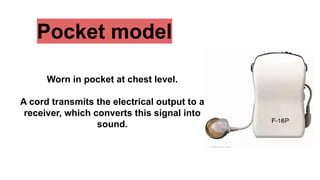
Pocket model
Worn in pocket at chest level.
A cord transmits the electrical output to a
receiver, which converts this signal into
sound.
In the ear
ITC hearing aids are customized to fit
the size and shape of the ear canal
and are used for mild or moderately
severe hearing loss.
Small one-piece hearing aid
Slight visible in the ear
Spectacle type
The hearing aid components
are incorporated within a
spectacle frame.
It is useful for those who use
glasses along with hearing
aids.
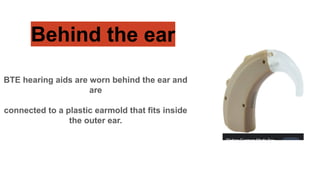
Behind the ear
BTE hearing aids are worn behind the ear and
are
connected to a plastic earmold that fits inside
the outer ear.
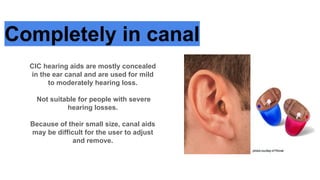
Completely in canal
CIC hearing aids are mostly concealed
in the ear canal and are used for mild
to moderately hearing loss.
Not suitable for people with severe
hearing losses.
Because of their small size, canal aids
may be difficult for the user to adjust
and remove.
Remote microphone
It combines the advantage
of BTE and ITE models.
This model is virtually
invisible.
Bone conductive hearing aid
● A bone conduction
vibrator is placed on the
mastoid
● bone behind the ear.
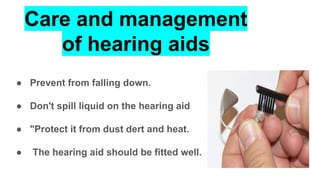
Care and management
of hearing aids
● Prevent from falling down.
● Don't spill liquid on the hearing aid
● "Protect it from dust dert and heat.
● The hearing aid should be fitted well.
Hearing aids ppt presentation topic in nursing

Hearing aids ppt presentation topic in nursing

  • 1.
  • 2.
    Hearing aids Subject -medical surgical nursing Presentation on - Hearing aids Presented by -Arti Deshmukh
  • 3.
    Definition A hearing aidis an electronic, battery-operated device that amplifies and changes sound to allow for improved communication.
  • 4.
  • 5.
    Components of hearingaids Microphone: Receives sound and converts it into electrical impulses. (picks up sound) Amplifier: Intensifies electrical impulses, (makes sound louder) Receiver: Translates those electrical impulses into louder sounds. (delivers amplified sound into ear-miniature loudspeaker) Battery: Serves as power source for device.
  • 6.
    Types of hearingaids Pocket Model Behind-the-Ear (BTE) In-the-Ear (ITE) Spectacle type Remote microphone (RM) Bone conduction (BC) hearing aid
  • 7.
    Pocket model Worn inpocket at chest level. A cord transmits the electrical output to a receiver, which converts this signal into sound.
  • 8.
    In the ear ITChearing aids are customized to fit the size and shape of the ear canal and are used for mild or moderately severe hearing loss. Small one-piece hearing aid Slight visible in the ear
  • 9.
    Spectacle type The hearingaid components are incorporated within a spectacle frame. It is useful for those who use glasses along with hearing aids.
  • 10.
    Behind the ear BTEhearing aids are worn behind the ear and are connected to a plastic earmold that fits inside the outer ear.
  • 11.
    Completely in canal CIChearing aids are mostly concealed in the ear canal and are used for mild to moderately hearing loss. Not suitable for people with severe hearing losses. Because of their small size, canal aids may be difficult for the user to adjust and remove.
  • 12.
    Remote microphone It combinesthe advantage of BTE and ITE models. This model is virtually invisible.
  • 13.
    Bone conductive hearingaid ● A bone conduction vibrator is placed on the mastoid ● bone behind the ear.
  • 14.
    Care and management ofhearing aids ● Prevent from falling down. ● Don't spill liquid on the hearing aid ● "Protect it from dust dert and heat. ● The hearing aid should be fitted well.