BINOMIAL HEAP
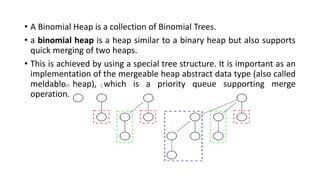
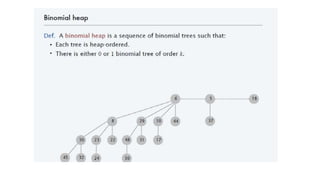
• A Binomial Heap is a collection of Binomial Trees.
• a binomial heap is a heap similar to a binary heap but also supports
quick merging of two heaps.
• This is achieved by using a special tree structure. It is important as an
implementation of the mergeable heap abstract data type (also called
meldable heap), which is a priority queue supporting merge
operation.
Structure of a binomial heap
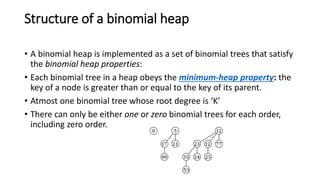
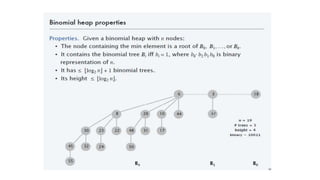
• A binomial heap is implemented as a set of binomial trees that satisfy
the binomial heap properties:
• Each binomial tree in a heap obeys the minimum-heap property: the
key of a node is greater than or equal to the key of its parent.
• Atmost one binomial tree whose root degree is ‘K’
• There can only be either one or zero binomial trees for each order,
including zero order.
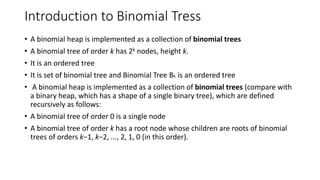
Introduction to Binomial Tress
• A binomial heap is implemented as a collection of binomial trees
• A binomial tree of order k has 2k nodes, height k.
• It is an ordered tree
• It is set of binomial tree and Binomial Tree Bk is an ordered tree
• A binomial heap is implemented as a collection of binomial trees (compare with
a binary heap, which has a shape of a single binary tree), which are defined
recursively as follows:
• A binomial tree of order 0 is a single node
• A binomial tree of order k has a root node whose children are roots of binomial
trees of orders k−1, k−2, ..., 2, 1, 0 (in this order).
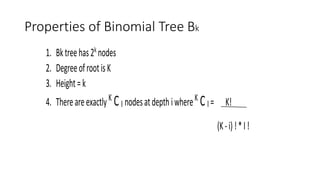
Properties of Binomial Tree Bk
1. Bktreehas2k
nodes
2. DegreeofrootisK
3. Height=k
4. ThereareexactlyK
CI nodesatdepthiwhereK
CI = K!
(K-i)!*I!
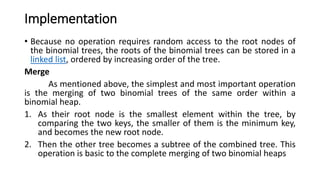
Implementation
• Because no operation requires random access to the root nodes of
the binomial trees, the roots of the binomial trees can be stored in a
linked list, ordered by increasing order of the tree.
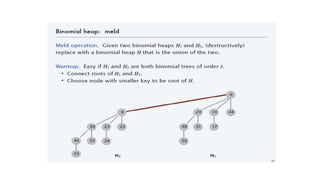
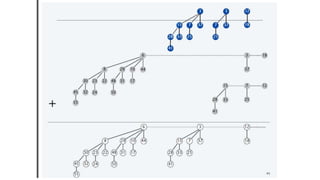
Merge
As mentioned above, the simplest and most important operation
is the merging of two binomial trees of the same order within a
binomial heap.
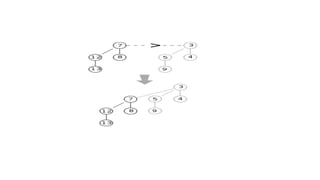
1. As their root node is the smallest element within the tree, by
comparing the two keys, the smaller of them is the minimum key,
and becomes the new root node.
2. Then the other tree becomes a subtree of the combined tree. This
operation is basic to the complete merging of two binomial heaps
Insert
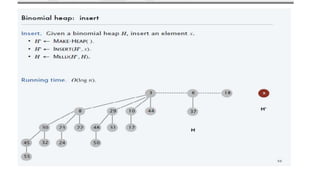
Inserting a new element to a heap can be done by simply creating a new heap
containing only this element and then merging it with the original heap.
Due to the merge, insert takes O(log n) time. However, across a series of n
consecutive insertions, insert has an amortized time of O(1) (i.e. constant).
Find minimum
• To find the minimum element of the heap, find the minimum among the roots of
the binomial trees. This can again be done easily in O(log n) time, as there are just
O(log n) trees and hence roots to examine.
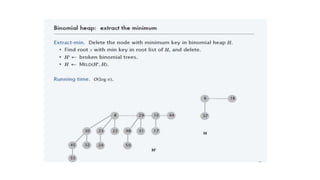
Delete minimum
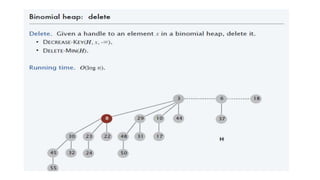
• To delete the minimum element from the heap, first find this element, remove it
from its binomial tree, and obtain a list of its subtrees. Then transform this list of
subtrees into a separate binomial heap by reordering them from smallest to largest
order.
• Then merge this heap with the original heap. Since each tree has at most log n
children, creating this new heap is O(log n). Merging heaps is O(log n), so the entire
delete minimum operation is O(log n).
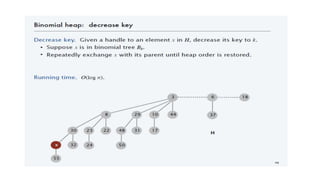
Decrease key
• After decreasing the key of an element, it may become smaller than
the key of its parent, violating the minimum-heap property.
• If this is the case, exchange the element with its parent, and possibly
also with its grandparent, and so on, until the minimum-heap
property is no longer violated.
• Each binomial tree has height at most log n, so this takes O(log n)
time.
B TREE
Introduction
• In B-trees, internal (non-leaf) nodes can have a variable
number of child nodes within some pre-defined range. When
data is inserted or removed from a node, its number of child
nodes changes. In order to maintain the pre-defined range,
internal nodes may be joined or split.
• Because a range of child nodes is permitted, B-trees do not
need re-balancing as frequently as other self-balancing search
trees, but may waste some space, since nodes are not entirely
full. The lower and upper bounds on the number of child
nodes are typically fixed for a particular implementation
Cont..
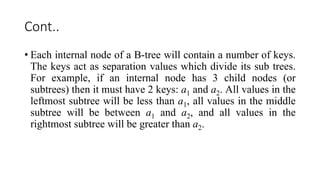
• Each internal node of a B-tree will contain a number of keys.
The keys act as separation values which divide its sub trees.
For example, if an internal node has 3 child nodes (or
subtrees) then it must have 2 keys: a1 and a2. All values in the
leftmost subtree will be less than a1, all values in the middle
subtree will be between a1 and a2, and all values in the
rightmost subtree will be greater than a2.
Advantages of B-tree usage for databases
• The B-tree uses all of the ideas described above. In particular, a B-
tree:
• keeps keys in sorted order for sequential traversing
• uses a hierarchical index to minimize the number of disk reads
• uses partially full blocks to speed insertions and deletions
• keeps the index balanced with an elegant recursive algorithm
• In addition, a B-tree minimizes waste by making sure the interior
nodes are at least half full. A B-tree can handle an arbitrary number of
insertions and deletions.
Definition
• According to Knuth's definition, a B-tree of order m is a tree which
satisfies the following properties:
• Every node has at most m children.
• Every non-leaf node (except root) has at least ⌈m/2⌉ children.
• The root has at least two children if it is not a leaf node.
• A non-leaf node with k children contains k−1 keys.
• All leaves appear in the same level
B-trees and B+ trees
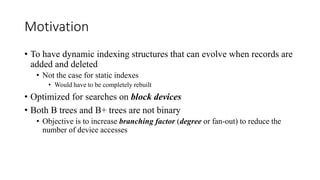
Motivation
• To have dynamic indexing structures that can evolve when records are
added and deleted
• Not the case for static indexes
• Would have to be completely rebuilt
• Optimized for searches on block devices
• Both B trees and B+ trees are not binary
• Objective is to increase branching factor (degree or fan-out) to reduce the
number of device accesses
B trees
• Generalization of binary search trees
• Not binary trees
• The B stands for Bayer (or Boeing)
• Designed for searching data stored on block-oriented devices
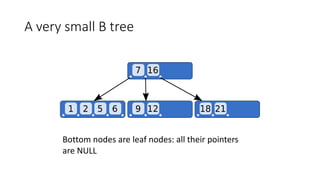
A very small B tree
Bottom nodes are leaf nodes: all their pointers
are NULL
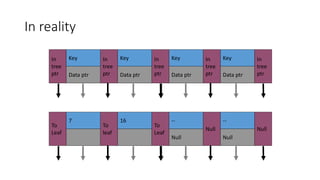
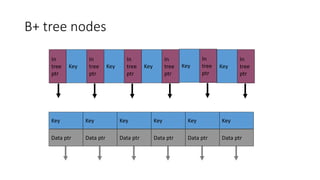
In reality
In
tree
ptr
Key
Data ptr
In
tree
ptr
Key
Data ptr
In
tree
ptr
Key
Data ptr
In
tree
ptr
Key
Data ptr
In
tree
ptr
To
Leaf
7
To
leaf
16
To
Leaf
--
Null
Null
--
Null
Null
B+ trees
• Variant of B trees
• Two types of nodes
• Internal nodes have no data pointers
• Leaf nodes have no in-tree pointers
• Were all null!
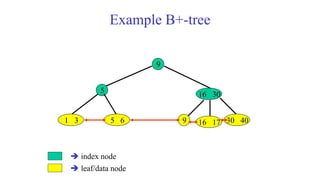
Example B+-tree
9
5
1 3 5 6 30 40
9 16 17
16 30
 index node
 leaf/data node
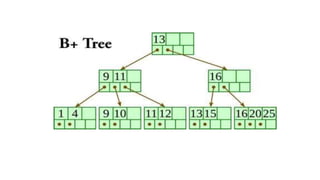
B+ Tree
• Only leave node has record pointer
• No record pointer in every node
• Each leave node has copy of node
• It uses more spaces than B tree
• Internal Nodes stores only key values
• All leaf nodes ‘r’ are interconnected each other for fast
access
• Key is used to search the proper key
• B+ tree combines feature of ISAM and B tree.
B+ tree nodes
In
tree
ptr
Key
In
tree
ptr
Key
In
tree
ptr
Key
In
tree
ptr
Key
In
tree
ptr
Key
In
tree
ptr
Key
Data ptr
Key
Data ptr
Key
Data ptr
Key
Data ptr
Key
Data ptr
Key
Data ptr
Importance
• B Tree are used in file systems to allow quick random access
to an arbitrary block in a particular file. The basic problem is
turning the file block i address into a disk block (or perhaps
to a cylinder-head-sector) address.
• MS-DOS
• File Allocation Table (FAT)
• FAT12 file system
B+ trees are used by
• NTFS, ReiserFS, NSS, XFS, JFS, ReFS, and BFS file
systems for metadata indexing
• BFS for storing directories.
• IBM DB2, Informix, Microsoft SQL Server, Oracle 8,
Sybase ASE, and SQLite for table indexes
Disjoint set data structure
Introduction
• grouping n distinct elements into a collection of disjoint sets.
• No common elements in two different sets/
• A disjoint-set data structure maintains a collection S = {S1, S2, . . . ,Sk}
of disjoint dynamic sets. Each set is identified by a representative,
which is some member of the set.
• rule for choosing the representative, such as choosing the smallest
member in the set
• Set of elements partitioned into no of disjoint subset
Operations
• MAKE-SET(x) creates a new set whose only member (and thus
representative) is pointed to by x. Since the sets are disjoint, we
require that x not already be in a set.
• UNION(x, y) unites the dynamic sets that contain x and y, say Sx and
Sy, into a new set that is the union of these two sets.
• The two sets are assumed to be disjoint prior to the operation. The
representative of the resulting set is some member of Sx U Sy,
although many implementations of UNION choose the representative
of either Sx or Sy, as the new representative.
• FIND-SET(x) returns a pointer to the representative of the (unique) set
containing x.
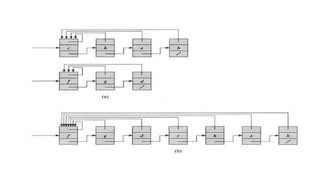
Linked List representation of DJS
• Linked-list representations of two sets.
• One contains objects b, c, e, and h, with c as the representative, and
the other contains objects d, f, and g, with f as the representative.
• Each object on the list contains a set member, a pointer to the next
object on the list, and a pointer back to the first object on the list,
which is the representative.
Disjoint-set forests
• In a faster implementation of disjoint sets, we represent sets by
rooted trees, with each node containing one member and each tree
representing one set.
• The root of each tree contains the representative and is its own
parent
• As we shall see, although the straightforward algorithms that use this
representation are no faster than ones that use the linked-list
representation, by introducing two heuristics--"union by rank" and
"path compression“
• we can achieve the asymptotically fastest disjoint-set data structure
known, and improve the optimization also
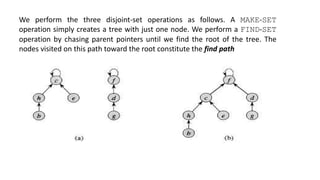
We perform the three disjoint-set operations as follows. A MAKE-SET
operation simply creates a tree with just one node. We perform a FIND-SET
operation by chasing parent pointers until we find the root of the tree. The
nodes visited on this path toward the root constitute the find path
Heuristics to improve the running time
• The first heuristic, union by rank, is similar to the weighted-union
heuristic we used with the linked-list representation. The idea is to
make the root of the tree with fewer nodes point to the root of the
tree with more nodes.
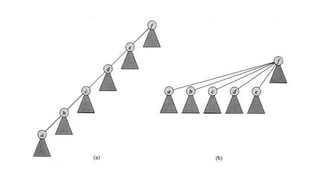
• The second heuristic, path compression, is also quite simple and very
effective. we use it during FIND-SET operations to make each node
on the find path point directly to the root. Path compression does not
change any ranks.
• Analysis of union by rank with path compression O(m lg* n).
Discuss about
• Disjoint sets and operations
• Detecting the Cycle
• Graphical Representation
• Array Implementation
• Weighted union and collapsing find…
• Disjoint set operations
1. Make Set - c
2. FIND
3. UNION
• Detecting the Cycles
DSJ is useful for detecting the Cycle in undirected graph. Example Kruskal’s
Algorithm, If the set consist of elements in same sets, lets say cycle.
• Disjoint set using Sets
• Disjoint set using Graph representation [weighted Union, and Find
Collapsing]
• Disjoint set using Array
• Disjoint set using Rank and Path Compression
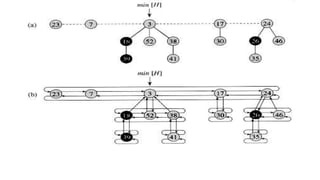
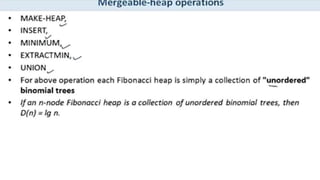
Fibonacci Heaps
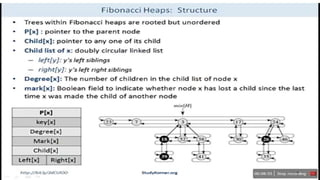
Introduction
• Called a lazy data structure
• Delay work for as long as possible
• Collection of heap ordered Trees
• Each Tree is rooted but unordered
• It maintains pointer to minimum elements
• It set marked nodes
• Each node X has pointed p[X] to its parent and child [X] to one of its
children
• Fibonacci heaps, in fact, are loosely based on binomial heaps
• Children are linked together represents by circular, doubly linked list.
Applications
• Graph Searching – Dijkstra’s Algorithm, Prim’s Algorithm
• Event Driven simulation - Queue
• Statistics- find largest and smallest values
• Graph Problems
• Computing Minimum spanning Trees
• Single source shortest path
Properties and Notations used in Fibonacci
heaps
1. Set of Heap ordered trees
2. Maintain pointer to minimum element Properties
3. Set of marked nodes
• n[H] = number of nodes in heap.
• degree/rank(x) = number of children of node x.
• degree/ rank(H) = max rank of any node in heap H. Notations
• trees(H) = number of trees in heap H.
• marks(H) = number of marked nodes in heap H.
• Min (H)= minimum key in heap
Amortized Potential function
• For the amortized running time analysis we use the potential method,
in that we pretend that very fast operations take a little bit longer
than they actually do .
• The amount of time saved for later use is measured at any given
moment by a potential function. The potential of a Fibonacci heap is
given by
•Ф ( H) = Trees (H) + 2 * Marks(H)
Create Fibonacci heaps
n[H] = 0 and min[H] = NIL; there are no trees in H.
Because t (H) = 0 and m(H) = 0, the potential of the empty Fibonacci
heap is Ф(H) = 0.
The amortized cost of MAKE-FIB-HEAP is thus equal to its O(1) actual
cost.
Steps:
1. Set of heap-ordered trees.
2. Maintain pointer to minimum element.
3. Set of marked nodes.
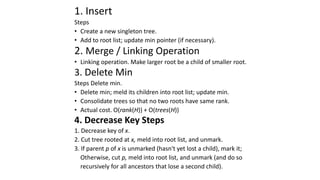
1. Insert
Steps
• Create a new singleton tree.
• Add to root list; update min pointer (if necessary).
2. Merge / Linking Operation
• Linking operation. Make larger root be a child of smaller root.
3. Delete Min
Steps Delete min.
• Delete min; meld its children into root list; update min.
• Consolidate trees so that no two roots have same rank.
• Actual cost. O(rank(H)) + O(trees(H))
4. Decrease Key Steps
1. Decrease key of x.
2. Cut tree rooted at x, meld into root list, and unmark.
3. If parent p of x is unmarked (hasn't yet lost a child), mark it;
Otherwise, cut p, meld into root list, and unmark (and do so
recursively for all ancestors that lose a second child).

chapter 6.1.pptx

  • 1.
  • 2.
    • A BinomialHeap is a collection of Binomial Trees. • a binomial heap is a heap similar to a binary heap but also supports quick merging of two heaps. • This is achieved by using a special tree structure. It is important as an implementation of the mergeable heap abstract data type (also called meldable heap), which is a priority queue supporting merge operation.
  • 3.
    Structure of abinomial heap • A binomial heap is implemented as a set of binomial trees that satisfy the binomial heap properties: • Each binomial tree in a heap obeys the minimum-heap property: the key of a node is greater than or equal to the key of its parent. • Atmost one binomial tree whose root degree is ‘K’ • There can only be either one or zero binomial trees for each order, including zero order.
  • 4.
    Introduction to BinomialTress • A binomial heap is implemented as a collection of binomial trees • A binomial tree of order k has 2k nodes, height k. • It is an ordered tree • It is set of binomial tree and Binomial Tree Bk is an ordered tree • A binomial heap is implemented as a collection of binomial trees (compare with a binary heap, which has a shape of a single binary tree), which are defined recursively as follows: • A binomial tree of order 0 is a single node • A binomial tree of order k has a root node whose children are roots of binomial trees of orders k−1, k−2, ..., 2, 1, 0 (in this order).
  • 5.
    Properties of BinomialTree Bk 1. Bktreehas2k nodes 2. DegreeofrootisK 3. Height=k 4. ThereareexactlyK CI nodesatdepthiwhereK CI = K! (K-i)!*I!
  • 6.
    Implementation • Because nooperation requires random access to the root nodes of the binomial trees, the roots of the binomial trees can be stored in a linked list, ordered by increasing order of the tree. Merge As mentioned above, the simplest and most important operation is the merging of two binomial trees of the same order within a binomial heap. 1. As their root node is the smallest element within the tree, by comparing the two keys, the smaller of them is the minimum key, and becomes the new root node. 2. Then the other tree becomes a subtree of the combined tree. This operation is basic to the complete merging of two binomial heaps
  • 8.
    Insert Inserting a newelement to a heap can be done by simply creating a new heap containing only this element and then merging it with the original heap. Due to the merge, insert takes O(log n) time. However, across a series of n consecutive insertions, insert has an amortized time of O(1) (i.e. constant). Find minimum • To find the minimum element of the heap, find the minimum among the roots of the binomial trees. This can again be done easily in O(log n) time, as there are just O(log n) trees and hence roots to examine. Delete minimum • To delete the minimum element from the heap, first find this element, remove it from its binomial tree, and obtain a list of its subtrees. Then transform this list of subtrees into a separate binomial heap by reordering them from smallest to largest order. • Then merge this heap with the original heap. Since each tree has at most log n children, creating this new heap is O(log n). Merging heaps is O(log n), so the entire delete minimum operation is O(log n).
  • 9.
    Decrease key • Afterdecreasing the key of an element, it may become smaller than the key of its parent, violating the minimum-heap property. • If this is the case, exchange the element with its parent, and possibly also with its grandparent, and so on, until the minimum-heap property is no longer violated. • Each binomial tree has height at most log n, so this takes O(log n) time.
  • 18.
  • 19.
    Introduction • In B-trees,internal (non-leaf) nodes can have a variable number of child nodes within some pre-defined range. When data is inserted or removed from a node, its number of child nodes changes. In order to maintain the pre-defined range, internal nodes may be joined or split. • Because a range of child nodes is permitted, B-trees do not need re-balancing as frequently as other self-balancing search trees, but may waste some space, since nodes are not entirely full. The lower and upper bounds on the number of child nodes are typically fixed for a particular implementation
  • 20.
    Cont.. • Each internalnode of a B-tree will contain a number of keys. The keys act as separation values which divide its sub trees. For example, if an internal node has 3 child nodes (or subtrees) then it must have 2 keys: a1 and a2. All values in the leftmost subtree will be less than a1, all values in the middle subtree will be between a1 and a2, and all values in the rightmost subtree will be greater than a2.
  • 21.
    Advantages of B-treeusage for databases • The B-tree uses all of the ideas described above. In particular, a B- tree: • keeps keys in sorted order for sequential traversing • uses a hierarchical index to minimize the number of disk reads • uses partially full blocks to speed insertions and deletions • keeps the index balanced with an elegant recursive algorithm • In addition, a B-tree minimizes waste by making sure the interior nodes are at least half full. A B-tree can handle an arbitrary number of insertions and deletions.
  • 22.
    Definition • According toKnuth's definition, a B-tree of order m is a tree which satisfies the following properties: • Every node has at most m children. • Every non-leaf node (except root) has at least ⌈m/2⌉ children. • The root has at least two children if it is not a leaf node. • A non-leaf node with k children contains k−1 keys. • All leaves appear in the same level
  • 23.
  • 24.
    Motivation • To havedynamic indexing structures that can evolve when records are added and deleted • Not the case for static indexes • Would have to be completely rebuilt • Optimized for searches on block devices • Both B trees and B+ trees are not binary • Objective is to increase branching factor (degree or fan-out) to reduce the number of device accesses
  • 25.
    B trees • Generalizationof binary search trees • Not binary trees • The B stands for Bayer (or Boeing) • Designed for searching data stored on block-oriented devices
  • 26.
    A very smallB tree Bottom nodes are leaf nodes: all their pointers are NULL
  • 27.
    In reality In tree ptr Key Data ptr In tree ptr Key Dataptr In tree ptr Key Data ptr In tree ptr Key Data ptr In tree ptr To Leaf 7 To leaf 16 To Leaf -- Null Null -- Null Null
  • 28.
    B+ trees • Variantof B trees • Two types of nodes • Internal nodes have no data pointers • Leaf nodes have no in-tree pointers • Were all null!
  • 30.
    Example B+-tree 9 5 1 35 6 30 40 9 16 17 16 30  index node  leaf/data node
  • 31.
    B+ Tree • Onlyleave node has record pointer • No record pointer in every node • Each leave node has copy of node • It uses more spaces than B tree • Internal Nodes stores only key values • All leaf nodes ‘r’ are interconnected each other for fast access • Key is used to search the proper key • B+ tree combines feature of ISAM and B tree.
  • 32.
  • 33.
    Importance • B Treeare used in file systems to allow quick random access to an arbitrary block in a particular file. The basic problem is turning the file block i address into a disk block (or perhaps to a cylinder-head-sector) address. • MS-DOS • File Allocation Table (FAT) • FAT12 file system
  • 34.
    B+ trees areused by • NTFS, ReiserFS, NSS, XFS, JFS, ReFS, and BFS file systems for metadata indexing • BFS for storing directories. • IBM DB2, Informix, Microsoft SQL Server, Oracle 8, Sybase ASE, and SQLite for table indexes
  • 35.
  • 36.
    Introduction • grouping ndistinct elements into a collection of disjoint sets. • No common elements in two different sets/ • A disjoint-set data structure maintains a collection S = {S1, S2, . . . ,Sk} of disjoint dynamic sets. Each set is identified by a representative, which is some member of the set. • rule for choosing the representative, such as choosing the smallest member in the set • Set of elements partitioned into no of disjoint subset
  • 37.
    Operations • MAKE-SET(x) createsa new set whose only member (and thus representative) is pointed to by x. Since the sets are disjoint, we require that x not already be in a set. • UNION(x, y) unites the dynamic sets that contain x and y, say Sx and Sy, into a new set that is the union of these two sets. • The two sets are assumed to be disjoint prior to the operation. The representative of the resulting set is some member of Sx U Sy, although many implementations of UNION choose the representative of either Sx or Sy, as the new representative. • FIND-SET(x) returns a pointer to the representative of the (unique) set containing x.
  • 38.
    Linked List representationof DJS • Linked-list representations of two sets. • One contains objects b, c, e, and h, with c as the representative, and the other contains objects d, f, and g, with f as the representative. • Each object on the list contains a set member, a pointer to the next object on the list, and a pointer back to the first object on the list, which is the representative.
  • 40.
    Disjoint-set forests • Ina faster implementation of disjoint sets, we represent sets by rooted trees, with each node containing one member and each tree representing one set. • The root of each tree contains the representative and is its own parent • As we shall see, although the straightforward algorithms that use this representation are no faster than ones that use the linked-list representation, by introducing two heuristics--"union by rank" and "path compression“ • we can achieve the asymptotically fastest disjoint-set data structure known, and improve the optimization also
  • 41.
    We perform thethree disjoint-set operations as follows. A MAKE-SET operation simply creates a tree with just one node. We perform a FIND-SET operation by chasing parent pointers until we find the root of the tree. The nodes visited on this path toward the root constitute the find path
  • 42.
    Heuristics to improvethe running time • The first heuristic, union by rank, is similar to the weighted-union heuristic we used with the linked-list representation. The idea is to make the root of the tree with fewer nodes point to the root of the tree with more nodes. • The second heuristic, path compression, is also quite simple and very effective. we use it during FIND-SET operations to make each node on the find path point directly to the root. Path compression does not change any ranks. • Analysis of union by rank with path compression O(m lg* n).
  • 44.
    Discuss about • Disjointsets and operations • Detecting the Cycle • Graphical Representation • Array Implementation • Weighted union and collapsing find…
  • 45.
    • Disjoint setoperations 1. Make Set - c 2. FIND 3. UNION • Detecting the Cycles DSJ is useful for detecting the Cycle in undirected graph. Example Kruskal’s Algorithm, If the set consist of elements in same sets, lets say cycle. • Disjoint set using Sets • Disjoint set using Graph representation [weighted Union, and Find Collapsing] • Disjoint set using Array • Disjoint set using Rank and Path Compression
  • 46.
  • 47.
    Introduction • Called alazy data structure • Delay work for as long as possible • Collection of heap ordered Trees • Each Tree is rooted but unordered • It maintains pointer to minimum elements • It set marked nodes • Each node X has pointed p[X] to its parent and child [X] to one of its children • Fibonacci heaps, in fact, are loosely based on binomial heaps • Children are linked together represents by circular, doubly linked list.
  • 48.
    Applications • Graph Searching– Dijkstra’s Algorithm, Prim’s Algorithm • Event Driven simulation - Queue • Statistics- find largest and smallest values • Graph Problems • Computing Minimum spanning Trees • Single source shortest path
  • 51.
    Properties and Notationsused in Fibonacci heaps 1. Set of Heap ordered trees 2. Maintain pointer to minimum element Properties 3. Set of marked nodes • n[H] = number of nodes in heap. • degree/rank(x) = number of children of node x. • degree/ rank(H) = max rank of any node in heap H. Notations • trees(H) = number of trees in heap H. • marks(H) = number of marked nodes in heap H. • Min (H)= minimum key in heap
  • 53.
    Amortized Potential function •For the amortized running time analysis we use the potential method, in that we pretend that very fast operations take a little bit longer than they actually do . • The amount of time saved for later use is measured at any given moment by a potential function. The potential of a Fibonacci heap is given by •Ф ( H) = Trees (H) + 2 * Marks(H)
  • 55.
    Create Fibonacci heaps n[H]= 0 and min[H] = NIL; there are no trees in H. Because t (H) = 0 and m(H) = 0, the potential of the empty Fibonacci heap is Ф(H) = 0. The amortized cost of MAKE-FIB-HEAP is thus equal to its O(1) actual cost. Steps: 1. Set of heap-ordered trees. 2. Maintain pointer to minimum element. 3. Set of marked nodes.
  • 56.
    1. Insert Steps • Createa new singleton tree. • Add to root list; update min pointer (if necessary). 2. Merge / Linking Operation • Linking operation. Make larger root be a child of smaller root. 3. Delete Min Steps Delete min. • Delete min; meld its children into root list; update min. • Consolidate trees so that no two roots have same rank. • Actual cost. O(rank(H)) + O(trees(H)) 4. Decrease Key Steps 1. Decrease key of x. 2. Cut tree rooted at x, meld into root list, and unmark. 3. If parent p of x is unmarked (hasn't yet lost a child), mark it; Otherwise, cut p, meld into root list, and unmark (and do so recursively for all ancestors that lose a second child).