
HEALTHY HOSPITAL
ENVIRONMENT
• Out lines
1.Introduction
2.The causes of hazards
3.The safety program
The identification
The prevention
Documentation
4.Hospital employee health and safety
5.Niosh(The national Institute Of occupational Health
And Safety)
6.hospital occupational health and safety
• 7.Hospital occupational health and safety
• 8.Hospital acquired infection
Routes of spread
Recipients
Prevention and control
Sterilization
Types of disinfection
Sampling methods
• The hospital environment presents
particular and, in some cases, unique
safety problems when compared with
other industrial settings.
• These problems affect the patient , staff,
and visitor.
The causes of such hazards fall
into two broad categories:
• a) Failure of a device to correctly perform
the desired function.
• b) Failure of hospital personnel to correctly
use medical equipment.
• Every hospital needs a safety program
and a safety committee to oversee these
aspects of the hospital's daily function.
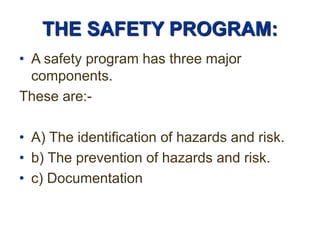
THE SAFETY PROGRAM:
• A safety program has three major
components.
These are:-
• A) The identification of hazards and risk.
• b) The prevention of hazards and risk.
• c) Documentation
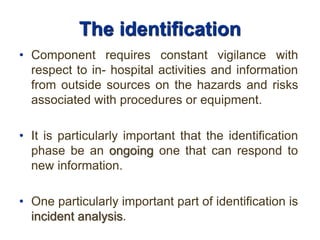
The identification
• Component requires constant vigilance with
respect to in- hospital activities and information
from outside sources on the hazards and risks
associated with procedures or equipment.
• It is particularly important that the identification
phase be an ongoing one that can respond to
new information.
• One particularly important part of identification is
incident analysis.
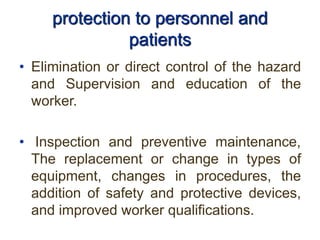
protection to personnel and
patients
• Elimination or direct control of the hazard
and Supervision and education of the
worker.
• Inspection and preventive maintenance,
The replacement or change in types of
equipment, changes in procedures, the
addition of safety and protective devices,
and improved worker qualifications.
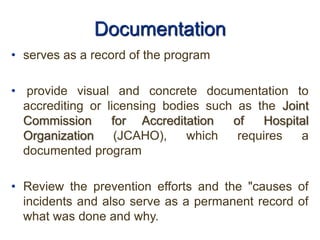
Documentation
• serves as a record of the program
• provide visual and concrete documentation to
accrediting or licensing bodies such as the Joint
Commission for Accreditation of Hospital
Organization (JCAHO), which requires a
documented program
• Review the prevention efforts and the "causes of
incidents and also serve as a permanent record of
what was done and why.
HOSPITAL EMPLOYEE HEALTH
AND SAFETY
• Hospital environmental exposures are
categorized in the same way as in other
workplaces; there are chemical, physical,
biological, and psychological conditions.
• The hospital has many of the same exposures
in these categories, as do other workplaces;
electrical equipment deficiencies, toxic gases,
weights to lift or move, job motivation and
responsibility, and poor house keeping.
NIOSH
• The National Institute for Occupational Safety and Health
• completed a survey of 3687 hospitals to identify the types
and frequencies of injuries and illnesses among hospital
employees.
• This study found that among all the exposures typified,
the most common types of injury were strains and
sprains.
• These injuries are usually caused by improperly lifting
objects, including patients, and slipping and falling on
slippery floors, stairs, or ladders.
Hospital Occupational Health and
Safety
1. Pre-placement medical examinations should be
given to all new employees.
• These examinations should include a medical history, a
thorough physical examination, laboratory tests (blood,
urine, chest X-ray, etc.), and special consultations as
indicated by the history , physical findings, or special job
requirements.
2. Periodic health maintenance procedures should
be instituted that include a general examination,
as in item 1 above, an assessment of continued
job compatibility, and special appraisals
necessitated by extensive illness or job changes
3. Health and safety education programs should
be developed to include job orientation safe
working habits, relevant health information and
the use of the hospital occupational health unit
for reporting injury or illness.
4. Employee immunizations should be given that include
smallpox, diphtheria, tetanus, polio, and other diseases
as indicated by epidemics or unusual laboratory
conditions.
Updating should also be a part of this program.
5. care of illness and injury at work should include
arrangements for medical, surgical, psychological, and
rehabilitative services; specific location availability of
competent medical personnel, and a formalized
procedure should be maintained.
Treatment and reports of occupational injuries and illnesses
should conform to state compensation laws and OSHA
requirements.
7. Environmental control and surveillance services should
be provided to detect, avoid, or limit harmful
occupational exposures. Special attention should be
given to hazardous occupational exposures for women
of childbearing age, to employees exposed to ionizing or
non-ionizing radiation, and to operating room personnel
exposed to anaesthetic gases.
8. Employee health and safety records should be
maintained in the health unit. These must include
examinations, injury or illness reports, radiation records,
and other environmental exposure reports or records.
9. Coordinated planning is recommended between
the health unit and other hospital departments
and services including the safety committee,
infection control committee, labour union, and
similar groups.
Hospital Acquired Infection
• Nosocomial infection
-Infection occurring during hospitalization is
considered the major problem.
• ‘cross infection’
• Agents: staph aureus, hemolytic strep,
ecoli, klebsiella, pseudomones and
viruses.
• Sources: patients: staff working in the
hospital and environment
Routes of spread:
• Direct contact: from hands of a doctor or
nurse
• Droplet
• Air borne
Recipients
• All patient are potential recipients of infection
from sources within hospital some patients are
more susceptible or more liable for cross
infection than others especially the severely ill
and the and those in whom the ability to resist
infection is reduced
Prevention and control
• Isolation
• Disinfection: is an agents which destroy all
micro-organism but not usually the spore
forming.
• E,g: phenol lysol
• Sterilization:
sterilization
• Is the only process that reliably kills all forms of
microbial life (bacteria, spores, fungi, and
viruses).
• Several types of sterilization have been used in
hospitals (e.g.; dry heat, chemical bath, or
irradiation) but two methods are most commonly
used: steam and gas sterilization.
• Steam sterilization is the oldest method (dating
from the 1800s) and the least expensive.
• However, some items cannot be steam sterilized
because of heat sensitivity.
• Ethylene oxide (ETO) sterilization is an
important method owing to the quantity of
medical devices that cannot be steam
sterilized.
• In this method, ETO gas is introduced into
the sterilizer chamber and the sterilization
cycle lasts from I to 4 hrs
Types of disinfection
• Concurrent disinfection
• Terminal disinfection
• Prophylactic disinfection
SAMPLING METHODS
• Air sampling
• Water Sampling
• Surface sampling
Thank you…

Healthy hospital environment

  • 1.
  • 2.
    • Out lines 1.Introduction 2.Thecauses of hazards 3.The safety program The identification The prevention Documentation 4.Hospital employee health and safety 5.Niosh(The national Institute Of occupational Health And Safety) 6.hospital occupational health and safety
  • 3.
    • 7.Hospital occupationalhealth and safety • 8.Hospital acquired infection Routes of spread Recipients Prevention and control Sterilization Types of disinfection Sampling methods
  • 4.
    • The hospitalenvironment presents particular and, in some cases, unique safety problems when compared with other industrial settings. • These problems affect the patient , staff, and visitor.
  • 5.
    The causes ofsuch hazards fall into two broad categories: • a) Failure of a device to correctly perform the desired function. • b) Failure of hospital personnel to correctly use medical equipment.
  • 6.
    • Every hospitalneeds a safety program and a safety committee to oversee these aspects of the hospital's daily function.
  • 7.
    THE SAFETY PROGRAM: •A safety program has three major components. These are:- • A) The identification of hazards and risk. • b) The prevention of hazards and risk. • c) Documentation
  • 8.
    The identification • Componentrequires constant vigilance with respect to in- hospital activities and information from outside sources on the hazards and risks associated with procedures or equipment. • It is particularly important that the identification phase be an ongoing one that can respond to new information. • One particularly important part of identification is incident analysis.
  • 9.
    protection to personneland patients • Elimination or direct control of the hazard and Supervision and education of the worker. • Inspection and preventive maintenance, The replacement or change in types of equipment, changes in procedures, the addition of safety and protective devices, and improved worker qualifications.
  • 10.
    Documentation • serves asa record of the program • provide visual and concrete documentation to accrediting or licensing bodies such as the Joint Commission for Accreditation of Hospital Organization (JCAHO), which requires a documented program • Review the prevention efforts and the "causes of incidents and also serve as a permanent record of what was done and why.
  • 11.
    HOSPITAL EMPLOYEE HEALTH ANDSAFETY • Hospital environmental exposures are categorized in the same way as in other workplaces; there are chemical, physical, biological, and psychological conditions. • The hospital has many of the same exposures in these categories, as do other workplaces; electrical equipment deficiencies, toxic gases, weights to lift or move, job motivation and responsibility, and poor house keeping.
  • 12.
    NIOSH • The NationalInstitute for Occupational Safety and Health • completed a survey of 3687 hospitals to identify the types and frequencies of injuries and illnesses among hospital employees. • This study found that among all the exposures typified, the most common types of injury were strains and sprains. • These injuries are usually caused by improperly lifting objects, including patients, and slipping and falling on slippery floors, stairs, or ladders.
  • 13.
    Hospital Occupational Healthand Safety 1. Pre-placement medical examinations should be given to all new employees. • These examinations should include a medical history, a thorough physical examination, laboratory tests (blood, urine, chest X-ray, etc.), and special consultations as indicated by the history , physical findings, or special job requirements.
  • 14.
    2. Periodic healthmaintenance procedures should be instituted that include a general examination, as in item 1 above, an assessment of continued job compatibility, and special appraisals necessitated by extensive illness or job changes
  • 15.
    3. Health andsafety education programs should be developed to include job orientation safe working habits, relevant health information and the use of the hospital occupational health unit for reporting injury or illness.
  • 16.
    4. Employee immunizationsshould be given that include smallpox, diphtheria, tetanus, polio, and other diseases as indicated by epidemics or unusual laboratory conditions. Updating should also be a part of this program. 5. care of illness and injury at work should include arrangements for medical, surgical, psychological, and rehabilitative services; specific location availability of competent medical personnel, and a formalized procedure should be maintained. Treatment and reports of occupational injuries and illnesses should conform to state compensation laws and OSHA requirements.
  • 17.
    7. Environmental controland surveillance services should be provided to detect, avoid, or limit harmful occupational exposures. Special attention should be given to hazardous occupational exposures for women of childbearing age, to employees exposed to ionizing or non-ionizing radiation, and to operating room personnel exposed to anaesthetic gases. 8. Employee health and safety records should be maintained in the health unit. These must include examinations, injury or illness reports, radiation records, and other environmental exposure reports or records.
  • 18.
    9. Coordinated planningis recommended between the health unit and other hospital departments and services including the safety committee, infection control committee, labour union, and similar groups.
  • 19.
    Hospital Acquired Infection •Nosocomial infection -Infection occurring during hospitalization is considered the major problem. • ‘cross infection’
  • 20.
    • Agents: staphaureus, hemolytic strep, ecoli, klebsiella, pseudomones and viruses. • Sources: patients: staff working in the hospital and environment
  • 21.
    Routes of spread: •Direct contact: from hands of a doctor or nurse • Droplet • Air borne
  • 22.
    Recipients • All patientare potential recipients of infection from sources within hospital some patients are more susceptible or more liable for cross infection than others especially the severely ill and the and those in whom the ability to resist infection is reduced
  • 23.
    Prevention and control •Isolation • Disinfection: is an agents which destroy all micro-organism but not usually the spore forming. • E,g: phenol lysol • Sterilization:
  • 24.
    sterilization • Is theonly process that reliably kills all forms of microbial life (bacteria, spores, fungi, and viruses). • Several types of sterilization have been used in hospitals (e.g.; dry heat, chemical bath, or irradiation) but two methods are most commonly used: steam and gas sterilization. • Steam sterilization is the oldest method (dating from the 1800s) and the least expensive. • However, some items cannot be steam sterilized because of heat sensitivity.
  • 25.
    • Ethylene oxide(ETO) sterilization is an important method owing to the quantity of medical devices that cannot be steam sterilized. • In this method, ETO gas is introduced into the sterilizer chamber and the sterilization cycle lasts from I to 4 hrs
  • 26.
    Types of disinfection •Concurrent disinfection • Terminal disinfection • Prophylactic disinfection
  • 27.
    SAMPLING METHODS • Airsampling • Water Sampling • Surface sampling
  • 28.