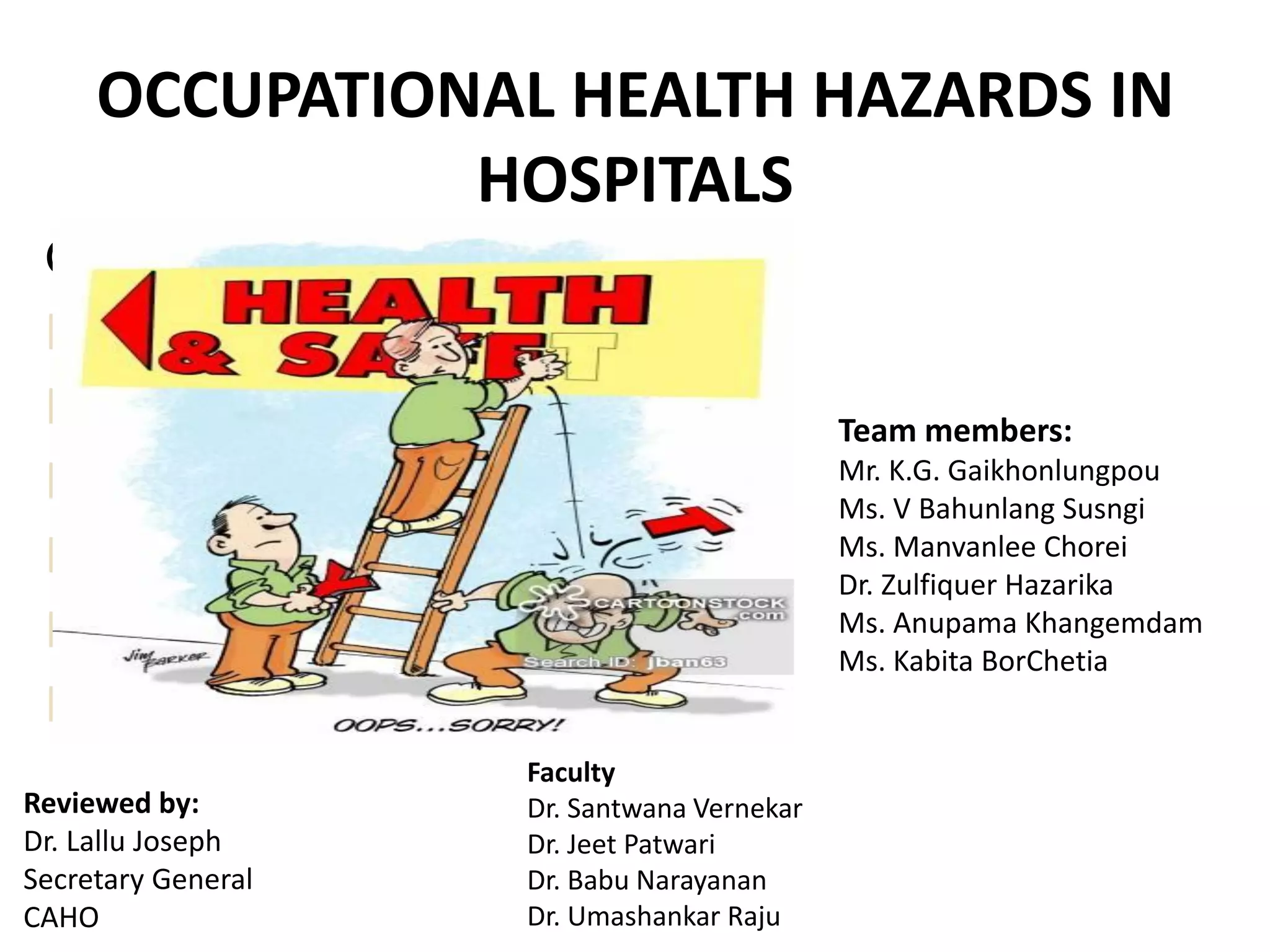
OCCUPATIONAL HEALTH HAZARDS IN
HOSPITALS
Group 6
Mr. K.G. Gaikhonlungpou
Ms. V Bahunlang Susngi
Ms. Manvanlee Chorei
Dr. Zulfiquer Hazarika
Ms. Anupama Khangemdam
Ms. Kabita BorChetia
Team members:
Mr. K.G. Gaikhonlungpou
Ms. V Bahunlang Susngi
Ms. Manvanlee Chorei
Dr. Zulfiquer Hazarika
Ms. Anupama Khangemdam
Ms. Kabita BorChetia
Reviewed by:
Dr. Lallu Joseph
Secretary General
CAHO
Faculty
Dr. Santwana Vernekar
Dr. Jeet Patwari
Dr. Babu Narayanan
Dr. Umashankar Raju
Objectives
1. Categorizing Possible Occupational Health Hazards in
Hospitals.
2. Outline the Work flow for Risk assessment & management.
3. Training of staff
Occupational Health Hazards
 are hazards of exposure to pollution, noise and vibrations in
the working environment. Exposure limits are promoted by
the International Labour Organization (ILO).Nov 15, 2001
 Hospitals have many unique hazards that can potentially
affect the health of employees. Exposures to occupational
hazards throughout hospital departments are highly variable
1. Categorizing
Hazards in hospitals
• Noise
• Vibration
• Radiation
• Lighting
• Heat
• Cold
• Fibres
• Dusts
CHEMICAL
• Fumes
• Gases
• Aerosols
• Mists
• Liquids
• Vapours
• Bacteria
• Fungi
• Insects
• Viruses
• Manual handling
• Repetitive movement
• Restrictive working area
PSYCHOLOGICAL
• Job stress
• Job monotony
• Unsociable hours
• Job organization
ERGONOMICAL
BIOLOGICAL
PHYSICAL
RADIO
LOGICAL
•X-ray scans
•CT scans,
• fluoroscopy,
•mammography,
angiocardiograms
•MRI
•Staff with MR unsafe implants
e.g. pacemakers
Potential Areas for Hazards
1. Clinical areas: • Blood borne pathogens • Airborne pathogens
• Ergonomic • Slips, trips, falls • Sharps
2. OT : • Anesthetic gases • Blood borne pathogens • Compressed
gases • Lasers • Ergonomic • Latex
3. Laboratory: • Infectious diseases • Chemical agents
(formaldehyde, toluene, xylene) • Ergonomic • Slips, trips, falls
• Sharps
4. Radiology: • Radiation • Ergonomics • Airborne pathogens
• Blood borne pathogens • Slips, trips, falls
5. Physical Therapy: • Ergonomics • Trips, falls • Equipment
hazards
• Blood borne pathogens
6. Pharmacy: • Drug absorption • Ergonomic • Slips, trips, falls •
Latex
7. Central Supply : • Compressed gases • Anesthetic gases • Chemical
agents (sterilizers, cleaners) • Ergonomic • Burns, cuts
8. Laundry : • Contaminated laundry • Noise • Heat • Lifting •
Sharps • Slips, trips, falls • Fire hazard
9. Housekeeping: • Chemical agents • Contaminated objects
(infectious agents) • Latex • Sharps • Lifting hazard • Slips, trips, falls
10. Dietary: • Food borne diseases • Heat • Moving machinery • Fire
hazards • Slips, trips, falls • Electrical equipment
11. Wards : Blood borne Pathogens • Hepatitis B • Hepatitis C • HIV
12. Hazardous Chemicals • Employee exposure to hazardous
chemicals, such as pesticides, disinfectants, and hazardous drugs in
the workplace.
13. Stress : • Life threatening illnesses and injuries • Understaffing
• Malfunctioning equipment • Patient death • Hierarchy of
authority • Demanding patients • Excessive paperwork •
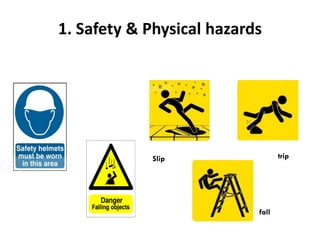
Safety & Physical hazards
1. Safety & Physical hazards
Slip trip
fall
2. Radiation hazards & safety
 Show danger light- do not enter when red light is on
 Use of TLD badge
 Lead aprons
 Radiation safety signage
 No X rays during pregnancy
 Annual health check up
 Training of staff
3. Biological Hazards & safety
 Pre exposure prophylaxis
 Segregation of waste at source and safe disposal
 Safe handling of needles and sharps
 Managing blood spills
 Use of PPE
 Pre employment and Annual health checkup for staff
 Complete your vaccination (3 doses of Hepatitis B vaccination at
0,1 and 6 months)
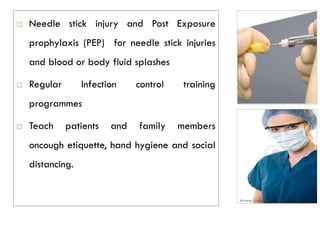
 Needle stick injury and Post Exposure
prophylaxis (PEP) for needle stick injuries
and blood or body fluid splashes
 Regular Infection control training
programmes
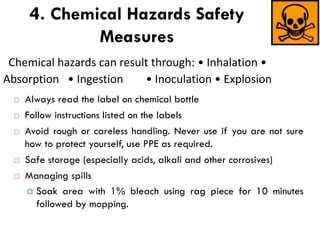
 Teach patients and family members
oncough etiquette, hand hygiene and social
distancing.
Chemical hazards can result through: • Inhalation •
Absorption • Ingestion • Inoculation • Explosion
4. Chemical Hazards Safety
Measures
 Always read the label on chemical bottle
 Follow instructions listed on the labels
 Avoid rough or careless handling. Never use if you are not sure
how to protect yourself, use PPE as required.
 Safe storage (especially acids, alkali and other corrosives)
 Managing spills
 Soak area with 1% bleach using rag piece for 10 minutes
followed by mopping.
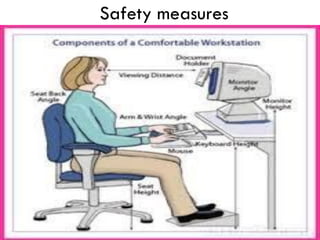
5. Ergonomic Hazards Safety measures
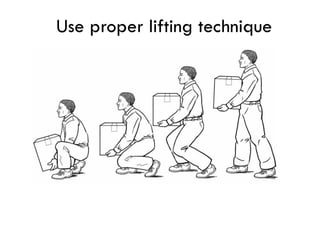
Ergonomic Hazards includes : •Improper adjusted workstation and
chairs • Poor posture Frequent lifting •Repeated activites without
adequate recovery time •Having to use too much force, especially
if you have to do it frequently • Vibration
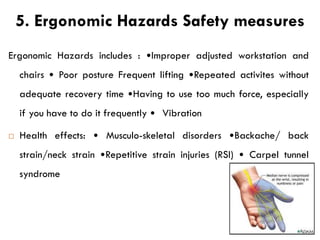
 Health effects: • Musculo-skeletal disorders •Backache/ back
strain/neck strain •Repetitive strain injuries (RSI) • Carpel tunnel
syndrome
Safety measures
Use proper lifting technique
Psychosocial hazards
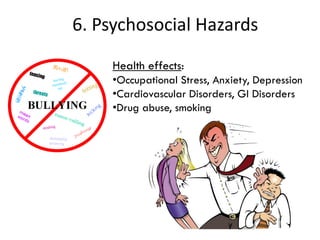
6. Psychosocial Hazards
Health effects:
•Occupational Stress, Anxiety, Depression
•Cardiovascular Disorders, GI Disorders
•Drug abuse, smoking
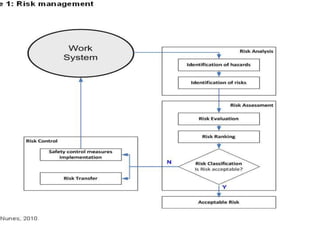
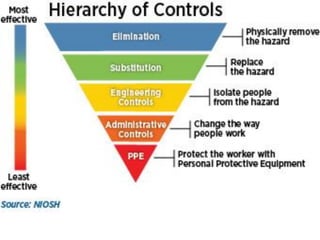
2. Outline the Work flow for Risk
assessment & management
December 1, 2013 17
3. Training
Training of staff :
• At the time of Induction
• Training on possible hazards related to your
profession.
• Mock drills at regular intervals.
(Details in the attached excel sheet)
References
1. Oshwiki.eu/wiki/occupational_safety_and_he
alth_risk_assessment_methodologies.
2.Oshwiki.eu/wiki/prevention_and_control_strat
egies
Occupational_Health_Hazards.pdf

Occupational_Health_Hazards.pdf

  • 1.
    OCCUPATIONAL HEALTH HAZARDSIN HOSPITALS Group 6 Mr. K.G. Gaikhonlungpou Ms. V Bahunlang Susngi Ms. Manvanlee Chorei Dr. Zulfiquer Hazarika Ms. Anupama Khangemdam Ms. Kabita BorChetia Team members: Mr. K.G. Gaikhonlungpou Ms. V Bahunlang Susngi Ms. Manvanlee Chorei Dr. Zulfiquer Hazarika Ms. Anupama Khangemdam Ms. Kabita BorChetia Reviewed by: Dr. Lallu Joseph Secretary General CAHO Faculty Dr. Santwana Vernekar Dr. Jeet Patwari Dr. Babu Narayanan Dr. Umashankar Raju
  • 2.
    Objectives 1. Categorizing PossibleOccupational Health Hazards in Hospitals. 2. Outline the Work flow for Risk assessment & management. 3. Training of staff
  • 3.
    Occupational Health Hazards are hazards of exposure to pollution, noise and vibrations in the working environment. Exposure limits are promoted by the International Labour Organization (ILO).Nov 15, 2001  Hospitals have many unique hazards that can potentially affect the health of employees. Exposures to occupational hazards throughout hospital departments are highly variable
  • 4.
    1. Categorizing Hazards inhospitals • Noise • Vibration • Radiation • Lighting • Heat • Cold • Fibres • Dusts CHEMICAL • Fumes • Gases • Aerosols • Mists • Liquids • Vapours • Bacteria • Fungi • Insects • Viruses • Manual handling • Repetitive movement • Restrictive working area PSYCHOLOGICAL • Job stress • Job monotony • Unsociable hours • Job organization ERGONOMICAL BIOLOGICAL PHYSICAL RADIO LOGICAL •X-ray scans •CT scans, • fluoroscopy, •mammography, angiocardiograms •MRI •Staff with MR unsafe implants e.g. pacemakers
  • 5.
    Potential Areas forHazards 1. Clinical areas: • Blood borne pathogens • Airborne pathogens • Ergonomic • Slips, trips, falls • Sharps 2. OT : • Anesthetic gases • Blood borne pathogens • Compressed gases • Lasers • Ergonomic • Latex 3. Laboratory: • Infectious diseases • Chemical agents (formaldehyde, toluene, xylene) • Ergonomic • Slips, trips, falls • Sharps 4. Radiology: • Radiation • Ergonomics • Airborne pathogens • Blood borne pathogens • Slips, trips, falls 5. Physical Therapy: • Ergonomics • Trips, falls • Equipment hazards • Blood borne pathogens 6. Pharmacy: • Drug absorption • Ergonomic • Slips, trips, falls • Latex
  • 6.
    7. Central Supply: • Compressed gases • Anesthetic gases • Chemical agents (sterilizers, cleaners) • Ergonomic • Burns, cuts 8. Laundry : • Contaminated laundry • Noise • Heat • Lifting • Sharps • Slips, trips, falls • Fire hazard 9. Housekeeping: • Chemical agents • Contaminated objects (infectious agents) • Latex • Sharps • Lifting hazard • Slips, trips, falls 10. Dietary: • Food borne diseases • Heat • Moving machinery • Fire hazards • Slips, trips, falls • Electrical equipment 11. Wards : Blood borne Pathogens • Hepatitis B • Hepatitis C • HIV 12. Hazardous Chemicals • Employee exposure to hazardous chemicals, such as pesticides, disinfectants, and hazardous drugs in the workplace. 13. Stress : • Life threatening illnesses and injuries • Understaffing • Malfunctioning equipment • Patient death • Hierarchy of authority • Demanding patients • Excessive paperwork •
  • 7.
    Safety & Physicalhazards 1. Safety & Physical hazards Slip trip fall
  • 8.
    2. Radiation hazards& safety  Show danger light- do not enter when red light is on  Use of TLD badge  Lead aprons  Radiation safety signage  No X rays during pregnancy  Annual health check up  Training of staff
  • 9.
    3. Biological Hazards& safety  Pre exposure prophylaxis  Segregation of waste at source and safe disposal  Safe handling of needles and sharps  Managing blood spills  Use of PPE  Pre employment and Annual health checkup for staff  Complete your vaccination (3 doses of Hepatitis B vaccination at 0,1 and 6 months)
  • 10.
     Needle stickinjury and Post Exposure prophylaxis (PEP) for needle stick injuries and blood or body fluid splashes  Regular Infection control training programmes  Teach patients and family members oncough etiquette, hand hygiene and social distancing.
  • 11.
    Chemical hazards canresult through: • Inhalation • Absorption • Ingestion • Inoculation • Explosion 4. Chemical Hazards Safety Measures  Always read the label on chemical bottle  Follow instructions listed on the labels  Avoid rough or careless handling. Never use if you are not sure how to protect yourself, use PPE as required.  Safe storage (especially acids, alkali and other corrosives)  Managing spills  Soak area with 1% bleach using rag piece for 10 minutes followed by mopping.
  • 12.
    5. Ergonomic HazardsSafety measures Ergonomic Hazards includes : •Improper adjusted workstation and chairs • Poor posture Frequent lifting •Repeated activites without adequate recovery time •Having to use too much force, especially if you have to do it frequently • Vibration  Health effects: • Musculo-skeletal disorders •Backache/ back strain/neck strain •Repetitive strain injuries (RSI) • Carpel tunnel syndrome
  • 13.
  • 14.
  • 15.
    Psychosocial hazards 6. PsychosocialHazards Health effects: •Occupational Stress, Anxiety, Depression •Cardiovascular Disorders, GI Disorders •Drug abuse, smoking
  • 16.
    2. Outline theWork flow for Risk assessment & management
  • 17.
  • 19.
    3. Training Training ofstaff : • At the time of Induction • Training on possible hazards related to your profession. • Mock drills at regular intervals. (Details in the attached excel sheet)
  • 20.