GROWTH AND DEVLOPEMENT
OF INFANT
SEMINAR PRESENTATION
BY- ANVIN THOMAS
M.SC NURSING (1ST YEAR)
• Weight
At birth is approximately 2.5 kg to 3.5kg and
trebled by one year .
• Length
At birth it is 50 cm, 75 cm at one year of age .
• Head circumference
Head circumference measures about 35 cm at
birth and at one year 45cm.
•Chest circumference
At birth it is 2-3 cm less than head circumference. At 6 to 12
months of age both become equal
•Mid upper arm circumference( MUAC )
The average MUAC at birth is 11 to 12 cm, at one year of age it
is 12 to16 cm
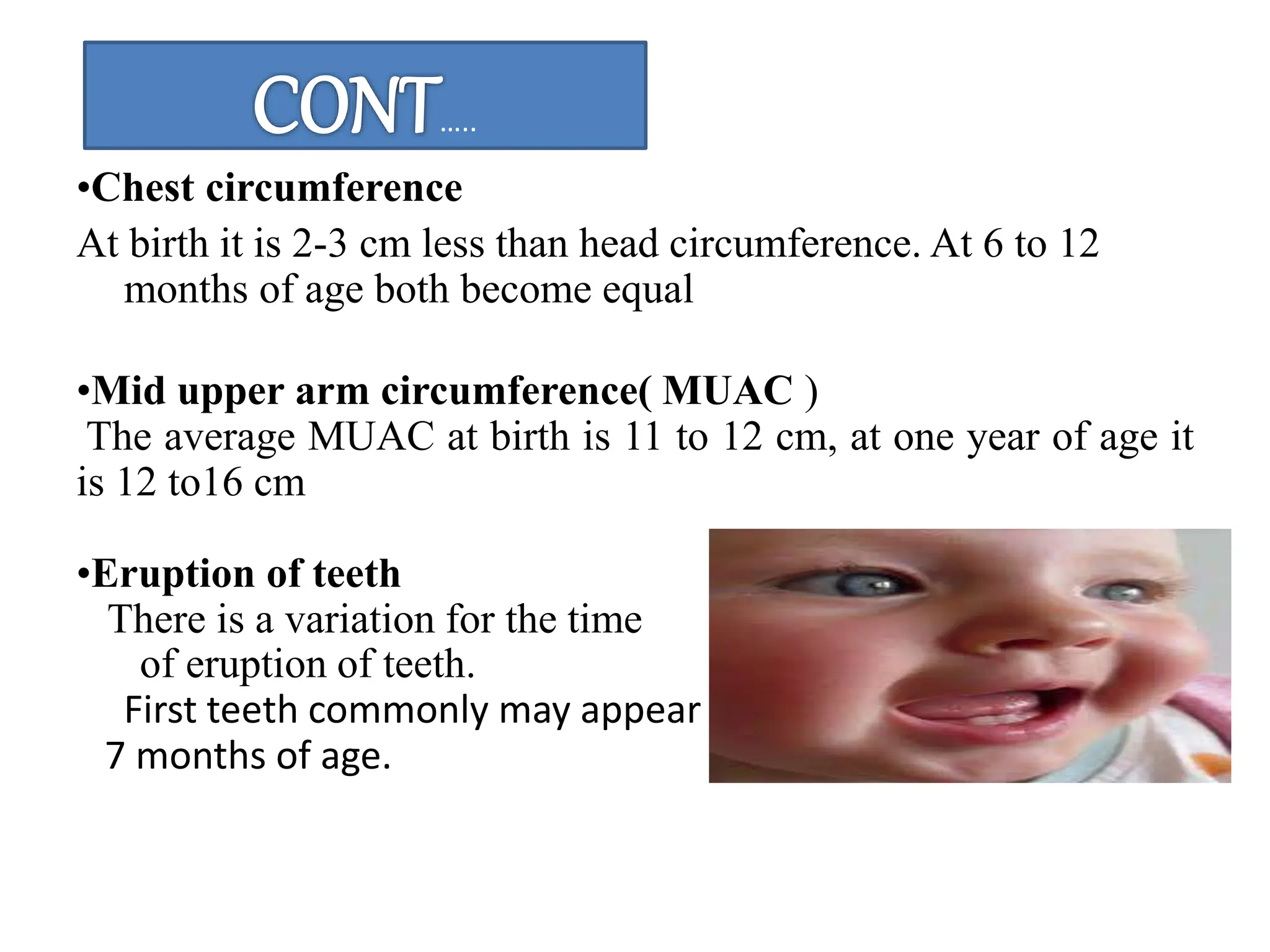
•Eruption of teeth
There is a variation for the time
of eruption of teeth.
First teeth commonly may appear in 6 to
7 months of age.
…..
• Respiratory changes
neonate is about 36 to 40 breaths per minute
• Cardiovascular changes
At birth 120 and 160 beats per minute at one year it is about
100 to 160 beats per minute.
Blood pressure in neonates is 80/46mm hg, at one year it is
about 96/66mmhg
• Gastrointestinal system
The acquisition of gross motor skill precedes the
development of fine motor skills.
Newborn: barely able to lift head
6 months: easily lifts head, chest and
upper abdomen and can bear weight on
arms
Gross Motor Development
At 12 months
• Sits down from standing position alone
• Walk few step with help or alone.
Fine motor:
• At birth
Hold hand in tight fists.
Can grasp but drops it
immediately
• 6th month
Grasps with simultaneous flexion of fingers.
Retain transient hold on two objects, one in
each hand.
At one year
• Picks up small bits of food and transfers them to
month
• Enjoy eating with fingers
Neonatal reflexes
• Sucking reflex
• Rooting reflex
• Moro reflex
• Swallowing reflex
• Sneezing and
coughing reflex
• Blinking reflex
Psychosocial development
• Erik Erikson’s theory centers around the
infants basic needs being met by parents and
this interaction leading to trust or mistrust.
• The child’s relative understanding of world
and society come from the parents and their
interaction with the child.
• Sense of trust versus mistrust.
Piaget’s theory of cognitive
development
 when an infant reaches about 7 to 9 months
of age the child now has the ability to
understand that objects keep existing even
when they cannot seen.
Moral development
• Piaget’s moral development parallels mental
development
• Morality Stage from birth to 2 years of age
• Infants land early toddlers are egocentric
and unable to understand rules or to judge
what is good or bad in terms of rules or
authority
• What is pleasant is good; what is unpleasant is
bad
• Both Piaget and Kohlberg believe that social
Interaction and experience are the major
determinants of how the child progresses
from one stage to another in moral
development
Psychosexual development
 According to Sigmund Freud the development of
sexuality proceeds in different stages that is oral,
anal, phallic, latency, puberty and geniality.
 The greatest sensual satisfaction is obtained
through stimulation of oral region or sensory area
of mouth as in breast feeding and sucking.
 If successful, feelings of security result and
unsuccessful an oral dependent character results.
Spiritual development
• Fowler describes spiritual development during
period of infancy as Stage I, Primal Faith,
During the early years, the infant forms a
attachment for parents that develops trust,
hope, and autonomy as a result of the give-
and -take relationship.
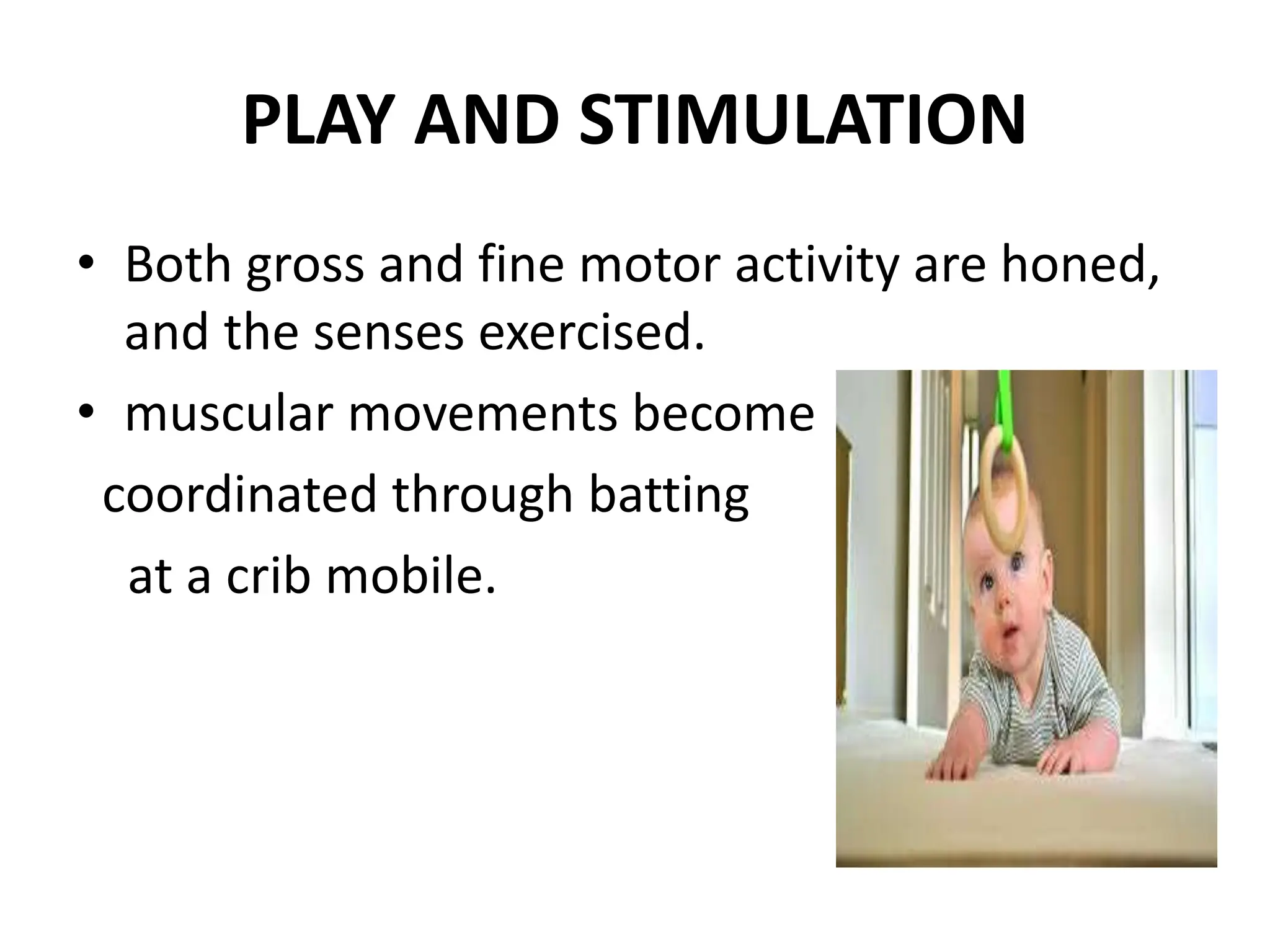
PLAY AND STIMULATION
• Both gross and fine motor activity are honed,
and the senses exercised.
• muscular movements become
coordinated through batting
at a crib mobile.
Factors influencing growth and
development
• Heredity or genetic factors
• Prenatal factors
Maternal malnutrition
Research conducted by Adu-Afarwuah
S, Lartey A in GHANA founded that Prenatal
Lipid-based nutrient supplementation can
improve fetal growth among vulnerable
women particularly primiparous women
Maternal infections.
Maternal substance abuse or drugs
A systemic review conducted by Giovanni
Previti and Susan Pawlby found that
antidepressant treatment may be associated
with some neurodevelopment changes in
fetus.
• Postnatal factors
Childhood illness.
Nutrition
Common problems of a new born
• Vomiting
• Constipation
• Diarrhea
• Excessive crying
Precautions
• Never give very small things to the child.
• Never feed solids which are difficult to chew.
• Never leave the infant near water tub .
NURSES RESPONSIBILITIES
Conclusion
Bibliography
• Parul Datta.” Pediatric nursing”. 2nd ED. Jaypee brother’s medical
publishers; 116-129.
• NP Pahuja.” Psychology of learning and development”. Anmol
publications private LTD; 81-9.
• Assuma Beevi TM. “A text book of pediatric nursing”. ELSEVIER India
private LMT; 163-5.
• Navdeep Kaur Brar, HC Rawat. “Text book of advanced nursing
practice”. Jaypee brother’s medical publishers; 765-780.
• Shebeer P Basheer, S Yaseen Khan. “A concise textbook of advanced
nursing practice”. Emmess medical publishers; 570-586.
• Marzia Giribaldi, Laura Cavallarin, Cristina
Baro, ‘et al’. Biological and Nutritional Aspects
of Human Milk in Feeding of Preterm Infants
[Internet]. Food and Nutrition Sciences 2012
Dec; Vol.3 No.12[about 1p.] [cited 2016 Sep
28 at 10 pm] .Available from:
http://www.scirp.org/journal/PaperInformat
ion.aspx?PaperID=25294
• Adu-Afarwuah S, Lartey A, Okronipa H, ‘et al’.
Lipid-based nutrient supplement increases the
birth size of infants of primiparous women in
Ghana[Internet].American journal of clinical
malnutrition 2015 Apr1(4):835-46. [cited 2016
sep 28at 10.30 pm]Available from:
https://www.ncbi.nlm.nih.gov/pmc/articles/P
MC42
• http://www.parents.com/baby/development/
growth
growth and devlopement assessment of baby

growth and devlopement assessment of baby

  • 1.
    GROWTH AND DEVLOPEMENT OFINFANT SEMINAR PRESENTATION BY- ANVIN THOMAS M.SC NURSING (1ST YEAR)
  • 3.
    • Weight At birthis approximately 2.5 kg to 3.5kg and trebled by one year . • Length At birth it is 50 cm, 75 cm at one year of age . • Head circumference Head circumference measures about 35 cm at birth and at one year 45cm.
  • 4.
    •Chest circumference At birthit is 2-3 cm less than head circumference. At 6 to 12 months of age both become equal •Mid upper arm circumference( MUAC ) The average MUAC at birth is 11 to 12 cm, at one year of age it is 12 to16 cm •Eruption of teeth There is a variation for the time of eruption of teeth. First teeth commonly may appear in 6 to 7 months of age. …..
  • 5.
    • Respiratory changes neonateis about 36 to 40 breaths per minute • Cardiovascular changes At birth 120 and 160 beats per minute at one year it is about 100 to 160 beats per minute. Blood pressure in neonates is 80/46mm hg, at one year it is about 96/66mmhg • Gastrointestinal system
  • 6.
    The acquisition ofgross motor skill precedes the development of fine motor skills. Newborn: barely able to lift head 6 months: easily lifts head, chest and upper abdomen and can bear weight on arms
  • 7.
    Gross Motor Development At12 months • Sits down from standing position alone • Walk few step with help or alone.
  • 8.
    Fine motor: • Atbirth Hold hand in tight fists. Can grasp but drops it immediately • 6th month Grasps with simultaneous flexion of fingers. Retain transient hold on two objects, one in each hand.
  • 9.
    At one year •Picks up small bits of food and transfers them to month • Enjoy eating with fingers
  • 10.
    Neonatal reflexes • Suckingreflex • Rooting reflex • Moro reflex • Swallowing reflex • Sneezing and coughing reflex • Blinking reflex
  • 11.
    Psychosocial development • ErikErikson’s theory centers around the infants basic needs being met by parents and this interaction leading to trust or mistrust. • The child’s relative understanding of world and society come from the parents and their interaction with the child. • Sense of trust versus mistrust.
  • 12.
    Piaget’s theory ofcognitive development  when an infant reaches about 7 to 9 months of age the child now has the ability to understand that objects keep existing even when they cannot seen.
  • 13.
    Moral development • Piaget’smoral development parallels mental development • Morality Stage from birth to 2 years of age • Infants land early toddlers are egocentric and unable to understand rules or to judge what is good or bad in terms of rules or authority
  • 14.
    • What ispleasant is good; what is unpleasant is bad • Both Piaget and Kohlberg believe that social Interaction and experience are the major determinants of how the child progresses from one stage to another in moral development
  • 15.
    Psychosexual development  Accordingto Sigmund Freud the development of sexuality proceeds in different stages that is oral, anal, phallic, latency, puberty and geniality.  The greatest sensual satisfaction is obtained through stimulation of oral region or sensory area of mouth as in breast feeding and sucking.  If successful, feelings of security result and unsuccessful an oral dependent character results.
  • 16.
    Spiritual development • Fowlerdescribes spiritual development during period of infancy as Stage I, Primal Faith, During the early years, the infant forms a attachment for parents that develops trust, hope, and autonomy as a result of the give- and -take relationship.
  • 17.
    PLAY AND STIMULATION •Both gross and fine motor activity are honed, and the senses exercised. • muscular movements become coordinated through batting at a crib mobile.
  • 18.
    Factors influencing growthand development • Heredity or genetic factors • Prenatal factors Maternal malnutrition Research conducted by Adu-Afarwuah S, Lartey A in GHANA founded that Prenatal Lipid-based nutrient supplementation can improve fetal growth among vulnerable women particularly primiparous women
  • 19.
    Maternal infections. Maternal substanceabuse or drugs A systemic review conducted by Giovanni Previti and Susan Pawlby found that antidepressant treatment may be associated with some neurodevelopment changes in fetus.
  • 20.
  • 21.
    Common problems ofa new born • Vomiting • Constipation • Diarrhea • Excessive crying
  • 22.
    Precautions • Never givevery small things to the child. • Never feed solids which are difficult to chew. • Never leave the infant near water tub .
  • 23.
  • 24.
  • 25.
    Bibliography • Parul Datta.”Pediatric nursing”. 2nd ED. Jaypee brother’s medical publishers; 116-129. • NP Pahuja.” Psychology of learning and development”. Anmol publications private LTD; 81-9. • Assuma Beevi TM. “A text book of pediatric nursing”. ELSEVIER India private LMT; 163-5. • Navdeep Kaur Brar, HC Rawat. “Text book of advanced nursing practice”. Jaypee brother’s medical publishers; 765-780. • Shebeer P Basheer, S Yaseen Khan. “A concise textbook of advanced nursing practice”. Emmess medical publishers; 570-586.
  • 26.
    • Marzia Giribaldi,Laura Cavallarin, Cristina Baro, ‘et al’. Biological and Nutritional Aspects of Human Milk in Feeding of Preterm Infants [Internet]. Food and Nutrition Sciences 2012 Dec; Vol.3 No.12[about 1p.] [cited 2016 Sep 28 at 10 pm] .Available from: http://www.scirp.org/journal/PaperInformat ion.aspx?PaperID=25294
  • 27.
    • Adu-Afarwuah S,Lartey A, Okronipa H, ‘et al’. Lipid-based nutrient supplement increases the birth size of infants of primiparous women in Ghana[Internet].American journal of clinical malnutrition 2015 Apr1(4):835-46. [cited 2016 sep 28at 10.30 pm]Available from: https://www.ncbi.nlm.nih.gov/pmc/articles/P MC42 • http://www.parents.com/baby/development/ growth