Health Communication
Dr. Gneyaa Bhatt
Objectives
• What is Communication?
• Communication process
• Functions of health communication
• Types of communication
• Barriers in communication
• Qualities of a good communicator
• Methods in health communication
• Application of health communication
- IEC, BCC,SBCC, Counselling
Communication
• Transfer of information between people with
ultimate motive to develop a better understanding
between them.
Communication
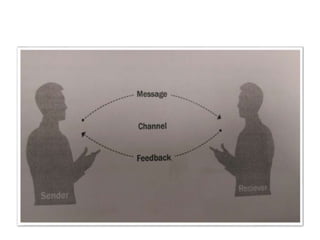
• It is a complex process in which
• a source of information (Sender) gives the
information (Message) through
• Various channels (Media) to the audience
(Receiver) and in turn gets the feedback to know
the effect of the process.
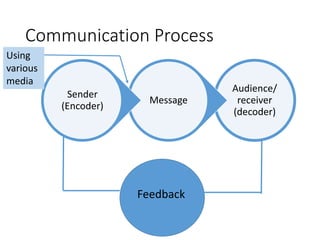
Communication Process
Audience/
receiver
(decoder)
Message
Sender
(Encoder)
Feedback
Using
various
media
Sender
• Is the communicator or originator of the message
• Should know the audience,
• Should know the message to be given and
• Should know the methods or channels to communicate.
• Should be Efficient.
Message
• It is the ‘technical know-how’ of the information being
communicated to the audience.
• They should understand, accept and act upon.
• The message should be clear, specific, precise,
understandable, interesting, meaningful, related to the
objective and acceptable by the audience.
Media
• It is the channel which bridges between the sender and the
receiver.
• There are three systems of media.
1. Interpersonal communication: (Face-to-face communication)
• This is very effective.
2. Mass media: TV, radio, printed media, etc.
• Advantage: Large number of people can be reached in a short
time.
• Disadvantage: Not very effective in bringing about the changes.
3. Traditional or folk media: Folk dance, songs, drama, puppetry,
harikatha, burrakatha (in AP), nautanki (in UP), tamasha in Dangs
etc.
• These types are close to cultural values and therefore they are
very effective.
Audience
• The receiver may be a single person or a group of
people.
• If the audience is a homogeneous group and have a
common interest, it is called ‘Controlled audience.’
Otherwise it is called ‘Uncontrolled or free’ audience
(That is a group which has gathered out of curiosity).
Feedback
• It is the reverse flow of information or remarks made by
the audience about the message to the sender so that
the sender can make modifications and improve the
communication to make it more effective and
acceptable to the audience.
Functions of health communication
• Public health
- Increase knowledge / awareness regarding health
issue/problem or its solution
- Influence the pre existing beliefs/myths/perception
- Prompt action
- Behaviour change
- Increase demand for health services
- Improve skills
• Clinical medicine
- Doctor-patient relationship
1. rapport building
2. exchange of information
3. involve patient in decision making
- A good relationship will have better chance that
patient will
- follow the advice,
- adhere to the treatment,
- take due care and
- come for follow up…
- which will in turn, have good outcome.
Exercise- Chinese whisper
• I went to Laxmi’s house because she was sick.
When I reached home, she was not there as she
went to Parent teacher’ s meeting in her son’s
school. Her brother was there and was repairing
the bicycle. I tried to get the detail of Laxmi’s illness
but he was not interested in talking and I left.
Types of Communication
One Way Communication
• It is also called ‘Didactic method.’
• The message flows in only one direction, i.e. from the communicator to
the audience, e.g. giving lecture in a classroom.
• The demerits are that:
• There is no participation from the audience
• There is no feedback
• Information is imposed
• Learning is passive
• Less likely to influence the human behavior.
Two Way Communication
• It is called ‘Socratic method.’
• Both the communicator and the audience take part. Audience may ask
questions and they may give their own suggestions.
• Thus, the communication become active, effective and ‘democratic.’
• This method is more likely to influence the human behavior.
Verbal Communication
• This is giving the information by talk and not by
showing written printed matter. It is more
persuasive.
Nonverbal Communication
• In the type, the message is communicated not by
talk but by body movements, postures, facial
expressions (smile, sorrow, staring, etc.). Often this
is also effective.
Formal & informal Communication
• Formal Follows lines of authority while Informal
Communication (grape-vine) occurs among Informal
network/gossip circles
Visual Communication
• Consists of charts, posters, pictures, graphs, tables, maps,
etc.
Telecommunication and Internet
• This is done by using electromagnetic instruments and the
communication is done over distance.
• Example, radio, TV, internet, etc. Telephone, telex and
telegraph are known as ‘point-to-point’
telecommunication system.
• Launching of satellites is an advanced technology in the
telecommunication system.
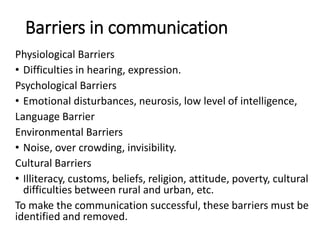
Barriers in communication
Physiological Barriers
• Difficulties in hearing, expression.
Psychological Barriers
• Emotional disturbances, neurosis, low level of intelligence,
Language Barrier
Environmental Barriers
• Noise, over crowding, invisibility.
Cultural Barriers
• Illiteracy, customs, beliefs, religion, attitude, poverty, cultural
difficulties between rural and urban, etc.
To make the communication successful, these barriers must be
identified and removed.
Qualities/skills of a good
communicator
• Knowledgeable
• Good listener/Active listener
• Empathetic
• Non judgemental
• Simple presentation of issue
• Appropriate body language
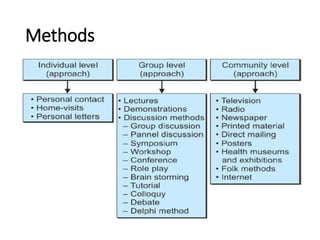
Methods
Materials/ tools for effective
communication
• Pamphlets/leaflets/brochure
• Flip charts
• Flash cards
• Charts
• Posters
• AV aids- laptop-projector-tablet- mobile
Application
Information, education and
communication (IEC)
• an important approach to bring about changes in
the knowledge, attitude and behavior of the people
for betterment of their health and the health of the
family and community in which they live.
BCC- Behaviour Change
Communication
SBCC-
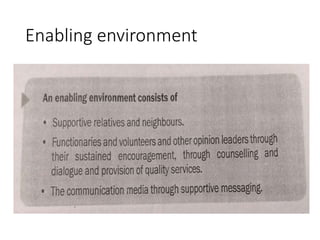
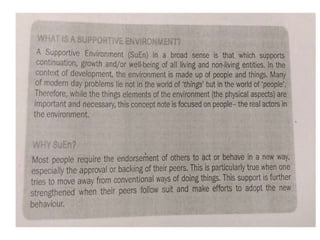
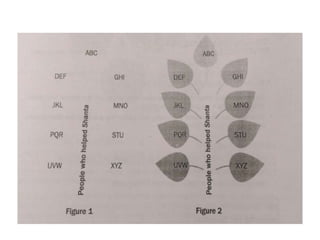
Enabling environment
Counselling
• Helping the client in making decision for oneself
• To help people to solve their problem
• Medical field- used for sensitive issues
• Individual/group
• GATHER approach
Health communication

Health communication

  • 1.
  • 2.
    Objectives • What isCommunication? • Communication process • Functions of health communication • Types of communication • Barriers in communication • Qualities of a good communicator • Methods in health communication • Application of health communication - IEC, BCC,SBCC, Counselling
  • 3.
    Communication • Transfer ofinformation between people with ultimate motive to develop a better understanding between them.
  • 4.
    Communication • It isa complex process in which • a source of information (Sender) gives the information (Message) through • Various channels (Media) to the audience (Receiver) and in turn gets the feedback to know the effect of the process.
  • 5.
  • 7.
    Sender • Is thecommunicator or originator of the message • Should know the audience, • Should know the message to be given and • Should know the methods or channels to communicate. • Should be Efficient. Message • It is the ‘technical know-how’ of the information being communicated to the audience. • They should understand, accept and act upon. • The message should be clear, specific, precise, understandable, interesting, meaningful, related to the objective and acceptable by the audience.
  • 8.
    Media • It isthe channel which bridges between the sender and the receiver. • There are three systems of media. 1. Interpersonal communication: (Face-to-face communication) • This is very effective. 2. Mass media: TV, radio, printed media, etc. • Advantage: Large number of people can be reached in a short time. • Disadvantage: Not very effective in bringing about the changes. 3. Traditional or folk media: Folk dance, songs, drama, puppetry, harikatha, burrakatha (in AP), nautanki (in UP), tamasha in Dangs etc. • These types are close to cultural values and therefore they are very effective.
  • 9.
    Audience • The receivermay be a single person or a group of people. • If the audience is a homogeneous group and have a common interest, it is called ‘Controlled audience.’ Otherwise it is called ‘Uncontrolled or free’ audience (That is a group which has gathered out of curiosity). Feedback • It is the reverse flow of information or remarks made by the audience about the message to the sender so that the sender can make modifications and improve the communication to make it more effective and acceptable to the audience.
  • 10.
    Functions of healthcommunication • Public health - Increase knowledge / awareness regarding health issue/problem or its solution - Influence the pre existing beliefs/myths/perception - Prompt action - Behaviour change - Increase demand for health services - Improve skills
  • 11.
    • Clinical medicine -Doctor-patient relationship 1. rapport building 2. exchange of information 3. involve patient in decision making - A good relationship will have better chance that patient will - follow the advice, - adhere to the treatment, - take due care and - come for follow up… - which will in turn, have good outcome.
  • 12.
    Exercise- Chinese whisper •I went to Laxmi’s house because she was sick. When I reached home, she was not there as she went to Parent teacher’ s meeting in her son’s school. Her brother was there and was repairing the bicycle. I tried to get the detail of Laxmi’s illness but he was not interested in talking and I left.
  • 13.
    Types of Communication OneWay Communication • It is also called ‘Didactic method.’ • The message flows in only one direction, i.e. from the communicator to the audience, e.g. giving lecture in a classroom. • The demerits are that: • There is no participation from the audience • There is no feedback • Information is imposed • Learning is passive • Less likely to influence the human behavior. Two Way Communication • It is called ‘Socratic method.’ • Both the communicator and the audience take part. Audience may ask questions and they may give their own suggestions. • Thus, the communication become active, effective and ‘democratic.’ • This method is more likely to influence the human behavior.
  • 14.
    Verbal Communication • Thisis giving the information by talk and not by showing written printed matter. It is more persuasive. Nonverbal Communication • In the type, the message is communicated not by talk but by body movements, postures, facial expressions (smile, sorrow, staring, etc.). Often this is also effective.
  • 15.
    Formal & informalCommunication • Formal Follows lines of authority while Informal Communication (grape-vine) occurs among Informal network/gossip circles Visual Communication • Consists of charts, posters, pictures, graphs, tables, maps, etc. Telecommunication and Internet • This is done by using electromagnetic instruments and the communication is done over distance. • Example, radio, TV, internet, etc. Telephone, telex and telegraph are known as ‘point-to-point’ telecommunication system. • Launching of satellites is an advanced technology in the telecommunication system.
  • 16.
    Barriers in communication PhysiologicalBarriers • Difficulties in hearing, expression. Psychological Barriers • Emotional disturbances, neurosis, low level of intelligence, Language Barrier Environmental Barriers • Noise, over crowding, invisibility. Cultural Barriers • Illiteracy, customs, beliefs, religion, attitude, poverty, cultural difficulties between rural and urban, etc. To make the communication successful, these barriers must be identified and removed.
  • 17.
    Qualities/skills of agood communicator • Knowledgeable • Good listener/Active listener • Empathetic • Non judgemental • Simple presentation of issue • Appropriate body language
  • 18.
  • 19.
    Materials/ tools foreffective communication • Pamphlets/leaflets/brochure • Flip charts • Flash cards • Charts • Posters • AV aids- laptop-projector-tablet- mobile
  • 20.
  • 21.
    Information, education and communication(IEC) • an important approach to bring about changes in the knowledge, attitude and behavior of the people for betterment of their health and the health of the family and community in which they live.
  • 22.
  • 28.
  • 31.
    Counselling • Helping theclient in making decision for oneself • To help people to solve their problem • Medical field- used for sensitive issues • Individual/group • GATHER approach

Editor's Notes

  • #8 The effect of the communication depends upon the efficiency of the communicator.
  • #11 Skills- first aid, CPR
  • #12 3 imp things in doctor-Patient communication
  • #19 putting yourself in someone else's shoes is to have empathy.
  • #33 FP, HIV,STI, Adolescent, teenage pregnancy, TB, Leprosy