Healthcare
Analytics
iabac.org
Introduction to Healthcare
Analytics
Definition: The application of data
analytics methods to enhance patient care,
efficiency, and healthcare results.
Includes statistical models, AI, machine
learning, and big data.
Improves the ability of legislators and
healthcare professionals to make
decisions.
iabac.org
iabac.org
Importance of Healthcare
Analytics
Improves patient outcomes by using
individualized care.
Increases the effectiveness of hospital and
clinic operations.
Lowers medical expenses through error
prevention and resource optimization.
Assist in the prevention of disease through
predictive analytics.
iabac.org
Types of Healthcare
Analytics
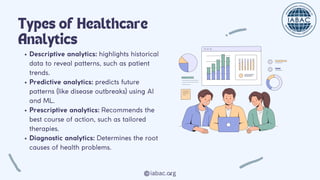
Descriptive analytics: highlights historical
data to reveal patterns, such as patient
trends.
Predictive analytics: predicts future
patterns (like disease outbreaks) using AI
and ML.
Prescriptive analytics: Recommends the
best course of action, such as tailored
therapies.
Diagnostic analytics: Determines the root
causes of health problems.
iabac.org
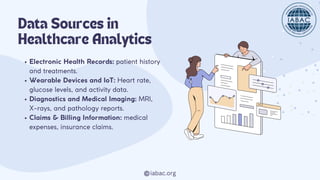
Data Sources in
Healthcare Analytics
Electronic Health Records: patient history
and treatments.
Wearable Devices and IoT: Heart rate,
glucose levels, and activity data.
Diagnostics and Medical Imaging: MRI,
X-rays, and pathology reports.
Claims & Billing Information: medical
expenses, insurance claims.
Challenges in Healthcare
Analytics
Data security and privacy: Making sure
GDPR and HIPAA regulations are
followed.
Problems with data integration: disparate
formats and platforms.
Bias in AI Models: Ethical Issues and
Fairness in Healthcare AI.
Scalability: The ability to handle enormous
volumes of real-time data.
iabac.org
iabac.org
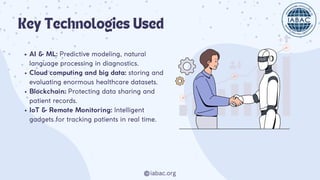
Key Technologies Used
AI & ML: Predictive modeling, natural
language processing in diagnostics.
Cloud computing and big data: storing and
evaluating enormous healthcare datasets.
Blockchain: Protecting data sharing and
patient records.
IoT & Remote Monitoring: Intelligent
gadgets for tracking patients in real time.
iabac.org
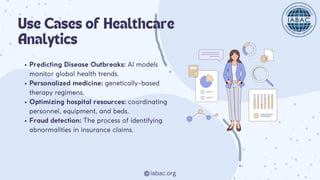
Use Cases of Healthcare
Analytics
Predicting Disease Outbreaks: AI models
monitor global health trends.
Personalized medicine: genetically-based
therapy regimens.
Optimizing hospital resources: coordinating
personnel, equipment, and beds.
Fraud detection: The process of identifying
abnormalities in insurance claims.
iabac.org
Future Trends in
Healthcare Analytics
AI-powered drug discovery to expedite the
creation of treatments.
Chatbots and virtual health assistants to
engage patients.
Combining personalized healthcare with
genetics.
Federated learning allows for safe data
exchange without sacrificing individual
privacy.
Thank you
Visit: iabac.org

Healthcare Analytics | IABAC Certification

  • 1.
  • 2.
    Introduction to Healthcare Analytics Definition:The application of data analytics methods to enhance patient care, efficiency, and healthcare results. Includes statistical models, AI, machine learning, and big data. Improves the ability of legislators and healthcare professionals to make decisions. iabac.org
  • 3.
    iabac.org Importance of Healthcare Analytics Improvespatient outcomes by using individualized care. Increases the effectiveness of hospital and clinic operations. Lowers medical expenses through error prevention and resource optimization. Assist in the prevention of disease through predictive analytics.
  • 4.
    iabac.org Types of Healthcare Analytics Descriptiveanalytics: highlights historical data to reveal patterns, such as patient trends. Predictive analytics: predicts future patterns (like disease outbreaks) using AI and ML. Prescriptive analytics: Recommends the best course of action, such as tailored therapies. Diagnostic analytics: Determines the root causes of health problems.
  • 5.
    iabac.org Data Sources in HealthcareAnalytics Electronic Health Records: patient history and treatments. Wearable Devices and IoT: Heart rate, glucose levels, and activity data. Diagnostics and Medical Imaging: MRI, X-rays, and pathology reports. Claims & Billing Information: medical expenses, insurance claims.
  • 6.
    Challenges in Healthcare Analytics Datasecurity and privacy: Making sure GDPR and HIPAA regulations are followed. Problems with data integration: disparate formats and platforms. Bias in AI Models: Ethical Issues and Fairness in Healthcare AI. Scalability: The ability to handle enormous volumes of real-time data. iabac.org
  • 7.
    iabac.org Key Technologies Used AI& ML: Predictive modeling, natural language processing in diagnostics. Cloud computing and big data: storing and evaluating enormous healthcare datasets. Blockchain: Protecting data sharing and patient records. IoT & Remote Monitoring: Intelligent gadgets for tracking patients in real time.
  • 8.
    iabac.org Use Cases ofHealthcare Analytics Predicting Disease Outbreaks: AI models monitor global health trends. Personalized medicine: genetically-based therapy regimens. Optimizing hospital resources: coordinating personnel, equipment, and beds. Fraud detection: The process of identifying abnormalities in insurance claims.
  • 9.
    iabac.org Future Trends in HealthcareAnalytics AI-powered drug discovery to expedite the creation of treatments. Chatbots and virtual health assistants to engage patients. Combining personalized healthcare with genetics. Federated learning allows for safe data exchange without sacrificing individual privacy.
  • 10.