

John Ward, Alain Feussi, James Young
BIS 656
6/18/2014
This paper defines and summarizes the huge
challenge ahead of North American
healthcare providers by illuminating current
and future trends of medical business
intelligence (BI), ramifications of EMR, the
pros and cons of BI and analytics, the myriad
ethical and privacy issues of big data’s role,
and lastly provide an industry overview of BI
and analytics solutions specific to healthcare.
Overview
 Electronic Medical Records (EMR) Mandate
 Present Day Healthcare BI
 Need for Healthcare “Big Data”
 Healthcare Analytics Pros & Cons
 Healthcare BI Solutions: Industry Overview
 Vendor Analysis – Key Terms
 SaaS Advantages
 On-Premise Solution
 Big Four Vendors
 Key Niche Vendors
 Conclusion
Content
Current Status of EMR Mandate
 Healthcare providers and the American Recovery and
Reinvestment Act of 2009
 Deploy an EMR solution or face penalties starting in 2015
 Must prove “meaningful use”
 Using a certified EMR
 Improved health quality and safety
 Improved health delivery efficacy
 Reduced disparities in healthcare
 Improved interaction with patients and families
 Advancement in the coordination of care
Current Status of EMR Mandate
Healthcare providers and the American Recovery
and Reinvestment Act of 2009 (continued)
 Compliance
 49% of small healthcare systems (< 2 FTE physicians) compliant
 83% of large healthcare systems (> 5 FTE physicians) compliant
 Cost to deploy EMR significant to small providers
Present Day Healthcare BI
80% of medical data is unstructured and clinically
relevant
Healthcare lags other industries in adoption of BI
Some healthcare organizations with BI making
decisions on comprehensive information
Improves patient and financial outcomes
Healthcare providers looking at ERP systems with BI
Healthcare ERP/BI solution are becoming more robust
Present Day Healthcare BI
 Healthcare providers Wish List
Enterprise Healthcare Business Intelligence
Predictive Analytics
Accountable Care Predictive Analytics
Healthcare Data Integration
Data Warehousing Population
Being Able to Visualize Data
Need for Healthcare “Big Data”
Larger scale benefits
Advances in predicting influenza outbreaks and
strain
Clinical responses based on “Big Data”
National BI on latest treatments and results
Healthcare cost reduction on National level
Current information on clinical trials and results
Healthcare BI has moved from a “nice to have” to a “must have”!
Healthcare Analytics & Big Data
Pros & Cons
Ethical Considerations
Life Extension & Quality of Life
Potential Misuse
Personal Privacy vs. Societal Benefit
Healthcare Analytics & Big Data
Pros & Cons
Analytics ROI
Reduction of Fraud & Claim Abuse
BetterTreatments=FewerMalpracticeClaims
Threat of Loss of Insurance Coverage?
Healthcare Analytics & Big Data
Pros & Cons
Analytics – The Dark Side
Potential Withholding of Treatments
Demographic Profiling
Is Anything Truly Private?
Healthcare Analytics & Big Data
Pros & Cons
Ethical Conclusions
OpportunityforMisuse,ButNotRealized
Cost Savings – For Patients or Doctors?
Ethical & Legal Issues Unresolved
Healthcare BI Solutions:
Industry Overview
Criteria to consider when selecting a BI solution
 Technology model
 TCO
 Ease of use/learning
 Market Share /Key client
 Complexity/capabilities
 Cost Reduction
 Health Improvement through proactive Care
 Company Size
Definition of Keys Terms for
Understanding the Vendor Table
 SaaS: Software As A Service: a model of software deployment
where an application is hosted as a service provided to customers
over the Internet
 SaaS reduces the customer’s need for software maintenance,
operation, and support
 The traditional model still accounts for most of the software
acquisition, but the SaaS is changing the dynamic very rapidly.
SaaS Advantages
No software licensing costs
No new infrastructure requirements
Low Cost of services
Vendors take care of the data security
On-Premise Solution
Brick-and-mortar method
Company has all the technology
deployed on its premises
All hardware and software on premise
On-Premise Advantages
 Control over all systems and data,
 Corporate data is stored and handled internally
 Dedicated IT staff for maintenance/support
 Initial investment is high but pays off over time
Note: Both technology models have disadvantages , for example data
security and confidentiality for SaaS and Cost for On-premise solution
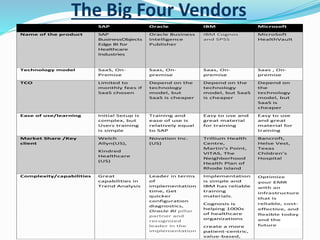
The Big Four Vendors
SAP Oracle IBM Microsoft
Name of the product SAP
BusinessObjects
Edge BI for
Healthcare
Industries
Oracle Business
Intelligence
Publisher
IBM Cognos
and SPSS
MicroSoft
HealthVault
Technology model SaaS, On-
Premise
Saas, On-
premise
Saas, On-
premise
Saas , On-
premise
TCO Limited to
monthly fees if
SaaS chosen
Depend on the
technology
model, but
SaaS is cheaper
Depend on the
technology
model, but SaaS
is cheaper
Depend on
the
technology
model, but
SaaS is
cheaper
Ease of use/learning Initial Setup is
complex, but
Users training
is simple
Training and
ease of use is
relatively equal
to SAP
Easy to use and
great material
for training
Easy to use
and great
material for
training
Market Share /Key
client
Welch
Allyn(US),
Kindred
Healthcare
(US)
Novation Inc.
(US)
Trillium Health
Centre,
Martin’s Point,
VITAS, The
Neighborhood
Health Plan of
Rhode Island
Bancroft,
Helse Vest,
Texas
Children’s
Hospital
Complexity/capabilities Great
capabilities in
Trend Analysis
Leader in terms
of
implementation
time, Get
quicker
configuration
diagnostics,
Oracle BI pillar
partner and
recognized
leader in the
implementation
Implementation
is simple and
IBM has reliable
training
materials.
Cognosis is
helping 1000s
of healthcare
organizations
create a more
patient-centric,
value-based,
Optimize
your EMR
with an
infrastructure
that is
reliable, cost-
effective, and
flexible today
and the
future
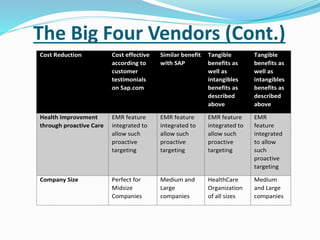
The Big Four Vendors (Cont.)
Cost Reduction Cost effective
according to
customer
testimonials
on Sap.com
Similar benefit
with SAP
Tangible
benefits as
well as
intangibles
benefits as
described
above
Tangible
benefits as
well as
intangibles
benefits as
described
above
Health Improvement
through proactive Care
EMR feature
integrated to
allow such
proactive
targeting
EMR feature
integrated to
allow such
proactive
targeting
EMR feature
integrated to
allow such
proactive
targeting
EMR
feature
integrated
to allow
such
proactive
targeting
Company Size Perfect for
Midsize
Companies
Medium and
Large
companies
HealthCare
Organization
of all sizes
Medium
and Large
companies
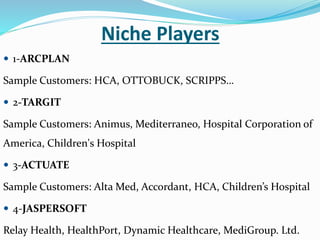
 1-ARCPLAN
Sample Customers: HCA, OTTOBUCK, SCRIPPS…
 2-TARGIT
Sample Customers: Animus, Mediterraneo, Hospital Corporation of
America, Children's Hospital
 3-ACTUATE
Sample Customers: Alta Med, Accordant, HCA, Children’s Hospital
 4-JASPERSOFT
Relay Health, HealthPort, Dynamic Healthcare, MediGroup. Ltd.
Niche Players
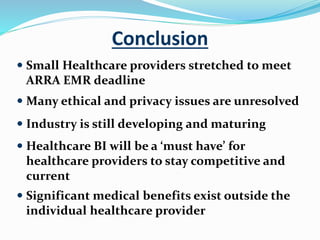
Conclusion
 Small Healthcare providers stretched to meet
ARRA EMR deadline
 Many ethical and privacy issues are unresolved
 Industry is still developing and maturing
 Healthcare BI will be a ‘must have’ for
healthcare providers to stay competitive and
current
 Significant medical benefits exist outside the
individual healthcare provider

Current Status of Healthcare Analytics

  • 1.
    John Ward, AlainFeussi, James Young BIS 656 6/18/2014
  • 2.
    This paper definesand summarizes the huge challenge ahead of North American healthcare providers by illuminating current and future trends of medical business intelligence (BI), ramifications of EMR, the pros and cons of BI and analytics, the myriad ethical and privacy issues of big data’s role, and lastly provide an industry overview of BI and analytics solutions specific to healthcare. Overview
  • 3.
     Electronic MedicalRecords (EMR) Mandate  Present Day Healthcare BI  Need for Healthcare “Big Data”  Healthcare Analytics Pros & Cons  Healthcare BI Solutions: Industry Overview  Vendor Analysis – Key Terms  SaaS Advantages  On-Premise Solution  Big Four Vendors  Key Niche Vendors  Conclusion Content
  • 4.
    Current Status ofEMR Mandate  Healthcare providers and the American Recovery and Reinvestment Act of 2009  Deploy an EMR solution or face penalties starting in 2015  Must prove “meaningful use”  Using a certified EMR  Improved health quality and safety  Improved health delivery efficacy  Reduced disparities in healthcare  Improved interaction with patients and families  Advancement in the coordination of care
  • 5.
    Current Status ofEMR Mandate Healthcare providers and the American Recovery and Reinvestment Act of 2009 (continued)  Compliance  49% of small healthcare systems (< 2 FTE physicians) compliant  83% of large healthcare systems (> 5 FTE physicians) compliant  Cost to deploy EMR significant to small providers
  • 6.
    Present Day HealthcareBI 80% of medical data is unstructured and clinically relevant Healthcare lags other industries in adoption of BI Some healthcare organizations with BI making decisions on comprehensive information Improves patient and financial outcomes Healthcare providers looking at ERP systems with BI Healthcare ERP/BI solution are becoming more robust
  • 7.
    Present Day HealthcareBI  Healthcare providers Wish List Enterprise Healthcare Business Intelligence Predictive Analytics Accountable Care Predictive Analytics Healthcare Data Integration Data Warehousing Population Being Able to Visualize Data
  • 8.
    Need for Healthcare“Big Data” Larger scale benefits Advances in predicting influenza outbreaks and strain Clinical responses based on “Big Data” National BI on latest treatments and results Healthcare cost reduction on National level Current information on clinical trials and results Healthcare BI has moved from a “nice to have” to a “must have”!
  • 9.
    Healthcare Analytics &Big Data Pros & Cons Ethical Considerations Life Extension & Quality of Life Potential Misuse Personal Privacy vs. Societal Benefit
  • 10.
    Healthcare Analytics &Big Data Pros & Cons Analytics ROI Reduction of Fraud & Claim Abuse BetterTreatments=FewerMalpracticeClaims Threat of Loss of Insurance Coverage?
  • 11.
    Healthcare Analytics &Big Data Pros & Cons Analytics – The Dark Side Potential Withholding of Treatments Demographic Profiling Is Anything Truly Private?
  • 12.
    Healthcare Analytics &Big Data Pros & Cons Ethical Conclusions OpportunityforMisuse,ButNotRealized Cost Savings – For Patients or Doctors? Ethical & Legal Issues Unresolved
  • 13.
    Healthcare BI Solutions: IndustryOverview Criteria to consider when selecting a BI solution  Technology model  TCO  Ease of use/learning  Market Share /Key client  Complexity/capabilities  Cost Reduction  Health Improvement through proactive Care  Company Size
  • 14.
    Definition of KeysTerms for Understanding the Vendor Table  SaaS: Software As A Service: a model of software deployment where an application is hosted as a service provided to customers over the Internet  SaaS reduces the customer’s need for software maintenance, operation, and support  The traditional model still accounts for most of the software acquisition, but the SaaS is changing the dynamic very rapidly.
  • 15.
    SaaS Advantages No softwarelicensing costs No new infrastructure requirements Low Cost of services Vendors take care of the data security
  • 16.
    On-Premise Solution Brick-and-mortar method Companyhas all the technology deployed on its premises All hardware and software on premise
  • 17.
    On-Premise Advantages  Controlover all systems and data,  Corporate data is stored and handled internally  Dedicated IT staff for maintenance/support  Initial investment is high but pays off over time Note: Both technology models have disadvantages , for example data security and confidentiality for SaaS and Cost for On-premise solution
  • 18.
    The Big FourVendors SAP Oracle IBM Microsoft Name of the product SAP BusinessObjects Edge BI for Healthcare Industries Oracle Business Intelligence Publisher IBM Cognos and SPSS MicroSoft HealthVault Technology model SaaS, On- Premise Saas, On- premise Saas, On- premise Saas , On- premise TCO Limited to monthly fees if SaaS chosen Depend on the technology model, but SaaS is cheaper Depend on the technology model, but SaaS is cheaper Depend on the technology model, but SaaS is cheaper Ease of use/learning Initial Setup is complex, but Users training is simple Training and ease of use is relatively equal to SAP Easy to use and great material for training Easy to use and great material for training Market Share /Key client Welch Allyn(US), Kindred Healthcare (US) Novation Inc. (US) Trillium Health Centre, Martin’s Point, VITAS, The Neighborhood Health Plan of Rhode Island Bancroft, Helse Vest, Texas Children’s Hospital Complexity/capabilities Great capabilities in Trend Analysis Leader in terms of implementation time, Get quicker configuration diagnostics, Oracle BI pillar partner and recognized leader in the implementation Implementation is simple and IBM has reliable training materials. Cognosis is helping 1000s of healthcare organizations create a more patient-centric, value-based, Optimize your EMR with an infrastructure that is reliable, cost- effective, and flexible today and the future
  • 19.
    The Big FourVendors (Cont.) Cost Reduction Cost effective according to customer testimonials on Sap.com Similar benefit with SAP Tangible benefits as well as intangibles benefits as described above Tangible benefits as well as intangibles benefits as described above Health Improvement through proactive Care EMR feature integrated to allow such proactive targeting EMR feature integrated to allow such proactive targeting EMR feature integrated to allow such proactive targeting EMR feature integrated to allow such proactive targeting Company Size Perfect for Midsize Companies Medium and Large companies HealthCare Organization of all sizes Medium and Large companies
  • 20.
     1-ARCPLAN Sample Customers:HCA, OTTOBUCK, SCRIPPS…  2-TARGIT Sample Customers: Animus, Mediterraneo, Hospital Corporation of America, Children's Hospital  3-ACTUATE Sample Customers: Alta Med, Accordant, HCA, Children’s Hospital  4-JASPERSOFT Relay Health, HealthPort, Dynamic Healthcare, MediGroup. Ltd. Niche Players
  • 21.
    Conclusion  Small Healthcareproviders stretched to meet ARRA EMR deadline  Many ethical and privacy issues are unresolved  Industry is still developing and maturing  Healthcare BI will be a ‘must have’ for healthcare providers to stay competitive and current  Significant medical benefits exist outside the individual healthcare provider