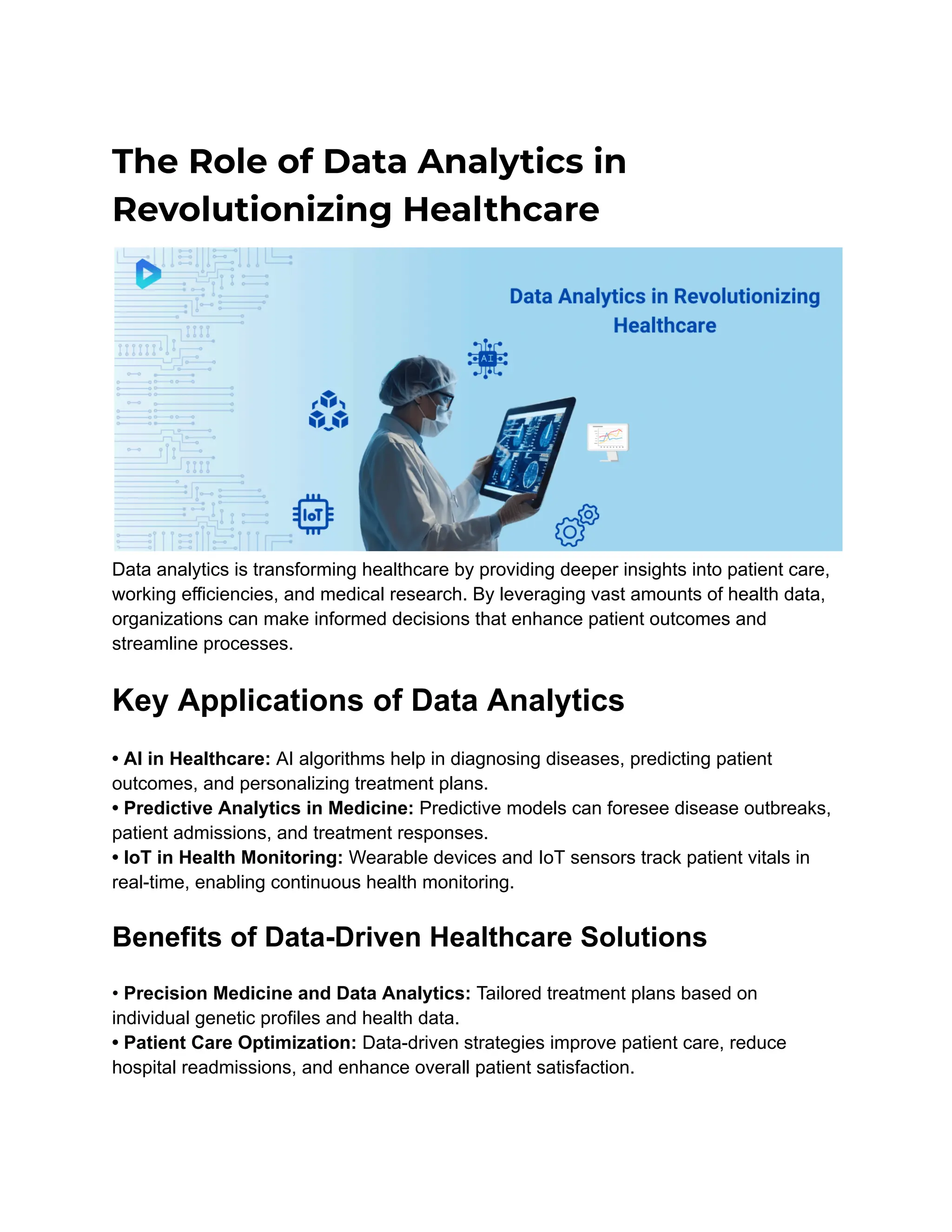
The Role of Data Analytics in
Revolutionizing Healthcare
Data analytics is transforming healthcare by providing deeper insights into patient care,
working efficiencies, and medical research. By leveraging vast amounts of health data,
organizations can make informed decisions that enhance patient outcomes and
streamline processes.
Key Applications of Data Analytics
• AI in Healthcare: AI algorithms help in diagnosing diseases, predicting patient
outcomes, and personalizing treatment plans.
• Predictive Analytics in Medicine: Predictive models can foresee disease outbreaks,
patient admissions, and treatment responses.
• IoT in Health Monitoring: Wearable devices and IoT sensors track patient vitals in
real-time, enabling continuous health monitoring.
Benefits of Data-Driven Healthcare Solutions
• Precision Medicine and Data Analytics: Tailored treatment plans based on
individual genetic profiles and health data.
• Patient Care Optimization: Data-driven strategies improve patient care, reduce
hospital readmissions, and enhance overall patient satisfaction.
• Blockchain in Health Data Management: Ensures secure, transparent, and
immutable health data records, fostering trust and data integrity.
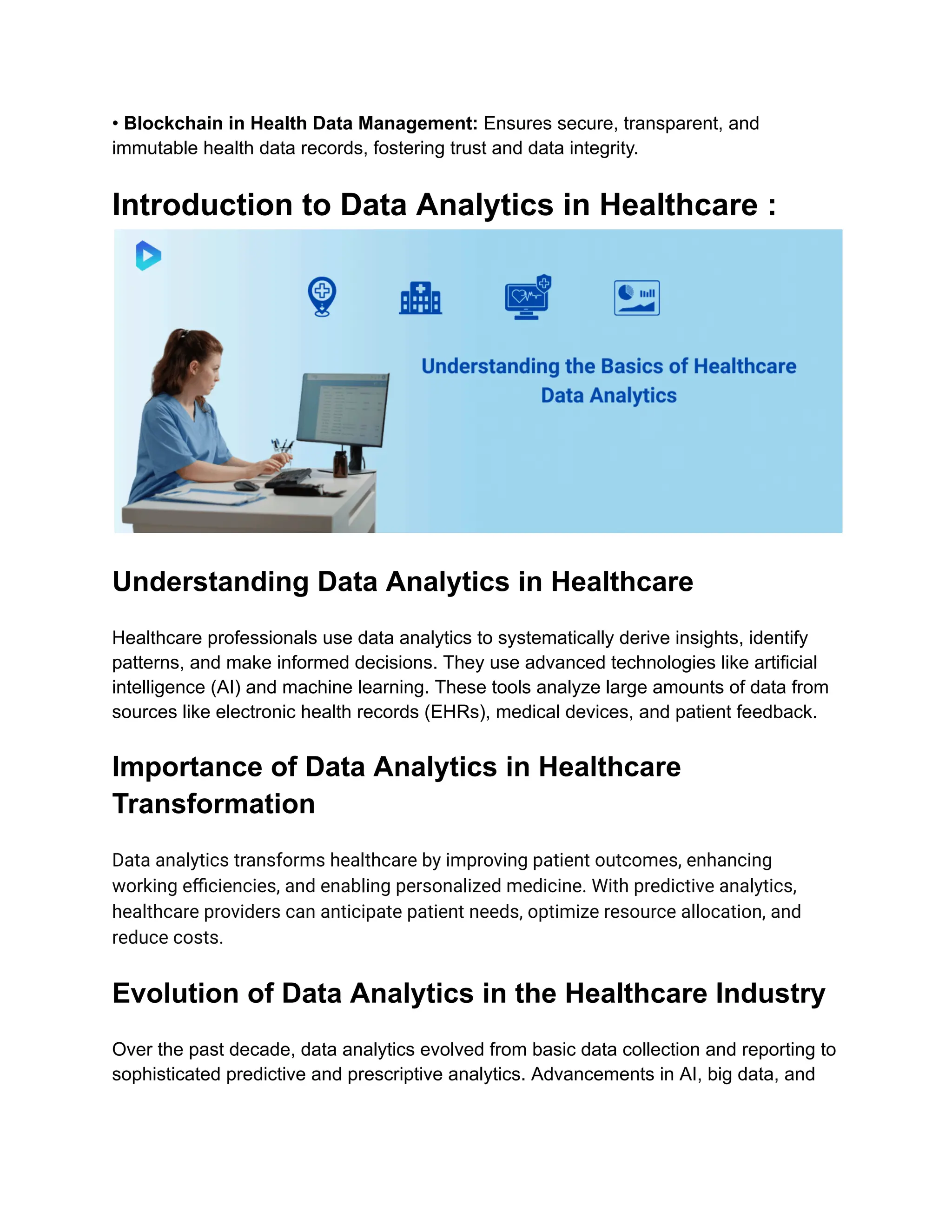
Introduction to Data Analytics in Healthcare :
Understanding Data Analytics in Healthcare
Healthcare professionals use data analytics to systematically derive insights, identify
patterns, and make informed decisions. They use advanced technologies like artificial
intelligence (AI) and machine learning. These tools analyze large amounts of data from
sources like electronic health records (EHRs), medical devices, and patient feedback.
Importance of Data Analytics in Healthcare
Transformation
Data analytics transforms healthcare by improving patient outcomes, enhancing
working efficiencies, and enabling personalized medicine. With predictive analytics,
healthcare providers can anticipate patient needs, optimize resource allocation, and
reduce costs.
Evolution of Data Analytics in the Healthcare Industry
Over the past decade, data analytics evolved from basic data collection and reporting to
sophisticated predictive and prescriptive analytics. Advancements in AI, big data, and
the Internet of Things (IoT) have driven this evolution. These technologies expand the
scope and impact of data-driven healthcare solutions.
Key Objectives of Implementing Data Analytics in
Healthcare
● Improving Patient Care: Data analytics helps monitor patient health, predict
diseases, and personalize treatment plans.
● Enhancing working Efficiency: It enables healthcare organizations to
streamline processes, manage resources effectively, and reduce working costs.
● Advancing Medical Research: By analyzing large datasets, researchers
uncover new insights, develop innovative treatments, and improve clinical trials.
● Ensuring Data Security: Technologies like blockchain secure health data and
maintain its integrity, fostering trust among patients and providers.
Types and Applications of Data Analytics in
Healthcare
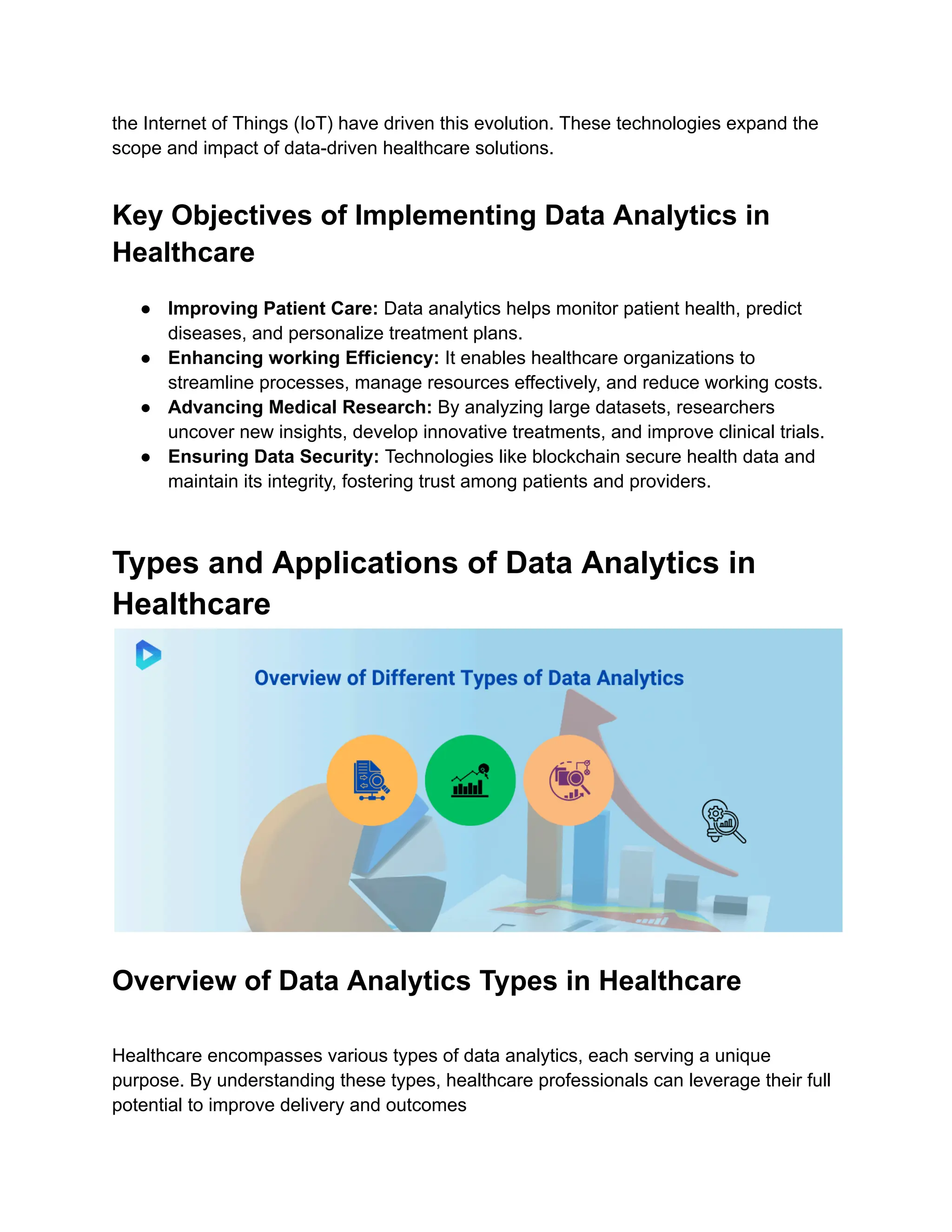
Overview of Data Analytics Types in Healthcare
Healthcare encompasses various types of data analytics, each serving a unique
purpose. By understanding these types, healthcare professionals can leverage their full
potential to improve delivery and outcomes
Descriptive, Predictive, and Prescriptive Analytics in
Healthcare, Prescriptive Analytics in Healthcare
1. Descriptive Analytics: Descriptive analytics summarizes historical data to
understand past events. It helps identify trends and patterns from patient records,
clinical data, and other healthcare information.
2. Predictive Analytics: Predictive analytics uses statistical models and machine
learning techniques to forecast future events. In healthcare, it predicts disease
outbreaks, patient admissions, and individual patient outcomes, aiding proactive
healthcare management.
3. Prescriptive Analytics: Prescriptive analytics predicts future outcomes and
suggests actions to achieve desired results. It recommends treatment plans,
resource allocation, and working improvements, ensuring optimal healthcare
delivery.
Applications in Disease Prediction and Prevention
Data analytics plays a pivotal role in disease prediction and prevention. By analyzing
patient data and identifying risk factors, healthcare providers can anticipate potential
health issues and intervene early to prevent disease progression.
Clinical Decision Support Systems
Clinical Decision Support Systems (CDSS) leverage data analytics to assist healthcare
professionals in making informed decisions. These systems analyze clinical data and
provide evidence-based recommendations, enhancing the accuracy and efficiency of
diagnoses and treatment plans.
Patient Care Optimization through Predictive Modeling
Predictive modeling optimizes patient care by forecasting individual health trajectories
and tailoring interventions accordingly. This approach improves patient outcomes,
reduces hospital readmissions, and enhances overall healthcare quality.
Benefits of Data Analytics in Healthcare
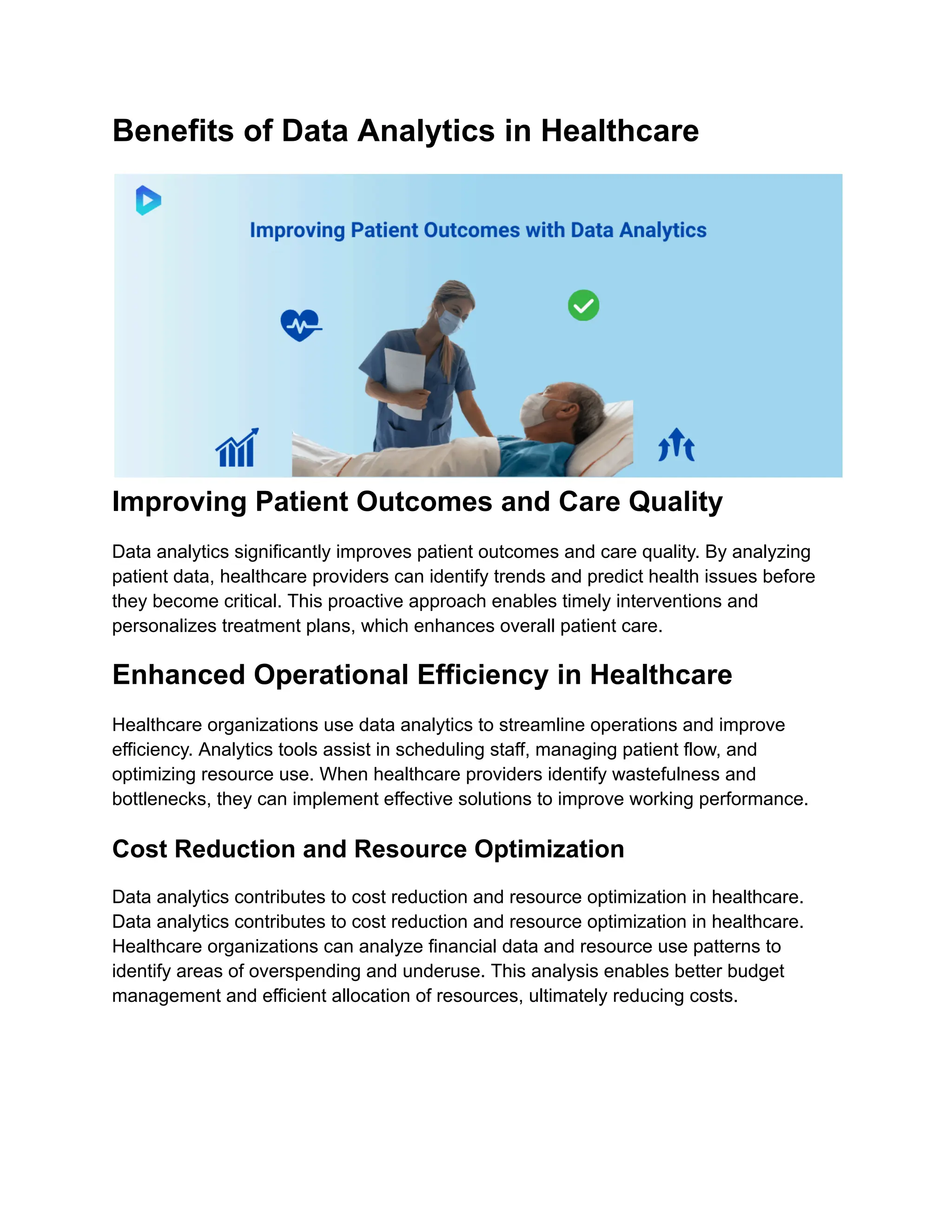
Improving Patient Outcomes and Care Quality
Data analytics significantly improves patient outcomes and care quality. By analyzing
patient data, healthcare providers can identify trends and predict health issues before
they become critical. This proactive approach enables timely interventions and
personalizes treatment plans, which enhances overall patient care.
Enhanced Operational Efficiency in Healthcare
Healthcare organizations use data analytics to streamline operations and improve
efficiency. Analytics tools assist in scheduling staff, managing patient flow, and
optimizing resource use. When healthcare providers identify wastefulness and
bottlenecks, they can implement effective solutions to improve working performance.
Cost Reduction and Resource Optimization
Data analytics contributes to cost reduction and resource optimization in healthcare.
Healthcare organizations can analyze financial data and resource use patterns to
identify areas of overspending and underuse. This analysis enables better budget
management and efficient allocation of resources, ultimately reducing costs.
Personalized Medicine and Patient Engagement
Personalized medicine relies heavily on data analytics to tailor treatments to individual
patients. Healthcare providers can consider genetic information, lifestyle factors, and
medical history to create customized treatment plans that improve outcomes and patient
satisfaction. Additionally, data analytics enhances patient engagement by offering
insights into patient behavior and preferences, enabling more effective communication
and support.
Challenges and Adoption of Data Analytics in
Healthcare
Addressing Data Privacy and Security Concerns
Healthcare data analytics faces major concerns related to data privacy and security. It is
critical to protect sensitive patient information from breaches and ensure compliance
with regulations like HIPAA. Healthcare organizations must implement robust
cybersecurity measures and encryption protocols to safeguard data.
Integration of Legacy Systems and Interoperability
Integrating legacy systems with modern data analytics tools presents a significant
challenge. Many healthcare organizations still use outdated software that does not work
together with newer technologies. To overcome this, healthcare providers need to invest
in integration solutions and develop standards for data exchange.
Staff Training and Adoption Challenges
Healthcare organizations must train staff to use data analytics tools effectively for
successful implementation. Many healthcare professionals may lack the necessary
skills and knowledge, which leads to resistance to adoption. Comprehensive training
programs and ongoing support help staff adapt to new technologies. They also use data
analytics to improve patient care.
Overcoming Regulatory and Compliance Hurdles
Navigating the complex landscape of healthcare regulations and compliance
requirements daunts many healthcare organizations. They must stay updated on the
latest regulations and ensure their data analytics practices comply with them. Engaging
with legal experts and compliance officers helps address regulatory challenges and
maintain adherence to standards.
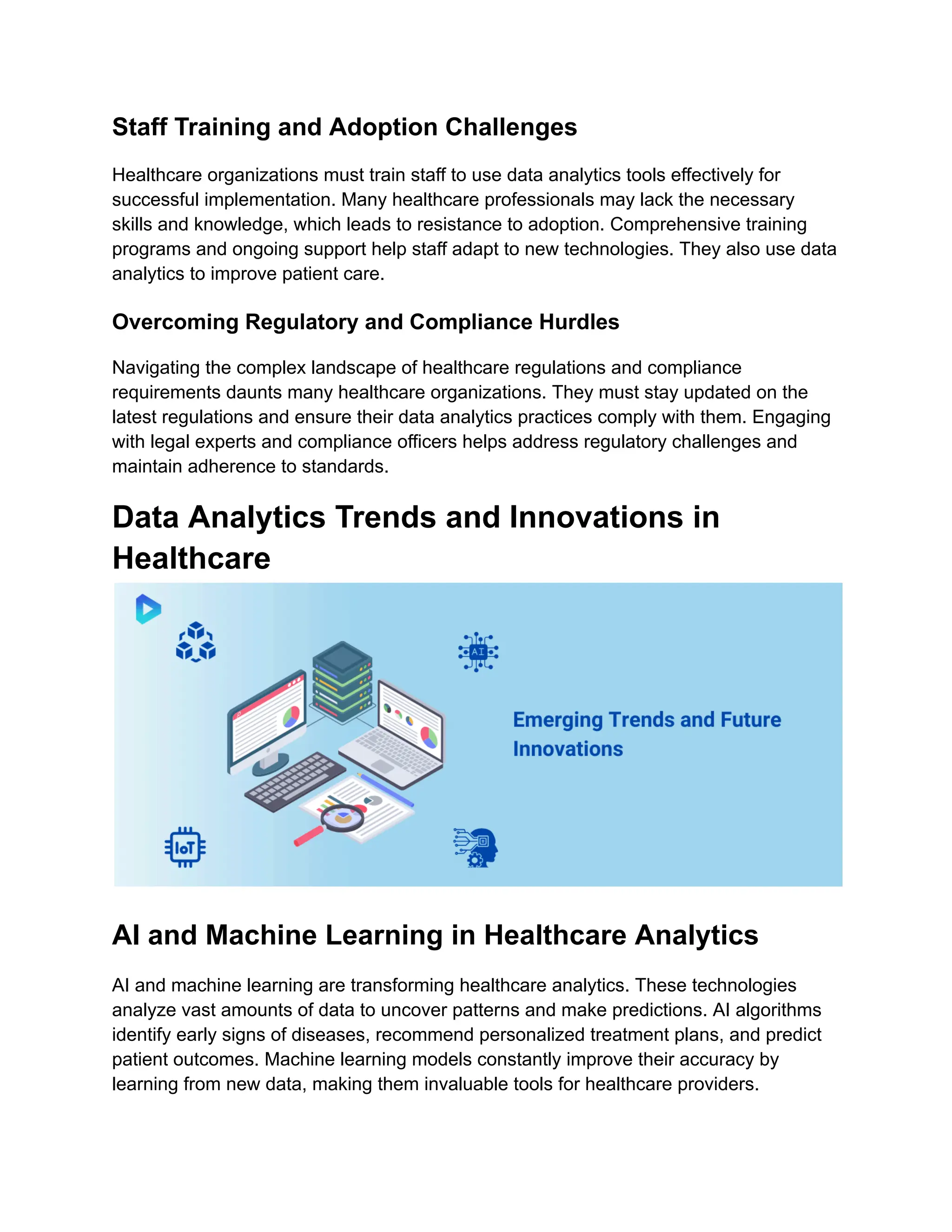
Data Analytics Trends and Innovations in
Healthcare
AI and Machine Learning in Healthcare Analytics
AI and machine learning are transforming healthcare analytics. These technologies
analyze vast amounts of data to uncover patterns and make predictions. AI algorithms
identify early signs of diseases, recommend personalized treatment plans, and predict
patient outcomes. Machine learning models constantly improve their accuracy by
learning from new data, making them invaluable tools for healthcare providers.
IoT Applications for Real-time Patient Monitoring
The Internet of Things (IoT) has transformed patient monitoring. Wearable devices and
smart sensors collect real-time health data so healthcare providers can monitor patients
remotely. IoT applications track vital signs, detect anomalies, and send alerts for
immediate medical attention. This continuous monitoring enhances patient care,
especially for chronic disease management and post-operative recovery.
Blockchain Technology in Health Data Management
Blockchain technology ensures the security and integrity of health data. It creates
decentralized, immutable records that are accessible only to authorized users.
Blockchain prevents data breaches and ensures data accuracy. With blockchain,
healthcare organizations can securely share patient information, improving collaboration
and trust among providers.
Predictive Analytics for Population Health Management
Predictive analytics helps manage population health by identifying at-risk groups and
predicting health trends. Healthcare providers analyze large datasets to forecast
disease outbreaks, track health behaviors, and allocate resources efficiently. Predictive
analytics supports proactive interventions, ultimately improving public health outcomes
and reducing healthcare costs.
Future Prospects and Expansion of Data
Analytics in Healthcare
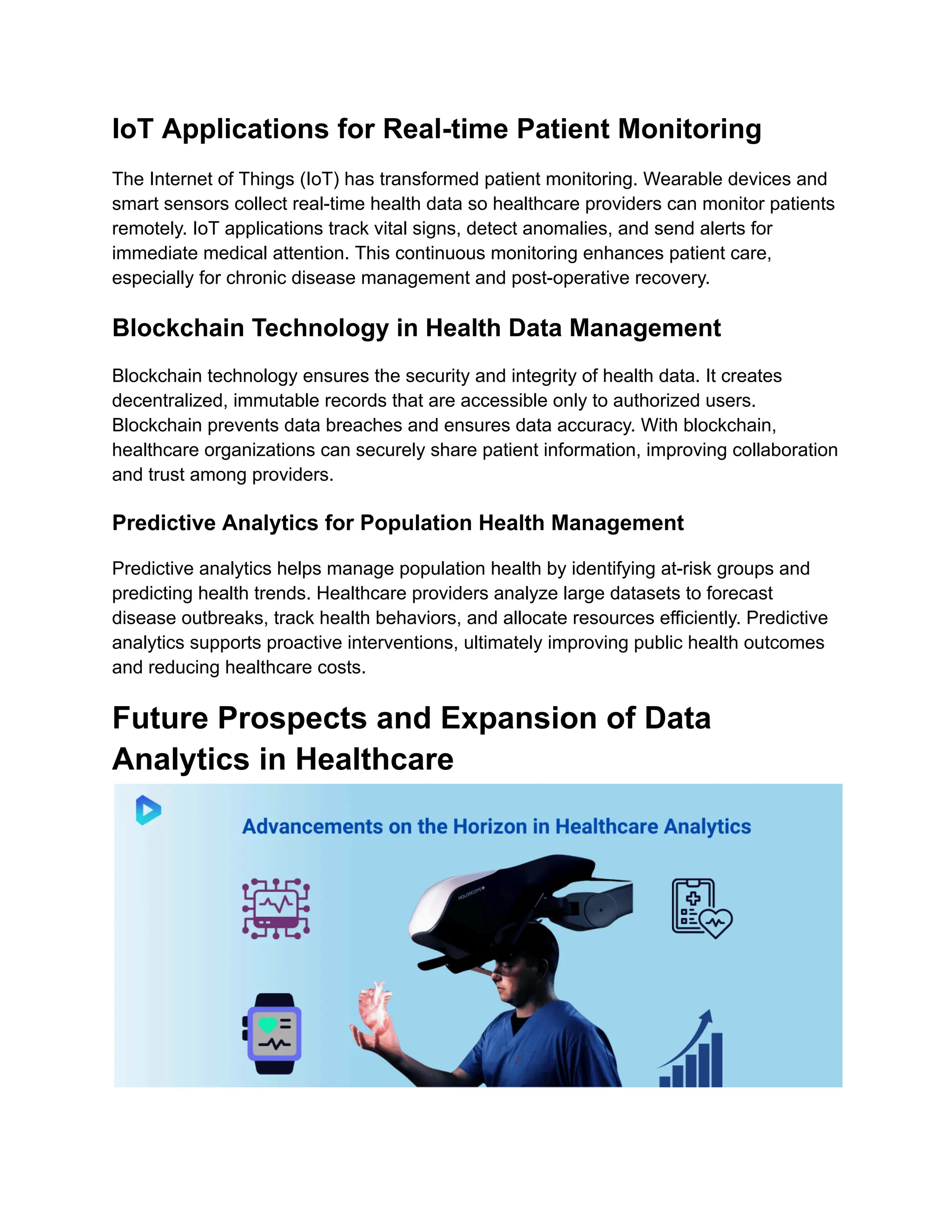
Advancements on the Horizon in Healthcare Analytics
The future of healthcare analytics promises remarkable advancements, driven by rapid
technological innovations. Key areas of development include:
● Artificial Intelligence (AI): Enhanced algorithms will diagnose diseases, predict
patient outcomes, and personalize treatment plans.
● Internet of Things (IoT): The Internet of Things (IoT) includes advanced health
monitoring devices. These devices provide real-time data, improving patient
monitoring and chronic disease management.
● Blockchain Technology: This technology will secure health data management,
ensure data integrity, and facilitate seamless data sharing among healthcare
providers.
These advancements will transform healthcare services, promoting efficiency and
improving patient outcomes.
Future Role of Big Data and Analytics in Precision Medicine
The Internet of Things (IoT) includes advanced health monitoring devices. These
devices provide real-time data, improving patient monitoring and chronic disease
management. Future prospects include:
● Genomic Data Integration: Healthcare providers will use comprehensive
genomic data to develop personalized treatment plans.
● Predictive Analytics: Predictive analytics helps providers use large amounts of
patient data. They can predict disease outbreaks and individual health risks,
allowing for proactive care.
● Machine Learning Models: These models will enhance the accuracy of
predictions to better understand disease progression and treatment responses.
These technologies will help healthcare providers offer more effective and personalized
care, reducing costs and improving patient satisfaction.
Potential Impact of Data Analytics on Global Health
Data analytics holds the potential to transform global health by addressing major
healthcare challenges and improving access to care. Key impacts include:
● Disease Surveillance: Early detection and tracking of disease outbreaks will
enable timely interventions.
● Resource Allocation: Optimizing the distribution of healthcare resources to
underserved areas.
● Health Policy Development: Data-driven policies will address global health
disparities and improve public health outcomes.
By harnessing the power of data, global health initiatives can become more effective
and equitable.
The Ongoing Evolution of Healthcare Delivery Through Analytics
Healthcare delivery continues to evolve with the integration of data analytics, leading to
more efficient and effective care. Notable trends include:
● Remote Healthcare: Expanding access to care through virtual consultations and
remote patient monitoring.
● Workflow Optimization: Streamlining administrative processes and improving
healthcare staff scheduling.
● Patient Care Optimization: Utilizing data to enhance patient care pathways,
reduce readmissions, and improve overall patient experiences.
Data analytics will be crucial in shaping the future of healthcare. It drives innovations
that benefit providers, patients, and the overall healthcare system.
FAQs
VIII. Frequently Asked Questions (FAQs) about Data Analytics in
Healthcare
FAQ1: What role does AI play in healthcare analytics?
AI enhances healthcare analytics by improving diagnostic accuracy,
predicting patient outcomes, and personalizing treatment plans. AI
analyzes medical images and patient data to detect diseases early. It
predicts health risks for proactive care and tailors treatments based on
individual data, improving overall healthcare delivery.
FAQ2: How does data analytics ensure patient data security and
privacy?
Data analytics ensures patient data security and privacy through
encryption, access control, and blockchain technology. Encryption protects
data during transmission and storage. Access control restricts data access
to authorized personnel. Blockchain provides a secure and transparent
method to manage health data, maintaining data integrity and privacy.
FAQ3: What challenges does healthcare face in implementing data
analytics?
Healthcare faces challenges in implementing data analytics, such as
combining data from different sources and ensuring data quality. They also
need to protect patient privacy while following regulations and dealing with
limited budgets and skilled personnel. Addressing these challenges is
crucial for the effective adoption of data analytics in healthcare.
FAQ4: Which areas of healthcare benefit most from predictive
analytics?
Predictive analytics benefit areas such as disease prevention, chronic
disease management, and reducing patient readmissions. Predictive
analytics identifies risk factors for disease outbreaks and monitors
long-term conditions like diabetes. It also predicts readmission rates to
implement targeted interventions, improve patient outcomes, and optimize
healthcare resources.
FAQ5: How can data analytics improve the efficiency of healthcare
operations?
Data analytics improves healthcare operations by optimizing workflows,
resource allocation, and patient care. It streamlines administrative
processes, enhances staff scheduling, ensures optimal use of medical
equipment and personnel, and reduces wait times. This leads to improved
patient flow and overall patient experience, making healthcare operations
more efficient.

Role Of Data Analytics In Revolutionizing Healthcare

  • 1.
    The Role ofData Analytics in Revolutionizing Healthcare Data analytics is transforming healthcare by providing deeper insights into patient care, working efficiencies, and medical research. By leveraging vast amounts of health data, organizations can make informed decisions that enhance patient outcomes and streamline processes. Key Applications of Data Analytics • AI in Healthcare: AI algorithms help in diagnosing diseases, predicting patient outcomes, and personalizing treatment plans. • Predictive Analytics in Medicine: Predictive models can foresee disease outbreaks, patient admissions, and treatment responses. • IoT in Health Monitoring: Wearable devices and IoT sensors track patient vitals in real-time, enabling continuous health monitoring. Benefits of Data-Driven Healthcare Solutions • Precision Medicine and Data Analytics: Tailored treatment plans based on individual genetic profiles and health data. • Patient Care Optimization: Data-driven strategies improve patient care, reduce hospital readmissions, and enhance overall patient satisfaction.
  • 2.
    • Blockchain inHealth Data Management: Ensures secure, transparent, and immutable health data records, fostering trust and data integrity. Introduction to Data Analytics in Healthcare : Understanding Data Analytics in Healthcare Healthcare professionals use data analytics to systematically derive insights, identify patterns, and make informed decisions. They use advanced technologies like artificial intelligence (AI) and machine learning. These tools analyze large amounts of data from sources like electronic health records (EHRs), medical devices, and patient feedback. Importance of Data Analytics in Healthcare Transformation Data analytics transforms healthcare by improving patient outcomes, enhancing working efficiencies, and enabling personalized medicine. With predictive analytics, healthcare providers can anticipate patient needs, optimize resource allocation, and reduce costs. Evolution of Data Analytics in the Healthcare Industry Over the past decade, data analytics evolved from basic data collection and reporting to sophisticated predictive and prescriptive analytics. Advancements in AI, big data, and
  • 3.
    the Internet ofThings (IoT) have driven this evolution. These technologies expand the scope and impact of data-driven healthcare solutions. Key Objectives of Implementing Data Analytics in Healthcare ● Improving Patient Care: Data analytics helps monitor patient health, predict diseases, and personalize treatment plans. ● Enhancing working Efficiency: It enables healthcare organizations to streamline processes, manage resources effectively, and reduce working costs. ● Advancing Medical Research: By analyzing large datasets, researchers uncover new insights, develop innovative treatments, and improve clinical trials. ● Ensuring Data Security: Technologies like blockchain secure health data and maintain its integrity, fostering trust among patients and providers. Types and Applications of Data Analytics in Healthcare Overview of Data Analytics Types in Healthcare Healthcare encompasses various types of data analytics, each serving a unique purpose. By understanding these types, healthcare professionals can leverage their full potential to improve delivery and outcomes
  • 4.
    Descriptive, Predictive, andPrescriptive Analytics in Healthcare, Prescriptive Analytics in Healthcare 1. Descriptive Analytics: Descriptive analytics summarizes historical data to understand past events. It helps identify trends and patterns from patient records, clinical data, and other healthcare information. 2. Predictive Analytics: Predictive analytics uses statistical models and machine learning techniques to forecast future events. In healthcare, it predicts disease outbreaks, patient admissions, and individual patient outcomes, aiding proactive healthcare management. 3. Prescriptive Analytics: Prescriptive analytics predicts future outcomes and suggests actions to achieve desired results. It recommends treatment plans, resource allocation, and working improvements, ensuring optimal healthcare delivery. Applications in Disease Prediction and Prevention Data analytics plays a pivotal role in disease prediction and prevention. By analyzing patient data and identifying risk factors, healthcare providers can anticipate potential health issues and intervene early to prevent disease progression. Clinical Decision Support Systems Clinical Decision Support Systems (CDSS) leverage data analytics to assist healthcare professionals in making informed decisions. These systems analyze clinical data and provide evidence-based recommendations, enhancing the accuracy and efficiency of diagnoses and treatment plans. Patient Care Optimization through Predictive Modeling Predictive modeling optimizes patient care by forecasting individual health trajectories and tailoring interventions accordingly. This approach improves patient outcomes, reduces hospital readmissions, and enhances overall healthcare quality.
  • 5.
    Benefits of DataAnalytics in Healthcare Improving Patient Outcomes and Care Quality Data analytics significantly improves patient outcomes and care quality. By analyzing patient data, healthcare providers can identify trends and predict health issues before they become critical. This proactive approach enables timely interventions and personalizes treatment plans, which enhances overall patient care. Enhanced Operational Efficiency in Healthcare Healthcare organizations use data analytics to streamline operations and improve efficiency. Analytics tools assist in scheduling staff, managing patient flow, and optimizing resource use. When healthcare providers identify wastefulness and bottlenecks, they can implement effective solutions to improve working performance. Cost Reduction and Resource Optimization Data analytics contributes to cost reduction and resource optimization in healthcare. Data analytics contributes to cost reduction and resource optimization in healthcare. Healthcare organizations can analyze financial data and resource use patterns to identify areas of overspending and underuse. This analysis enables better budget management and efficient allocation of resources, ultimately reducing costs.
  • 6.
    Personalized Medicine andPatient Engagement Personalized medicine relies heavily on data analytics to tailor treatments to individual patients. Healthcare providers can consider genetic information, lifestyle factors, and medical history to create customized treatment plans that improve outcomes and patient satisfaction. Additionally, data analytics enhances patient engagement by offering insights into patient behavior and preferences, enabling more effective communication and support. Challenges and Adoption of Data Analytics in Healthcare Addressing Data Privacy and Security Concerns Healthcare data analytics faces major concerns related to data privacy and security. It is critical to protect sensitive patient information from breaches and ensure compliance with regulations like HIPAA. Healthcare organizations must implement robust cybersecurity measures and encryption protocols to safeguard data. Integration of Legacy Systems and Interoperability Integrating legacy systems with modern data analytics tools presents a significant challenge. Many healthcare organizations still use outdated software that does not work together with newer technologies. To overcome this, healthcare providers need to invest in integration solutions and develop standards for data exchange.
  • 7.
    Staff Training andAdoption Challenges Healthcare organizations must train staff to use data analytics tools effectively for successful implementation. Many healthcare professionals may lack the necessary skills and knowledge, which leads to resistance to adoption. Comprehensive training programs and ongoing support help staff adapt to new technologies. They also use data analytics to improve patient care. Overcoming Regulatory and Compliance Hurdles Navigating the complex landscape of healthcare regulations and compliance requirements daunts many healthcare organizations. They must stay updated on the latest regulations and ensure their data analytics practices comply with them. Engaging with legal experts and compliance officers helps address regulatory challenges and maintain adherence to standards. Data Analytics Trends and Innovations in Healthcare AI and Machine Learning in Healthcare Analytics AI and machine learning are transforming healthcare analytics. These technologies analyze vast amounts of data to uncover patterns and make predictions. AI algorithms identify early signs of diseases, recommend personalized treatment plans, and predict patient outcomes. Machine learning models constantly improve their accuracy by learning from new data, making them invaluable tools for healthcare providers.
  • 8.
    IoT Applications forReal-time Patient Monitoring The Internet of Things (IoT) has transformed patient monitoring. Wearable devices and smart sensors collect real-time health data so healthcare providers can monitor patients remotely. IoT applications track vital signs, detect anomalies, and send alerts for immediate medical attention. This continuous monitoring enhances patient care, especially for chronic disease management and post-operative recovery. Blockchain Technology in Health Data Management Blockchain technology ensures the security and integrity of health data. It creates decentralized, immutable records that are accessible only to authorized users. Blockchain prevents data breaches and ensures data accuracy. With blockchain, healthcare organizations can securely share patient information, improving collaboration and trust among providers. Predictive Analytics for Population Health Management Predictive analytics helps manage population health by identifying at-risk groups and predicting health trends. Healthcare providers analyze large datasets to forecast disease outbreaks, track health behaviors, and allocate resources efficiently. Predictive analytics supports proactive interventions, ultimately improving public health outcomes and reducing healthcare costs. Future Prospects and Expansion of Data Analytics in Healthcare
  • 9.
    Advancements on theHorizon in Healthcare Analytics The future of healthcare analytics promises remarkable advancements, driven by rapid technological innovations. Key areas of development include: ● Artificial Intelligence (AI): Enhanced algorithms will diagnose diseases, predict patient outcomes, and personalize treatment plans. ● Internet of Things (IoT): The Internet of Things (IoT) includes advanced health monitoring devices. These devices provide real-time data, improving patient monitoring and chronic disease management. ● Blockchain Technology: This technology will secure health data management, ensure data integrity, and facilitate seamless data sharing among healthcare providers. These advancements will transform healthcare services, promoting efficiency and improving patient outcomes. Future Role of Big Data and Analytics in Precision Medicine The Internet of Things (IoT) includes advanced health monitoring devices. These devices provide real-time data, improving patient monitoring and chronic disease management. Future prospects include: ● Genomic Data Integration: Healthcare providers will use comprehensive genomic data to develop personalized treatment plans. ● Predictive Analytics: Predictive analytics helps providers use large amounts of patient data. They can predict disease outbreaks and individual health risks, allowing for proactive care. ● Machine Learning Models: These models will enhance the accuracy of predictions to better understand disease progression and treatment responses. These technologies will help healthcare providers offer more effective and personalized care, reducing costs and improving patient satisfaction. Potential Impact of Data Analytics on Global Health Data analytics holds the potential to transform global health by addressing major healthcare challenges and improving access to care. Key impacts include: ● Disease Surveillance: Early detection and tracking of disease outbreaks will enable timely interventions.
  • 10.
    ● Resource Allocation:Optimizing the distribution of healthcare resources to underserved areas. ● Health Policy Development: Data-driven policies will address global health disparities and improve public health outcomes. By harnessing the power of data, global health initiatives can become more effective and equitable. The Ongoing Evolution of Healthcare Delivery Through Analytics Healthcare delivery continues to evolve with the integration of data analytics, leading to more efficient and effective care. Notable trends include: ● Remote Healthcare: Expanding access to care through virtual consultations and remote patient monitoring. ● Workflow Optimization: Streamlining administrative processes and improving healthcare staff scheduling. ● Patient Care Optimization: Utilizing data to enhance patient care pathways, reduce readmissions, and improve overall patient experiences. Data analytics will be crucial in shaping the future of healthcare. It drives innovations that benefit providers, patients, and the overall healthcare system. FAQs VIII. Frequently Asked Questions (FAQs) about Data Analytics in Healthcare FAQ1: What role does AI play in healthcare analytics? AI enhances healthcare analytics by improving diagnostic accuracy, predicting patient outcomes, and personalizing treatment plans. AI analyzes medical images and patient data to detect diseases early. It predicts health risks for proactive care and tailors treatments based on individual data, improving overall healthcare delivery.
  • 11.
    FAQ2: How doesdata analytics ensure patient data security and privacy? Data analytics ensures patient data security and privacy through encryption, access control, and blockchain technology. Encryption protects data during transmission and storage. Access control restricts data access to authorized personnel. Blockchain provides a secure and transparent method to manage health data, maintaining data integrity and privacy. FAQ3: What challenges does healthcare face in implementing data analytics? Healthcare faces challenges in implementing data analytics, such as combining data from different sources and ensuring data quality. They also need to protect patient privacy while following regulations and dealing with limited budgets and skilled personnel. Addressing these challenges is crucial for the effective adoption of data analytics in healthcare. FAQ4: Which areas of healthcare benefit most from predictive analytics? Predictive analytics benefit areas such as disease prevention, chronic disease management, and reducing patient readmissions. Predictive analytics identifies risk factors for disease outbreaks and monitors long-term conditions like diabetes. It also predicts readmission rates to implement targeted interventions, improve patient outcomes, and optimize healthcare resources. FAQ5: How can data analytics improve the efficiency of healthcare operations?
  • 12.
    Data analytics improveshealthcare operations by optimizing workflows, resource allocation, and patient care. It streamlines administrative processes, enhances staff scheduling, ensures optimal use of medical equipment and personnel, and reduces wait times. This leads to improved patient flow and overall patient experience, making healthcare operations more efficient.