1
Fundamental of Nursing
Health & illness
Dr; mosa alfageh
Learning Objectives
 Define health, wellness, illness and disease
 Differentiate illness from disease and acute illness from chronic illness.
 Explain the five stages of illness.
 Explain the basic human needs
 Identify factors affecting health and illness
 List at least 3 Risk Factors for Illness or Injury
 List at least 3 General health maintenance activities
3
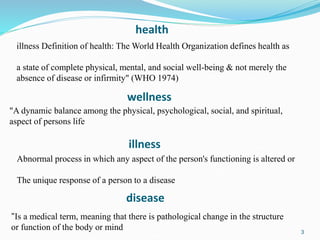
health
illness Definition of health: The World Health Organization defines health as
a state of complete physical, mental, and social well-being & not merely the
absence of disease or infirmity" (WHO 1974)
wellness
"A dynamic balance among the physical, psychological, social, and spiritual,
aspect of persons life
Abnormal process in which any aspect of the person's functioning is altered or
The unique response of a person to a disease
"Is a medical term, meaning that there is pathological change in the structure
or function of the body or mind
illness
disease
4
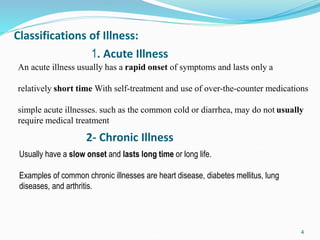
1. Acute Illness
An acute illness usually has a rapid onset of symptoms and lasts only a
relatively short time With self-treatment and use of over-the-counter medications
simple acute illnesses. such as the common cold or diarrhea, may do not usually
require medical treatment
2- Chronic Illness
Usually have a slow onset and lasts long time or long life.
Examples of common chronic illnesses are heart disease, diabetes mellitus, lung
diseases, and arthritis.
Classifications of Illness:
5
Causes of disease
1- Inherited genetic defects.
2. Developmental defect resulting from exposure to such factors as virus or
chemicals during pregnancy
3- Biological agent or toxin
4- Physical agent such as temperature, chemicals, and radiation.
5. Generalized tissue response to injury or irritation.
6 Physiologic and emotional reaction to stress
7. Excessive or insufficient production of body secretions (hormones, &
enzymes).
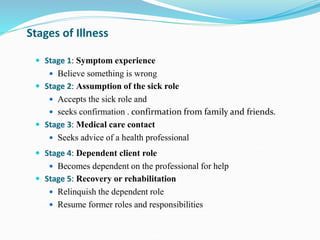
Stages of Illness
 Stage 1: Symptom experience
 Believe something is wrong
 Stage 2: Assumption of the sick role
 Accepts the sick role and
 seeks confirmation . confirmation from family and friends.
 Stage 3: Medical care contact
 Seeks advice of a health professional
 Stage 4: Dependent client role
 Becomes dependent on the professional for help
 Stage 5: Recovery or rehabilitation
 Relinquish the dependent role
 Resume former roles and responsibilities
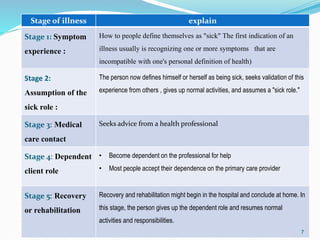
explain
Stage of illness
How to people define themselves as "sick" The first indication of an
illness usually is recognizing one or more symptoms that are
incompatible with one's personal definition of health)
Stage 1: Symptom
experience :
The person now defines himself or herself as being sick, seeks validation of this
experience from others , gives up normal activities, and assumes a "sick role."
Stage 2:
Assumption of the
sick role :
Seeks advice from a health professional
Stage 3: Medical
care contact
• Become dependent on the professional for help
• Most people accept their dependence on the primary care provider
Stage 4: Dependent
client role
Recovery and rehabilitation might begin in the hospital and conclude at home. In
this stage, the person gives up the dependent role and resumes normal
activities and responsibilities.
Stage 5: Recovery
or rehabilitation
7
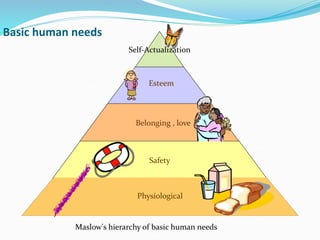
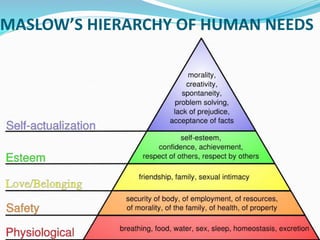
Esteem
Self-Actualization
Safety
Belonging , love
Physiological
Maslow's hierarchy of basic human needs
Basic human needs
MASLOW’S HIERARCHY OF HUMAN NEEDS
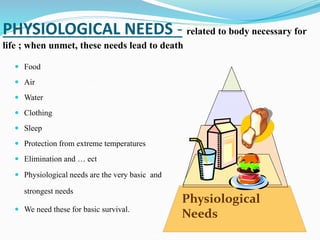
PHYSIOLOGICAL NEEDS - related to body necessary for
life ; when unmet, these needs lead to death
 Food
 Air
 Water
 Clothing
 Sleep
 Protection from extreme temperatures
 Elimination and … ect
Physiological
Needs
 Physiological needs are the very basic and
strongest needs
 We need these for basic survival.
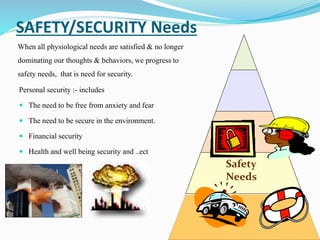
SAFETY/SECURITY Needs
Personal security :- includes
 The need to be free from anxiety and fear
 The need to be secure in the environment.
 Financial security
 Health and well being security and ..ect
Safety
Needs
When all physiological needs are satisfied & no longer
dominating our thoughts & behaviors, we progress to
safety needs, that is need for security.
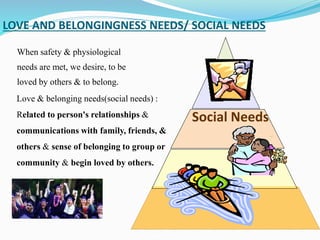
LOVE AND BELONGINGNESS NEEDS/ SOCIAL NEEDS
Social Needs
When safety & physiological
needs are met, we desire, to be
loved by others & to belong.
Love & belonging needs(social needs) :
Related to person's relationships &
communications with family, friends, &
others & sense of belonging to group or
community & begin loved by others.
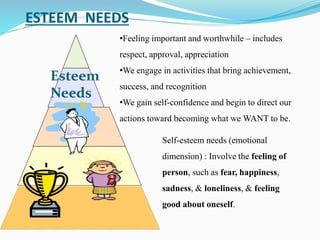
ESTEEM NEEDS
Esteem
Needs
•Feeling important and worthwhile – includes
respect, approval, appreciation
•We engage in activities that bring achievement,
success, and recognition
•We gain self-confidence and begin to direct our
actions toward becoming what we WANT to be.
Self-esteem needs (emotional
dimension) : Involve the feeling of
person, such as fear, happiness,
sadness, & loneliness, & feeling
good about oneself.
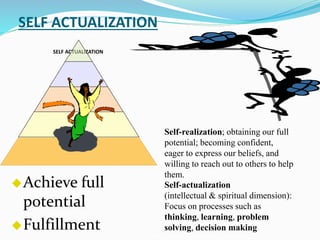
SELF ACTUALIZATION
Achieve full
potential
Fulfillment
Self-realization; obtaining our full
potential; becoming confident,
eager to express our beliefs, and
willing to reach out to others to help
them.
SELF ACTUALIZATION
Self-actualization
(intellectual & spiritual dimension):
Focus on processes such as
thinking, learning, problem
solving, decision making
15
1.Basic human needs
 A basic human need is something that is essential to the emotional and
physiologic health and survival of the humans .
 A person whose needs are met may be considered to be healthy,
and a person who has one or more unmet needs is at an increased risk for illness
2.Human dimension
Factors affecting health & illness
Many factors influence a person's health status, health beliefs, and health practices.
These factor may be internal or external to the individual and may or may not be
under the person's conscious control. To plan and provide holistic care, the nurse must
understand how these factors influence behavior in both healthy and ill patients.
16
1. Physical dimension
2. Emotional dimension
3. Intellectual dimension
4. Environmental dimension
5. Sociocultural dimension
6. Spiritual dimension
2.Human dimension
Factors affecting health & illness continue:
Genetic makeup, age developmental level, race, & gender, all strongly
influence the person's health sate & health practices
examples of the physical dimension Any young woman who has a family
history of breast cancer and diabetes, therefore is at higher risk for these
conditions.
17
1.Physical dimension
2.Human dimension
Long term stress effects body system & anxiety affects health habits:
conversely calm acceptance and relaxation can actually change body response
to illness.
Some examples of the Emotional dimension are Before test most of students
has diarrhea.. Using relaxation techniques, a young woman reduces her pain
after surgery
18
2.Human dimension
2. Emotional dimension
The Intellectual dimension encompasses cognitive abilities, educational
background, and past experiences. Example of Intellectual dimension A
young college student with diabetes who follows a diabetic diet but continuous
to eat pizza with friends several weeks
19
3. Intellectual dimension
2.Human dimension
The environmental Dimension may influences on health and illness. Housing,
sanitation, climate. and pollution of air, food, d water are elements in the
environmental Dimension Examples of environmental causes of illness:
Increase incidence of skin cancer in people who live in hot, sunny area of the
world, Food poisoning.
4. Environmental Dimension
Health practice and beliefs are strongly influenced by a person's economic
level, life style, family, and culture. Examples of Sociocultural factors that
influence health and illness An adolescence who sees nothing wrong with
smoking or Qat chawing because his parents smoke & Qat chawing.
20
5.Sociocultural Dimension
2.Human dimension
6. Spiritual Dimension
Spiritual beliefs and value are important components of a person's health and
illness behaviors. The nurse respects these values . Holy Quran is the spirit
nutrition
Risk Factors for Illness or Injury: A risk factor is something that
increases a person's chances for illness or injury.
1. age: School-age children are at high risk for communicable disease. .
After menopause, women are more likely to develop cardiovascular
disease .
2. Genetic: Family history of cancer or diabetes predisposes a person to
developing the disease.
3. Physiologic: Obesity increases the possibility of heart disease.
Pregnancy places increased risk on both the mother & the developing
4. Health habits: Smoking increases the probability of lung cancer.
Poor nutrition can lead to Variety of health problem.
5. Lifestyle: Laziness people or immobility leads to obesity.
6. Environment: Working & living environments (such as hazardous
material & poor sanitation) may lead to contribute disease
21
General health maintenance activities:
Health maintains include a variety of activities:
1. Sleeping regularly (7-8 hours/night).
2. Eating breakfast.
3. Eating mails, which include essential recommended food items.
4. Maintaining ideal body weight and activities.
5. Avoid bad habitués such as smoking or Qat chewing.
6. Maintain positive mental health and self-concept.
22
THANK
YOU

health and illness.ppt

  • 1.
    1 Fundamental of Nursing Health& illness Dr; mosa alfageh
  • 2.
    Learning Objectives  Definehealth, wellness, illness and disease  Differentiate illness from disease and acute illness from chronic illness.  Explain the five stages of illness.  Explain the basic human needs  Identify factors affecting health and illness  List at least 3 Risk Factors for Illness or Injury  List at least 3 General health maintenance activities
  • 3.
    3 health illness Definition ofhealth: The World Health Organization defines health as a state of complete physical, mental, and social well-being & not merely the absence of disease or infirmity" (WHO 1974) wellness "A dynamic balance among the physical, psychological, social, and spiritual, aspect of persons life Abnormal process in which any aspect of the person's functioning is altered or The unique response of a person to a disease "Is a medical term, meaning that there is pathological change in the structure or function of the body or mind illness disease
  • 4.
    4 1. Acute Illness Anacute illness usually has a rapid onset of symptoms and lasts only a relatively short time With self-treatment and use of over-the-counter medications simple acute illnesses. such as the common cold or diarrhea, may do not usually require medical treatment 2- Chronic Illness Usually have a slow onset and lasts long time or long life. Examples of common chronic illnesses are heart disease, diabetes mellitus, lung diseases, and arthritis. Classifications of Illness:
  • 5.
    5 Causes of disease 1-Inherited genetic defects. 2. Developmental defect resulting from exposure to such factors as virus or chemicals during pregnancy 3- Biological agent or toxin 4- Physical agent such as temperature, chemicals, and radiation. 5. Generalized tissue response to injury or irritation. 6 Physiologic and emotional reaction to stress 7. Excessive or insufficient production of body secretions (hormones, & enzymes).
  • 6.
    Stages of Illness Stage 1: Symptom experience  Believe something is wrong  Stage 2: Assumption of the sick role  Accepts the sick role and  seeks confirmation . confirmation from family and friends.  Stage 3: Medical care contact  Seeks advice of a health professional  Stage 4: Dependent client role  Becomes dependent on the professional for help  Stage 5: Recovery or rehabilitation  Relinquish the dependent role  Resume former roles and responsibilities
  • 7.
    explain Stage of illness Howto people define themselves as "sick" The first indication of an illness usually is recognizing one or more symptoms that are incompatible with one's personal definition of health) Stage 1: Symptom experience : The person now defines himself or herself as being sick, seeks validation of this experience from others , gives up normal activities, and assumes a "sick role." Stage 2: Assumption of the sick role : Seeks advice from a health professional Stage 3: Medical care contact • Become dependent on the professional for help • Most people accept their dependence on the primary care provider Stage 4: Dependent client role Recovery and rehabilitation might begin in the hospital and conclude at home. In this stage, the person gives up the dependent role and resumes normal activities and responsibilities. Stage 5: Recovery or rehabilitation 7
  • 8.
    Esteem Self-Actualization Safety Belonging , love Physiological Maslow'shierarchy of basic human needs Basic human needs
  • 9.
  • 10.
    PHYSIOLOGICAL NEEDS -related to body necessary for life ; when unmet, these needs lead to death  Food  Air  Water  Clothing  Sleep  Protection from extreme temperatures  Elimination and … ect Physiological Needs  Physiological needs are the very basic and strongest needs  We need these for basic survival.
  • 11.
    SAFETY/SECURITY Needs Personal security:- includes  The need to be free from anxiety and fear  The need to be secure in the environment.  Financial security  Health and well being security and ..ect Safety Needs When all physiological needs are satisfied & no longer dominating our thoughts & behaviors, we progress to safety needs, that is need for security.
  • 12.
    LOVE AND BELONGINGNESSNEEDS/ SOCIAL NEEDS Social Needs When safety & physiological needs are met, we desire, to be loved by others & to belong. Love & belonging needs(social needs) : Related to person's relationships & communications with family, friends, & others & sense of belonging to group or community & begin loved by others.
  • 13.
    ESTEEM NEEDS Esteem Needs •Feeling importantand worthwhile – includes respect, approval, appreciation •We engage in activities that bring achievement, success, and recognition •We gain self-confidence and begin to direct our actions toward becoming what we WANT to be. Self-esteem needs (emotional dimension) : Involve the feeling of person, such as fear, happiness, sadness, & loneliness, & feeling good about oneself.
  • 14.
    SELF ACTUALIZATION Achieve full potential Fulfillment Self-realization;obtaining our full potential; becoming confident, eager to express our beliefs, and willing to reach out to others to help them. SELF ACTUALIZATION Self-actualization (intellectual & spiritual dimension): Focus on processes such as thinking, learning, problem solving, decision making
  • 15.
    15 1.Basic human needs A basic human need is something that is essential to the emotional and physiologic health and survival of the humans .  A person whose needs are met may be considered to be healthy, and a person who has one or more unmet needs is at an increased risk for illness 2.Human dimension Factors affecting health & illness Many factors influence a person's health status, health beliefs, and health practices. These factor may be internal or external to the individual and may or may not be under the person's conscious control. To plan and provide holistic care, the nurse must understand how these factors influence behavior in both healthy and ill patients.
  • 16.
    16 1. Physical dimension 2.Emotional dimension 3. Intellectual dimension 4. Environmental dimension 5. Sociocultural dimension 6. Spiritual dimension 2.Human dimension Factors affecting health & illness continue:
  • 17.
    Genetic makeup, agedevelopmental level, race, & gender, all strongly influence the person's health sate & health practices examples of the physical dimension Any young woman who has a family history of breast cancer and diabetes, therefore is at higher risk for these conditions. 17 1.Physical dimension 2.Human dimension
  • 18.
    Long term stresseffects body system & anxiety affects health habits: conversely calm acceptance and relaxation can actually change body response to illness. Some examples of the Emotional dimension are Before test most of students has diarrhea.. Using relaxation techniques, a young woman reduces her pain after surgery 18 2.Human dimension 2. Emotional dimension
  • 19.
    The Intellectual dimensionencompasses cognitive abilities, educational background, and past experiences. Example of Intellectual dimension A young college student with diabetes who follows a diabetic diet but continuous to eat pizza with friends several weeks 19 3. Intellectual dimension 2.Human dimension The environmental Dimension may influences on health and illness. Housing, sanitation, climate. and pollution of air, food, d water are elements in the environmental Dimension Examples of environmental causes of illness: Increase incidence of skin cancer in people who live in hot, sunny area of the world, Food poisoning. 4. Environmental Dimension
  • 20.
    Health practice andbeliefs are strongly influenced by a person's economic level, life style, family, and culture. Examples of Sociocultural factors that influence health and illness An adolescence who sees nothing wrong with smoking or Qat chawing because his parents smoke & Qat chawing. 20 5.Sociocultural Dimension 2.Human dimension 6. Spiritual Dimension Spiritual beliefs and value are important components of a person's health and illness behaviors. The nurse respects these values . Holy Quran is the spirit nutrition
  • 21.
    Risk Factors forIllness or Injury: A risk factor is something that increases a person's chances for illness or injury. 1. age: School-age children are at high risk for communicable disease. . After menopause, women are more likely to develop cardiovascular disease . 2. Genetic: Family history of cancer or diabetes predisposes a person to developing the disease. 3. Physiologic: Obesity increases the possibility of heart disease. Pregnancy places increased risk on both the mother & the developing 4. Health habits: Smoking increases the probability of lung cancer. Poor nutrition can lead to Variety of health problem. 5. Lifestyle: Laziness people or immobility leads to obesity. 6. Environment: Working & living environments (such as hazardous material & poor sanitation) may lead to contribute disease 21
  • 22.
    General health maintenanceactivities: Health maintains include a variety of activities: 1. Sleeping regularly (7-8 hours/night). 2. Eating breakfast. 3. Eating mails, which include essential recommended food items. 4. Maintaining ideal body weight and activities. 5. Avoid bad habitués such as smoking or Qat chewing. 6. Maintain positive mental health and self-concept. 22
  • 23.