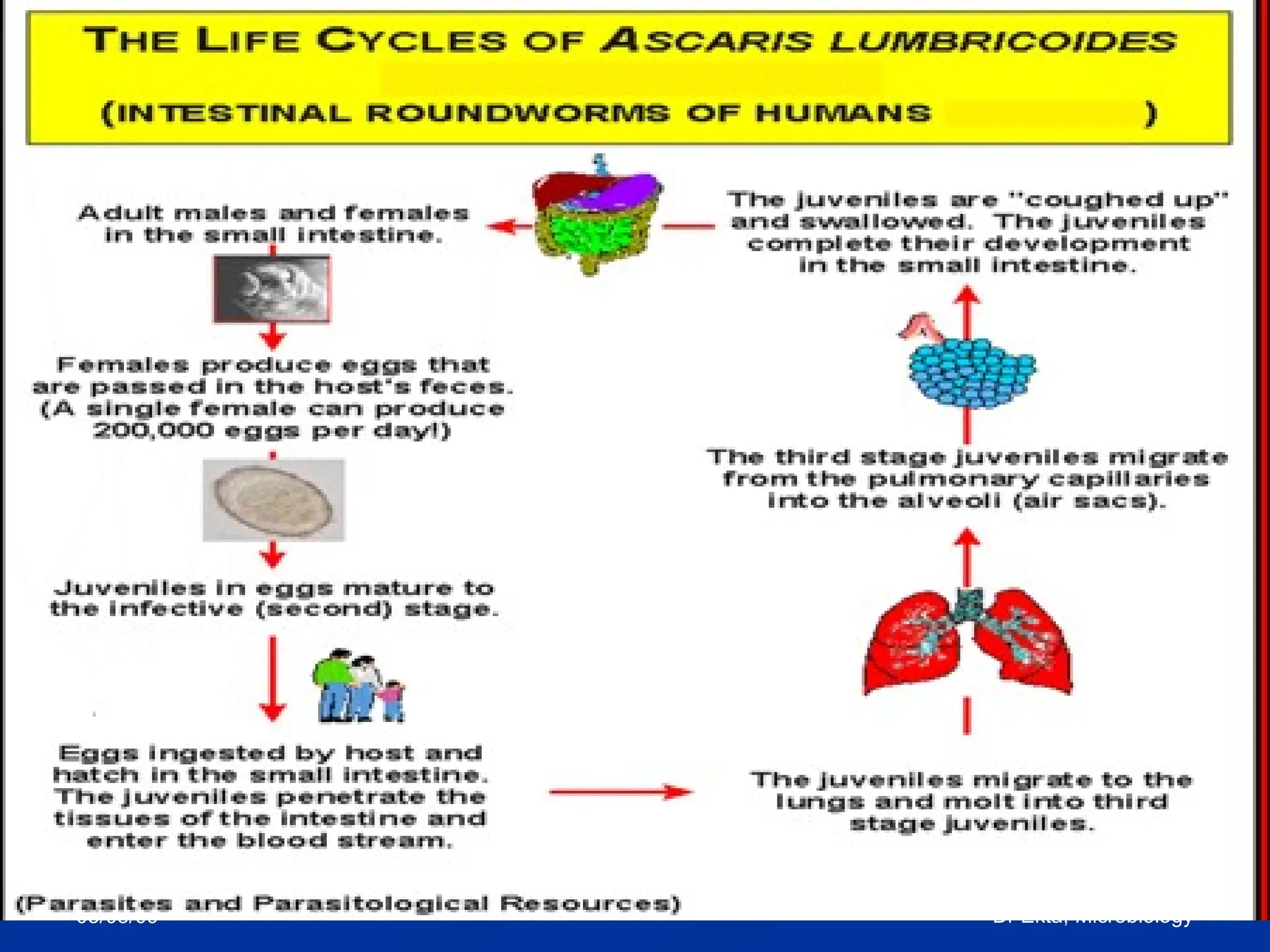
Development of Ascaris inside body of infected human
Venous circulation
Adult Ascaris in
small intestine
Migration stage
Intestinal stage
Rhabditiform
larva
Larva is swallowed Embryonated egg
is swallowed
2nd
moult
3rd
& 4th
moults
03/05/09 Dr Ekta, Microbiology
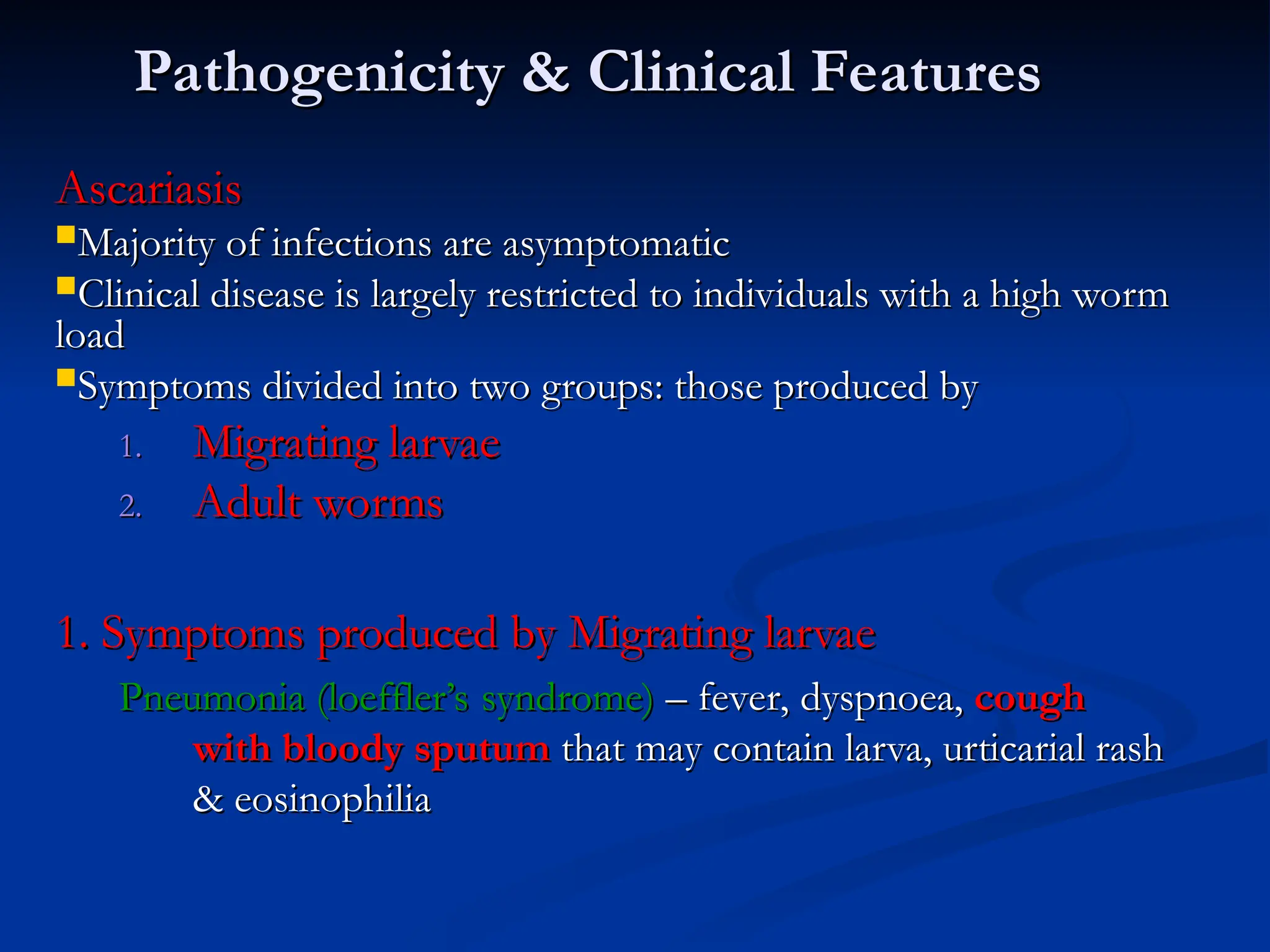
Pathogenicity & Clinical Features
Ascariasis
Ascariasis
Majority of infections are asymptomatic
Majority of infections are asymptomatic
Clinical disease is largely restricted to individuals with a high worm
Clinical disease is largely restricted to individuals with a high worm
load
load
Symptoms divided into two groups: those produced by
Symptoms divided into two groups: those produced by
1.
1. Migrating larvae
Migrating larvae
2.
2. Adult worms
Adult worms
1. Symptoms produced by Migrating larvae
Pneumonia (loeffler’s syndrome)
Pneumonia (loeffler’s syndrome) – fever, dyspnoea,
– fever, dyspnoea, cough
cough
with bloody sputum
with bloody sputum that may contain larva, urticarial rash
that may contain larva, urticarial rash
& eosinophilia
& eosinophilia
Symptoms & Complications
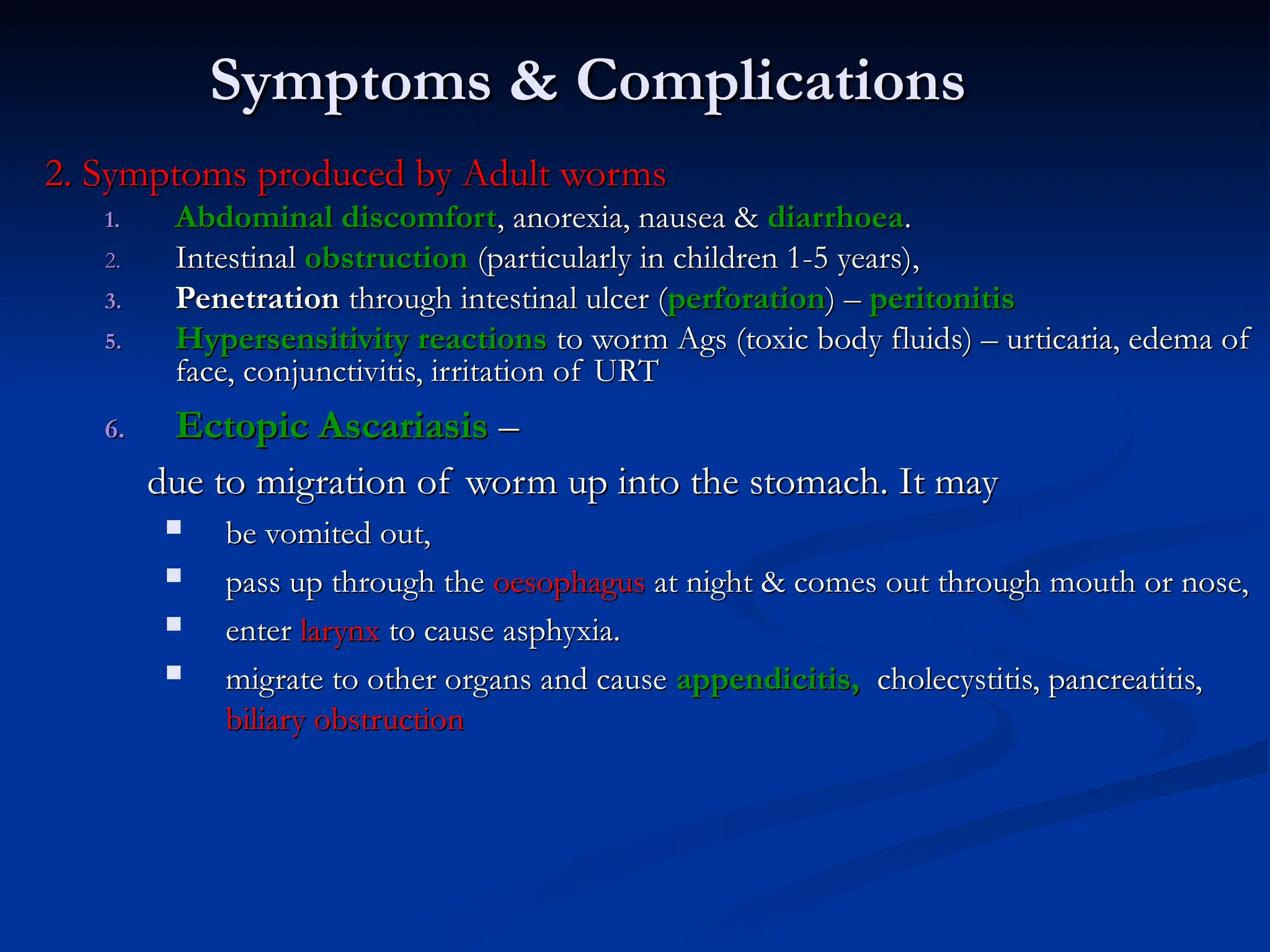
2. Symptoms produced by Adult worms
1.
1. Abdominal discomfort
Abdominal discomfort, anorexia, nausea &
, anorexia, nausea & diarrhoea
diarrhoea.
.
2.
2. Intestinal
Intestinal obstruction
obstruction (particularly in children 1-5 years),
(particularly in children 1-5 years),
3.
3. Penetration
Penetration through intestinal ulcer (
through intestinal ulcer (perforation
perforation) –
) – peritonitis
peritonitis
5.
5. Hypersensitivity reactions
Hypersensitivity reactions to worm Ags (toxic body fluids) – urticaria, edema of
to worm Ags (toxic body fluids) – urticaria, edema of
face, conjunctivitis, irritation of URT
6.
6. Ectopic Ascariasis
Ectopic Ascariasis –
–
due to migration of worm up into the stomach. It may
 be vomited out,
be vomited out,
 pass up through the
pass up through the oesophagus
oesophagus at night & comes out through mouth or nose,
at night & comes out through mouth or nose,
 enter
enter larynx
larynx to cause asphyxia.
to cause asphyxia.
 migrate to other organs and cause
migrate to other organs and cause appendicitis,
appendicitis, cholecystitis, pancreatitis,
cholecystitis, pancreatitis,
biliary obstruction
biliary obstruction
Laboratory Diagnosis
 Macroscopic
Macroscopic - Direct detection of
- Direct detection of
worm/s in stool or vomit
 Microscopic
Microscopic – direct examination of
– direct examination of
feces-
feces- bile stained eggs
bile stained eggs
 Blood examination
Blood examination –
– eosinophilia
eosinophilia.
.
Treatment and Prevention
Treatment
Treatment
 Mebendazole/ Albendazole
Mebendazole/ Albendazole
 Pyrantel pamoate
Pyrantel pamoate
Prevention
Prevention:
:
 Good sanitation and personal hygiene
Good sanitation and personal hygiene
 Mass treatments
Mass treatments with single dose
with single dose
mebendazole or albendazole for all
school-age children every three to four
months -
months -
Enterobius vermicularis
Enterobius vermicularis (Pin Worm)
(Pin Worm)
Adult worms Male 2 - 5 mm
Female 8 -13 mm, oviparous
Eggs 60 µ, non bile stained
flatted side with coiled
embryo
Infective form Embryonated egg
Mode of
transmission
Ingestion,
Autoinfection
Site of localization Large intestine –
caecum &
appendix
Life cycle –
Life cycle – E. vermicularis
E. vermicularis
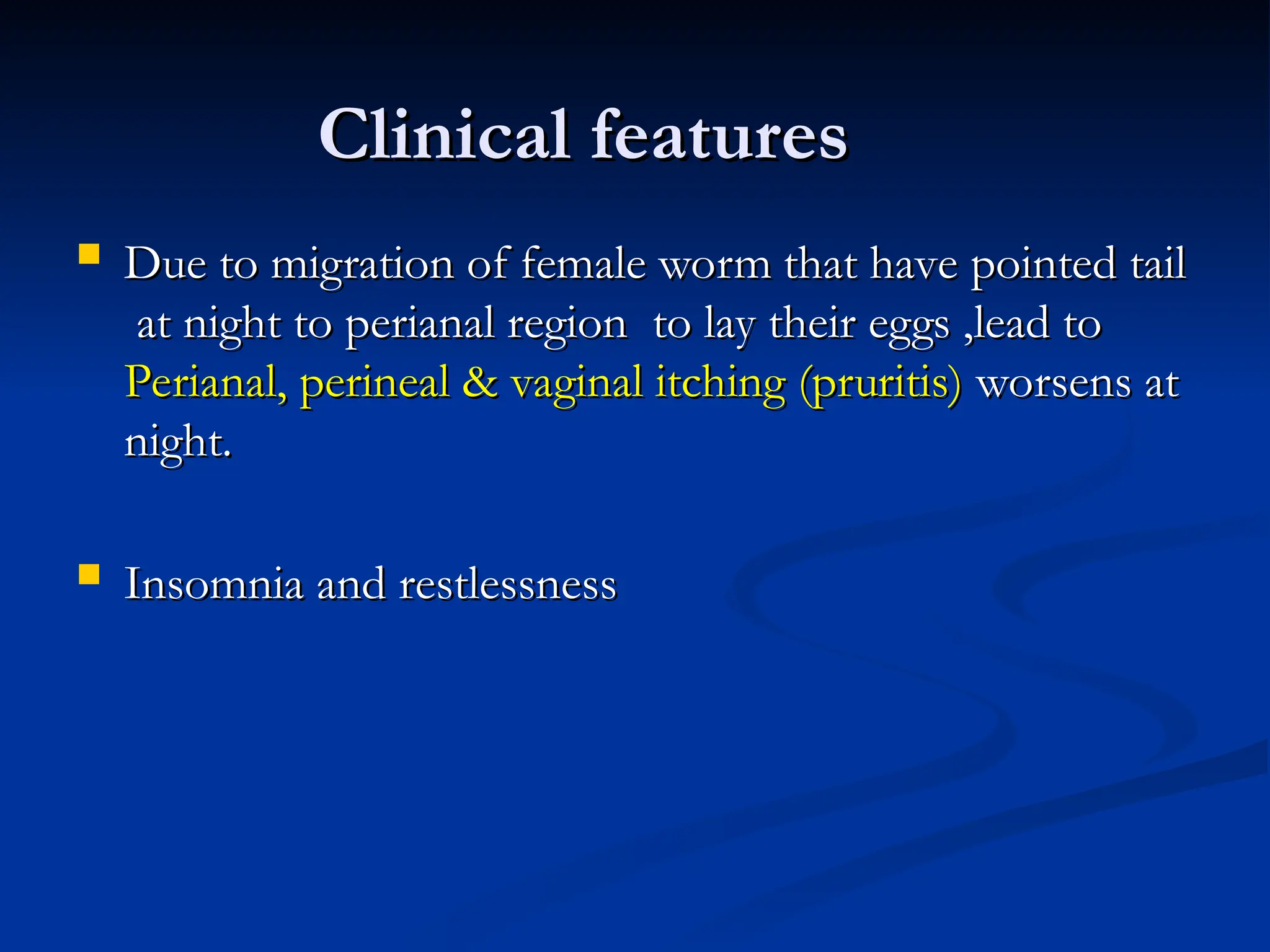
Clinical features
Clinical features
 Due to migration of female worm that have pointed tail
Due to migration of female worm that have pointed tail
at night to perianal region to lay their eggs ,lead to
Perianal, perineal & vaginal itching (pruritis)
Perianal, perineal & vaginal itching (pruritis) worsens at
worsens at
night.
night.
 Insomnia and restlessness
Insomnia and restlessness
Laboratory Diagnosis & Treatment
 Detection of adult worms in-
Detection of adult worms in-
 Feces
Feces
 Perianal region
Perianal region
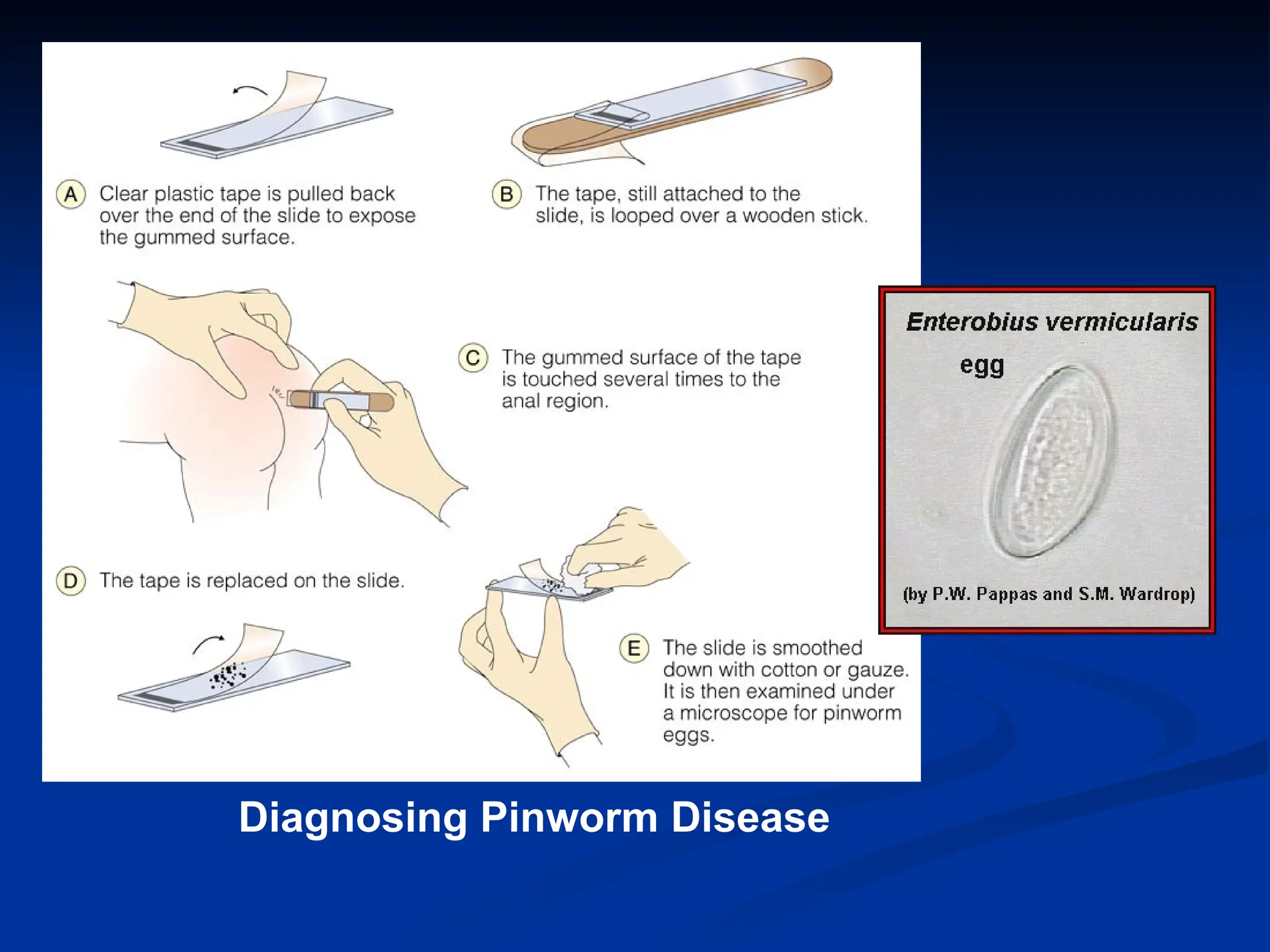
 Anal Swabs / Scotch Tape
Anal Swabs / Scotch Tape–
–
scrapings from perianal region
 Microscopy
Microscopy – eggs
– eggs
Treatment :
Treatment :
 Mebendazole,
Mebendazole,
Diagnosing Pinworm Disease
03/05/09
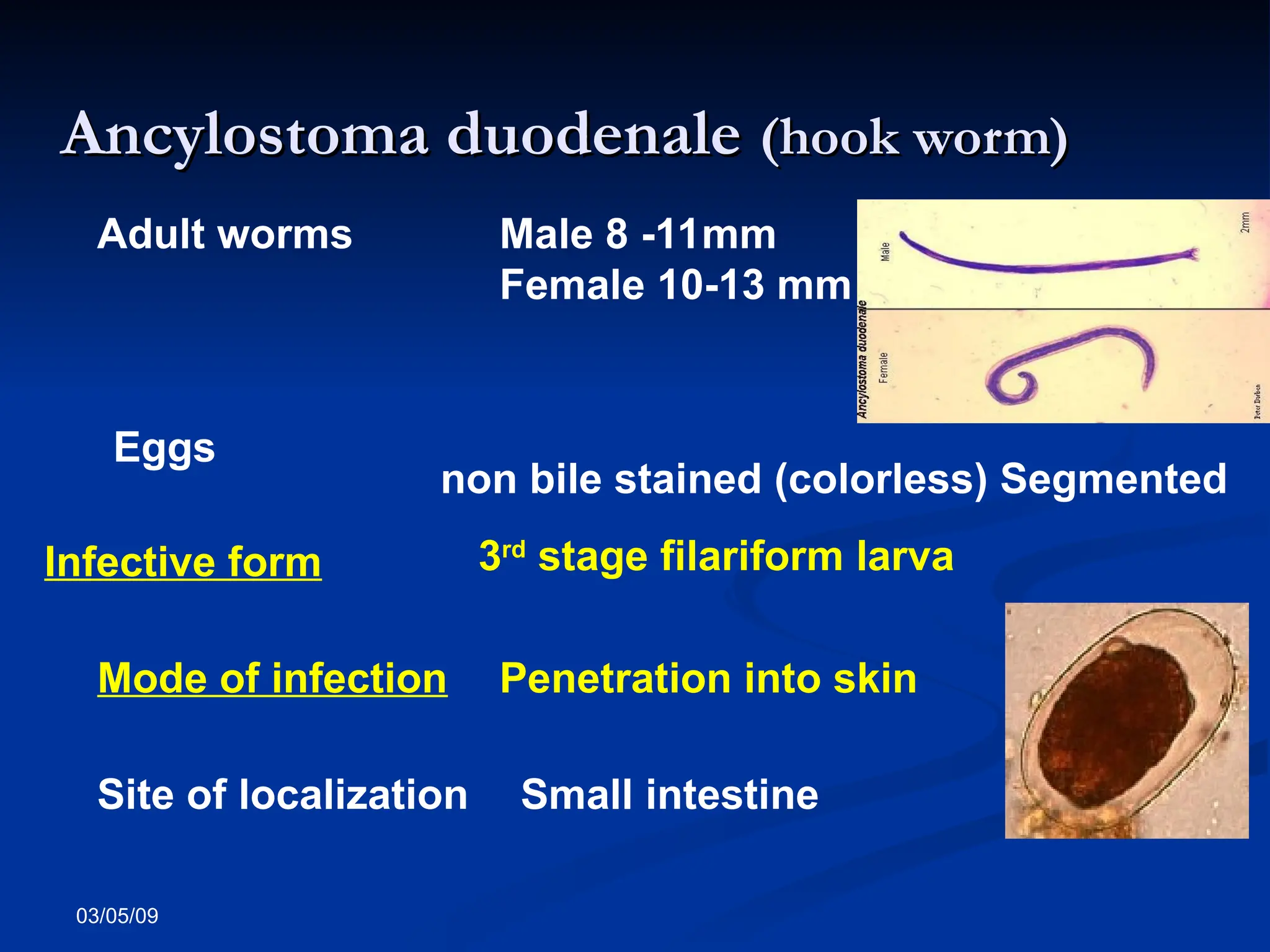
Adult worms Male 8 -11mm
Female 10-13 mm
Eggs
non bile stained (colorless) Segmented
Infective form 3rd
stage filariform larva
Mode of infection Penetration into skin
Site of localization Small intestine
Ancylostoma duodenale
Ancylostoma duodenale (hook worm)
(hook worm)
48 hours
6 to 8 days
6 to 8 weeks
8 to 10 days
Life cycle of
hookworm
The Life Cycle
03/05/09 Dr Ekta, Microbiology
Pathogenicity & Clinical Features
 Ancylostomiasis
Ancylostomiasis or hookworm disease, characterised
or hookworm disease, characterised
by
by iron deficiency anaemia
iron deficiency anaemia
 Majority of infections are asymptomatic
Majority of infections are asymptomatic
 Symptoms develop in heavy infections and divided
Symptoms develop in heavy infections and divided
into two groups: those produced by
1.
1. Migrating larvae
Migrating larvae
2.
2. Adult worms
Adult worms
Filariform larvae
03/05/09
Symptoms produced by larvae
 Lesions in the skin:
Lesions in the skin:
1.
1. Ancylostome dermatitis or Ground itch
Ancylostome dermatitis or Ground itch – occurs at
– occurs at
the site of entry, lasts for 2 to 4 weeks
2.
2. Creeping eruption
Creeping eruption – reddish itchy
– reddish itchy
papule along the path traversed by
filariform larvae (
filariform larvae (larva migrans
larva migrans)
)
 Lesions in the lungs
Lesions in the lungs – bronchitis &
– bronchitis &
bronchopneumonia.
bronchopneumonia.
03/05/09
Symptoms produced by adult worm
 Epigastric pain, diarrhoea & vomiting during early
Epigastric pain, diarrhoea & vomiting during early
phase of infection.
phase of infection.
 Microcytic hypochromic (Iron deficiency) anaemia –
Microcytic hypochromic (Iron deficiency) anaemia –
due to chronic blood loss:
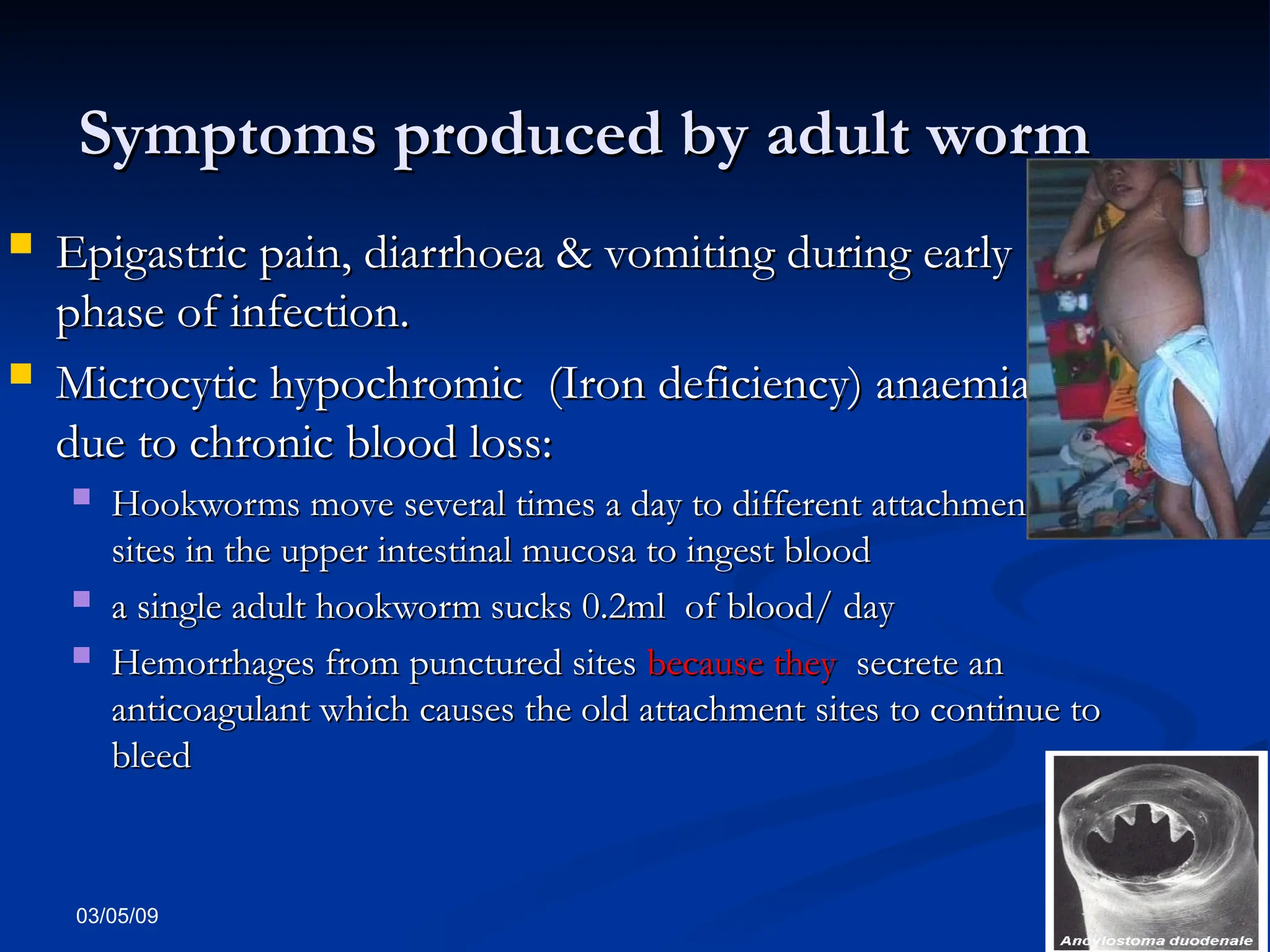
 Hookworms move several times a day to different attachment
Hookworms move several times a day to different attachment
sites in the upper intestinal mucosa to ingest blood
 a single adult hookworm sucks 0.2ml of blood/ day
a single adult hookworm sucks 0.2ml of blood/ day
 Hemorrhages from punctured sites
Hemorrhages from punctured sites because they
because they secrete an
secrete an
anticoagulant which causes the old attachment sites to continue to
bleed
bleed
03/05/09
Laboratory Diagnosis
 Stool examination
Stool examination –
–
microscopy: non bile
stained egg, segmented
 Occult blood in stool
Occult blood in stool –
–
positive
positive
 Blood examination
Blood examination –
–
anaemia, eosinophilia
Egg of A. duodenale in faecal smear
03/05/09 Dr Ekta, Microbiology
Treatment
Treatment
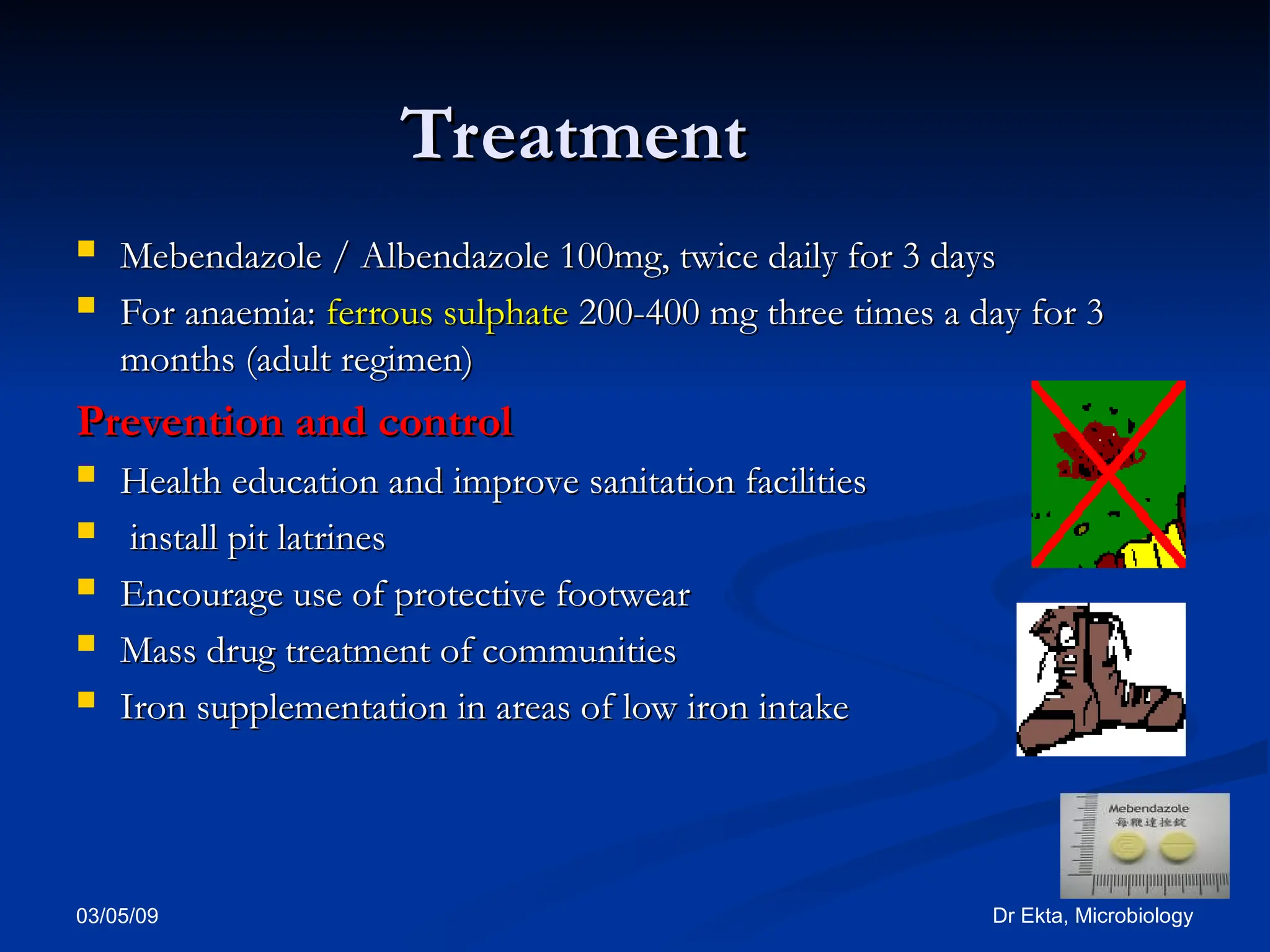
 Mebendazole / Albendazole
Mebendazole / Albendazole 100mg, twice daily for 3 days
100mg, twice daily for 3 days
 For anaemia:
For anaemia: ferrous sulphate
ferrous sulphate 200-400 mg three times a day for 3
200-400 mg three times a day for 3
months (adult regimen)
Prevention and control
 Health education and improve sanitation facilities
Health education and improve sanitation facilities
 install pit latrines
install pit latrines
 Encourage use of protective footwear
Encourage use of protective footwear
 Mass drug treatment of communities
Mass drug treatment of communities
 Iron supplementation in areas of low iron intake
Iron supplementation in areas of low iron intake
03/05/09
Trichuris trichiura
Trichuris trichiura (Whip Worm)
(Whip Worm)
Adult worm 30 – 50 mm
Eggs 60 µ, bile stained
Barrel-shaped with Mucus
plug at each pole
Infective form Mature embryonated eggs
Mode of transmission Ingestion
Site of localization Large intestine -
caecum
03/05/09 Dr Ekta, Microbiology
Life cycle
Life cycle
03/05/09
Clinical features
Clinical features
 Infection –
Infection – Trichuriasis
Trichuriasis
 Symptoms depend on worm burden
Symptoms depend on worm burden
 Less than 10 worms – asymptomatic
Less than 10 worms – asymptomatic
 Heavier infections –
Heavier infections –
1.
1. chronic
chronic profuse mucus and bloody diarrhea
profuse mucus and bloody diarrhea with
with
abdominal pains
abdominal pains and edematous rectum
and edematous rectum
2.
2. Rectal epilepsy
Rectal epilepsy
3.
3. malnutrition,
malnutrition, weight loss
weight loss and anemia
and anemia
03/05/09
Laboratory diagnosis & Treatment
 Stool examination
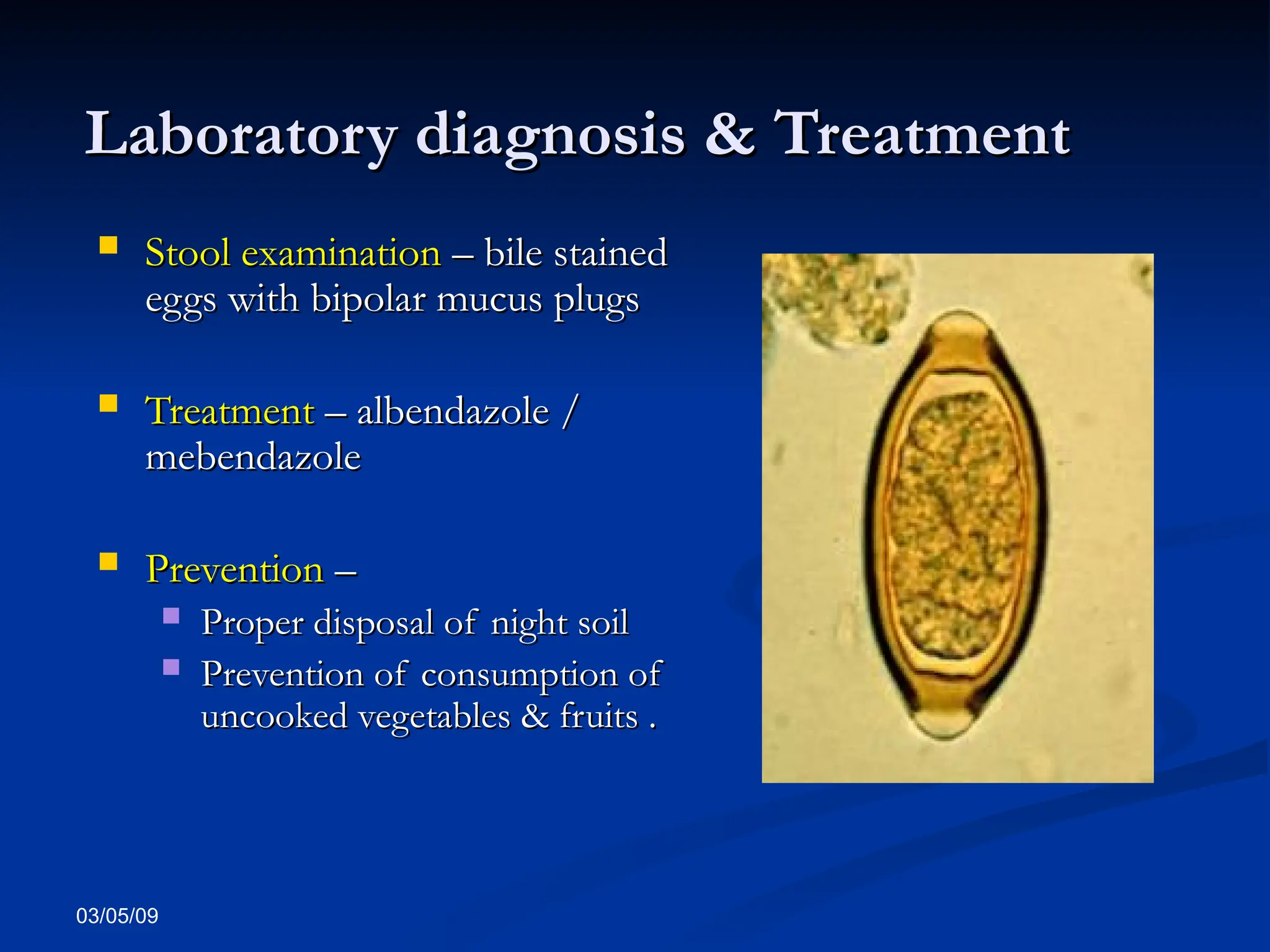
Stool examination – bile stained
– bile stained
eggs with bipolar mucus plugs
 Treatment
Treatment – albendazole /
– albendazole /
mebendazole
mebendazole
 Prevention
Prevention –
–
 Proper disposal of night soil
Proper disposal of night soil
 Prevention of consumption of
Prevention of consumption of
uncooked vegetables & fruits .

Ascaris, Enterobius, Hookworm and Trichrous 6.ppt

  • 1.
    Development of Ascarisinside body of infected human Venous circulation Adult Ascaris in small intestine Migration stage Intestinal stage Rhabditiform larva Larva is swallowed Embryonated egg is swallowed 2nd moult 3rd & 4th moults
  • 2.
    03/05/09 Dr Ekta,Microbiology
  • 3.
    Pathogenicity & ClinicalFeatures Pathogenicity & Clinical Features Ascariasis Ascariasis Majority of infections are asymptomatic Majority of infections are asymptomatic Clinical disease is largely restricted to individuals with a high worm Clinical disease is largely restricted to individuals with a high worm load load Symptoms divided into two groups: those produced by Symptoms divided into two groups: those produced by 1. 1. Migrating larvae Migrating larvae 2. 2. Adult worms Adult worms 1. Symptoms produced by Migrating larvae 1. Symptoms produced by Migrating larvae Pneumonia (loeffler’s syndrome) Pneumonia (loeffler’s syndrome) – fever, dyspnoea, – fever, dyspnoea, cough cough with bloody sputum with bloody sputum that may contain larva, urticarial rash that may contain larva, urticarial rash & eosinophilia & eosinophilia
  • 4.
    Symptoms & Complications Symptoms& Complications 2. Symptoms produced by Adult worms 2. Symptoms produced by Adult worms 1. 1. Abdominal discomfort Abdominal discomfort, anorexia, nausea & , anorexia, nausea & diarrhoea diarrhoea. . 2. 2. Intestinal Intestinal obstruction obstruction (particularly in children 1-5 years), (particularly in children 1-5 years), 3. 3. Penetration Penetration through intestinal ulcer ( through intestinal ulcer (perforation perforation) – ) – peritonitis peritonitis 5. 5. Hypersensitivity reactions Hypersensitivity reactions to worm Ags (toxic body fluids) – urticaria, edema of to worm Ags (toxic body fluids) – urticaria, edema of face, conjunctivitis, irritation of URT face, conjunctivitis, irritation of URT 6. 6. Ectopic Ascariasis Ectopic Ascariasis – – due to migration of worm up into the stomach. It may due to migration of worm up into the stomach. It may  be vomited out, be vomited out,  pass up through the pass up through the oesophagus oesophagus at night & comes out through mouth or nose, at night & comes out through mouth or nose,  enter enter larynx larynx to cause asphyxia. to cause asphyxia.  migrate to other organs and cause migrate to other organs and cause appendicitis, appendicitis, cholecystitis, pancreatitis, cholecystitis, pancreatitis, biliary obstruction biliary obstruction
  • 5.
    Laboratory Diagnosis Laboratory Diagnosis Macroscopic Macroscopic - Direct detection of - Direct detection of worm/s in stool or vomit worm/s in stool or vomit  Microscopic Microscopic – direct examination of – direct examination of feces- feces- bile stained eggs bile stained eggs  Blood examination Blood examination – – eosinophilia eosinophilia. .
  • 6.
    Treatment and Prevention Treatmentand Prevention Treatment Treatment  Mebendazole/ Albendazole Mebendazole/ Albendazole  Pyrantel pamoate Pyrantel pamoate Prevention Prevention: :  Good sanitation and personal hygiene Good sanitation and personal hygiene  Mass treatments Mass treatments with single dose with single dose mebendazole or albendazole for all mebendazole or albendazole for all school-age children every three to four school-age children every three to four months - months -
  • 7.
    Enterobius vermicularis Enterobius vermicularis(Pin Worm) (Pin Worm) Adult worms Male 2 - 5 mm Female 8 -13 mm, oviparous Eggs 60 µ, non bile stained flatted side with coiled embryo Infective form Embryonated egg Mode of transmission Ingestion, Autoinfection Site of localization Large intestine – caecum & appendix
  • 8.
    Life cycle – Lifecycle – E. vermicularis E. vermicularis
  • 9.
    Clinical features Clinical features Due to migration of female worm that have pointed tail Due to migration of female worm that have pointed tail at night to perianal region to lay their eggs ,lead to at night to perianal region to lay their eggs ,lead to Perianal, perineal & vaginal itching (pruritis) Perianal, perineal & vaginal itching (pruritis) worsens at worsens at night. night.  Insomnia and restlessness Insomnia and restlessness
  • 10.
    Laboratory Diagnosis &Treatment Laboratory Diagnosis & Treatment  Detection of adult worms in- Detection of adult worms in-  Feces Feces  Perianal region Perianal region  Anal Swabs / Scotch Tape Anal Swabs / Scotch Tape– – scrapings from perianal region scrapings from perianal region  Microscopy Microscopy – eggs – eggs Treatment : Treatment :  Mebendazole, Mebendazole,
  • 11.
  • 12.
    03/05/09 Adult worms Male8 -11mm Female 10-13 mm Eggs non bile stained (colorless) Segmented Infective form 3rd stage filariform larva Mode of infection Penetration into skin Site of localization Small intestine Ancylostoma duodenale Ancylostoma duodenale (hook worm) (hook worm)
  • 13.
    48 hours 6 to8 days 6 to 8 weeks 8 to 10 days Life cycle of hookworm
  • 14.
  • 15.
    03/05/09 Dr Ekta,Microbiology Pathogenicity & Clinical Features Pathogenicity & Clinical Features  Ancylostomiasis Ancylostomiasis or hookworm disease, characterised or hookworm disease, characterised by by iron deficiency anaemia iron deficiency anaemia  Majority of infections are asymptomatic Majority of infections are asymptomatic  Symptoms develop in heavy infections and divided Symptoms develop in heavy infections and divided into two groups: those produced by into two groups: those produced by 1. 1. Migrating larvae Migrating larvae 2. 2. Adult worms Adult worms Filariform larvae
  • 16.
    03/05/09 Symptoms produced bylarvae Symptoms produced by larvae  Lesions in the skin: Lesions in the skin: 1. 1. Ancylostome dermatitis or Ground itch Ancylostome dermatitis or Ground itch – occurs at – occurs at the site of entry, lasts for 2 to 4 weeks the site of entry, lasts for 2 to 4 weeks 2. 2. Creeping eruption Creeping eruption – reddish itchy – reddish itchy papule along the path traversed by papule along the path traversed by filariform larvae ( filariform larvae (larva migrans larva migrans) )  Lesions in the lungs Lesions in the lungs – bronchitis & – bronchitis & bronchopneumonia. bronchopneumonia.
  • 17.
    03/05/09 Symptoms produced byadult worm Symptoms produced by adult worm  Epigastric pain, diarrhoea & vomiting during early Epigastric pain, diarrhoea & vomiting during early phase of infection. phase of infection.  Microcytic hypochromic (Iron deficiency) anaemia – Microcytic hypochromic (Iron deficiency) anaemia – due to chronic blood loss: due to chronic blood loss:  Hookworms move several times a day to different attachment Hookworms move several times a day to different attachment sites in the upper intestinal mucosa to ingest blood sites in the upper intestinal mucosa to ingest blood  a single adult hookworm sucks 0.2ml of blood/ day a single adult hookworm sucks 0.2ml of blood/ day  Hemorrhages from punctured sites Hemorrhages from punctured sites because they because they secrete an secrete an anticoagulant which causes the old attachment sites to continue to anticoagulant which causes the old attachment sites to continue to bleed bleed
  • 18.
    03/05/09 Laboratory Diagnosis Laboratory Diagnosis Stool examination Stool examination – – microscopy: non bile microscopy: non bile stained egg, segmented stained egg, segmented  Occult blood in stool Occult blood in stool – – positive positive  Blood examination Blood examination – – anaemia, eosinophilia anaemia, eosinophilia Egg of A. duodenale in faecal smear
  • 19.
    03/05/09 Dr Ekta,Microbiology Treatment Treatment  Mebendazole / Albendazole Mebendazole / Albendazole 100mg, twice daily for 3 days 100mg, twice daily for 3 days  For anaemia: For anaemia: ferrous sulphate ferrous sulphate 200-400 mg three times a day for 3 200-400 mg three times a day for 3 months (adult regimen) months (adult regimen) Prevention and control Prevention and control  Health education and improve sanitation facilities Health education and improve sanitation facilities  install pit latrines install pit latrines  Encourage use of protective footwear Encourage use of protective footwear  Mass drug treatment of communities Mass drug treatment of communities  Iron supplementation in areas of low iron intake Iron supplementation in areas of low iron intake
  • 20.
    03/05/09 Trichuris trichiura Trichuris trichiura(Whip Worm) (Whip Worm) Adult worm 30 – 50 mm Eggs 60 µ, bile stained Barrel-shaped with Mucus plug at each pole Infective form Mature embryonated eggs Mode of transmission Ingestion Site of localization Large intestine - caecum
  • 21.
    03/05/09 Dr Ekta,Microbiology Life cycle Life cycle
  • 22.
    03/05/09 Clinical features Clinical features Infection – Infection – Trichuriasis Trichuriasis  Symptoms depend on worm burden Symptoms depend on worm burden  Less than 10 worms – asymptomatic Less than 10 worms – asymptomatic  Heavier infections – Heavier infections – 1. 1. chronic chronic profuse mucus and bloody diarrhea profuse mucus and bloody diarrhea with with abdominal pains abdominal pains and edematous rectum and edematous rectum 2. 2. Rectal epilepsy Rectal epilepsy 3. 3. malnutrition, malnutrition, weight loss weight loss and anemia and anemia
  • 23.
    03/05/09 Laboratory diagnosis &Treatment Laboratory diagnosis & Treatment  Stool examination Stool examination – bile stained – bile stained eggs with bipolar mucus plugs eggs with bipolar mucus plugs  Treatment Treatment – albendazole / – albendazole / mebendazole mebendazole  Prevention Prevention – –  Proper disposal of night soil Proper disposal of night soil  Prevention of consumption of Prevention of consumption of uncooked vegetables & fruits . uncooked vegetables & fruits .

Editor's Notes

  • #3 Visceral larva migrans – if larvae enter systemic circulation (from pulmonary capillaries) to reach other organs like brain, spinal cord, heart, kidney; usually seen in massive infection
  • #4 PEM, Vit. A deficiency (night blindness) Intestinal obstruction (particularly in children 1-5 years), intussusception & volvulus
  • #5 Microscopic – direct examination of feces following floatation method. Microscopic – direct examination of feces : bile stained eggs. (eggs may not be seen at least 40 days after infection
  • #6 Piperazine citrate - suspected intestinal or biliary obstruction since this drug paralyzes worms to aid expulsion. Levamisole Mebendazole/ Albendazole – drug of choice but contraindicated in pregnancy & heavy infection serves dual function: treats the children and reduces the overall worm burden in the community
  • #9 Nocturnal enuresis
  • #10 pyrantel pamoate
  • #12 Epidemiology >1200m infections each year of which 100m are symptomatic It is due to 2 parasites both of which occur worldwide: Necator americanus - predominant species in sub-Saharan Africa, south Asia and the Pacific Ancylostoma duodenale –predominant in S. Europe, N. Africa, western Asia, northern China, Japan and the west coast of America Sites of skin penetration: Most common sites are: Thin skin between toes Dorsum of the feet Inner side of the soles Gardeners & miners – skin of hands Buccal cavity lined with teeth & cutting plates and anticoagulant glands
  • #13 Adult worms live in the intestine and excrete eggs in the faeces In the absence of latrines, eggs contaminate soil and develop in warm, damp conditions eggs hatch and infective filariform larvae develop in about one week and remain infective in soil for many weeks filariform larvae penetrate the skin when a person walks barefoot in the soil larva migrate from the skin to the lungs via the lymphatic and blood systems larvae penetrate the capillary wall to enter the alveolus Larvae are propelled up the respiratory tree to the epiglottis where they are swallowed Develops to adult stage in upper intestine; adult worms are fully mature after about 5 weeks Eggs are excreted in the faeces Note: eating soil (pica) is a common practice. Ingested filariform larvae of A. duodenale can pass directly to the gut mucosa
  • #17 Pathology Hookworms move several times a day to different attachment sites in the upper intestinal mucosa to ingest blood They secrete an anticoagulant which causes the old attachment sites to continue to bleed Heavy hookworm infection results in chronic haemorrhage from the duodenal and jejunal mucosa The combination of constant blood loss due to hookworm infection and poor iron intake in the diet results in iron deficiency anaemia A. duodenale ingests 4-5 times more blood each day than N. americanus In a child, the continued daily loss of 10ml of blood can lead to severe anaemia Clinical features of hookworm anemia: Extreme pallor Abnormal appetite showing Pica or Geophagy – perverted taste for earth, mud or lime Epigastric tenderness with dyspepsia Constipation Puffy face with swelling of lower eyelids Pedal edema Growth retardation General appearance – pale plumpy with protuberant abdomen & dry lustreless hair
  • #19 If Hb is below 30%, then anemia should be treated first with Iron till Hb comes over 50%. Mebendazole is contraindicated in pregnancy – use Bephenium hydroxynaphthoate “alcopar” Prevention and control : Discourage soil eating (pica)
  • #20 Male and female worm have narrow anterior portion penetrate the intestinal mucosa.
  • #22 Rectal prolapse in children is a common complication. imp