PROJECT :-
DEFINITION :- Health is defined as a state of complete
physical, mental and social-being and not merely an absence
of disease or infirmity.
Physical health and mental health are inter-related. A sound
mind in a sound body is an old and appropriate saying for
good health.
AVOID COLD DRINKS.
A healthy human being has generally the following features :-
A clear skin.
Bright, clear eyes.
A body neither too fat nor too thin.
Fresh breath.
Good appetite.
Sound sleep.
Regular activity of bladder and bowels.
Coordinated body movements.
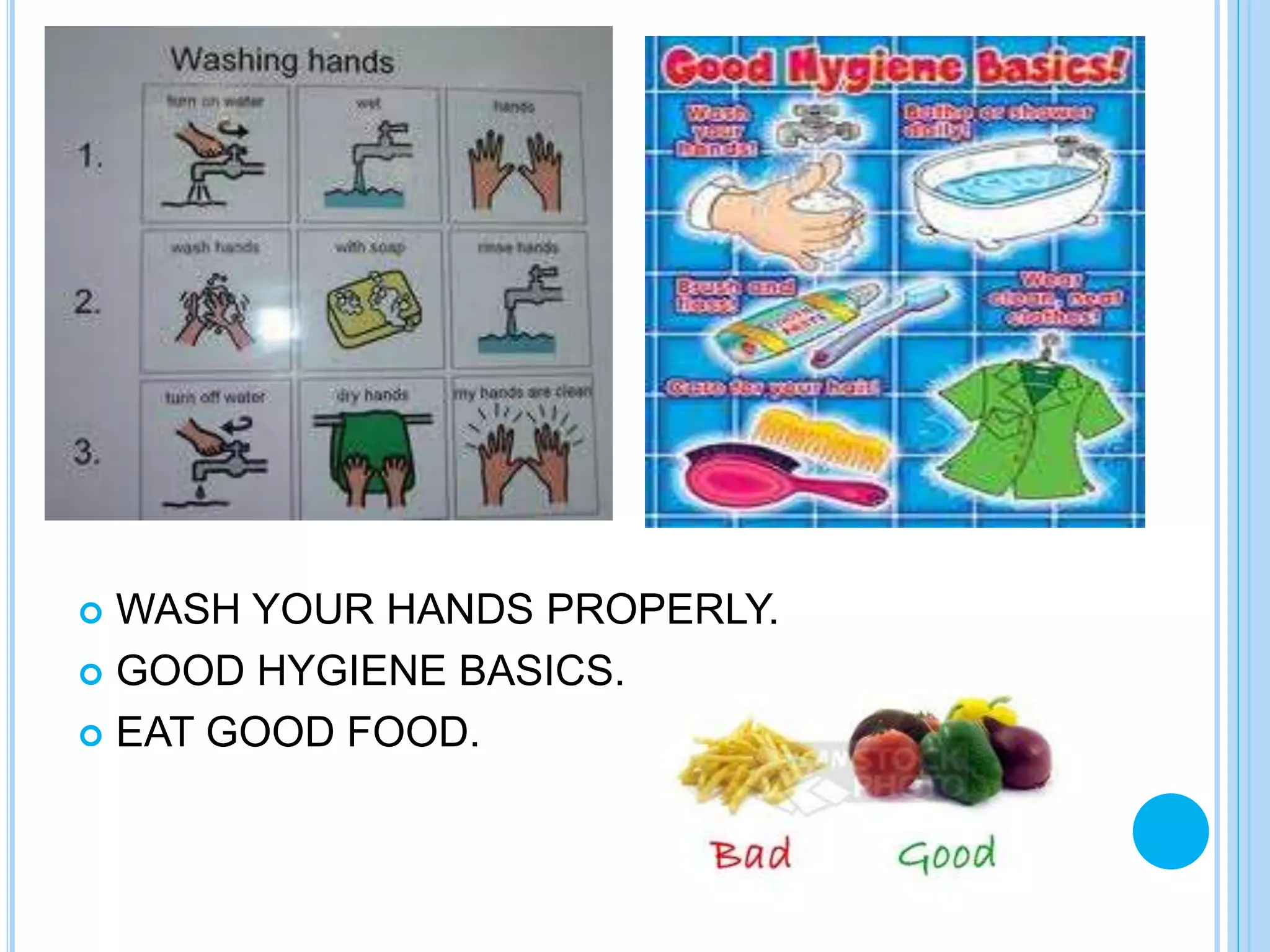
 WASH YOUR HANDS PROPERLY.
 GOOD HYGIENE BASICS.
 EAT GOOD FOOD.
Definition :- Disease is a departure from normal health
through structural or functional disorder of the body.
1. NON-COMMUNICABLE OR NON-INFECTIOUS
DISEASES :- Such diseases are not caused by any germ,
therefore these diseases cannot spread from person to person.
These are caused due to improper functioning of the body
organs. E.g.:- diabetes, heart attack, etc.
2. COMMUNICABLE OR INFECTIOUS DISEASES :- Such
diseases are caused by the germs which are called pathogens.
When pathogens reach healthy person, he or she is infected by a
communicable disease. E.g.:-viral fever, chicken pox, malaria,
cholera, etc.
1. Metabolic diseases :- These diseases are caused due to the
malfunctioning of various body organs. These diseases are also
called organic diseases. E.g. :- diabetes mellitus, goitre, heart
diseases, uraemia.
2. Genetic diseases :- Such diseases develop at the time of
embryonic development due to defects in the genes of the
chromosomes inherited from the patients. E.g. :- haemophilia,
thalassemia.
3. Allergy :- Allergy is an unpredictable reaction to a particular
substance. This type of substance is called allergen. Different
people are allergic to different substances. A few common
allergens are dust, spores, pollen, certain clothes, particular
medicines, cosmetics, etc. The common areas of the body parts
which are affected by allergies are skin, respiratory and
digestive tracts. Asthma, eczema, diarrhoea, vomiting, nausea,
hay fever, etc. are some common allergic reactions.
4. Dietary Deficiency Diseases :-
i. A diet lacking in nutrients, such as proteins, required for the
growth and repair of the body, results in degeneration of
muscles and body weight. Some of the examples of protein
deficiency diseases are kwashiorkor and marasmus.
ii. Vitamin deficiency diseases are nightblindness, pellagra,
scurvy and beri-beri.
iii. Mineral deficiency diseases :- Human body also require
different mineral salt. The deficiency of minerals gives rise to
disease like anaemia, goitre, rickets, fluorosis, etc.
A PERSON SUFFERING
FROM GOITRE.
A CHILD SUFFERING FROM
MARASMUS.
SWOLLEN GUMS.
5. Cancer or uncontrolled growth of body cells :- Cancer is caused due
to some of the important factors like smoking, tobacco chewing,
addictive drugs, pollution, radiation, and even viruses. Agents
which cause cancer are called carcinogens. E.g. :- breasts cancer,
luekemia.
6. Degenerative diseases :- With age, deterioration occurs in the
structure and functioning of body cells and organs. Some of the
diseases which occur due to old age are cataract, arthritis,
arteriosclerosis.
7. Diseases caused due to physical and chemical agents :-
Sunburn and heat stroke are examples of some diseases caused by
physicals agents. Chemical agents which cause diseases are lead,
mercury, etc.
 These diseases are caused due to microorganisms such as
viruses, bacteria, fungi and protozoa. The disease-causing
germs are called pathogens. We get such infections through air,
water, food, contact, cuts, sexual contact and from agents like
mosquitoes, flies, etc.
1. Diseases caused by viruses:-
Cold, influenza, mumps, smallpox, poliomyelitis, measles,
rabies/hydrophobia, jaundice/hepatitis, AIDS.
2. Diseases caused by bacteria:-
Tuberculosis(TB), diphtheria, tetanus, whooping cough
(Pertussis), pneumonia, cholera, etc.
3. Diseases caused by moulds and fungi:-
Ring worm, athelete’s foot, etc.
4. Diseases caused by Protozoa:-
Malaria, amoebiasis or amoebic dysentery, etc. TAPEWORM.
5. Diseases caused by worms:-
Elephantiasis, ascariasis, taeniasis, etc.
To continue their race, the pathogens try to come out of the body of an
infected person and reach out to more hosts for their survival. These
healthy pathogens transfer from a patient to a healthy person,
generally, in the following ways:
Direct method:-
Diseases like measles, chicken pox and fungal infections can
spread through direct contact with an infected person.
Indirect method :-
Touching and sharing items used by the infected person,
contaminated food and drink, vectors and carriers.
First Aid :-
As the name suggests, it is the first or the immediate
care given to a patient at the time of emergency
before he or she is taken to a doctor. e.g., during
accidents, heart attack, snake bite, burns, etc.
 Burns, bleeding, fractures, eye, unconsciousness,
heart attack, swallowing poison, snake bite, stinging.
When we feel body ache, cold and our body temperature is more
than 98.6 degree F, it indicates that we are suffering from a fever.
A fever is not a diseases but it is symptom of some disease.
In case of a high fever, we can immediately apply an ice pack or
a piece of cloth dipped in ice-cold water on our forehead to bring
down the body temperature. If the fever persists for more time,
consult a doctor immediately.
1. Prevention of deficiency diseases:-
 Eat healthy and seasonal fruits and vegetables in proper
quantities to develop body resistance against diseases.
 Proper cooking should be done. Cut vegetables should be
cooked immediately.
 Avoid too much frying of vegetables.
 Drinking water must either be boiled or properly purified with
the help of a filter.
 Keep your surroundings clean.
2.Public hygiene:-
Sewage and chemical wastes should not be released into the water
bodies. Sewage should be chemically treated first before being
released into the water bodies to avoid water-borne diseases.
3.Immunization :-
Immunization and vaccination can prevent infectious diseases.
4.Personal hygiene:-
Take care of the skin, keep your hands and nails clean, wash your hair
regularly, brush your teeth and gums after every meal, wash your eye
daily with tap water, nose must be cleaned at regular intervals, never
clean an ear with a sharp object, do physical exercise to keep the body
muscles active, take proper rest, sleep for 6-8hr daily, one should
develop healthy habits.
5. Healthy Environment :-
Maintain a healthy environment to prevent the spreading of
diseases due to the breeding of mosquitoes, house flies and
microorganisms.
Garbage should be kept in covered bins so that flies do not breed
on them.
Do not allow water to stagnate outside your house and in your
neighborhood. All drains should also be covered. This will avoid
breeding of mosquitoes.
There should be proper sewer lines connected to sewage
treatment plants.
Contamination of drinking water with a little amount of
faeces(human excreta) causes a number of diseases.
EAT HEALTHY FOOD.
Vaccination is the practice of artificially introducing germs or
germ substance into the body for developing resistance to
particular diseases. Scientifically, this practice is called
prophylaxis and the material introduced into the body is called
the vaccine.
Immunization is a general term used for introducing ant kind of
dead or weakened germs into the body of a living being for the
development of immunity against the respective disease or
diseases.
THE END.

Health and Hygiene

  • 1.
  • 2.
    DEFINITION :- Healthis defined as a state of complete physical, mental and social-being and not merely an absence of disease or infirmity. Physical health and mental health are inter-related. A sound mind in a sound body is an old and appropriate saying for good health. AVOID COLD DRINKS.
  • 3.
    A healthy humanbeing has generally the following features :- A clear skin. Bright, clear eyes. A body neither too fat nor too thin. Fresh breath. Good appetite. Sound sleep. Regular activity of bladder and bowels. Coordinated body movements.
  • 4.
     WASH YOURHANDS PROPERLY.  GOOD HYGIENE BASICS.  EAT GOOD FOOD.
  • 5.
    Definition :- Diseaseis a departure from normal health through structural or functional disorder of the body.
  • 6.
    1. NON-COMMUNICABLE ORNON-INFECTIOUS DISEASES :- Such diseases are not caused by any germ, therefore these diseases cannot spread from person to person. These are caused due to improper functioning of the body organs. E.g.:- diabetes, heart attack, etc. 2. COMMUNICABLE OR INFECTIOUS DISEASES :- Such diseases are caused by the germs which are called pathogens. When pathogens reach healthy person, he or she is infected by a communicable disease. E.g.:-viral fever, chicken pox, malaria, cholera, etc.
  • 7.
    1. Metabolic diseases:- These diseases are caused due to the malfunctioning of various body organs. These diseases are also called organic diseases. E.g. :- diabetes mellitus, goitre, heart diseases, uraemia. 2. Genetic diseases :- Such diseases develop at the time of embryonic development due to defects in the genes of the chromosomes inherited from the patients. E.g. :- haemophilia, thalassemia.
  • 8.
    3. Allergy :-Allergy is an unpredictable reaction to a particular substance. This type of substance is called allergen. Different people are allergic to different substances. A few common allergens are dust, spores, pollen, certain clothes, particular medicines, cosmetics, etc. The common areas of the body parts which are affected by allergies are skin, respiratory and digestive tracts. Asthma, eczema, diarrhoea, vomiting, nausea, hay fever, etc. are some common allergic reactions.
  • 9.
    4. Dietary DeficiencyDiseases :- i. A diet lacking in nutrients, such as proteins, required for the growth and repair of the body, results in degeneration of muscles and body weight. Some of the examples of protein deficiency diseases are kwashiorkor and marasmus. ii. Vitamin deficiency diseases are nightblindness, pellagra, scurvy and beri-beri. iii. Mineral deficiency diseases :- Human body also require different mineral salt. The deficiency of minerals gives rise to disease like anaemia, goitre, rickets, fluorosis, etc.
  • 10.
    A PERSON SUFFERING FROMGOITRE. A CHILD SUFFERING FROM MARASMUS. SWOLLEN GUMS.
  • 11.
    5. Cancer oruncontrolled growth of body cells :- Cancer is caused due to some of the important factors like smoking, tobacco chewing, addictive drugs, pollution, radiation, and even viruses. Agents which cause cancer are called carcinogens. E.g. :- breasts cancer, luekemia. 6. Degenerative diseases :- With age, deterioration occurs in the structure and functioning of body cells and organs. Some of the diseases which occur due to old age are cataract, arthritis, arteriosclerosis. 7. Diseases caused due to physical and chemical agents :- Sunburn and heat stroke are examples of some diseases caused by physicals agents. Chemical agents which cause diseases are lead, mercury, etc.
  • 12.
     These diseasesare caused due to microorganisms such as viruses, bacteria, fungi and protozoa. The disease-causing germs are called pathogens. We get such infections through air, water, food, contact, cuts, sexual contact and from agents like mosquitoes, flies, etc. 1. Diseases caused by viruses:- Cold, influenza, mumps, smallpox, poliomyelitis, measles, rabies/hydrophobia, jaundice/hepatitis, AIDS.
  • 13.
    2. Diseases causedby bacteria:- Tuberculosis(TB), diphtheria, tetanus, whooping cough (Pertussis), pneumonia, cholera, etc. 3. Diseases caused by moulds and fungi:- Ring worm, athelete’s foot, etc. 4. Diseases caused by Protozoa:- Malaria, amoebiasis or amoebic dysentery, etc. TAPEWORM. 5. Diseases caused by worms:- Elephantiasis, ascariasis, taeniasis, etc.
  • 14.
    To continue theirrace, the pathogens try to come out of the body of an infected person and reach out to more hosts for their survival. These healthy pathogens transfer from a patient to a healthy person, generally, in the following ways: Direct method:- Diseases like measles, chicken pox and fungal infections can spread through direct contact with an infected person. Indirect method :- Touching and sharing items used by the infected person, contaminated food and drink, vectors and carriers.
  • 15.
    First Aid :- Asthe name suggests, it is the first or the immediate care given to a patient at the time of emergency before he or she is taken to a doctor. e.g., during accidents, heart attack, snake bite, burns, etc.  Burns, bleeding, fractures, eye, unconsciousness, heart attack, swallowing poison, snake bite, stinging.
  • 16.
    When we feelbody ache, cold and our body temperature is more than 98.6 degree F, it indicates that we are suffering from a fever. A fever is not a diseases but it is symptom of some disease. In case of a high fever, we can immediately apply an ice pack or a piece of cloth dipped in ice-cold water on our forehead to bring down the body temperature. If the fever persists for more time, consult a doctor immediately.
  • 17.
    1. Prevention ofdeficiency diseases:-  Eat healthy and seasonal fruits and vegetables in proper quantities to develop body resistance against diseases.  Proper cooking should be done. Cut vegetables should be cooked immediately.  Avoid too much frying of vegetables.  Drinking water must either be boiled or properly purified with the help of a filter.  Keep your surroundings clean.
  • 18.
    2.Public hygiene:- Sewage andchemical wastes should not be released into the water bodies. Sewage should be chemically treated first before being released into the water bodies to avoid water-borne diseases. 3.Immunization :- Immunization and vaccination can prevent infectious diseases. 4.Personal hygiene:- Take care of the skin, keep your hands and nails clean, wash your hair regularly, brush your teeth and gums after every meal, wash your eye daily with tap water, nose must be cleaned at regular intervals, never clean an ear with a sharp object, do physical exercise to keep the body muscles active, take proper rest, sleep for 6-8hr daily, one should develop healthy habits.
  • 19.
    5. Healthy Environment:- Maintain a healthy environment to prevent the spreading of diseases due to the breeding of mosquitoes, house flies and microorganisms. Garbage should be kept in covered bins so that flies do not breed on them. Do not allow water to stagnate outside your house and in your neighborhood. All drains should also be covered. This will avoid breeding of mosquitoes. There should be proper sewer lines connected to sewage treatment plants. Contamination of drinking water with a little amount of faeces(human excreta) causes a number of diseases.
  • 20.
  • 21.
    Vaccination is thepractice of artificially introducing germs or germ substance into the body for developing resistance to particular diseases. Scientifically, this practice is called prophylaxis and the material introduced into the body is called the vaccine. Immunization is a general term used for introducing ant kind of dead or weakened germs into the body of a living being for the development of immunity against the respective disease or diseases.
  • 22.