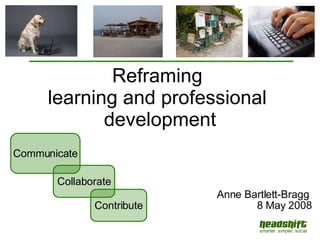
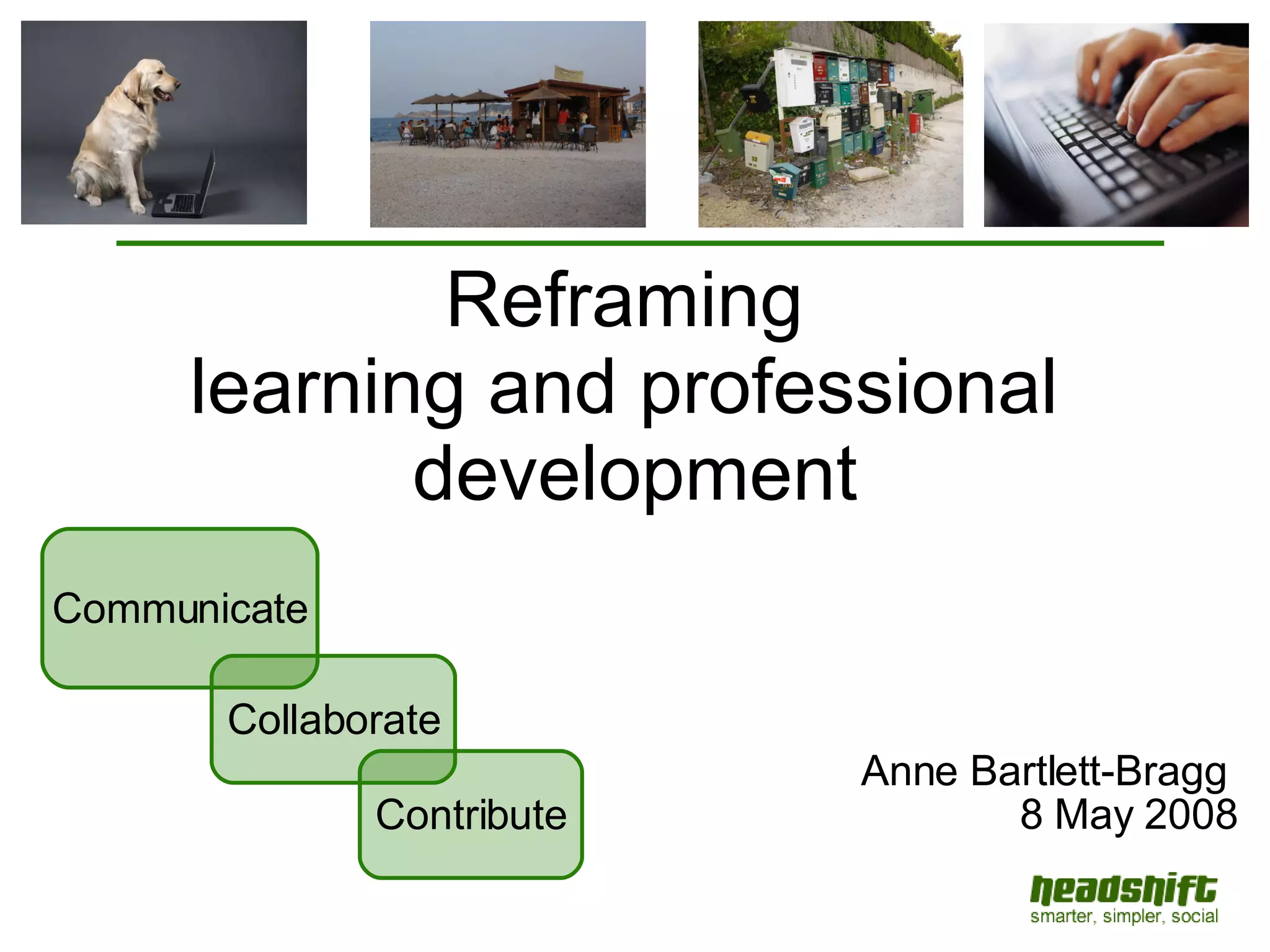

Reframing  learning and professional  development Anne Bartlett-Bragg  8 May 2008 Contribute Communicate Collaborate
Why are you here? to learn to meet people  to network to talk to generate new ideas for the view?! Your learning landscape…
What’s happening in your learning landscape…?
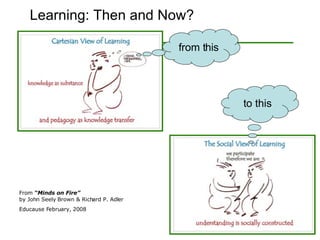
Learning: Then and Now? From  “Minds on Fire”   by John Seely Brown & Richard P. Adler Educause February, 2008 to this from this
Creating learning landscapes… What if…. You could create dialogues - learning  conversations that provoke questions… Collaborate with and be the conduit for learning What if learning became discretely embedded into  our everyday activities?…..
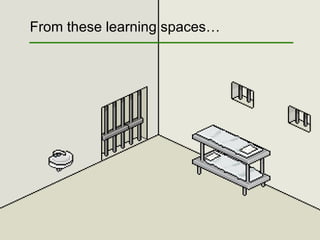
From these learning spaces…
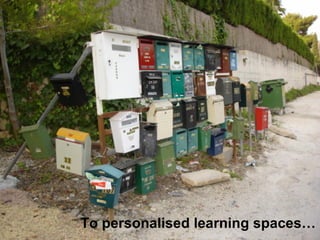
To personalised learning spaces…
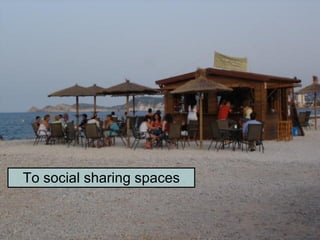
To social sharing spaces
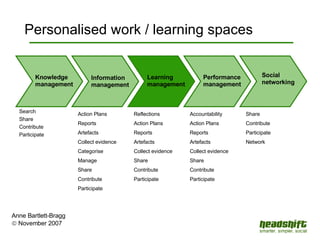
Personalised work / learning spaces Anne Bartlett-Bragg    November 2007 Knowledge management Information management Learning management Performance management Social networking Reflections Action Plans Reports Artefacts Collect evidence Share Contribute Participate Accountability Action Plans Reports Artefacts Collect evidence Share Contribute Participate Share Contribute Participate Network Action Plans Reports Artefacts Collect evidence Categorise Manage Share Contribute Participate Search Share Contribute Participate
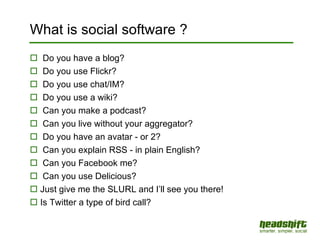
Do you have a blog? Do you use Flickr? Do you use chat/IM? Do you use a wiki? Can you make a podcast? Can you live without your aggregator? Do you have an avatar - or 2? Can you explain RSS - in plain English? Can you Facebook me? Can you use Delicious? Just give me the SLURL and I’ll see you there! Is Twitter a type of bird call? What is social software ?
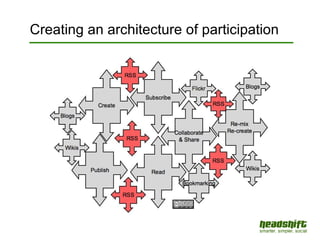
Creating an architecture of participation
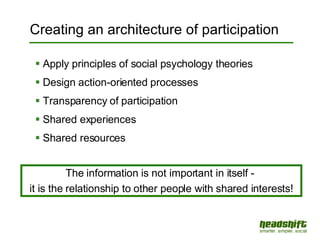
Creating an architecture of participation Apply principles of social psychology theories Design action-oriented processes Transparency of participation Shared experiences Shared resources The information is not important in itself -  it is the relationship to other people with shared interests!
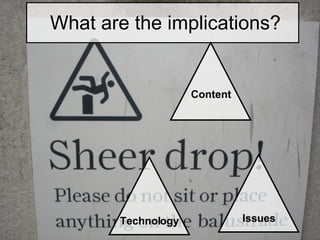
What are the implications? Content Technology Issues
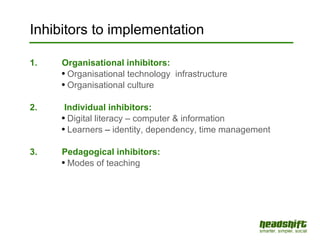
Inhibitors to implementation 1. Organisational inhibitors: Organisational technology  infrastructure Organisational culture 2.  Individual inhibitors:  Digital literacy – computer & information Learners  –  identity, dependency, time management 3.  Pedagogical inhibitors: Modes of teaching
A final word from your learners …

Headshift Breakfast Workshop May08

  • 1.
    Reframing learningand professional development Anne Bartlett-Bragg 8 May 2008 Contribute Communicate Collaborate
  • 2.
    Why are youhere? to learn to meet people to network to talk to generate new ideas for the view?! Your learning landscape…
  • 3.
    What’s happening inyour learning landscape…?
  • 4.
    Learning: Then andNow? From “Minds on Fire” by John Seely Brown & Richard P. Adler Educause February, 2008 to this from this
  • 5.
    Creating learning landscapes…What if…. You could create dialogues - learning conversations that provoke questions… Collaborate with and be the conduit for learning What if learning became discretely embedded into our everyday activities?…..
  • 6.
  • 7.
  • 8.
  • 9.
    Personalised work /learning spaces Anne Bartlett-Bragg  November 2007 Knowledge management Information management Learning management Performance management Social networking Reflections Action Plans Reports Artefacts Collect evidence Share Contribute Participate Accountability Action Plans Reports Artefacts Collect evidence Share Contribute Participate Share Contribute Participate Network Action Plans Reports Artefacts Collect evidence Categorise Manage Share Contribute Participate Search Share Contribute Participate
  • 10.
    Do you havea blog? Do you use Flickr? Do you use chat/IM? Do you use a wiki? Can you make a podcast? Can you live without your aggregator? Do you have an avatar - or 2? Can you explain RSS - in plain English? Can you Facebook me? Can you use Delicious? Just give me the SLURL and I’ll see you there! Is Twitter a type of bird call? What is social software ?
  • 11.
    Creating an architectureof participation
  • 12.
    Creating an architectureof participation Apply principles of social psychology theories Design action-oriented processes Transparency of participation Shared experiences Shared resources The information is not important in itself - it is the relationship to other people with shared interests!
  • 13.
    What are theimplications? Content Technology Issues
  • 14.
    Inhibitors to implementation1. Organisational inhibitors: Organisational technology infrastructure Organisational culture 2. Individual inhibitors: Digital literacy – computer & information Learners – identity, dependency, time management 3. Pedagogical inhibitors: Modes of teaching
  • 15.
    A final wordfrom your learners …