WORD CATEGORIES
DR.VMS
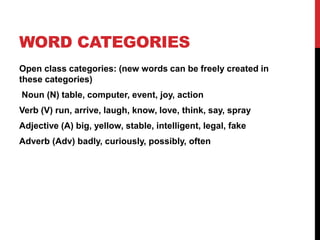
WORD CATEGORIES
Open class categories: (new words can be freely created in
these categories)
Noun (N) table, computer, event, joy, action
Verb (V) run, arrive, laugh, know, love, think, say, spray
Adjective (A) big, yellow, stable, intelligent, legal, fake
Adverb (Adv) badly, curiously, possibly, often
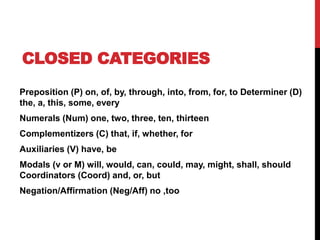
CLOSED CATEGORIES
Preposition (P) on, of, by, through, into, from, for, to Determiner (D)
the, a, this, some, every
Numerals (Num) one, two, three, ten, thirteen
Complementizers (C) that, if, whether, for
Auxiliaries (V) have, be
Modals (v or M) will, would, can, could, may, might, shall, should
Coordinators (Coord) and, or, but
Negation/Affirmation (Neg/Aff) no ,too
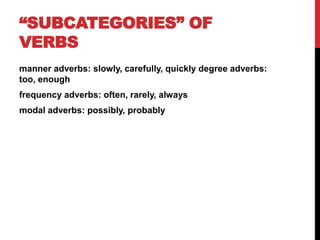
“SUBCATEGORIES” OF
VERBS
manner adverbs: slowly, carefully, quickly degree adverbs:
too, enough
frequency adverbs: often, rarely, always
modal adverbs: possibly, probably
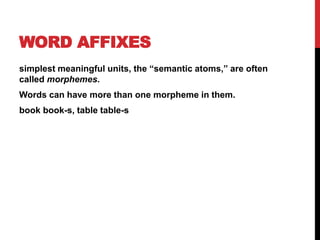
WORD AFFIXES
simplest meaningful units, the “semantic atoms,” are often
called morphemes.
Words can have more than one morpheme in them.
book book-s, table table-s
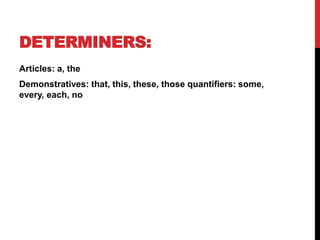
DETERMINERS:
Articles: a, the
Demonstratives: that, this, these, those quantifiers: some,
every, each, no
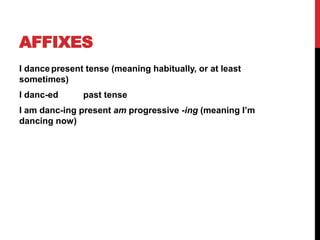
AFFIXES
I dance present tense (meaning habitually, or at least
sometimes)
I danc-ed past tense
I am danc-ing present am progressive -ing (meaning I’m
dancing now)
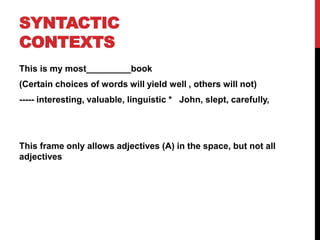
SYNTACTIC
CONTEXTS
This is my most_________book
(Certain choices of words will yield well , others will not)
----- interesting, valuable, linguistic * John, slept, carefully,
This frame only allows adjectives (A) in the space, but not all
adjectives
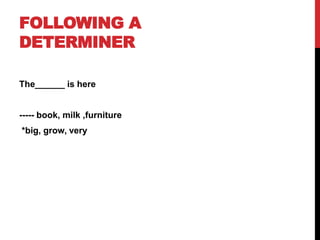
FOLLOWING A
DETERMINER
The______ is here
----- book, milk ,furniture
*big, grow, very
MODIFIERS
a word that modifies a verb is probably an adverb of some kind, and
similarly for other categories:
Categ
ory
Modifier Example
V Adv [V stop] stop suddenly (a way of
stopping)
N A(djective) [N stop] sudden stop (a type of stop)
P Intensifier [P in] the middle right in the middle,
smack in the middle
A Degree [A sad] very sad, too sad, more sad
Adv Degree [Adv sadly] very sadly, too sadly, more
MODIFIERS
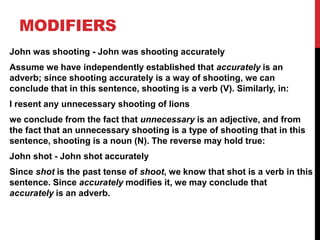
John was shooting - John was shooting accurately
Assume we have independently established that accurately is an
adverb; since shooting accurately is a way of shooting, we can
conclude that in this sentence, shooting is a verb (V). Similarly, in:
I resent any unnecessary shooting of lions
we conclude from the fact that unnecessary is an adjective, and from
the fact that an unnecessary shooting is a type of shooting that in this
sentence, shooting is a noun (N). The reverse may hold true:
John shot - John shot accurately
Since shot is the past tense of shoot, we know that shot is a verb in this
sentence. Since accurately modifies it, we may conclude that
accurately is an adverb.
COMPLEMENTARY
DISTRIBUTION
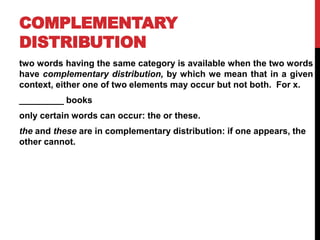
two words having the same category is available when the two words
have complementary distribution, by which we mean that in a given
context, either one of two elements may occur but not both. For x.
_________ books
only certain words can occur: the or these.
the and these are in complementary distribution: if one appears, the
other cannot.
AFFIXES
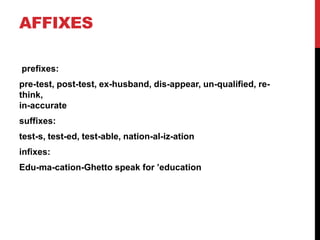
prefixes:
pre-test, post-test, ex-husband, dis-appear, un-qualified, re-
think,
in-accurate
suffixes:
test-s, test-ed, test-able, nation-al-iz-ation
infixes:
Edu-ma-cation-Ghetto speak for ’education
COMPOSITIONALITY
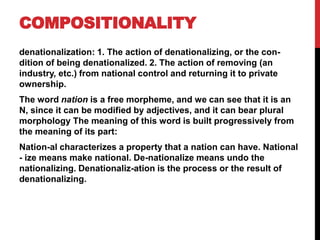
denationalization: 1. The action of denationalizing, or the con-
dition of being denationalized. 2. The action of removing (an
industry, etc.) from national control and returning it to private
ownership.
The word nation is a free morpheme, and we can see that it is an
N, since it can be modified by adjectives, and it can bear plural
morphology The meaning of this word is built progressively from
the meaning of its part:
Nation-al characterizes a property that a nation can have. National
- ize means make national. De-nationalize means undo the
nationalizing. Denationaliz-ation is the process or the result of
denationalizing.
COMPOSITIONALITY
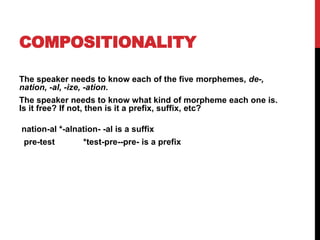
The speaker needs to know each of the five morphemes, de-,
nation, -al, -ize, -ation.
The speaker needs to know what kind of morpheme each one is.
Is it free? If not, then is it a prefix, suffix, etc?
nation-al *-alnation- -al is a suffix
pre-test *test-pre--pre- is a prefix
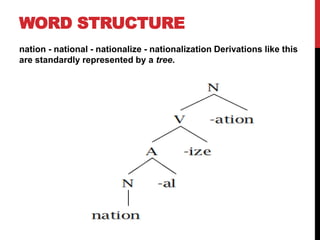
WORD STRUCTURE
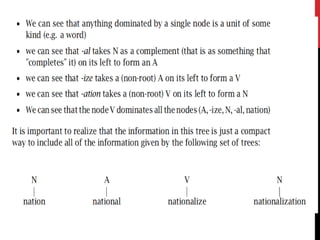
nation - national - nationalize - nationalization Derivations like this
are standardly represented by a tree.
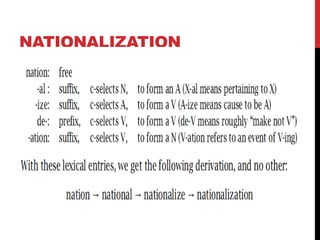
NATIONALIZATION
Word sense, notions
Word sense, notions

Word sense, notions

  • 1.
  • 2.
    WORD CATEGORIES Open classcategories: (new words can be freely created in these categories) Noun (N) table, computer, event, joy, action Verb (V) run, arrive, laugh, know, love, think, say, spray Adjective (A) big, yellow, stable, intelligent, legal, fake Adverb (Adv) badly, curiously, possibly, often
  • 3.
    CLOSED CATEGORIES Preposition (P)on, of, by, through, into, from, for, to Determiner (D) the, a, this, some, every Numerals (Num) one, two, three, ten, thirteen Complementizers (C) that, if, whether, for Auxiliaries (V) have, be Modals (v or M) will, would, can, could, may, might, shall, should Coordinators (Coord) and, or, but Negation/Affirmation (Neg/Aff) no ,too
  • 4.
    “SUBCATEGORIES” OF VERBS manner adverbs:slowly, carefully, quickly degree adverbs: too, enough frequency adverbs: often, rarely, always modal adverbs: possibly, probably
  • 5.
    WORD AFFIXES simplest meaningfulunits, the “semantic atoms,” are often called morphemes. Words can have more than one morpheme in them. book book-s, table table-s
  • 6.
    DETERMINERS: Articles: a, the Demonstratives:that, this, these, those quantifiers: some, every, each, no
  • 7.
    AFFIXES I dance presenttense (meaning habitually, or at least sometimes) I danc-ed past tense I am danc-ing present am progressive -ing (meaning I’m dancing now)
  • 8.
    SYNTACTIC CONTEXTS This is mymost_________book (Certain choices of words will yield well , others will not) ----- interesting, valuable, linguistic * John, slept, carefully, This frame only allows adjectives (A) in the space, but not all adjectives
  • 9.
    FOLLOWING A DETERMINER The______ ishere ----- book, milk ,furniture *big, grow, very
  • 10.
    MODIFIERS a word thatmodifies a verb is probably an adverb of some kind, and similarly for other categories: Categ ory Modifier Example V Adv [V stop] stop suddenly (a way of stopping) N A(djective) [N stop] sudden stop (a type of stop) P Intensifier [P in] the middle right in the middle, smack in the middle A Degree [A sad] very sad, too sad, more sad Adv Degree [Adv sadly] very sadly, too sadly, more
  • 11.
    MODIFIERS John was shooting- John was shooting accurately Assume we have independently established that accurately is an adverb; since shooting accurately is a way of shooting, we can conclude that in this sentence, shooting is a verb (V). Similarly, in: I resent any unnecessary shooting of lions we conclude from the fact that unnecessary is an adjective, and from the fact that an unnecessary shooting is a type of shooting that in this sentence, shooting is a noun (N). The reverse may hold true: John shot - John shot accurately Since shot is the past tense of shoot, we know that shot is a verb in this sentence. Since accurately modifies it, we may conclude that accurately is an adverb.
  • 12.
    COMPLEMENTARY DISTRIBUTION two words havingthe same category is available when the two words have complementary distribution, by which we mean that in a given context, either one of two elements may occur but not both. For x. _________ books only certain words can occur: the or these. the and these are in complementary distribution: if one appears, the other cannot.
  • 13.
    AFFIXES prefixes: pre-test, post-test, ex-husband,dis-appear, un-qualified, re- think, in-accurate suffixes: test-s, test-ed, test-able, nation-al-iz-ation infixes: Edu-ma-cation-Ghetto speak for ’education
  • 14.
    COMPOSITIONALITY denationalization: 1. Theaction of denationalizing, or the con- dition of being denationalized. 2. The action of removing (an industry, etc.) from national control and returning it to private ownership. The word nation is a free morpheme, and we can see that it is an N, since it can be modified by adjectives, and it can bear plural morphology The meaning of this word is built progressively from the meaning of its part: Nation-al characterizes a property that a nation can have. National - ize means make national. De-nationalize means undo the nationalizing. Denationaliz-ation is the process or the result of denationalizing.
  • 15.
    COMPOSITIONALITY The speaker needsto know each of the five morphemes, de-, nation, -al, -ize, -ation. The speaker needs to know what kind of morpheme each one is. Is it free? If not, then is it a prefix, suffix, etc? nation-al *-alnation- -al is a suffix pre-test *test-pre--pre- is a prefix
  • 16.
    WORD STRUCTURE nation -national - nationalize - nationalization Derivations like this are standardly represented by a tree.
  • 17.