Chemicals Regulation – Global Challenges Helsinki Chemicals Forum 2010 Lena Perenius Executive Director
Chemical Regulation- Global Challenges The Global Challenge: To ensure that, by the year 2020, chemicals are produced and used in ways that minimize significant adverse impacts on the environment and human health. 2002 Johannesburg World Summit on Sustainable Development  SAICM is the strategy and process to achieve that goal
Opportunities and Challenges To improve global regulatory systems Many regulatory developments around the world To increase Regulatory Convergence facilitating trade and a level playing field To introduce Smart Regulations Delivering desired results in the least burdensome way Allowing industry to innovate and to compete fairly and effectively
Trends in Regulatory Developments Implement Global Harmonised System for classification and labelling, Modernise and improve existing chemicals legislation Introduce a regulatory system for chemicals EU: REACH is Europe's contribution to SAICM  under implementation – gaining experience review in 2010
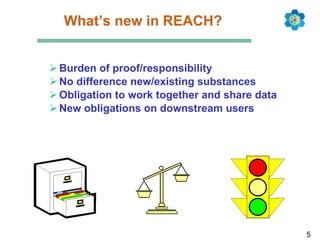
What’s new in REACH? Burden of proof/responsibility No difference new/existing substances Obligation to work together and share data New obligations on downstream users
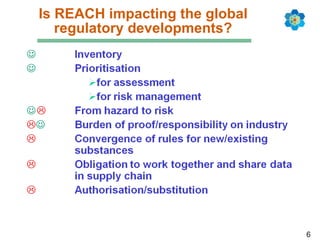
Is REACH impacting the global regulatory developments?
Possible barriers for REACH elements Burden of proof/responsibility Societal values and capacity Convergence new/existing substances Existing approach (if any) Data sharing Confidentiality, workability Authorisation Bureaucracy, cost REACH is comprehensive and ambitious – Is it the “smartest”? Complex and costly with workability issues still to be solved
Cooperation contributing to  regulatory convergence Making it happen UN, OECD, Governments, Industry Global Chemicals Industry: Responsible Care Global Charter Product Stewardship objective to “ Enhance the management of chemical products worldwide” Global Product Strategy Industry’s contribution to SAICM and convergence Risk characterization and risk management measures for chemicals in commerce until the year 2018
ICCA vision Global Product Strategy (GPS) By 2020, through a combination of voluntary and regulatory initiatives, we will have: Established a base-set of hazard and exposure information adequate to conduct  safety assessments for chemicals in commerce Provided global capacity to implement best assessment practices and management procedures, especially in developing countries Shared relevant product information with co-producers, governments and the public  Worked across the value chain so suppliers and customers can effectively evaluate the risks and enhance their performance Made information on chemicals publicly available  (GPS IT-portal via http://www.icca-chem.org/.) 05/25/10
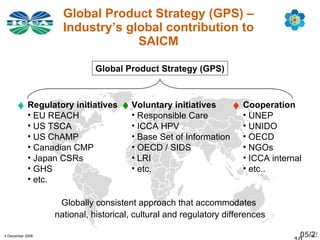
Global Product Strategy (GPS) – Industry’s global contribution to SAICM 05/25/10 4 December 2008 Global Product Strategy (GPS) Globally consistent approach that accommodates  national, historical, cultural and regulatory differences  Voluntary initiatives Responsible Care ICCA HPV Base Set of Information OECD / SIDS LRI etc.    Regulatory initiatives EU REACH US TSCA US ChAMP Canadian CMP Japan CSRs GHS etc.  Cooperation UNEP UNIDO OECD NGOs ICCA internal etc..
Back-up slides
Benefits of GPS implementation Even level playing field of the global conditions of competition (through harmonization of global product safety standards) Improvement of global chemicals management Open access to relevant product safety information for co-producers, governments and the public Joint information base for chemicals supports classification and labeling under GHS Achieving a balance between regulation and voluntary industry commitments. The goal is a single global standard in Product Safety Global harmonization of chemicals management systems will eventually help to reduce trade barriers.  05/25/10
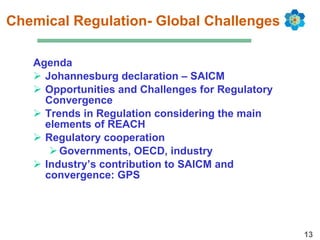
Chemical Regulation- Global Challenges Agenda Johannesburg declaration – SAICM Opportunities and Challenges for Regulatory Convergence Trends in Regulation considering the main elements of REACH Regulatory cooperation Governments, OECD, industry Industry’s contribution to SAICM and convergence: GPS

Lena Perenius of Cefic discusses global chemicals regulation

  • 1.
    Chemicals Regulation –Global Challenges Helsinki Chemicals Forum 2010 Lena Perenius Executive Director
  • 2.
    Chemical Regulation- GlobalChallenges The Global Challenge: To ensure that, by the year 2020, chemicals are produced and used in ways that minimize significant adverse impacts on the environment and human health. 2002 Johannesburg World Summit on Sustainable Development SAICM is the strategy and process to achieve that goal
  • 3.
    Opportunities and ChallengesTo improve global regulatory systems Many regulatory developments around the world To increase Regulatory Convergence facilitating trade and a level playing field To introduce Smart Regulations Delivering desired results in the least burdensome way Allowing industry to innovate and to compete fairly and effectively
  • 4.
    Trends in RegulatoryDevelopments Implement Global Harmonised System for classification and labelling, Modernise and improve existing chemicals legislation Introduce a regulatory system for chemicals EU: REACH is Europe's contribution to SAICM under implementation – gaining experience review in 2010
  • 5.
    What’s new inREACH? Burden of proof/responsibility No difference new/existing substances Obligation to work together and share data New obligations on downstream users
  • 6.
    Is REACH impactingthe global regulatory developments?
  • 7.
    Possible barriers forREACH elements Burden of proof/responsibility Societal values and capacity Convergence new/existing substances Existing approach (if any) Data sharing Confidentiality, workability Authorisation Bureaucracy, cost REACH is comprehensive and ambitious – Is it the “smartest”? Complex and costly with workability issues still to be solved
  • 8.
    Cooperation contributing to regulatory convergence Making it happen UN, OECD, Governments, Industry Global Chemicals Industry: Responsible Care Global Charter Product Stewardship objective to “ Enhance the management of chemical products worldwide” Global Product Strategy Industry’s contribution to SAICM and convergence Risk characterization and risk management measures for chemicals in commerce until the year 2018
  • 9.
    ICCA vision GlobalProduct Strategy (GPS) By 2020, through a combination of voluntary and regulatory initiatives, we will have: Established a base-set of hazard and exposure information adequate to conduct safety assessments for chemicals in commerce Provided global capacity to implement best assessment practices and management procedures, especially in developing countries Shared relevant product information with co-producers, governments and the public Worked across the value chain so suppliers and customers can effectively evaluate the risks and enhance their performance Made information on chemicals publicly available (GPS IT-portal via http://www.icca-chem.org/.) 05/25/10
  • 10.
    Global Product Strategy(GPS) – Industry’s global contribution to SAICM 05/25/10 4 December 2008 Global Product Strategy (GPS) Globally consistent approach that accommodates national, historical, cultural and regulatory differences  Voluntary initiatives Responsible Care ICCA HPV Base Set of Information OECD / SIDS LRI etc.  Regulatory initiatives EU REACH US TSCA US ChAMP Canadian CMP Japan CSRs GHS etc.  Cooperation UNEP UNIDO OECD NGOs ICCA internal etc..
  • 11.
  • 12.
    Benefits of GPSimplementation Even level playing field of the global conditions of competition (through harmonization of global product safety standards) Improvement of global chemicals management Open access to relevant product safety information for co-producers, governments and the public Joint information base for chemicals supports classification and labeling under GHS Achieving a balance between regulation and voluntary industry commitments. The goal is a single global standard in Product Safety Global harmonization of chemicals management systems will eventually help to reduce trade barriers. 05/25/10
  • 13.
    Chemical Regulation- GlobalChallenges Agenda Johannesburg declaration – SAICM Opportunities and Challenges for Regulatory Convergence Trends in Regulation considering the main elements of REACH Regulatory cooperation Governments, OECD, industry Industry’s contribution to SAICM and convergence: GPS