Hazardous
Waste Training
What we will cover
• History
• Regulations
• Practical Applications
• Best Practices
Resource Conservation and
Recovery Act (RCRA)
Passed by Congress in 1976 to provide a
cradle-to-grave management of hazardous
waste
Enforced by the following governmental
agencies:
• Federal - Environmental Protection Agency
(EPA)
• State – Tennessee Department of
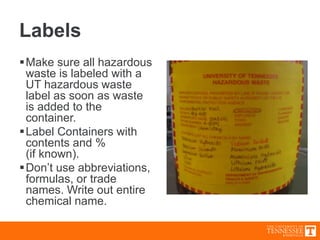
Environment and Conservation (TDEC)
• UT has a Hazardous Waste Policy found
on the EHS web-site: ehs.utk.edu
Training Requirements
EPA and TDEC require documented
training for individuals who handle
and/or generate hazardous waste
What is a Hazardous Waste?
Hazardous Waste is
defined by the EPA as:
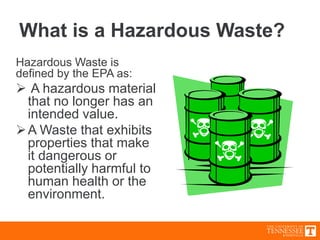
 A hazardous material
that no longer has an
intended value.
A Waste that exhibits
properties that make
it dangerous or
potentially harmful to
human health or the
environment.
Fast Facts about Hazardous
Waste on Campus
• UT Knoxville generates and disposes of roughly 18
tons of hazardous waste per year.
• UT ships approximately 600-800 containers of
hazardous waste for disposal at a cost of roughly
250K each year.
• We typically incinerate or recycle the waste. We
don’t landfill the waste.
• EHS punctures the aerosol cans that are collected
throughout campus (including the “Rock”, we
puncture the can, collect the contents and recycle
the steel cans.
4 Categories of Hazardous
Waste:
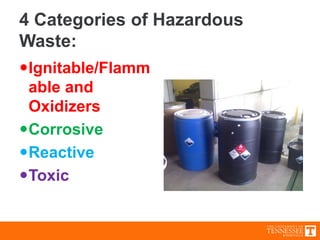
Ignitable/Flamm
able and
Oxidizers
Corrosive
Reactive
Toxic
4 Categories of Hazardous
Waste:
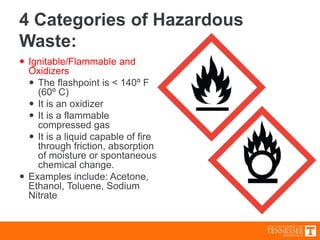
 Ignitable/Flammable and
Oxidizers
 The flashpoint is < 140º F
(60º C)
 It is an oxidizer
 It is a flammable
compressed gas
 It is a liquid capable of fire
through friction, absorption
of moisture or spontaneous
chemical change.
 Examples include: Acetone,
Ethanol, Toluene, Sodium
Nitrate
4 Categories of Hazardous
Waste:
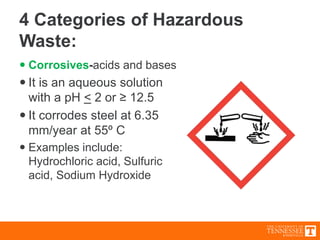
 Corrosives-acids and bases
 It is an aqueous solution
with a pH < 2 or ≥ 12.5
 It corrodes steel at 6.35
mm/year at 55º C
 Examples include:
Hydrochloric acid, Sulfuric
acid, Sodium Hydroxide
4 Categories of Hazardous
Waste:
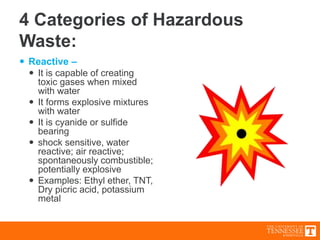
 Reactive –
 It is capable of creating
toxic gases when mixed
with water
 It forms explosive mixtures
with water
 It is cyanide or sulfide
bearing
 shock sensitive, water
reactive; air reactive;
spontaneously combustible;
potentially explosive
 Examples: Ethyl ether, TNT,
Dry picric acid, potassium
metal
4 Categories of Hazardous
Waste:
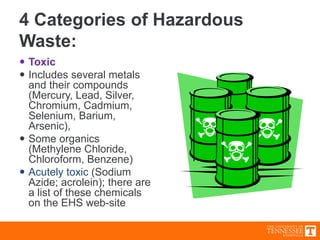
 Toxic
 Includes several metals
and their compounds
(Mercury, Lead, Silver,
Chromium, Cadmium,
Selenium, Barium,
Arsenic),
 Some organics
(Methylene Chloride,
Chloroform, Benzene)
 Acutely toxic (Sodium
Azide; acrolein); there are
a list of these chemicals
on the EHS web-site
Examples of Hazardous Waste in
Laboratories:
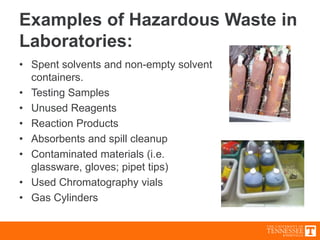
• Spent solvents and non-empty solvent
containers.
• Testing Samples
• Unused Reagents
• Reaction Products
• Absorbents and spill cleanup
• Contaminated materials (i.e.
glassware, gloves; pipet tips)
• Used Chromatography vials
• Gas Cylinders
Hazardous Waste Exclusions
The following categories of waste are
not considered hazardous waste for
this program:
1. Sewage
2. Regular trash
3. Universal waste (fluorescent
bulbs, batteries)
4. Radioactive and biohazard
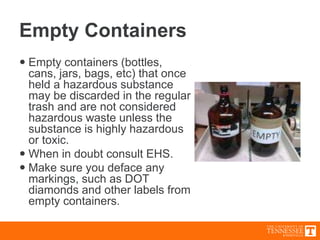
Steps to Hazardous Waste
Management
• Determine if it is a
hazardous waste
• Find an appropriate
waste container
• Label waste
• Ensure waste is stored
properly
• Bring to EHS for
disposal
Container Management
• Contents must be compatible with container
material
• The container (lid) must be closed except
when adding or removing waste
• Must be in good condition (no cracks or rust)
• Clean on outside; leakproof
• Use separate waste containers for different
wastestreams to avoid unwanted reactions; be
careful mixing waste.
• For large quantities, EHS can provide 30 or 50
gallon drums or 5 gallon plastic containers.
Empty Containers
 Empty containers (bottles,
cans, jars, bags, etc) that once
held a hazardous substance
may be discarded in the regular
trash and are not considered
hazardous waste unless the
substance is highly hazardous
or toxic.
 When in doubt consult EHS.
 Make sure you deface any
markings, such as DOT
diamonds and other labels from
empty containers.
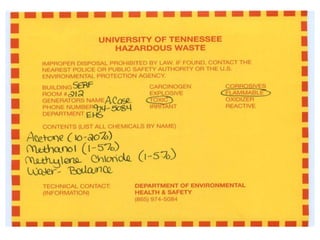
Labels
Make sure all hazardous
waste is labeled with a
UT hazardous waste
label as soon as waste
is added to the
container.
Label Containers with
contents and %
(if known).
Don’t use abbreviations,
formulas, or trade
names. Write out entire
chemical name.
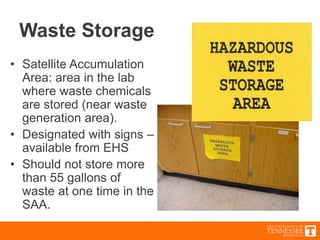
Waste Storage
• Satellite Accumulation
Area: area in the lab
where waste chemicals
are stored (near waste
generation area).
• Designated with signs –
available from EHS
• Should not store more
than 55 gallons of
waste at one time in the
SAA.
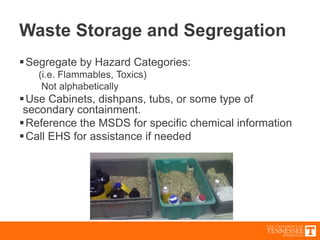
Waste Storage and Segregation
Segregate by Hazard Categories:
(i.e. Flammables, Toxics)
Not alphabetically
Use Cabinets, dishpans, tubs, or some type of
secondary containment.
Reference the MSDS for specific chemical information
Call EHS for assistance if needed
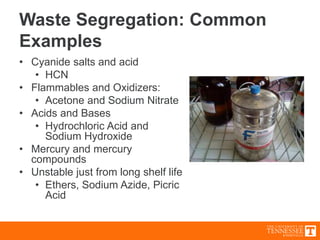
Waste Segregation: Common
Examples
• Cyanide salts and acid
• HCN
• Flammables and Oxidizers:
• Acetone and Sodium Nitrate
• Acids and Bases
• Hydrochloric Acid and
Sodium Hydroxide
• Mercury and mercury
compounds
• Unstable just from long shelf life
• Ethers, Sodium Azide, Picric
Acid
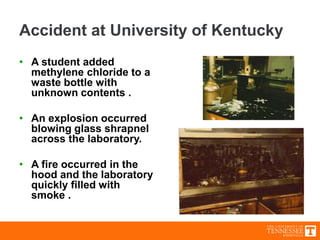
Accident at University of Kentucky
• A student added
methylene chloride to a
waste bottle with
unknown contents .
• An explosion occurred
blowing glass shrapnel
across the laboratory.
• A fire occurred in the
hood and the laboratory
quickly filled with
smoke .
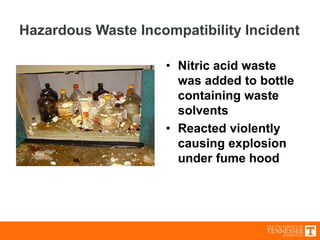
Hazardous Waste Incompatibility Incident
• Nitric acid waste
was added to bottle
containing waste
solvents
• Reacted violently
causing explosion
under fume hood
Hazardous Waste Disposal
 Dispose of all hazardous
waste through EHS.
 Do not pour waste down the
sink or throw away in the
trash.
 “Dilution is NOT the
Solution”
 If you are not sure if waste is
hazardous, assume worst
case and manage as
hazardous waste.
 Any questions?
Contact EHS.
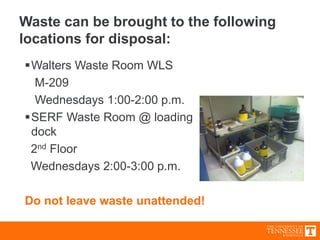
Waste can be brought to the following
locations for disposal:
Walters Waste Room WLS
M-209
Wednesdays 1:00-2:00 p.m.
SERF Waste Room @ loading
dock
2nd Floor
Wednesdays 2:00-3:00 p.m.
Do not leave waste unattended!
Spills
Clean-up small spills
if you:
Have materials to
absorb and bag the
spilled material
Are familiar with the
properties of the
spilled materials
Have the proper
personal protective
equipment
Know spilled acids or
bases are dilute
Do not clean-up a
spill if you:
Don’t know the identity
of the chemical
Lack the knowledge to
safely handle the spill
Feel the spill is unsafe
to clean up
If a spilled chemical
enters the drain, soil or
water body
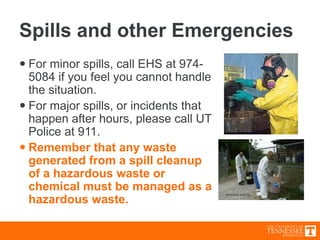
Spills and other Emergencies
 For minor spills, call EHS at 974-
5084 if you feel you cannot handle
the situation.
 For major spills, or incidents that
happen after hours, please call UT
Police at 911.
 Remember that any waste
generated from a spill cleanup
of a hazardous waste or
chemical must be managed as a
hazardous waste.
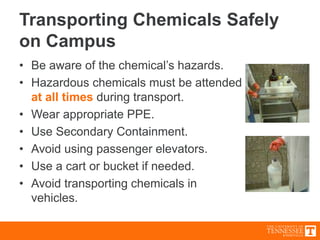
Transporting Chemicals Safely
on Campus
• Be aware of the chemical’s hazards.
• Hazardous chemicals must be attended
at all times during transport.
• Wear appropriate PPE.
• Use Secondary Containment.
• Avoid using passenger elevators.
• Use a cart or bucket if needed.
• Avoid transporting chemicals in
vehicles.
UTK’s Hazardous Waste
Minimization Policy
State regulations require the university write and
implement a hazardous waste reduction and waste
minimization plan.
In 2007, UT Knoxville disposed of approximately
60,000 pounds of hazardous waste at a cost of
$230,042.05.
A copy of the plan is found on the EHS web-site
Contact EHS (x5084) to discuss hazardous waste
reduction activities – even activities that have
occurred in the past. We must document these
efforts in the policy.
UT has a Mercury Reduction Policy
Hazardous Waste Minimization
Ideas
• Substitution with a non-hazardous
substance
• EHS Chemical Exchange Program
• Microchemistry or reduced volumes
• Avoid mixing or contamination with
non-hazardous substances
• Distillation of solvents
• Buy only the amount of chemicals
you need
Be Vigilant
• We are regularly inspected by TDEC
• Citations can result in fines.
• Hazardous waste containers must
be kept closed, properly labeled, in
good condition, acceptable for the
contents and properly stored.
• Labels and regulatory guidance are
available from EHS (x5084)
• Strive for hazardous waste reduction
and waste minimization
• If you have any questions, please
call EHS.
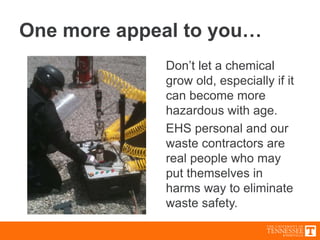
One more appeal to you…
Don’t let a chemical
grow old, especially if it
can become more
hazardous with age.
EHS personal and our
waste contractors are
real people who may
put themselves in
harms way to eliminate
waste safety.
Contact Information
• Hazardous Waste: Steve Crouch; scrouch4@utk.edu
• Lab Safety: Pam Koontz; ehs_labsafety@utk.edu
• Knoxville Fire Department,
Knoxville Police or Ambulance Service 911
• UT Police 974-3111 (call 911 first)
• Environmental Health & Safety 974-5084
• Radiation Safety Dept. 974–5580
• Bio-safety Dept. 974-1938
• Recycling Coordinator (Jay Price): 974-3480
www.osha.com
http://www.state.tn.us/labor-wfd/
http://www.cdc.gov/
www.ehs.utk.edu
EHS at 974-5084
Information Sources

Hazardous Waste UTK

  • 1.
  • 2.
    What we willcover • History • Regulations • Practical Applications • Best Practices
  • 3.
    Resource Conservation and RecoveryAct (RCRA) Passed by Congress in 1976 to provide a cradle-to-grave management of hazardous waste Enforced by the following governmental agencies: • Federal - Environmental Protection Agency (EPA) • State – Tennessee Department of Environment and Conservation (TDEC) • UT has a Hazardous Waste Policy found on the EHS web-site: ehs.utk.edu
  • 4.
    Training Requirements EPA andTDEC require documented training for individuals who handle and/or generate hazardous waste
  • 5.
    What is aHazardous Waste? Hazardous Waste is defined by the EPA as:  A hazardous material that no longer has an intended value. A Waste that exhibits properties that make it dangerous or potentially harmful to human health or the environment.
  • 6.
    Fast Facts aboutHazardous Waste on Campus • UT Knoxville generates and disposes of roughly 18 tons of hazardous waste per year. • UT ships approximately 600-800 containers of hazardous waste for disposal at a cost of roughly 250K each year. • We typically incinerate or recycle the waste. We don’t landfill the waste. • EHS punctures the aerosol cans that are collected throughout campus (including the “Rock”, we puncture the can, collect the contents and recycle the steel cans.
  • 7.
    4 Categories ofHazardous Waste: Ignitable/Flamm able and Oxidizers Corrosive Reactive Toxic
  • 8.
    4 Categories ofHazardous Waste:  Ignitable/Flammable and Oxidizers  The flashpoint is < 140º F (60º C)  It is an oxidizer  It is a flammable compressed gas  It is a liquid capable of fire through friction, absorption of moisture or spontaneous chemical change.  Examples include: Acetone, Ethanol, Toluene, Sodium Nitrate
  • 9.
    4 Categories ofHazardous Waste:  Corrosives-acids and bases  It is an aqueous solution with a pH < 2 or ≥ 12.5  It corrodes steel at 6.35 mm/year at 55º C  Examples include: Hydrochloric acid, Sulfuric acid, Sodium Hydroxide
  • 10.
    4 Categories ofHazardous Waste:  Reactive –  It is capable of creating toxic gases when mixed with water  It forms explosive mixtures with water  It is cyanide or sulfide bearing  shock sensitive, water reactive; air reactive; spontaneously combustible; potentially explosive  Examples: Ethyl ether, TNT, Dry picric acid, potassium metal
  • 11.
    4 Categories ofHazardous Waste:  Toxic  Includes several metals and their compounds (Mercury, Lead, Silver, Chromium, Cadmium, Selenium, Barium, Arsenic),  Some organics (Methylene Chloride, Chloroform, Benzene)  Acutely toxic (Sodium Azide; acrolein); there are a list of these chemicals on the EHS web-site
  • 12.
    Examples of HazardousWaste in Laboratories: • Spent solvents and non-empty solvent containers. • Testing Samples • Unused Reagents • Reaction Products • Absorbents and spill cleanup • Contaminated materials (i.e. glassware, gloves; pipet tips) • Used Chromatography vials • Gas Cylinders
  • 13.
    Hazardous Waste Exclusions Thefollowing categories of waste are not considered hazardous waste for this program: 1. Sewage 2. Regular trash 3. Universal waste (fluorescent bulbs, batteries) 4. Radioactive and biohazard
  • 14.
    Steps to HazardousWaste Management • Determine if it is a hazardous waste • Find an appropriate waste container • Label waste • Ensure waste is stored properly • Bring to EHS for disposal
  • 15.
    Container Management • Contentsmust be compatible with container material • The container (lid) must be closed except when adding or removing waste • Must be in good condition (no cracks or rust) • Clean on outside; leakproof • Use separate waste containers for different wastestreams to avoid unwanted reactions; be careful mixing waste. • For large quantities, EHS can provide 30 or 50 gallon drums or 5 gallon plastic containers.
  • 16.
    Empty Containers  Emptycontainers (bottles, cans, jars, bags, etc) that once held a hazardous substance may be discarded in the regular trash and are not considered hazardous waste unless the substance is highly hazardous or toxic.  When in doubt consult EHS.  Make sure you deface any markings, such as DOT diamonds and other labels from empty containers.
  • 17.
    Labels Make sure allhazardous waste is labeled with a UT hazardous waste label as soon as waste is added to the container. Label Containers with contents and % (if known). Don’t use abbreviations, formulas, or trade names. Write out entire chemical name.
  • 19.
    Waste Storage • SatelliteAccumulation Area: area in the lab where waste chemicals are stored (near waste generation area). • Designated with signs – available from EHS • Should not store more than 55 gallons of waste at one time in the SAA.
  • 20.
    Waste Storage andSegregation Segregate by Hazard Categories: (i.e. Flammables, Toxics) Not alphabetically Use Cabinets, dishpans, tubs, or some type of secondary containment. Reference the MSDS for specific chemical information Call EHS for assistance if needed
  • 21.
    Waste Segregation: Common Examples •Cyanide salts and acid • HCN • Flammables and Oxidizers: • Acetone and Sodium Nitrate • Acids and Bases • Hydrochloric Acid and Sodium Hydroxide • Mercury and mercury compounds • Unstable just from long shelf life • Ethers, Sodium Azide, Picric Acid
  • 22.
    Accident at Universityof Kentucky • A student added methylene chloride to a waste bottle with unknown contents . • An explosion occurred blowing glass shrapnel across the laboratory. • A fire occurred in the hood and the laboratory quickly filled with smoke .
  • 23.
    Hazardous Waste IncompatibilityIncident • Nitric acid waste was added to bottle containing waste solvents • Reacted violently causing explosion under fume hood
  • 24.
    Hazardous Waste Disposal Dispose of all hazardous waste through EHS.  Do not pour waste down the sink or throw away in the trash.  “Dilution is NOT the Solution”  If you are not sure if waste is hazardous, assume worst case and manage as hazardous waste.  Any questions? Contact EHS.
  • 25.
    Waste can bebrought to the following locations for disposal: Walters Waste Room WLS M-209 Wednesdays 1:00-2:00 p.m. SERF Waste Room @ loading dock 2nd Floor Wednesdays 2:00-3:00 p.m. Do not leave waste unattended!
  • 26.
    Spills Clean-up small spills ifyou: Have materials to absorb and bag the spilled material Are familiar with the properties of the spilled materials Have the proper personal protective equipment Know spilled acids or bases are dilute Do not clean-up a spill if you: Don’t know the identity of the chemical Lack the knowledge to safely handle the spill Feel the spill is unsafe to clean up If a spilled chemical enters the drain, soil or water body
  • 27.
    Spills and otherEmergencies  For minor spills, call EHS at 974- 5084 if you feel you cannot handle the situation.  For major spills, or incidents that happen after hours, please call UT Police at 911.  Remember that any waste generated from a spill cleanup of a hazardous waste or chemical must be managed as a hazardous waste.
  • 28.
    Transporting Chemicals Safely onCampus • Be aware of the chemical’s hazards. • Hazardous chemicals must be attended at all times during transport. • Wear appropriate PPE. • Use Secondary Containment. • Avoid using passenger elevators. • Use a cart or bucket if needed. • Avoid transporting chemicals in vehicles.
  • 29.
    UTK’s Hazardous Waste MinimizationPolicy State regulations require the university write and implement a hazardous waste reduction and waste minimization plan. In 2007, UT Knoxville disposed of approximately 60,000 pounds of hazardous waste at a cost of $230,042.05. A copy of the plan is found on the EHS web-site Contact EHS (x5084) to discuss hazardous waste reduction activities – even activities that have occurred in the past. We must document these efforts in the policy. UT has a Mercury Reduction Policy
  • 30.
    Hazardous Waste Minimization Ideas •Substitution with a non-hazardous substance • EHS Chemical Exchange Program • Microchemistry or reduced volumes • Avoid mixing or contamination with non-hazardous substances • Distillation of solvents • Buy only the amount of chemicals you need
  • 31.
    Be Vigilant • Weare regularly inspected by TDEC • Citations can result in fines. • Hazardous waste containers must be kept closed, properly labeled, in good condition, acceptable for the contents and properly stored. • Labels and regulatory guidance are available from EHS (x5084) • Strive for hazardous waste reduction and waste minimization • If you have any questions, please call EHS.
  • 32.
    One more appealto you… Don’t let a chemical grow old, especially if it can become more hazardous with age. EHS personal and our waste contractors are real people who may put themselves in harms way to eliminate waste safety.
  • 33.
    Contact Information • HazardousWaste: Steve Crouch; scrouch4@utk.edu • Lab Safety: Pam Koontz; ehs_labsafety@utk.edu • Knoxville Fire Department, Knoxville Police or Ambulance Service 911 • UT Police 974-3111 (call 911 first) • Environmental Health & Safety 974-5084 • Radiation Safety Dept. 974–5580 • Bio-safety Dept. 974-1938 • Recycling Coordinator (Jay Price): 974-3480
  • 34.

Editor's Notes

  • #4 Love Canal, NY Hooker Chemical began dumping chemicals in 1941 School built on the old dump site in 1954 School and nearby houses became affected Cancer rates increased and an emergency was declared Times Beach, MO Dioxin contaminated oil used to control dust on town roads in 1972 Government spent 32 million to buy resident homes in 1982-83 after numerous people and animals became sick Maintains Healthy Work Environment Ensure compliance Reduced costs (proper I.D., generation reduction, and disposal procedures) Promotes efficiency in research Sets good example for community
  • #6 Maintains Healthy Work Environment Ensure compliance Reduced costs (proper I.D., generation reduction, and disposal procedures) Promotes efficiency in research Sets good example for community
  • #7 In 2007, UT Knoxville disposed of approximately 60,000 pounds of hazardous waste at a cost of $230,042.05.
  • #8 Corrosive: Hydrochloric acid; Sodium Hydroxide Ignitable: Typically have flash point <140F. Acetone, Methanol, Ethanol; ammonium nitrate (oxidizer) potassium permanganate; sodium nitrate Reactive: Alkali metals (lithium, sodium) are water reactive; sulfites, dry picric acid cyanides; explosives; dry picric acid; expired ethyl ethers; sulfide containing wastes, “yl” chlorides and fluorides. Toxic: lead, mercury, sodium azide, benzene, arsenic; tetrachloroethylene Some are acutely toxic, which are very dangerous: i.e. sodium azide, arsenic compounds cyanide compounds Examples of acutely toxicsodium azide, cyanides, arsenic compounds, some pesticides, and acrolein.
  • #9 Corrosive: Hydrochloric acid; Sodium Hydroxide Ignitable: Typically have flash point <140F. Acetone, Methanol, Ethanol; ammonium nitrate (oxidizer) potassium permanganate; sodium nitrate Reactive: Alkali metals (lithium, sodium) are water reactive; sulfites, dry picric acid cyanides; explosives; dry picric acid; expired ethyl ethers; sulfide containing wastes, “yl” chlorides and fluorides. Toxic: lead, mercury, sodium azide, benzene, arsenic; tetrachloroethylene Some are acutely toxic, which are very dangerous: i.e. sodium azide, arsenic compounds cyanide compounds Examples of acutely toxicsodium azide, cyanides, arsenic compounds, some pesticides, and acrolein.
  • #10 Corrosive: Hydrochloric acid; Sodium Hydroxide Ignitable: Typically have flash point <140F. Acetone, Methanol, Ethanol; ammonium nitrate (oxidizer) potassium permanganate; sodium nitrate Reactive: Alkali metals (lithium, sodium) are water reactive; sulfites, dry picric acid cyanides; explosives; dry picric acid; expired ethyl ethers; sulfide containing wastes, “yl” chlorides and fluorides. Toxic: lead, mercury, sodium azide, benzene, arsenic; tetrachloroethylene Some are acutely toxic, which are very dangerous: i.e. sodium azide, arsenic compounds cyanide compounds Examples of acutely toxicsodium azide, cyanides, arsenic compounds, some pesticides, and acrolein.
  • #11 Corrosive: Hydrochloric acid; Sodium Hydroxide Ignitable: Typically have flash point <140F. Acetone, Methanol, Ethanol; ammonium nitrate (oxidizer) potassium permanganate; sodium nitrate Reactive: Alkali metals (lithium, sodium) are water reactive; sulfites, dry picric acid cyanides; explosives; dry picric acid; expired ethyl ethers; sulfide containing wastes, “yl” chlorides and fluorides. Toxic: lead, mercury, sodium azide, benzene, arsenic; tetrachloroethylene Some are acutely toxic, which are very dangerous: i.e. sodium azide, arsenic compounds cyanide compounds Examples of acutely toxicsodium azide, cyanides, arsenic compounds, some pesticides, and acrolein.
  • #12 Corrosive: Hydrochloric acid; Sodium Hydroxide Ignitable: Typically have flash point <140F. Acetone, Methanol, Ethanol; ammonium nitrate (oxidizer) potassium permanganate; sodium nitrate Reactive: Alkali metals (lithium, sodium) are water reactive; sulfites, dry picric acid cyanides; explosives; dry picric acid; expired ethyl ethers; sulfide containing wastes, “yl” chlorides and fluorides. Toxic: lead, mercury, sodium azide, benzene, arsenic; tetrachloroethylene Some are acutely toxic, which are very dangerous: i.e. sodium azide, arsenic compounds cyanide compounds Examples of acutely toxicsodium azide, cyanides, arsenic compounds, some pesticides, and acrolein.
  • #15 Corrosives in metal containers
  • #16 Corrosives in metal containers
  • #17 An empty container is defined by the EPA as one where: All product has been emptied using common practice No more than 1 inch of product residue remains in container No more than 3% by weight of the product remains (containers <110 gallons) Not sure, bring to us
  • #18 Abbreviations such as: HCL, MEK (methyl ethyl ketone);
  • #19 Evaporation of solvents in a hood is NOT acceptable Rinsing it down the drain is NOT acceptable Hiding it on the back of the shelf for 10 years is NOT acceptable Residual : bring the container to us High Toxicity: bring the container to us Not sure?: bring the container to us
  • #21 Nitric Acid is both Corrosive and an Oxidizer Glacial Acetic Acid is both Corrosive and Flammable
  • #27 Large spills Spills involving extremely hazardous chemicals Inadequate ventilation in spill area No spill clean-up materials Personnel uncomfortable handling clean-up If a spilled chemical enters the drain, soil or water body
  • #31 -use water-based solvents;substitute ethanol thermometers for mercury thermometers -don’t use chromic acid to clean glassware; use other speciality detergents