Group 2
Bussines Crime
Ilegal Logging
Abdul Faruq
18121993
Amin Yusuf Wicaksono
18122279
Baharudin Yusuf
18121606
Beny Aryanto
18121473
Diena
18121565
Majid Abdul Aziz
18122186
Roby Novrialdi
18122653
Ilegal
LoggingBackground
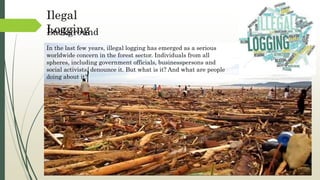
In the last few years, illegal logging has emerged as a serious
worldwide concern in the forest sector. Individuals from all
spheres, including government officials, businesspersons and
social activists, denounce it. But what is it? And what are people
doing about it?
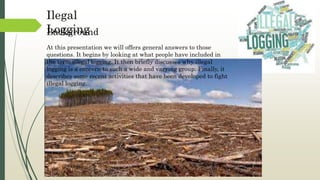
At this presentation we will offers general answers to those
questions. It begins by looking at what people have included in
the term illegal logging. It then briefly discusses why illegal
logging is a concern to such a wide and varying group. Finally, it
describes some recent activities that have been developed to fight
illegal logging.
Background
Ilegal
Logging
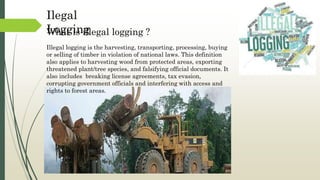
Illegal logging is the harvesting, transporting, processing, buying
or selling of timber in violation of national laws. This definition
also applies to harvesting wood from protected areas, exporting
threatened plant/tree species, and falsifying official documents. It
also includes breaking license agreements, tax evasion,
corrupting government officials and interfering with access and
rights to forest areas.
What is illegal logging ?
Ilegal
Logging
->Underreporting harvest volumes and tax payable
->Ignoring selective cutting guidelines
->Harvesting outside concession boundaries
->Falsifying log transport documents
->Accepting falsified log transport documents
->Timber can also be considered illegal if the plantations
are not properly managed. This includes:
->Clear-cutting natural forest, then failing to replant
->Not planting at rates required to maintain long-term
production
->Replanting with low-quality species
->Replanting at low density
Other examples of illegal logging are:
Ilegal
Logging
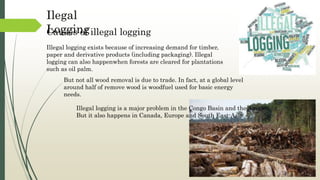
Illegal logging exists because of increasing demand for timber,
paper and derivative products (including packaging). Illegal
logging can also happenwhen forests are cleared for plantations
such as oil palm.
Causes of illegal logging
Ilegal
Logging
But not all wood removal is due to trade. In fact, at a global level
around half of remove wood is woodfuel used for basic energy
needs.
Illegal logging is a major problem in the Congo Basin and the Amazon.
But it also happens in Canada, Europe and South East-Asia.
Underneath this agreement lies a diversity of concerns about the
effects of illegal logging. These concerns include:
Why are people concerned about illegal logging?
Ilegal
Logging
 Environment: Illegal logging has destroyed forests and the
services they provide: sustainable fuel and fibre supplies,
wildlife habitat, water supplies, and other environmental
values.
 Commerce: Orderly conduct of business depends on enforcement of
property rights, honouring of contracts, and the even-handed
application of the law.
.
 • Governance: Illegal logging is a symptom of the failure to
administer justice effectively, and it feeds corruption and
organized crime
 • Revenues: Illegal logging has cost governments billions of
dollars in lost tax revenue and forest owners billions of dollars
in lost stumpage. Because illegal logging is often
unsustainable, it robs communities of future income
In August 1999, the Environmental Investigation Agency (EIA)
and Indonesian partners Telapak released a report in Jakarta
called The Final Cut, exposing the commercial logging of Tanjung
Putting National Park in Central Kalimantan, Indonesia.
Illegal Logging in Indonesia
Ilegal
Logging
by Faith Doherty, Environmental Investigation Agency
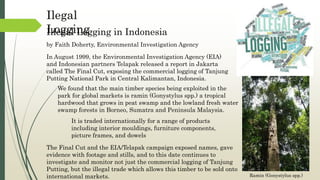
We found that the main timber species being exploited in the
park for global markets is ramin (Gonystylus spp.) a tropical
hardwood that grows in peat swamp and the lowland fresh water
swamp forests in Borneo, Sumatra and Peninsula Malaysia.
Ramin (Gonystylus spp.)
It is traded internationally for a range of products
including interior mouldings, furniture components,
picture frames, and dowels
The Final Cut and the EIA/Telapak campaign exposed names, gave
evidence with footage and stills, and to this date continues to
investigate and monitor not just the commercial logging of Tanjung
Putting, but the illegal trade which allows this timber to be sold onto
international markets.
Actors Illegal Logging
Ilegal
Logging
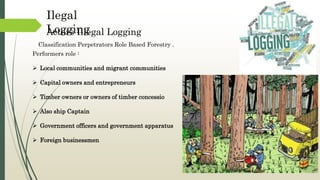
Performers role :
 Local communities and migrant communities
 Capital owners and entrepreneurs
 Timber owners or owners of timber concessio
 Also ship Captain
 Government officers and government apparatus
 Foreign businessmen
Classification Perpetrators Role Based Forestry .
Actors Illegal Logging
Ilegal
Logging
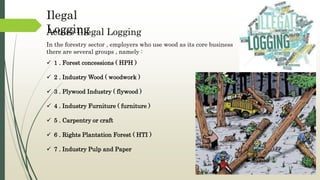
 1 . Forest concessions ( HPH )
 2 . Industry Wood ( woodwork )
 3 . Plywood Industry ( flywood )
 4 . Industry Furniture ( furniture )
 5 . Carpentry or craft
 6 . Rights Plantation Forest ( HTI )
 7 . Industry Pulp and Paper
In the forestry sector , employers who use wood as its core business
there are several groups , namely :
Policy Recommendations
Ilegal
Logging
1. Providing legal sanctions to the law enforcement agencies (military, police,
Prosecutor, Judge, Customs) and government officials (Forestry Employees at
all levels of government levels ranging from central, provincial and district /
city) is known to be backing and perpetrator forest crime
2. Revise any form of legislation that is no longer compatible with the current
condition of forests in Indonesia as a whole
3. Restoring forestry management in an integrated manner to traditional
communities by providing incentives to the people who can keep their forests
well.
4. Provide a clear affirmation of the limits on all types of forests.
5. Perform reforestation and sustainable way to get back the forest that had
been abandoned by HPH and HTI.
After discussing about illegal logging and illegal logging as well as
product legislation related to forestry, it can be made the following
policy recommendations:
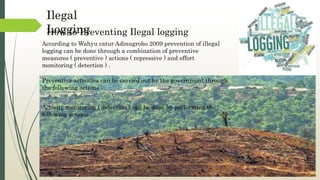
According to Wahyu catur Adinugroho 2009 prevention of illegal
logging can be done through a combination of preventive
measures ( preventive ) actions ( repressive ) and effort
monitoring ( detection ) .
How to Preventing Ilegal logging
Ilegal
Logging
Preventive activities can be carried out by the government through
the following actions :
Activity monitoring ( detection ) can be done by performing the
following actions :
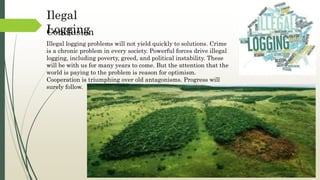
Illegal logging problems will not yield quickly to solutions. Crime
is a chronic problem in every society. Powerful forces drive illegal
logging, including poverty, greed, and political instability. These
will be with us for many years to come. But the attention that the
world is paying to the problem is reason for optimism.
Cooperation is triumphing over old antagonisms. Progress will
surely follow.
Conclusion
Ilegal
Logging
Thanks For Attention !
Ilegal
Logging
We would say thanks to G

Ilegal logging

  • 1.
    Group 2 Bussines Crime IlegalLogging Abdul Faruq 18121993 Amin Yusuf Wicaksono 18122279 Baharudin Yusuf 18121606 Beny Aryanto 18121473 Diena 18121565 Majid Abdul Aziz 18122186 Roby Novrialdi 18122653
  • 3.
    Ilegal LoggingBackground In the lastfew years, illegal logging has emerged as a serious worldwide concern in the forest sector. Individuals from all spheres, including government officials, businesspersons and social activists, denounce it. But what is it? And what are people doing about it?
  • 4.
    At this presentationwe will offers general answers to those questions. It begins by looking at what people have included in the term illegal logging. It then briefly discusses why illegal logging is a concern to such a wide and varying group. Finally, it describes some recent activities that have been developed to fight illegal logging. Background Ilegal Logging
  • 5.
    Illegal logging isthe harvesting, transporting, processing, buying or selling of timber in violation of national laws. This definition also applies to harvesting wood from protected areas, exporting threatened plant/tree species, and falsifying official documents. It also includes breaking license agreements, tax evasion, corrupting government officials and interfering with access and rights to forest areas. What is illegal logging ? Ilegal Logging
  • 6.
    ->Underreporting harvest volumesand tax payable ->Ignoring selective cutting guidelines ->Harvesting outside concession boundaries ->Falsifying log transport documents ->Accepting falsified log transport documents ->Timber can also be considered illegal if the plantations are not properly managed. This includes: ->Clear-cutting natural forest, then failing to replant ->Not planting at rates required to maintain long-term production ->Replanting with low-quality species ->Replanting at low density Other examples of illegal logging are: Ilegal Logging
  • 7.
    Illegal logging existsbecause of increasing demand for timber, paper and derivative products (including packaging). Illegal logging can also happenwhen forests are cleared for plantations such as oil palm. Causes of illegal logging Ilegal Logging But not all wood removal is due to trade. In fact, at a global level around half of remove wood is woodfuel used for basic energy needs. Illegal logging is a major problem in the Congo Basin and the Amazon. But it also happens in Canada, Europe and South East-Asia.
  • 8.
    Underneath this agreementlies a diversity of concerns about the effects of illegal logging. These concerns include: Why are people concerned about illegal logging? Ilegal Logging  Environment: Illegal logging has destroyed forests and the services they provide: sustainable fuel and fibre supplies, wildlife habitat, water supplies, and other environmental values.  Commerce: Orderly conduct of business depends on enforcement of property rights, honouring of contracts, and the even-handed application of the law. .  • Governance: Illegal logging is a symptom of the failure to administer justice effectively, and it feeds corruption and organized crime  • Revenues: Illegal logging has cost governments billions of dollars in lost tax revenue and forest owners billions of dollars in lost stumpage. Because illegal logging is often unsustainable, it robs communities of future income
  • 9.
    In August 1999,the Environmental Investigation Agency (EIA) and Indonesian partners Telapak released a report in Jakarta called The Final Cut, exposing the commercial logging of Tanjung Putting National Park in Central Kalimantan, Indonesia. Illegal Logging in Indonesia Ilegal Logging by Faith Doherty, Environmental Investigation Agency We found that the main timber species being exploited in the park for global markets is ramin (Gonystylus spp.) a tropical hardwood that grows in peat swamp and the lowland fresh water swamp forests in Borneo, Sumatra and Peninsula Malaysia. Ramin (Gonystylus spp.) It is traded internationally for a range of products including interior mouldings, furniture components, picture frames, and dowels The Final Cut and the EIA/Telapak campaign exposed names, gave evidence with footage and stills, and to this date continues to investigate and monitor not just the commercial logging of Tanjung Putting, but the illegal trade which allows this timber to be sold onto international markets.
  • 10.
    Actors Illegal Logging Ilegal Logging Performersrole :  Local communities and migrant communities  Capital owners and entrepreneurs  Timber owners or owners of timber concessio  Also ship Captain  Government officers and government apparatus  Foreign businessmen Classification Perpetrators Role Based Forestry .
  • 11.
    Actors Illegal Logging Ilegal Logging 1 . Forest concessions ( HPH )  2 . Industry Wood ( woodwork )  3 . Plywood Industry ( flywood )  4 . Industry Furniture ( furniture )  5 . Carpentry or craft  6 . Rights Plantation Forest ( HTI )  7 . Industry Pulp and Paper In the forestry sector , employers who use wood as its core business there are several groups , namely :
  • 12.
    Policy Recommendations Ilegal Logging 1. Providinglegal sanctions to the law enforcement agencies (military, police, Prosecutor, Judge, Customs) and government officials (Forestry Employees at all levels of government levels ranging from central, provincial and district / city) is known to be backing and perpetrator forest crime 2. Revise any form of legislation that is no longer compatible with the current condition of forests in Indonesia as a whole 3. Restoring forestry management in an integrated manner to traditional communities by providing incentives to the people who can keep their forests well. 4. Provide a clear affirmation of the limits on all types of forests. 5. Perform reforestation and sustainable way to get back the forest that had been abandoned by HPH and HTI. After discussing about illegal logging and illegal logging as well as product legislation related to forestry, it can be made the following policy recommendations:
  • 13.
    According to Wahyucatur Adinugroho 2009 prevention of illegal logging can be done through a combination of preventive measures ( preventive ) actions ( repressive ) and effort monitoring ( detection ) . How to Preventing Ilegal logging Ilegal Logging Preventive activities can be carried out by the government through the following actions : Activity monitoring ( detection ) can be done by performing the following actions :
  • 14.
    Illegal logging problemswill not yield quickly to solutions. Crime is a chronic problem in every society. Powerful forces drive illegal logging, including poverty, greed, and political instability. These will be with us for many years to come. But the attention that the world is paying to the problem is reason for optimism. Cooperation is triumphing over old antagonisms. Progress will surely follow. Conclusion Ilegal Logging
  • 15.
    Thanks For Attention! Ilegal Logging We would say thanks to G