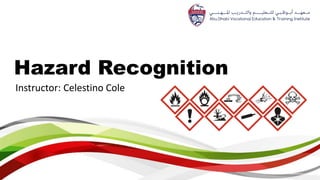
Hazard Recognition
Instructor: Celestino Cole
Welcome
• Emergency Alarms
• Exits and Assembly Points
• Washroom Locations
• Mobile Phones
• Smoking Areas
• Break and Lunch Timing
• Participation
• Questions?
Celestino Cole
Introduction
• Instructor Introduction
• Your Name
• Business Unit
• Current Position
• Experience
• Experience of Today’s Topic
• Your Expectations from Today’s Program
Celestino Cole
Outlines
• Objectives
• Hazard Recognition
• The Purpose of Hazard Recognition
• What is a Hazard?
• What is Safety?
• Unsafe Acts and Unsafe Conditions
• Types of Hazards
• Common Workplace Hazards
Celestino Cole
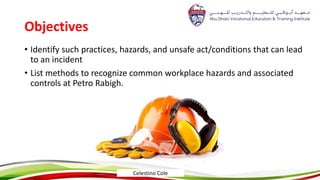
Objectives
• Identify such practices, hazards, and unsafe act/conditions that can lead
to an incident
• List methods to recognize common workplace hazards and associated
controls at Petro Rabigh.
Celestino Cole
Hazard Recognition
Hazard identification is the process in which the
hazards of a workplace are identified within:
• Systems
• Procedures
• Equipment
• Behaviors
Celestino Cole
Principles of ​Hazard Recognition
1. Hazard Recognition is the responsibility
of everyone.
2. Management is responsible for
providing training to recognize hazards.​
3. Hazards exist everywhere. Hazards can
be identified and prevented.​
4. Hazard Recognition is a key element of
“Doing the Job Safely”.
Celestino Cole
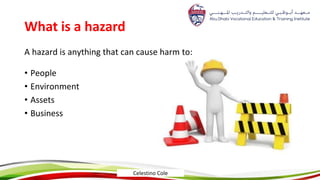
What is a hazard
A hazard is anything that can cause harm to:
• People
• Environment
• Assets
• Business
Celestino Cole
What is safety
• Freedom from risk or harm
• Is it possible to do something
100% safely?
Celestino Cole
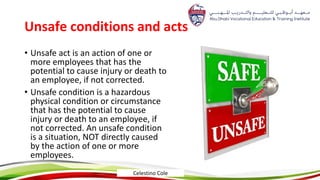
Unsafe conditions and acts
• Unsafe act is an action of one or
more employees that has the
potential to cause injury or death to
an employee, if not corrected.
• Unsafe condition is a hazardous
physical condition or circumstance
that has the potential to cause
injury or death to an employee, if
not corrected. An unsafe condition
is a situation, NOT directly caused
by the action of one or more
employees.
Celestino Cole
What are the results of poor hazard
identification & control?
Celestino Cole
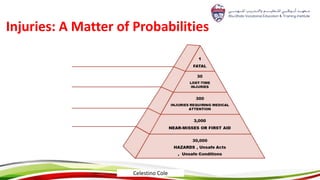
Injuries: A Matter of Probabilities
Celestino Cole
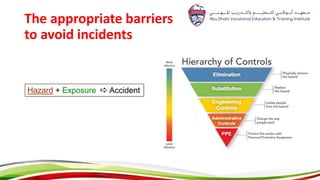
The appropriate barriers
to avoid incidents
Hazard + Exposure a Accident
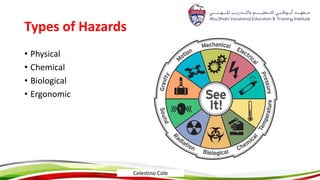
Types of Hazards
• Physical
• Chemical
• Biological
• Ergonomic
Celestino Cole
Main Sources of Hazards
• Materials – liquids, solids, gases
• Equipment – machinery, tools, devices
• Environment – noise, temperature, atmospheres
• Employees – unsafe acts
Celestino Cole
Common Workplace Hazards
Celestino Cole
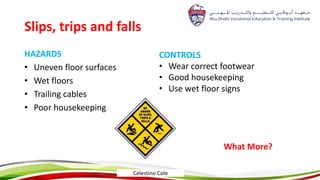
Slips, trips and falls
HAZARDS
• Uneven floor surfaces
• Wet floors
• Trailing cables
• Poor housekeeping
CONTROLS
• Wear correct footwear
• Good housekeeping
• Use wet floor signs
What More?
Celestino Cole
Celestino Cole
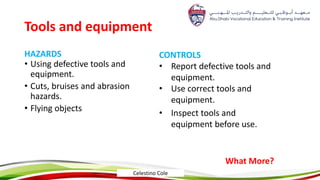
Tools and equipment
HAZARDS
• Using defective tools and
equipment.
• Cuts, bruises and abrasion
hazards.
• Flying objects
CONTROLS
• Report defective tools and
equipment.
• Use correct tools and
equipment.
• Inspect tools and
equipment before use.
What More?
Celestino Cole
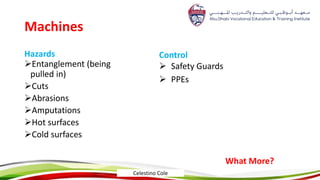
Machines
Hazards
Entanglement (being
pulled in)
Cuts
Abrasions
Amputations
Hot surfaces
Cold surfaces
Control
 Safety Guards
 PPEs
What More?
Celestino Cole
Celestino Cole
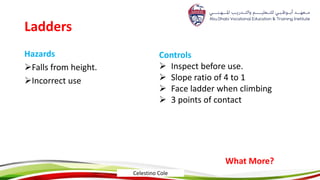
Ladders
Hazards
Falls from height.
Incorrect use
Controls
 Inspect before use.
 Slope ratio of 4 to 1
 Face ladder when climbing
 3 points of contact
What More?
Celestino Cole
Scaffolding
Hazards
Falling of:
Objects.
Equipment.
People.
Scaffold collapse.
Controls
 Safe means of entry and exit
 Fall protection
 Fall prevention
 Conduct Scaffolding inspection
and install TAGs.
 Perform inspection of scaffolds
every two weeks.
What More?
Celestino Cole
Celestino Cole
Cranes
Hazards
Failure of rigging, ropes
and slings.
Contact with overhead
power lines.
Toppling over.
Contact with people and
equipment
Controls
 Inspection third party.
 Daily inspection by operator.
 Barriers and signs.
 Valid inspection sticker.
 Certified crane operators.
 Certified Rigger.
 Critical lift plans.
What More?
Celestino Cole
Critical lift plans
 Crane operation around power lines.
 operating around hydrocarbons and above-ground pressurized piping
areas, and populated/traffic areas; Contact with overhead power lines.
 All loads of 40 tons or greater.
 All loads exceeding 85% of the rated load capacity of the crane for that
specific lift.
 Tandem lifts.
 Crane suspended personnel platforms (man-baskets).
Celestino Cole
Celestino Cole
Fork lifts
Hazards
Unauthorized use.
Uncertified operators.
Roll-over.
Impact with personnel or
equipment.
Controls
 Trained and certified operators.
 Inspection by third party.
 Daily inspection by operator.
 No walking under the raised forks
or loads.
 Backup warnings.
 Banksman/ Flagman/ Signalman
What More?
Celestino Cole
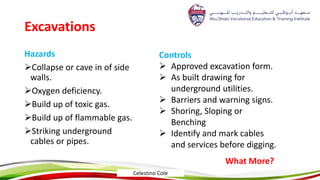
Excavations
Hazards
Collapse or cave in of side
walls.
Oxygen deficiency.
Build up of toxic gas.
Build up of flammable gas.
Striking underground
cables or pipes.
Controls
 Approved excavation form.
 As built drawing for
underground utilities.
 Barriers and warning signs.
 Shoring, Sloping or
Benching
 Identify and mark cables
and services before digging.
What More?
Celestino Cole
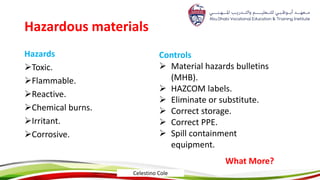
Hazardous materials
Hazards
Toxic.
Flammable.
Reactive.
Chemical burns.
Irritant.
Corrosive.
Controls
 Material hazards bulletins
(MHB).
 HAZCOM labels.
 Eliminate or substitute.
 Correct storage.
 Correct PPE.
 Spill containment
equipment.
What More?
Celestino Cole
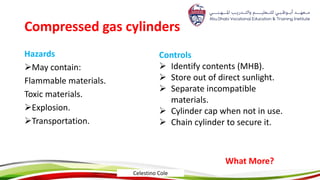
Compressed gas cylinders
Hazards
May contain:
Flammable materials.
Toxic materials.
Explosion.
Transportation.
Controls
 Identify contents (MHB).
 Store out of direct sunlight.
 Separate incompatible
materials.
 Cylinder cap when not in use.
 Chain cylinder to secure it.
What More?
Celestino Cole
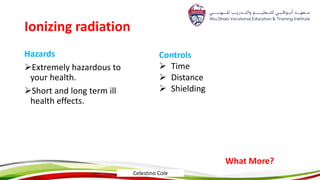
Ionizing radiation
Hazards
Extremely hazardous to
your health.
Short and long term ill
health effects.
Controls
 Time
 Distance
 Shielding
What More?
Celestino Cole
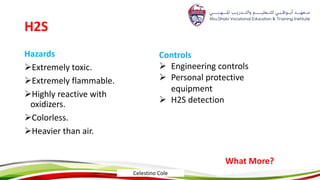
H2S
Hazards
Extremely toxic.
Extremely flammable.
Highly reactive with
oxidizers.
Colorless.
Heavier than air.
Controls
 Engineering controls
 Personal protective
equipment
 H2S detection
What More?
Celestino Cole
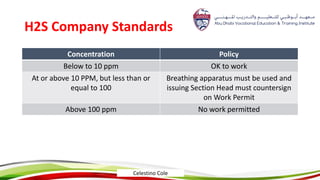
H2S Company Standards
Concentration Policy
Below to 10 ppm OK to work
At or above 10 PPM, but less than or
equal to 100
Breathing apparatus must be used and
issuing Section Head must countersign
on Work Permit
Above 100 ppm No work permitted
Celestino Cole
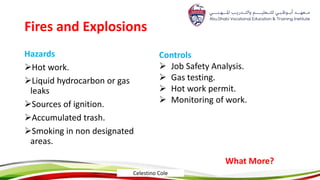
Fires and Explosions
Hazards
Hot work.
Liquid hydrocarbon or gas
leaks
Sources of ignition.
Accumulated trash.
Smoking in non designated
areas.
Controls
 Job Safety Analysis.
 Gas testing.
 Hot work permit.
 Monitoring of work.
What More?
Celestino Cole
Celestino Cole
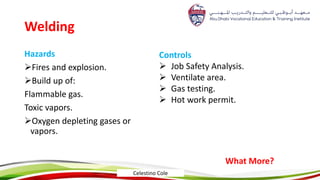
Welding
Hazards
Fires and explosion.
Build up of:
Flammable gas.
Toxic vapors.
Oxygen depleting gases or
vapors.
Controls
 Job Safety Analysis.
 Ventilate area.
 Gas testing.
 Hot work permit.
What More?
Celestino Cole
Electricity
Hazards
Fires.
Electric shock.
Damaged power cords.
Overloaded extension
cords.
Controls
 Job Safety Analysis
 LOTO.
 Ground fault circuit
interrupter.
 Hot work permit.
 Regular inspections.
What More?
Celestino Cole
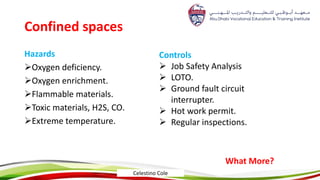
Confined spaces
Hazards
Oxygen deficiency.
Oxygen enrichment.
Flammable materials.
Toxic materials, H2S, CO.
Extreme temperature.
Controls
 Job Safety Analysis
 LOTO.
 Ground fault circuit
interrupter.
 Hot work permit.
 Regular inspections.
What More?
Celestino Cole
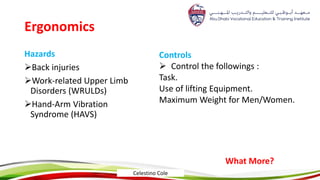
Ergonomics
Hazards
Back injuries
Work-related Upper Limb
Disorders (WRULDs)
Hand-Arm Vibration
Syndrome (HAVS)
Controls
 Control the followings :
Task.
Use of lifting Equipment.
Maximum Weight for Men/Women.
What More?
Celestino Cole
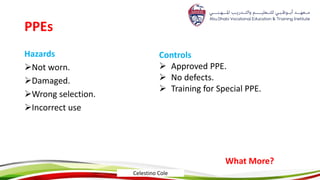
PPEs
Hazards
Not worn.
Damaged.
Wrong selection.
Incorrect use
Controls
 Approved PPE.
 No defects.
 Training for Special PPE.
What More?
Celestino Cole
Respiratory protection
equipment (RPE)
Hazards
If not worn, Inhalation
(breathing in) of:
-Hazardous dust, mist, vapor.
-Toxic gases.
Poor face seal.
Controls
 Wear the correct RPE as per MHB..
 Ensure RPE is clean.
What More?
Celestino Cole
Emergency Preparedness
and Response
Significance :
• Preparing before an emergency incident plays a vital role in ensuring
that employers and workers have the necessary equipment, know
where to go, and know how to keep themselves safe when an
emergency occurs.
• Provide information on how to prepare and train for emergencies and
the hazards to be aware of when an emergency occurs.
Celestino Cole
Emergency Preparedness
and Response
Methods :
• Orientations
• Response plans
• Reporting and responding to an emergency
Celestino Cole
Summary
• Identifying hazards and precautions are part of how you will manage
your site safety risks so that you will know how to work safely.
• Remember, hazard identification and analysis will make your
workplace safer.
Celestino Cole
Thank You

Topic 2_Hazard Recognition.pptx

  • 1.
  • 2.
    Welcome • Emergency Alarms •Exits and Assembly Points • Washroom Locations • Mobile Phones • Smoking Areas • Break and Lunch Timing • Participation • Questions? Celestino Cole
  • 3.
    Introduction • Instructor Introduction •Your Name • Business Unit • Current Position • Experience • Experience of Today’s Topic • Your Expectations from Today’s Program Celestino Cole
  • 4.
    Outlines • Objectives • HazardRecognition • The Purpose of Hazard Recognition • What is a Hazard? • What is Safety? • Unsafe Acts and Unsafe Conditions • Types of Hazards • Common Workplace Hazards Celestino Cole
  • 5.
    Objectives • Identify suchpractices, hazards, and unsafe act/conditions that can lead to an incident • List methods to recognize common workplace hazards and associated controls at Petro Rabigh. Celestino Cole
  • 6.
    Hazard Recognition Hazard identificationis the process in which the hazards of a workplace are identified within: • Systems • Procedures • Equipment • Behaviors Celestino Cole
  • 7.
    Principles of ​HazardRecognition 1. Hazard Recognition is the responsibility of everyone. 2. Management is responsible for providing training to recognize hazards.​ 3. Hazards exist everywhere. Hazards can be identified and prevented.​ 4. Hazard Recognition is a key element of “Doing the Job Safely”. Celestino Cole
  • 8.
    What is ahazard A hazard is anything that can cause harm to: • People • Environment • Assets • Business Celestino Cole
  • 9.
    What is safety •Freedom from risk or harm • Is it possible to do something 100% safely? Celestino Cole
  • 10.
    Unsafe conditions andacts • Unsafe act is an action of one or more employees that has the potential to cause injury or death to an employee, if not corrected. • Unsafe condition is a hazardous physical condition or circumstance that has the potential to cause injury or death to an employee, if not corrected. An unsafe condition is a situation, NOT directly caused by the action of one or more employees. Celestino Cole
  • 11.
    What are theresults of poor hazard identification & control? Celestino Cole
  • 12.
    Injuries: A Matterof Probabilities Celestino Cole
  • 13.
    The appropriate barriers toavoid incidents Hazard + Exposure a Accident
  • 14.
    Types of Hazards •Physical • Chemical • Biological • Ergonomic Celestino Cole
  • 15.
    Main Sources ofHazards • Materials – liquids, solids, gases • Equipment – machinery, tools, devices • Environment – noise, temperature, atmospheres • Employees – unsafe acts Celestino Cole
  • 16.
  • 17.
    Slips, trips andfalls HAZARDS • Uneven floor surfaces • Wet floors • Trailing cables • Poor housekeeping CONTROLS • Wear correct footwear • Good housekeeping • Use wet floor signs What More? Celestino Cole
  • 18.
  • 19.
    Tools and equipment HAZARDS •Using defective tools and equipment. • Cuts, bruises and abrasion hazards. • Flying objects CONTROLS • Report defective tools and equipment. • Use correct tools and equipment. • Inspect tools and equipment before use. What More? Celestino Cole
  • 20.
    Machines Hazards Entanglement (being pulled in) Cuts Abrasions Amputations Hotsurfaces Cold surfaces Control  Safety Guards  PPEs What More? Celestino Cole
  • 21.
  • 22.
    Ladders Hazards Falls from height. Incorrectuse Controls  Inspect before use.  Slope ratio of 4 to 1  Face ladder when climbing  3 points of contact What More? Celestino Cole
  • 23.
    Scaffolding Hazards Falling of: Objects. Equipment. People. Scaffold collapse. Controls Safe means of entry and exit  Fall protection  Fall prevention  Conduct Scaffolding inspection and install TAGs.  Perform inspection of scaffolds every two weeks. What More? Celestino Cole
  • 24.
  • 25.
    Cranes Hazards Failure of rigging,ropes and slings. Contact with overhead power lines. Toppling over. Contact with people and equipment Controls  Inspection third party.  Daily inspection by operator.  Barriers and signs.  Valid inspection sticker.  Certified crane operators.  Certified Rigger.  Critical lift plans. What More? Celestino Cole
  • 26.
    Critical lift plans Crane operation around power lines.  operating around hydrocarbons and above-ground pressurized piping areas, and populated/traffic areas; Contact with overhead power lines.  All loads of 40 tons or greater.  All loads exceeding 85% of the rated load capacity of the crane for that specific lift.  Tandem lifts.  Crane suspended personnel platforms (man-baskets). Celestino Cole
  • 27.
  • 28.
    Fork lifts Hazards Unauthorized use. Uncertifiedoperators. Roll-over. Impact with personnel or equipment. Controls  Trained and certified operators.  Inspection by third party.  Daily inspection by operator.  No walking under the raised forks or loads.  Backup warnings.  Banksman/ Flagman/ Signalman What More? Celestino Cole
  • 29.
    Excavations Hazards Collapse or cavein of side walls. Oxygen deficiency. Build up of toxic gas. Build up of flammable gas. Striking underground cables or pipes. Controls  Approved excavation form.  As built drawing for underground utilities.  Barriers and warning signs.  Shoring, Sloping or Benching  Identify and mark cables and services before digging. What More? Celestino Cole
  • 31.
    Hazardous materials Hazards Toxic. Flammable. Reactive. Chemical burns. Irritant. Corrosive. Controls Material hazards bulletins (MHB).  HAZCOM labels.  Eliminate or substitute.  Correct storage.  Correct PPE.  Spill containment equipment. What More? Celestino Cole
  • 32.
    Compressed gas cylinders Hazards Maycontain: Flammable materials. Toxic materials. Explosion. Transportation. Controls  Identify contents (MHB).  Store out of direct sunlight.  Separate incompatible materials.  Cylinder cap when not in use.  Chain cylinder to secure it. What More? Celestino Cole
  • 33.
    Ionizing radiation Hazards Extremely hazardousto your health. Short and long term ill health effects. Controls  Time  Distance  Shielding What More? Celestino Cole
  • 34.
    H2S Hazards Extremely toxic. Extremely flammable. Highlyreactive with oxidizers. Colorless. Heavier than air. Controls  Engineering controls  Personal protective equipment  H2S detection What More? Celestino Cole
  • 35.
    H2S Company Standards ConcentrationPolicy Below to 10 ppm OK to work At or above 10 PPM, but less than or equal to 100 Breathing apparatus must be used and issuing Section Head must countersign on Work Permit Above 100 ppm No work permitted Celestino Cole
  • 36.
    Fires and Explosions Hazards Hotwork. Liquid hydrocarbon or gas leaks Sources of ignition. Accumulated trash. Smoking in non designated areas. Controls  Job Safety Analysis.  Gas testing.  Hot work permit.  Monitoring of work. What More? Celestino Cole
  • 37.
  • 38.
    Welding Hazards Fires and explosion. Buildup of: Flammable gas. Toxic vapors. Oxygen depleting gases or vapors. Controls  Job Safety Analysis.  Ventilate area.  Gas testing.  Hot work permit. What More? Celestino Cole
  • 39.
    Electricity Hazards Fires. Electric shock. Damaged powercords. Overloaded extension cords. Controls  Job Safety Analysis  LOTO.  Ground fault circuit interrupter.  Hot work permit.  Regular inspections. What More? Celestino Cole

  • 40.
    Confined spaces Hazards Oxygen deficiency. Oxygenenrichment. Flammable materials. Toxic materials, H2S, CO. Extreme temperature. Controls  Job Safety Analysis  LOTO.  Ground fault circuit interrupter.  Hot work permit.  Regular inspections. What More? Celestino Cole
  • 41.
    Ergonomics Hazards Back injuries Work-related UpperLimb Disorders (WRULDs) Hand-Arm Vibration Syndrome (HAVS) Controls  Control the followings : Task. Use of lifting Equipment. Maximum Weight for Men/Women. What More? Celestino Cole
  • 42.
    PPEs Hazards Not worn. Damaged. Wrong selection. Incorrectuse Controls  Approved PPE.  No defects.  Training for Special PPE. What More? Celestino Cole
  • 43.
    Respiratory protection equipment (RPE) Hazards Ifnot worn, Inhalation (breathing in) of: -Hazardous dust, mist, vapor. -Toxic gases. Poor face seal. Controls  Wear the correct RPE as per MHB..  Ensure RPE is clean. What More? Celestino Cole
  • 44.
    Emergency Preparedness and Response Significance: • Preparing before an emergency incident plays a vital role in ensuring that employers and workers have the necessary equipment, know where to go, and know how to keep themselves safe when an emergency occurs. • Provide information on how to prepare and train for emergencies and the hazards to be aware of when an emergency occurs. Celestino Cole
  • 45.
    Emergency Preparedness and Response Methods: • Orientations • Response plans • Reporting and responding to an emergency Celestino Cole
  • 46.
    Summary • Identifying hazardsand precautions are part of how you will manage your site safety risks so that you will know how to work safely. • Remember, hazard identification and analysis will make your workplace safer. Celestino Cole
  • 47.